




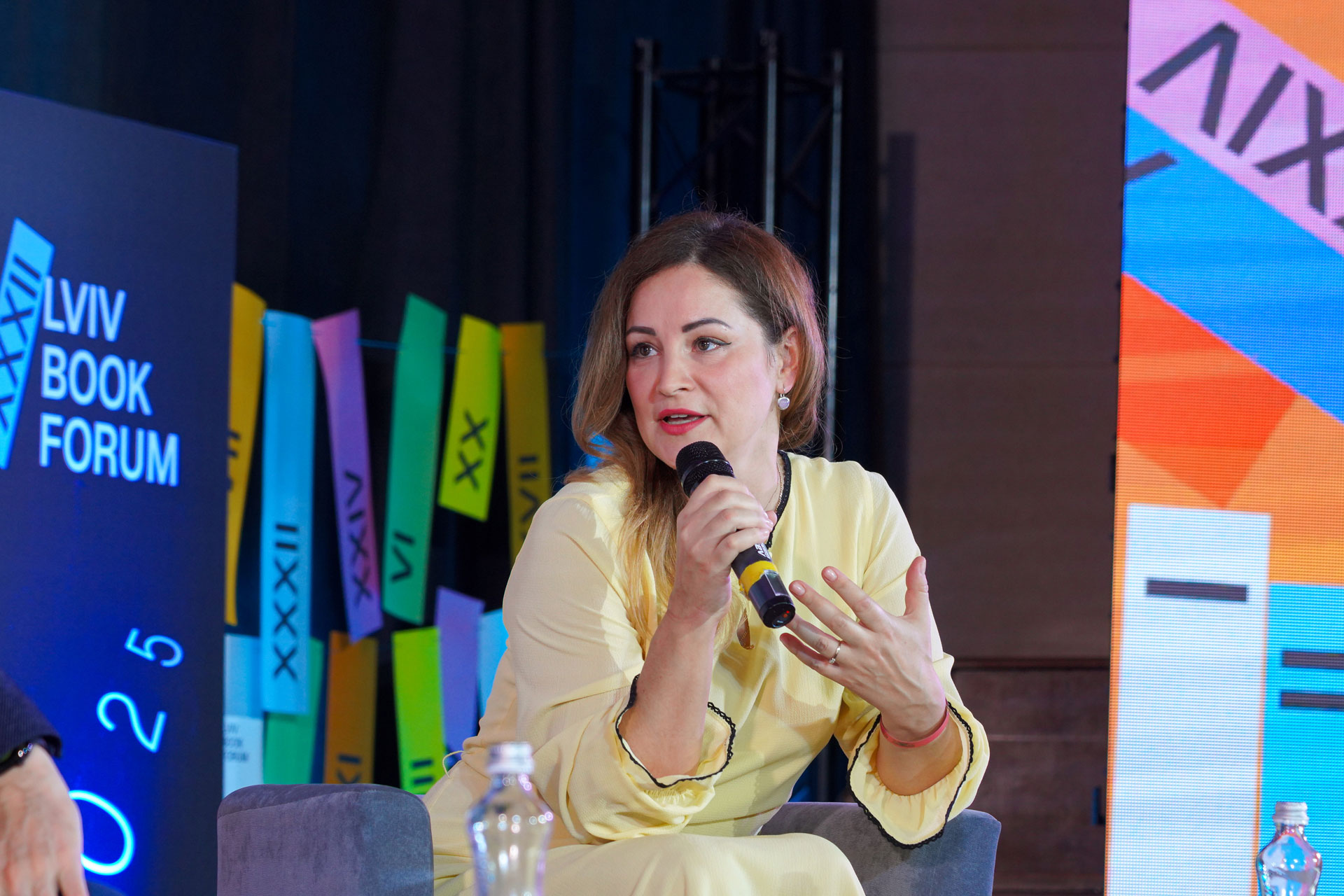
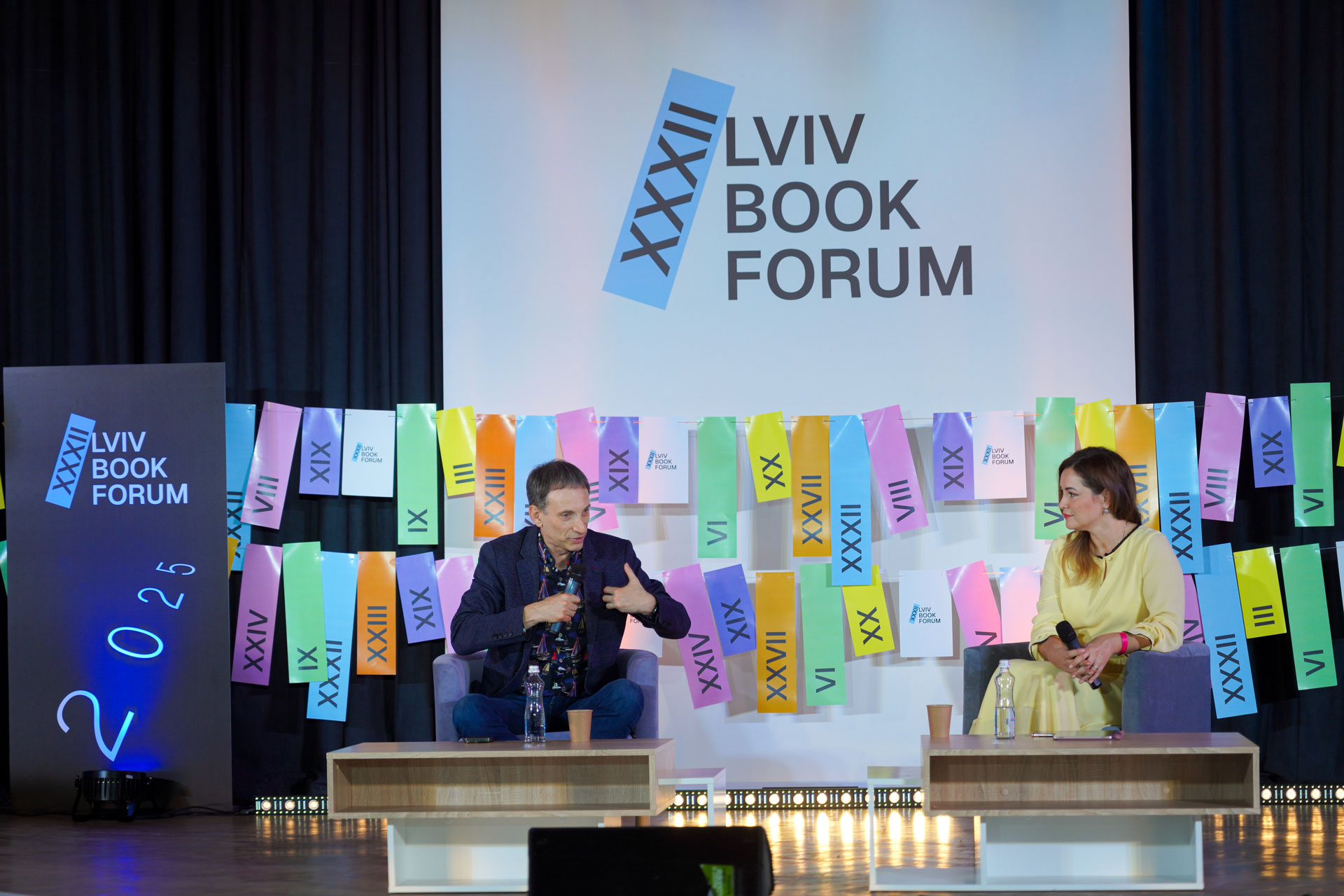
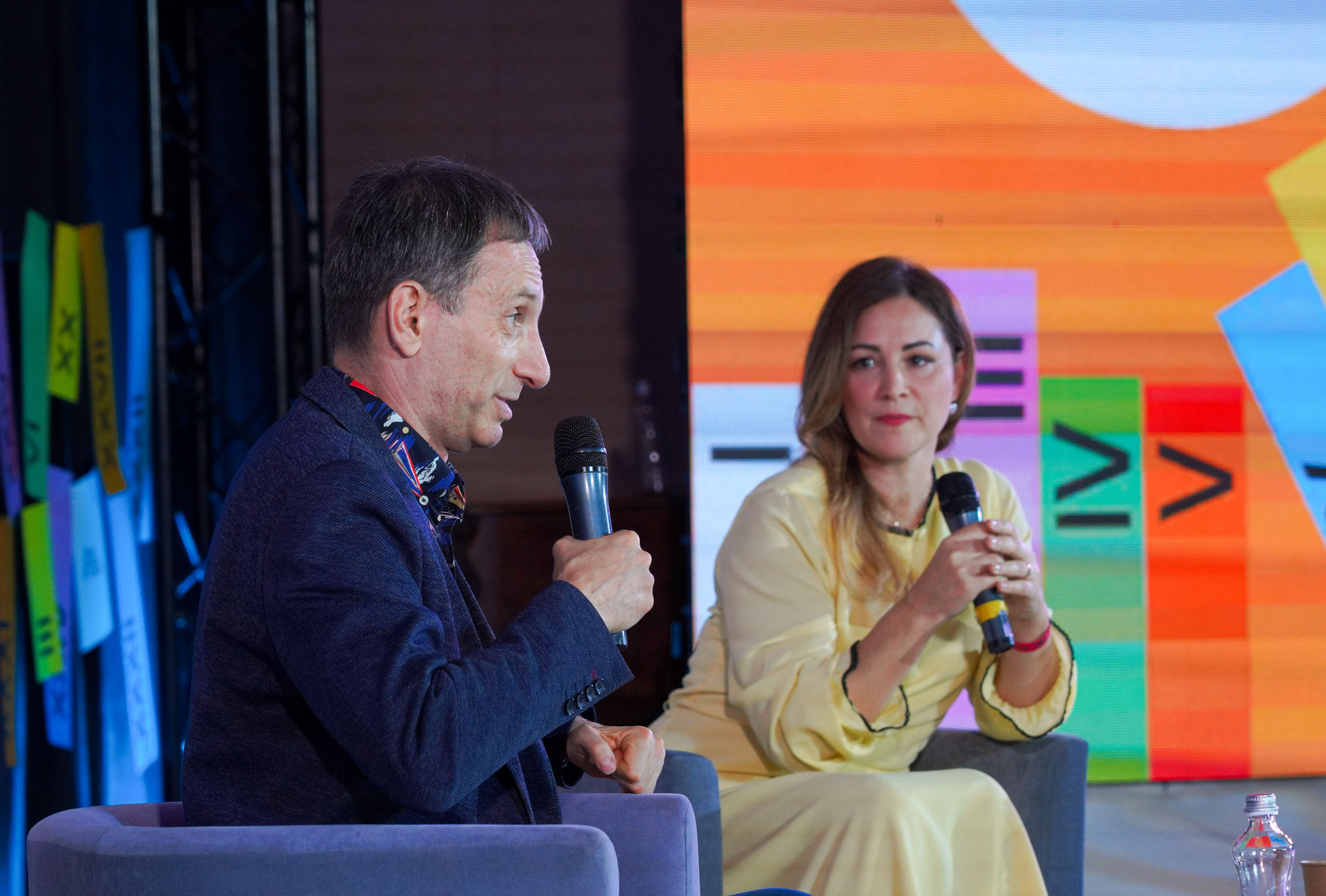
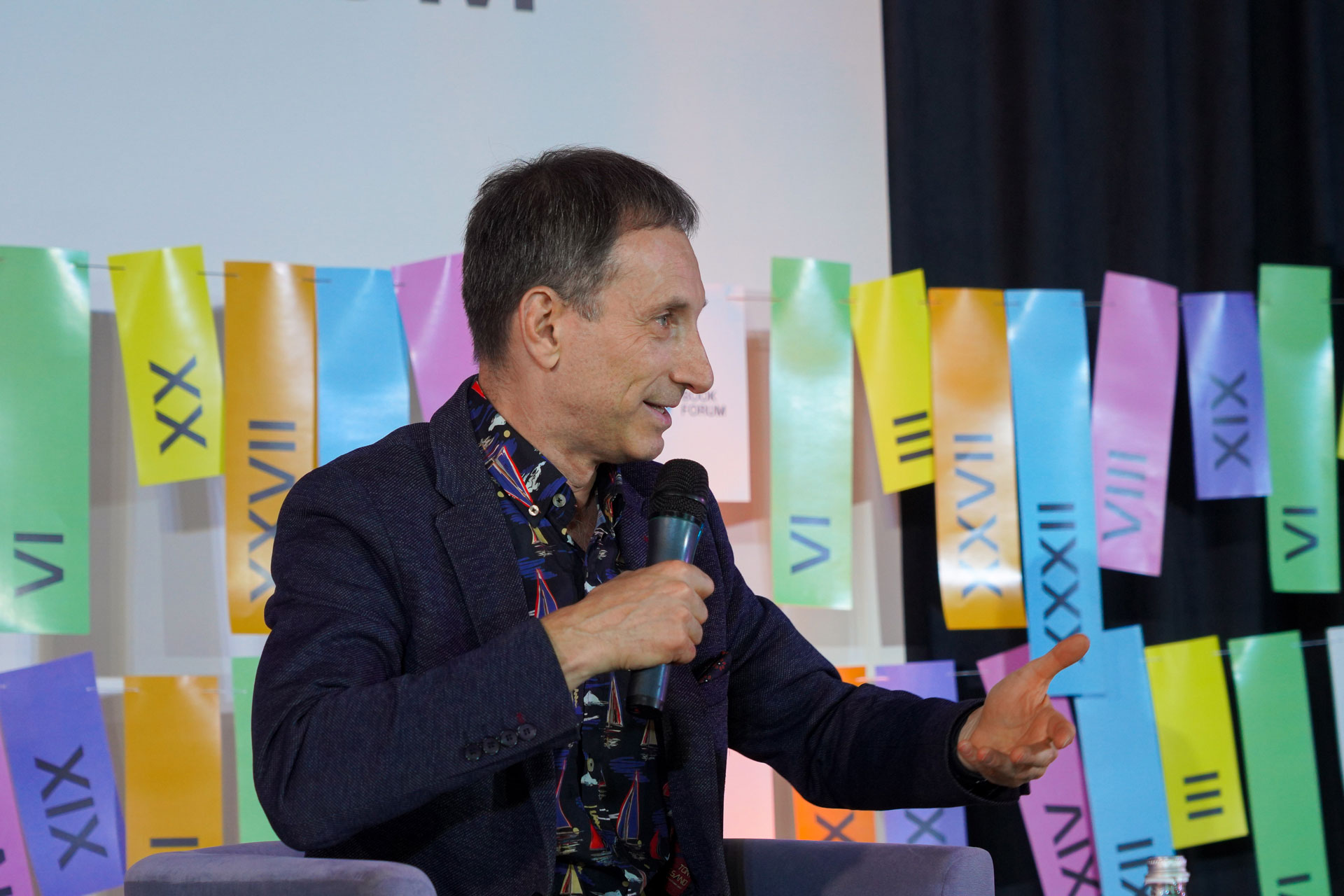
English-language transcript: Renowned Ukrainian journalists Vitaly Portnikov and Maria Hurska at the 32nd International Lviv BookForum
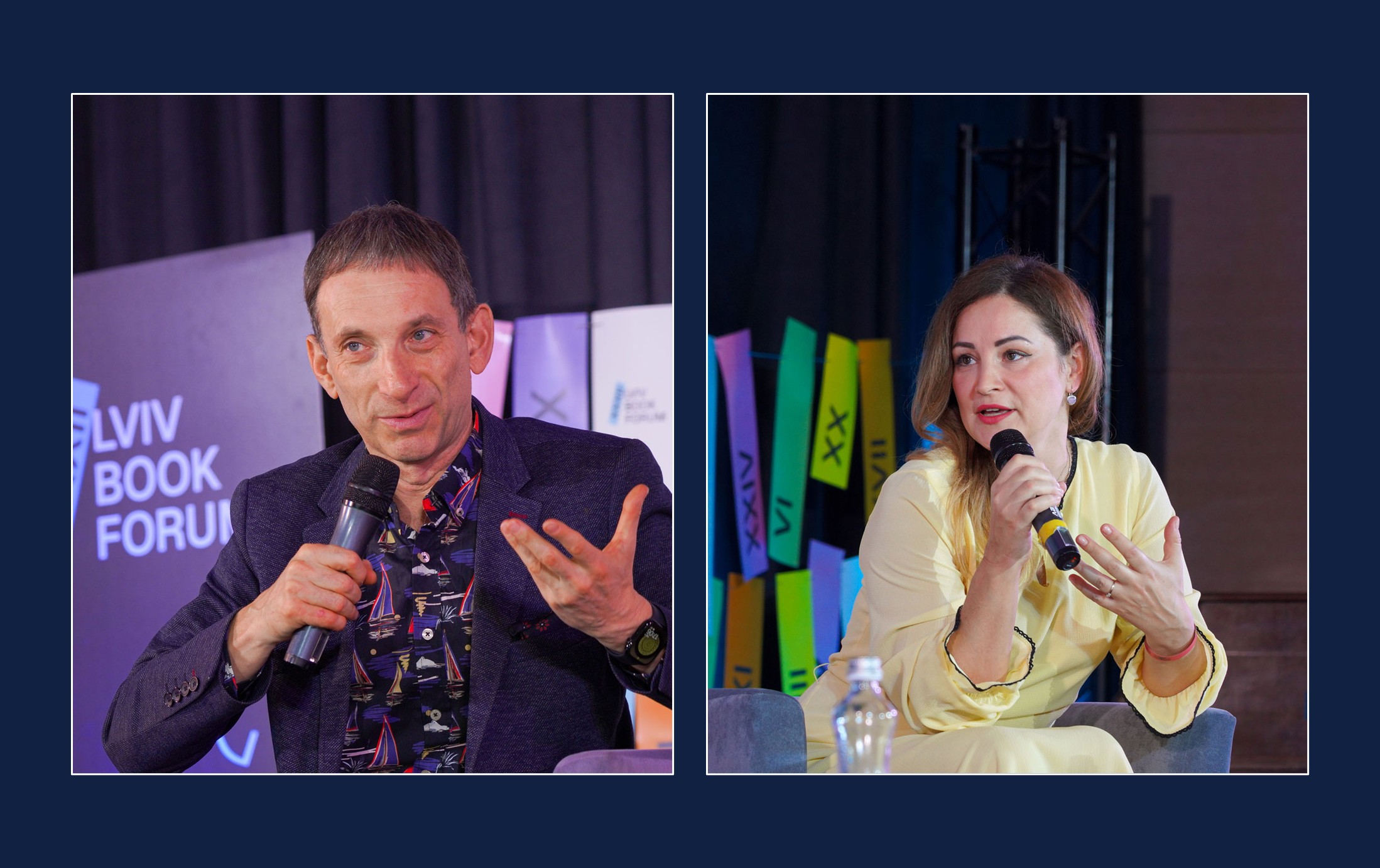
Editor’s note: On 5 October 2025, Vitaly Portnikov, the renowned Ukrainian journalist and analyst, and Maria Hurska, creator and head of the Ukrainian TV channel Slawa in Warsaw, participated in a widely acclaimed discussion at the 32nd International Lviv BookForum. The night before their talk, Lviv withstood its most massive missile and drone attack by Russia, which launched a full-scale invasion of Ukraine on 24 February 2022. Residents and visitors to this Western Ukrainian city that borders Poland and is far from the front lines spent the night in bomb shelters or hiding in safe places in residential buildings. The air on the morning of 5 October was thick with smoke, and it was unclear whether the Lviv BookForum would continue. But authorities gave the all-clear by mid-morning, and despite a sleepless night, visitors in the thousands attended the last day of the book fair and a myriad of discussions held throughout the city.
Below we present an English-language transcipt of the discussion between Portikov and Hurska, which touches on the many issues concerning Ukrainians today: from statebuilding, belonging and immigration, language, security, as well as the intersection of history, nationality and statehood, lessons from the Israeli experience, Russian views on Ukrainians and how to comprehend Russia, which ‘loves’ Ukraine so much that it wants to annihilate its existence as an independent state.
We hope this transcript of their discussion, which took place in Ukrainian, will lead to a better understanding of Ukraine and its fight against a genocidal Russia.
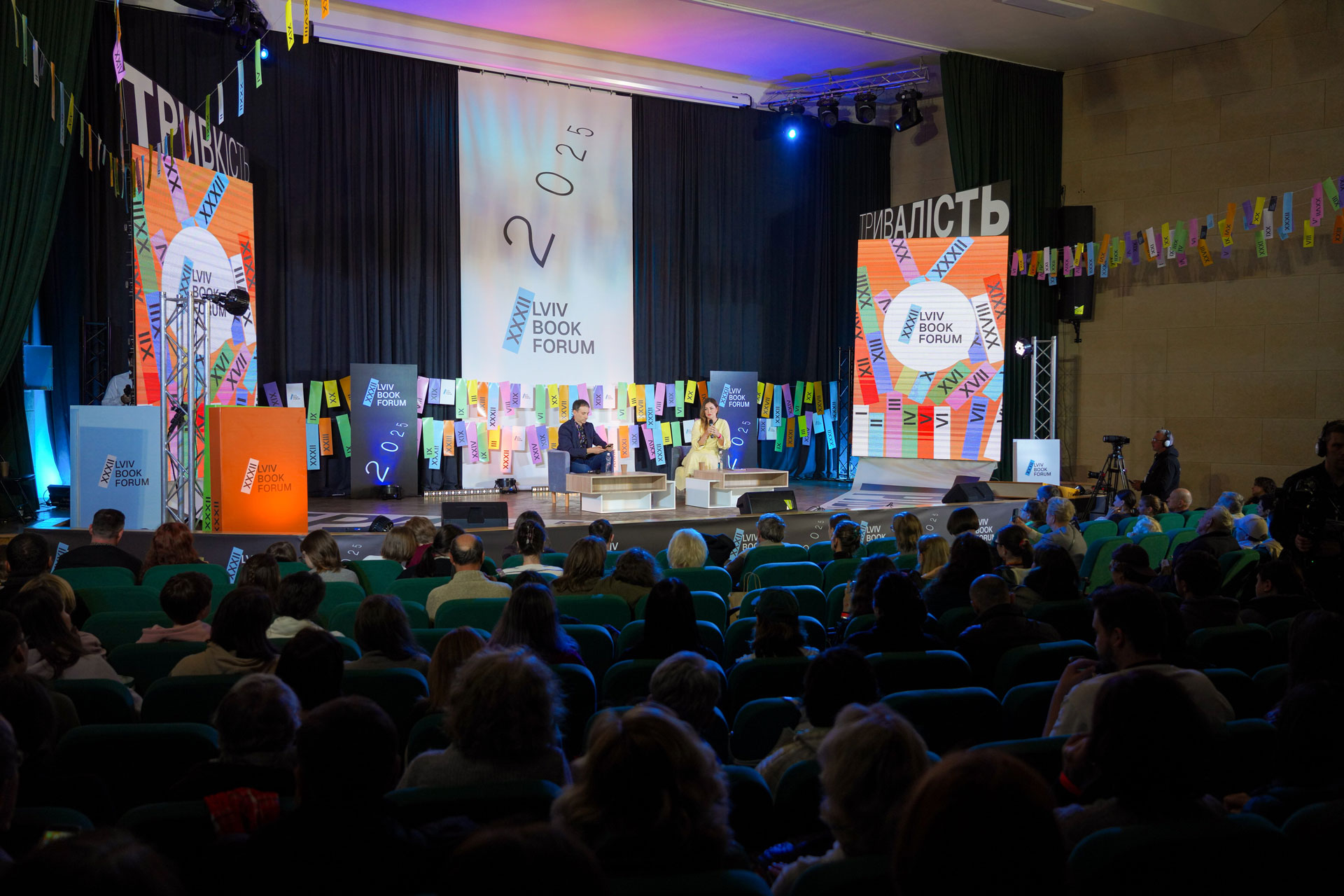
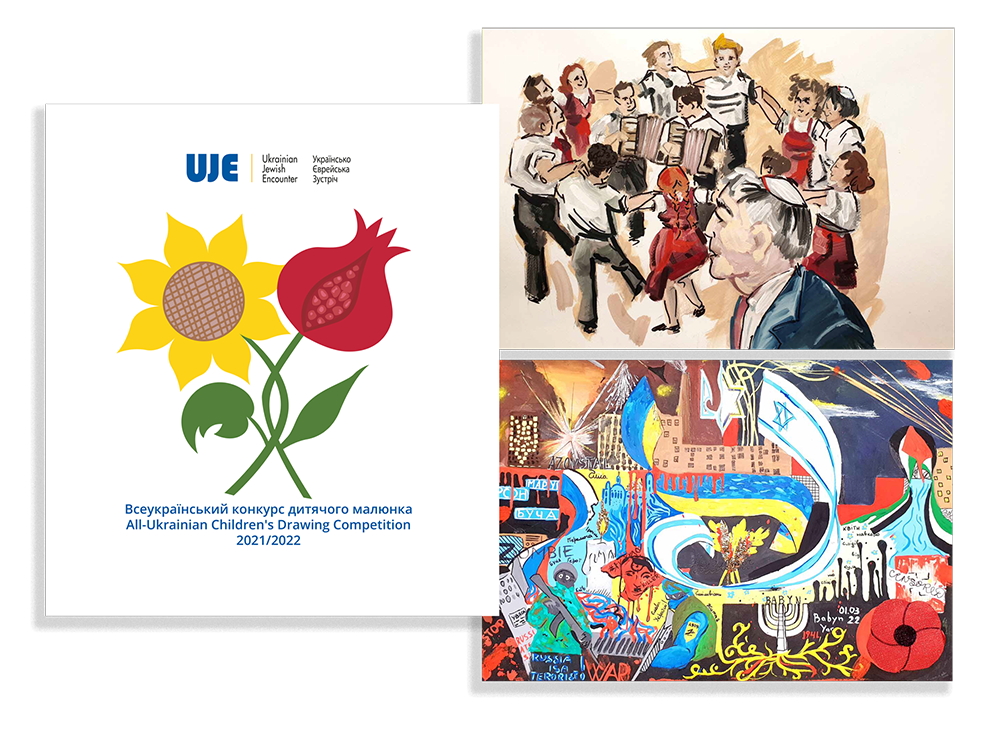
Natalia Feduschak: Good afternoon or good evening! Thank you all for coming today. My name is Natalia Fedushchak. I am the Director of Communications of Ukrainian Jewish Encounter, a Canadian nongovernmental organization. Our organization was established in 2008 to support a dialogue between Ukrainians and Jews. We have done a great deal over all these years and participated in the Lviv BookForum almost from our beginning. For several years now, we have been having discussions that we hope will be of interest to the Ukrainian public and people abroad, as they reflect the current state of Ukrainian-Jewish relations in Ukraine.
Today, we have a panel. My colleague Andriy Pavlyshyn, with whom we have worked for many years, will introduce the discussion and our participants.
Andriy Pavylshyn: Good evening. Today, I am honored to present "Ukraine and the Middle East: Identity and War. Discussions of Political Issues." This is a conversation between Vitaly Portnikov, a brilliant journalist, political analyst, writer, and essayist, and Maria Hurska, an analyst, Ukrainian journalist, and founder and leader of the Slawa TV Ukrainian television channel in Warsaw. She will have the moderator role, and Vitaly will act as the interlocutor. Thank you.
Maria Hurska: There are so many familiar and simply warm faces in this room. Welcome, and thank you for coming to listen to this conversation. I’d like to start the discussion by talking about my own experiences. As many of you are aware, I am currently residing in Warsaw temporarily. It so happened that almost immediately after working here in Lviv with Vitaly for half a year, where I hosted a live broadcast on the Espresso channel, and then giving birth to a baby, I left for Warsaw in September 2022. I launched a number of media initiatives there that I believe are important for Ukraine, including the Sestry online magazine produced in collaboration with Polish journalists from Gazeta Wyborcza. Slawa TV, a Ukrainian TV channel, has been in operation for seven months now. It's the first Ukrainian TV channel in Poland and the EU. Vitaly and I host our program there, which can be watched live via satellite or on the Espresso Ukrainian TV channel, which is our partner.
Why am I telling you all this? I come home quite rarely now, but every time it is very important to me. Why rarely? Because I have two small children, and the younger one has just turned three. We have not been to Ukraine for more than half a year. And it so happens that every time we arrive, we come under a major missile attack.
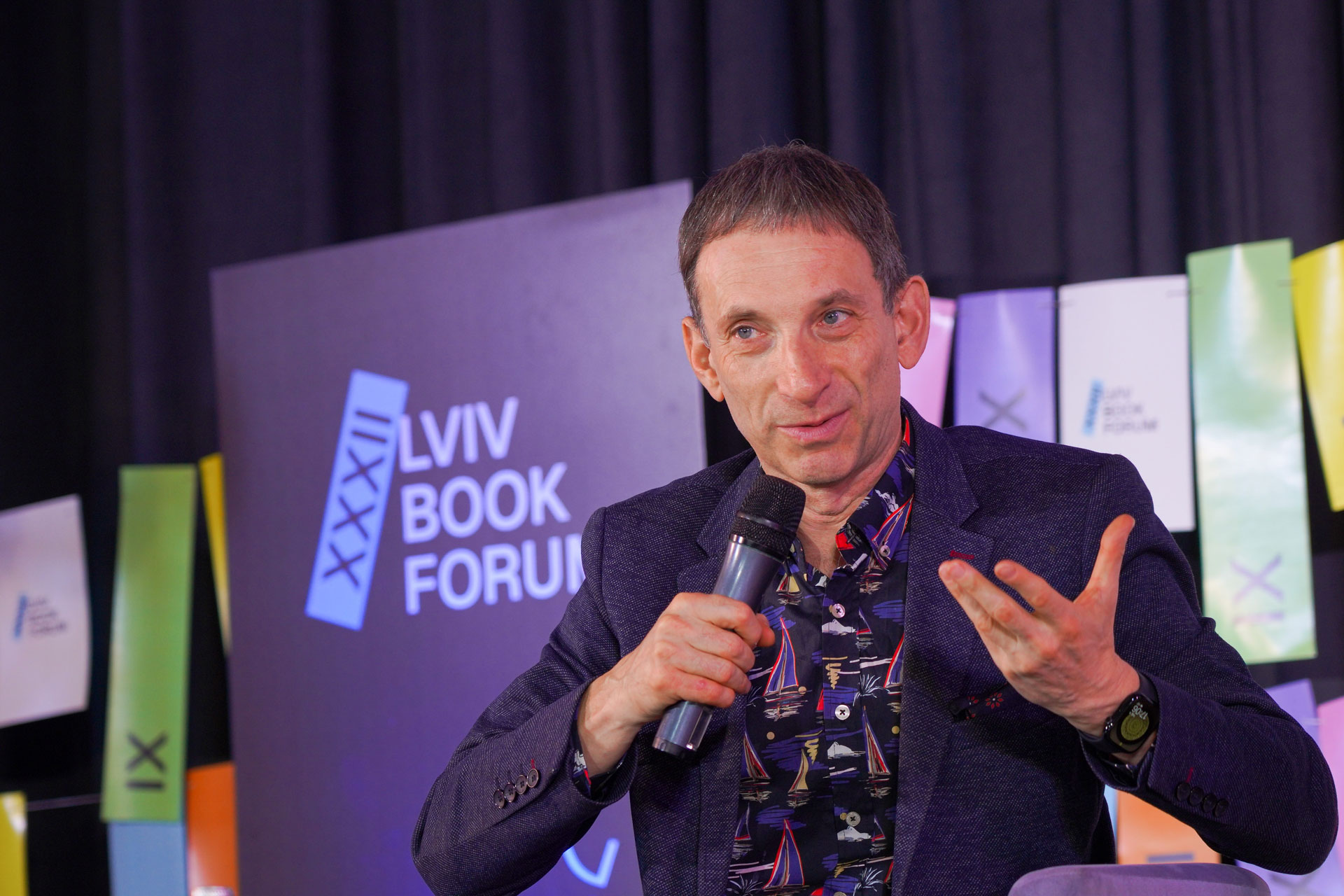
Vitaly Portnikov: Every time I come to Lviv, I also come under fire. I believe this is our journalistic fate: to experience together with Lvivites the most difficult moments of their lives.
Maria Hurska: Well, I am asked every time: "Why are you going to Ukraine, with two small children to boot? It is so dangerous there." These are, of course, my Polish friends. Wait it out, they say. This time they again asked me: "Why are you going to Ukraine with two small children?" I thought about it and said, "Why, I'm going to the BookForum, of course." And this, you know, is an extremely important opportunity for me. I thank Andriy Pavlyshyn and Natalia Feduschak for inviting me.
It seems to me that this is the best answer to the question about the basis of our identity today. It is crucial for me to feel united with my country. If I'm not here, if I'm not meeting with you and communicating, if I'm not under these missile attacks together with you, I don't feel like myself. I think we should discuss it in more detail. I thought about this last night as I was experiencing this missile attack with my children, and I posted about it on my Facebook page and wrote to my friends, asking how they were doing.
You know, I planned to start this conversation by reflecting on the basis of our identity, a topic once raised by Harvard professor Serhii Plokhy. Today, it somehow looks completely different than 10 or 15 years ago, when this discourse first emerged. In the first half of the 2010s, Plokhy formulated the theory that the evolution of Ukrainians' consciousness from Homo Sovieticus to European civilizational community members occurs from west to east and can be measured by three indicators: attitude to the OUN-UPA, attitude to the communist legacy, the so-called Leninopad, and recognition of the Holodomor. So let's start our conversation by trying to understand how this changed with the beginning of Russia's full-scale war against Ukraine and what measures apply to the consciousness of modern Ukrainians, wherever they are.
Vitaly Portnikov: When I think about these quotes from Plokhy and compare them with your feelings... When you want to come here despite all the danger and you want your children to see Ukraine, you don't think about the Holodomor, the UPA, and the Leninopad. And in general, you think that it's natural to be here. So, I still proceed from the fact that identity is, first of all, a matter of chemistry. It's like love. It can be awakened, but if it's not there internally, if there's no chemistry, then no Holodomor, Leninopad, or love for the UPA will help you.
For example, I have my own identity, which is based on some other things related to Ukrainian civilization, but still remains an identity nonetheless. When you were talking about your feelings, I suddenly remembered the lines from the Nobel lecture by Yosef Shmuel Agnon, a writer born in Buchach who dedicated his work to Hebrew literature. In the lecture, he said he was born in Buchach, but if it had not been for Emperor Titus, who destroyed the Temple in Jerusalem, he would have been born in Jerusalem. And this is the feeling of identity, the sense of roots — I come from that place.
The question is not where I came into this world and where I live, but what I feel part of. This can be a purely chemistry-based feeling, part of family upbringing. It can be a passion for a particular civilization. The German literary critic Marcel Reich-Ranicki once said that his homeland was German literature, which was quite an admission for a Polish Jew. But it was true, because he made German literature the essence of his existence in this world. If I were asked whether Ukrainian literature was my homeland, I would have great doubts, because I see Ukraine in a completely different dimension. I see it as a civilization that is very close to me. But I do not put Ukrainian literature at the center of my civilizational interests. I could say that some other literature is nearer to me. Yes, I probably see more of what is close to me in Jewish literature than in Ukrainian. But at the same time, I see in Ukraine the country in which I was born and for which I have feelings.
One more point. We recently discussed it with my colleague, Volodymyr Beglov. I asked him a question that keeps tormenting me. I can put this question to you as well. It's strange, but it's always such an interesting test. It's clear that if I were to ask you whether you love Ukraine, it would be a pretentious question. You will answer it positively. And the audience will probably answer it positively, because these are such logical things. Even if you don't love it, you won't tell me. But the question is, does Ukraine love you? Now, think about it: does Ukraine love you? Do you know the answer to this question?
Maria Hurska: What is meant by "Ukraine"?
Vitaly Portnikov: No, no. I will explain it to you, Maria. When you come, do you feel this stream directed at you?
Maria Hurska: I do.
Vitaly Portnikov: You feel it. And you, do you feel it? No, please don't answer pretentiously. Think about it and say: Do you all feel that Ukraine loves you? Maybe just because you are Ukrainian, right? No, you are not sure. You see, this is a different question, a philosophical one. I cannot answer this question for you. I know I have feelings for Ukraine. I don't know if they are reciprocated.
But there is a different situation. For example, I am certain that Israel loves me.
Maria Hurska: And how do you know that?
Vitaly Portnikov: There's no special way. I just came and saw it. I feel love directed at me. You see, it's like parental love. You may not even reciprocate. Your parents love you without asking you if you are ready to love them back. Love for the homeland is not love for a woman. That is, your love for your homeland can be like love for a woman, and your homeland's love for you is parental love. You see?
There are situations when you do not respond to your parents with the emotions that they feel for you, but they still love you, no matter what kind of person you are.
Maria Hurska: In the case of the state, this feeling of mutual love is formed as a result of us shaping our country as a democratic European state in which we live and which loves us.
Vitaly Portnikov: On the one hand, yes, but on the other, you need to be loved by civilization itself, and then you can build a state. Why do I say this? This is not a theoretical question. It addresses exactly how we awaken this feeling. It indeed becomes awakened from the west through the center to the east and south, because it was more dormant in the east and south. More dormant because it has always been more integral here [in the west], while the east and south has always experienced fierce competition with the civilizational influence of the Russian Empire, Russian civilization, and Russkiy mir [Russian world. — Transl.]. And many people have been so shaped by this Russkiy mir that they feel part of it. And I don't know if people who feel they are part of Russkiy mir can be pulled out of it into some other world.
Maria Hurska: And that's my next question. You say that love for Ukraine is like chemistry, like romantic love. Then why can it differ among citizens in the same city who seem to function in the same rhythm and live together in the same time plane? For example, the entire center of Kyiv is dotted with flags and portraits of fallen heroes of the Heavenly Hundred and soldiers who died at the front. Almost every Ukrainian will now find a familiar face among those portraits. The entire country freezes for a minute of silence every morning at 9 o'clock to honor the memory of these heroes. However, some don't care. They don't feel the importance of stopping and thinking about the price these soldiers paid when they laid down their lives.
Vitaly Portnikov: Well, that may be because some people don't care about this place of residence. They simply live here, grow, and conduct their business, but for them, it is just a location. They could do the same thing anywhere else. They just do it here.
Maria Hurska: That is, this chemistry has been awakened in some but not in others.
Vitaly Portnikov: And it may never emerge in them. It is always a question of quality and quantity. In fact, we have lived in this country for how long? It'll be 35 years soon. We have always had this so-called passionate minority, ready to defend the sovereignty of this country even at the cost of their own lives, health, and time. People who ran to catch a train from Lviv to Kyiv during the two Maidans. They came and stood side by side with the Kyivites. And you know very well that if these people had not come to Kyiv, we would have had a Belarus here long ago.
In contrast, some people merely looked on, failing to grasp why all this was happening. Some of them had developed this feeling. Some others didn't because it's not there deep down. Our task is to help turn this passionate minority into a majority, so that there will be more of these people. Incidentally, this is something we can possibly obtain during the war. We have always had these people I've mentioned who, in principle, remain part of Russkiy mir and who are now telling us, "If you continue to insist that we speak Ukrainian, I will leave this place. I will leave." We hear this from public figures, and some people actually have never defined who they are. Now changes are taking place among these people. Roughly speaking, they can join either us or them, because you can't live without making this choice when you are being killed. Our task is to attract as many people as possible to join us, those who value Ukrainian civilization, regardless of their place of residence, ethnic origin, religious preferences, or political views. You see?
A Ukrainian can be a liberal, a conservative, a socialist, or even a communist. The problem is that our communists have always been Moscow's agents rather than communists. And this was also a serious problem. I could never get this thought across in 2013, when they told me: "Here you are standing on the podium next to Oleh Tiahnybok or Iryna Farion. You declare your liberal views, while they are right-wing radicals." Well, yes, Ukraine unites us. In Ukraine, you can be a liberal or a right-wing radical, but if there is no Ukraine — those people who are against us want Ukraine to cease to exist — where will liberals and right-wing radicals be? In the cemetery. So, we want to live and struggle among ourselves in this country, not in some other.
Maria Hurska: You mentioned language and how dynamically Ukrainians are switching to Ukrainian overall during the full-scale invasion. This is also undoubtedly the basis of our self-identification and our identity. In Plokhy's discourse, which predates the beginning of the war in 2014, identity is defined by three factors: attitude toward the Holodomor, the OUN-UPA, and the communist regime (so-called Leninopad). If we consider the discourse after the start of the war, particularly after the beginning of the full-scale invasion, what are these factors? We see that they have changed dramatically. None of the previously listed factors is now key for self-identification. So what are these factors, if we take the principle of three? The first, no doubt, is language.
Vitaly Portnikov: I think it looks completely different now. The first one may not even be language, Maria. Let me give you an example. I once visited the Risorgimento Museum in Turin, and it was absolutely clear to me what united Italians and what made Italy the country it is today. A common language, which actually didn't exist. We think it did, but it didn't. Many people, to put it mildly, who are symbols of Italy didn't speak Italian. Claudia Cardinale, a star of Italian cinema and a symbol of Italy, has passed away. She didn't speak Italian well, even in the 1960s, because her native language was Sicilian, a Sicilian dialect, which is very distant from Italian. She couldn't act in Italian cinema and was dubbed until she learned to speak Italian. And there are many such examples in every region of Italy.
Could it be a shared history or a sense of pride in Rome or Dante Alighieri? Well, in Sicily it was far from a common civilization, and even more so in Sardinia, where Aragon ruled for many years, all culture and literature were Spanish, and people spoke Sardinian. What united people, then? I went to the Risorgimento Museum with the certainty that it was language, common culture, and a desire for a unified Italian statehood, which, in reality, never truly existed. And then I saw that a vast number of halls in this museum were dedicated to the Crimean War, which came as a surprise. Why the Crimean War? The reason was that Italians — in fact, future Italians — met each other in trials there. People from different regions within the same army went through a common trial.
Consider what happened to the Soviet Union after World War II. In fact, there were no "Soviet people" before 1941. They appeared in 1945, making it possible to launch such a frantic Russification process — people were united by a common tragedy, a common trial, and a common army. Pockets of people who didn't identify with the Soviet Union remained in the regions not involved in these things for historical reasons: the Baltic countries, Galicia, and the territories annexed just before World War II, as well as areas that were immediately occupied and did not have time to participate in this process, in this cauldron.
We currently have a very similar situation. People are united by a common trial, because a missile strike on Lviv is the same as a missile strike on Kharkiv. A soldier defending the country who came to a military unit from Chortkiv is the same as the one from Kramatorsk. You see? I think this is the first factor. In essence, you can declare independence and assert it. You can adopt laws and constitutions, but when the first real war for independence is raging and the question is to be or not to be, this can be the basis of identity.
Now the question is: how will these people view the things we consider foundational after the war? Our task is to tell them, "Yes, you are united by a common ordeal, and therefore you must protect the language. It must be part of your identity because you have it. It is a treasure." We must succeed in this. Some peoples, for example, the Irish, did not succeed. They fought for independence, then fought among themselves, and as a result, lost their language as part of their identity. Well, they kept the religion.
Maria Hurska: So, common trials and language?
Vitaly Portnikov: Common trials should give us an opportunity. That is, if our priority is a common language. We must tell people united by common trials what all these trials are for: for the sake of Ukraine, for the sake of the Ukrainian language, for the sake of Ukrainian civilization, for the sake of the Ukrainian vision of the world, and for the sake of our right to free development in Europe, because we are European peoples, European civilization. These common trials need to have an explanation as to why they are happening.
Maria Hurska: To what extent is the Ukrainian land itself — the territory and unity of Ukraine — a factor in the self-identification of our compatriots during the war? There's some interesting data on this. This summer, KIIS [Kyiv International Institute of Sociology] surveyed Ukrainians on their willingness to cede territories for the sake of peace. The absolute majority (78%) reject the transfer of Ukraine-controlled territories to Russia, while more than 50% are against any territorial concessions.
Vitaly Portnikov: Again, sociology and people's stance when they say they are against territorial concessions are symbolic things, because you always have to ask people how willing they are to win these territories back. This is also a very important point, as it serves as a symbol for people. They do not want to give in, because no one wants to lose. If you give up territory, you lose. However, if people are asked, "What is the instrument for returning these territories?" they often cannot answer, because they frequently want this to happen without their involvement.
In 2022, I told Ukrainian society, "Our victory will be the preservation of statehood." The point is not to keep the borders — it's about preserving statehood. If people want to live in Ukraine, they can come from the occupied territories to the free ones or return to Ukraine from emigration. If they don't want to live here and the main thing for them is simply to live in a specific place, they will live there or abroad. That is, our task is to preserve Ukrainian statehood wherever we can protect and develop it.
Maria Hurska: I think of two different discourses here. One is presented by Tamara Horikha Zernya in her novel Daughter, a pearl of the recent period. Based largely on Tamara's own experience, it's a story about a volunteer girl from Donetsk who has never been particularly active in public life. However, when the seizure of Donetsk begins, she becomes very active simply answering the call of her blood. She is not ready to give up her city, her building, her apartment, and in general, the world in which she lives. And that is why she gives all of herself to this struggle.
The other discourse is represented, for example, by [writer] Vasyl Shkliar, who spoke to Lesia Vakuliuk in a recent episode of the Europeans program. He says we don't necessarily have to fight for the Donetsk region, for the Donbas, because it is dominated by the non-Ukrainian-speaking population, for which Ukraine is not the highest value. How can one find the truth between these two visions?
Vitaly Portnikov: Shkliar's vision is not very clear to me for one simple reason. The Donetsk region is a territory occupied by Russia, not a territory that declared it wants to be Russia. From this point of view, we must then say [the same about] the Galician territories, specifically, Eastern Galicia, which were occupied by Poland in approximately 1920, when the Western Ukrainian People's Republic lost this struggle. If we cannot liberate them, it's not Ukraine, either. And any territory invaded by a foreign army is not Ukraine. We can say that there is a Ukrainian-speaking population or a non-Ukrainian-speaking population here or there. But that's not the point. The point is that when discussing Shkliar's discourse, we again begin to confuse occupation and separatism. There have been no separatist movements in Ukraine. There was no mass movement in Ukraine for Donetsk, Luhansk, Zaporizhia, or Kherson to become Russia. Thus, it turns out that we are ready to cede any region where the Russian army comes with the motivation that the local population is not the kind we need. However, this way, the Russian army will come to Lviv sooner or later, and we will say the same thing.
I frame this question differently. Let me repeat once again: in reality, Ukraine needs to be built wherever we can do it. This should be the main principle. Whatever we can protect is Ukraine. If we can defend the Donbas and win it back, it is Ukraine, just like the Crimea, Zaporizhia, and the Kherson region. If we can now stop at this line where the Russian and Ukrainian troops are standing, in an optimistic scenario, we will build Ukraine in that area. It's that simple, I think.
When the population starts to be assessed to see whether it is the right kind or not, let me again remind you that this entire territory was under Soviet occupation and was Russified from Uzhhorod to Kharkiv. In Lviv, people went to the Russian Orthodox Church (ROC), not the Ukrainian Greek Catholic Church (UGCC). Most of the people you see at UGCC services went to ROC churches. So, is this the wrong kind of population? No, this is the population under occupation. I saw Lithuanians who lived under occupation and were afraid to go to the Catholic Church. I saw Latvians who lived in Russified Riga. Are they to blame, or is the occupier to blame? That is, who do we blame, the victim or the executioner? This is a very serious question.
There is also another question here. What is a priority: an apartment, a house, a region, or a country? Everyone answers this question differently. I think that the country is important. Well, eventually.
Maria Hurska: But where does it begin?
Vitaly Portnikov: It begins there where you feel Ukraine. If you have exclusively regional consciousness, you basically fight for the region. If you have state or civilizational consciousness, you want it to be… After all, let's look at the map of the modern state of Israel and say that this is the Promised Land. The idea of Jews returning has always been that they would return to the Promised Land. But the Promised Land is actually the Hashemite Kingdom of Jordan, while Tel Aviv and this entire territory on the Mediterranean coast is where the Philistines actually lived. The Lord did not promise it to the Jews. He promised them the land that Great Britain allocated for the creation of the Kingdom of Jordan.
Should we then say, for example, that if it is impossible to create Israel in these territories, then it cannot exist at all? No, Israel is where the Jews are. Ukraine is where the Ukrainians are. You see? Israel is where the Jews can build a state. Ukraine is where the Ukrainians can build a state, protect it, and develop it. This logic is absolutely obvious for me.
Yes, the issue of land is crucial, as is affinity with land. But this is not an issue of administrative-territorial borders. After all, the administrative-territorial borders of Ukraine were not drawn by that girl from Donetsk. They were not drawn by the Ukrainian army that fought to win those territories back. They were drawn by one person, whose name we all know — Stalin. He drew the borders of Soviet Ukraine in such a way that it would never be independent. This was followed by the Holodomor and population replacement throughout the territory of central and eastern Ukraine. The population was [partly] replaced in the west after World War II, as you remember. Have you forgotten how the population changed here?
I have always said that we have two tasks. The first and most important one is to preserve statehood. The second one is whether we will be able to preserve statehood within the borders of the Ukrainian SSR, knowing that these borders are drawn purposefully to rule out statehood. Well, I would say that we are coming out of this struggle not weakened but strengthened, because most of this territory is ours at present. Meanwhile, Stalin specifically drew the borders in such a way that nothing would be left.
Maria Hurska: To summarize our gains from this conversation so far, we have been able to outline at least two factors of self-identification of modern Ukrainians today: the ability to defend their land and…
Vitaly Portnikov: And the ability to develop on it.
Maria Hurska: The ability to develop will be the third factor. We still had the first one, which we determined was not language. I didn't get enough sleep last night like, I think, most of us.
Vitaly Portnikov: I didn't get enough sleep, either. Why not language? I'm simply telling you that language is part of the civilizational world that we… OK, let's try to summarize it again, like in school. If we say that a common experience cements…
Maria Hurska: The ability, or rather, having the experience of common trials.
VITALY PORTNIKOV: Right.
Maria Hurska: In our case, it's the defense during the ongoing full-scale invasion and the entire war since 2014. Add to this three Maidans as well.
Vitaly Portnikov: Right. And we are telling people who are going through common trials... The three Maidans could not have been a common trial, as a large part of the population could have been opposed to the Maidans, but there is no opposition now. The Maidans were our cause, but a large part of the population was always against these Maidans or remained indifferent. Now they cannot be indifferent to the war, seeing with their own eyes all the things we have been saying about Russia for a long time, but they did not believe us before. And now we are telling this entire population — those who were on the Maidan, those who were not on the Maidan, and even those who went to the Anti-Maidan — one simple thing: how we can continue building Ukraine and what values should be upheld after this trial. And we simply need to strengthen the impact of the values we consider Ukrainian. That's all.
Maria Hurska: What about those 4.5 million Ukrainians who are considered internally displaced persons (IPDs) today? Another seven million left Ukraine during the war. In fact, many of our compatriots began to take pride in their Ukrainian passports after the start of the full-scale Russian invasion. A significant number of our compatriots began to speak Ukrainian abroad after the start of the great war. Looking at these facts, do you think that staying in one's homeland is the foundation for developing national self-identification? Or is it a process that is more likely related to the grounds for national pride provided by the state a person comes from?
Vitaly Portnikov: Look, I think the issue of IDPs and the issue of those who left the country are two different things. Internal migrants are integrating into Ukrainian society. And again, it is crucial that this integration takes place in a useful manner. People shouldn't be pushed away. Rather, attempts should be made to win them over as supporters, remembering that they have, if you like, a different regional and civilizational experience, and that this is a question of evolution, not revolution. You cannot approach a person who spoke a different language for 40 or 50 years, thought in a different language, and was interested in completely different issues, and tell them, "That's it. One, two, three — you are a different person now." It doesn't happen that way, and it has never happened that way anywhere, believe me. That is, there can be two options here: a revolution, which may lead to a split, or evolution, which requires patience. I never call for patience in Galicia. I don't believe anyone will hear these calls, but I'm stating it as a fact nonetheless.
The second point concerns the individuals who left. For people living abroad to identify with Ukraine, we need a strong state because only a strong state can cooperate with a strong diaspora. You see? For the diaspora to feel part of Ukraine, rather than wanting to disengage from it. [We want to avoid a scenario] when no one understands why they should remember about Ukrainianness, because it's just an unnecessary waste of time, offering no prospects and bringing nothing in terms of developing themselves or their families. We need to ensure that the diaspora can see this Ukraine, that Ukraine has the ability to communicate with the diaspora, and that Ukraine loves the diaspora.
This is how it happens with Canadian Ukrainians who feel they are Ukrainians when they come here. They feel the same stream that you feel. However, for this to happen to people who are not so deeply rooted in all things Ukrainian, the state needs to think about this dialogue. Look at what happens on St. Patrick's Day in Ireland. You know, all the ministers of the Irish government leave Ireland for St. Patrick's Day. Each one goes to an Irish community in some other country, such as the United States, and other countries where the Irish live, and they celebrate St. Patrick's Day together. You know that St. Patrick's Day is actually a global holiday. The Irish take pride in being Irish. But it is so only because these people, who remained on this small island after a great famine, uprisings for independence, a civil war, and years of economic and political hardship, were able to build a state one can be proud of — a strong, successful state.
If you build a state you are proud of, everyone is proud of these roots, even when it's dangerous. Do you know how Jewish identity changed in the Soviet Union in 1967 after Israel won the Six-Day War?
Maria Hurska: How, Vitaly? Now, we will discuss how it is changing today.
Vitaly Portnikov: People who could have been frontline soldiers, who had frontline orders, who had gone through severe trials, but who felt, one might say, at home in the state where they lived, and to whom everyone always said: "Listen, you spent the war in Tashkent, can you really fight?" Things like that could be said to people decorated with orders, heroes of the Soviet Union, etc. Suddenly, they saw a state that defeated Soviet equipment and shot down Soviet planes, literally destroying them at airfields, within a few days. It practically eliminated the entire Soviet military machine in the Middle East so much that a plenum of the Communist Party's Central Committee voiced a concern: "Oh, we have some problems with air defense in Moscow. It's dangerous." And then these people said: "Well, yes, we Jews can do things like that. See, what did you think of us?" It completely changed their self-perception: we are not some losers as you think and rebuke us; we are a nation of warriors.
Maria Hurska: This is what Ukraine and Ukrainians worldwide have been experiencing for the fourth year.
Vitaly Portnikov: Yes, of course, of course. If we, I repeat, if we can defend this and show that Ukraine is capable of developing after the war, rather than lagging behind, then I argue we will be a country that will seamlessly interact with the diaspora. That's all.
Maria Hurska: Let's talk about what Ukrainians in Poland are experiencing today. Let's recall that from the wave of admiration for Ukraine at the beginning of the full-scale war, Poland has largely moved on to something else in the public sphere and on social networks this year: discussing the law on condemning Banderism, the appropriateness of payments to the children of displaced persons, and the topic of gratitude to Poles for the assistance provided. Of course, this campaign is being inflated and inspired by Russians on social networks, but its victims are a marginal part of society, and it is quite significant. These are the members of society who vote for the right-wing radical forces that we see. Sympathy for them is growing not only in Poland but also in other Central European countries. And these people continue to vote and elect politicians. So, depending on the developments in Polish politics, what will our compatriots in Poland face? Will they return home, go further into the EU, or assimilate, turning into Poles? What do you think about their future?
Vitaly Portnikov: I think all options will be present. Someone will try to adapt to the Polish environment; another group — I don't think it will be very large — of people who will not find themselves will return, while still others will go further. All four options are possible. The only question is about proportions.
Maria Hurska: And some will find themselves and will return.
Vitaly Portnikov: Those who will find themselves in Poland are unlikely to return. Those who will find themselves and understand how they can be useful in Ukraine will return.
Maria Hurska: The question is about this scenario. I am thinking about myself and my family.
Vitaly Portnikov: Yes. The question is in percentages. Most people will still stay in Poland. It was a very interesting moment for me — we are experiencing this moment right now — when I came to Poland in the 1990s, or in the 2000s, and thought: "What an amazing country created after World War II! Essentially, 95% of the population is of ethnic Polish descent. So representatives of national minorities don't even try to mention that they are representatives of national minorities. Not that they do not exist, but they are somehow absent. We still remember Poland, where people of Ukrainian origin said they were Poles, people of Jewish origin said they were Poles, and people of Belarusian origin said they were Poles. I met some Poles in the 1990s, and 10 or 20 years later, I learned to my great surprise that they were actually Ukrainians and Jews, rather than ethnic Poles. I have known a person since I was 18 and found out 20 years later that this person had a completely different ethnic background.
Maria Hurska: But it remains [monoethnic] psychologically.
Vitaly Portnikov: It remains so psychologically but not in reality. Pre-war Poland was not monoethnic.
Maria Hurska: But it wants to stay that way, even though it is not.
VITALY PORTNIKOV: This adaptation of the illusion to reality is taking place right now. The number of Ukrainians now living in Poland, combined with Poland's membership in the European Union, does not allow Poland to be what it once was. Now we will see how Polish society will respond to this challenge. The future of Ukrainians in Poland depends on this response. Our task is actually not only to help our compatriots in Poland feel comfortable.
Maria Hurska: Or not abandoned.
Vitaly Portnikov: Or not abandoned. Our task is to explain to the Poles that our destiny is in the future, not in the past. We constantly immerse ourselves in the past when we discussing Polish-Ukrainian relations. And this is not so much the Ukrainian or Polish past but the past of the Poles in Galicia and Volhynia, while people in central Ukraine, not to mention eastern or southern Ukraine, have no idea what it's all about. Meanwhile, it is, in fact, absolutely obvious that a strong Poland and a strong Ukraine in Central Europe are the scenario that guarantees security for both of our countries and peoples. Security. After those drones flew into Poland, it's clearly not just about welfare but about security. This is what we need to discuss with Polish politicians all the time, even if they prefer to focus on history rather than security.
I understand perfectly well that every nation… — the Ukrainian nation is no exception here, as is the Polish nation. I belong to a nation whose historical wounds are a major part of self-identification. But in any case, we need to think about the future. If we start thinking about the future first, we will grasp how to overcome the differences of the past.
Maria Hurska: A few days from now, it will be two years since the terrorist attack on 7 October 2023 in Israel, when Hamas terrorists killed more than 1,200 people and took hundreds hostage. A large part of these people did not return home. A large part of them are already dead. At the same time, Israel is currently facing a backlash from the whole world like never before. It protests over the genocide in Gaza, blaming Israel, its government, army, and society for everything. How does the new dimension of this war affect the self-identification of Jews and their willingness to openly acknowledge their nationality abroad? What lessons can we learn from this? After all, Ukrainians may also face all this in the near future.
Vitaly Portnikov: I really hope — at least that's my wish for you — that Ukrainians will never face what the Jews faced. Simply because you have always lived on your own land. Losing your land and the opportunity to develop on your own land is the greatest tragedy for any people. Take my word for it and don't check. But there is another problem here, which, I would say, is indeed common for Ukrainians, Jews, and everyone else. It's been 50, 60, no, 80 years after World War II.
Maria Hurska: World War II ended 80 years ago.
Vitaly Portnikov: Eighty. The lack of sleep causes these problems with numbers. Eighty years is a period of two or three generations. We lost the inoculation of World War II and the responsibility, including the peoples of Europe, for World War II. And we saw how the narratives changed. There was a narrative that we had to do everything possible to prevent any other war from happening anywhere, from Vladivostok to Paris. In Russia, this was replaced by the trendy catchphrase "We can repeat." Even in communist times, no communist leader would have said something like that — about repeating it — because those people had gone through a real war. They experienced its atrocities. They had lost their loved ones. They themselves were at the front. It was terrible. Yes, they were ready to send some troops to Czechoslovakia or Afghanistan, where, in their opinion, they were not seriously threatened by anything, i.e., there was no threat to the majority of the population. But a great war was always a horror for them. Now we are dealing with generations for whom war has become some kind of computer game. And not only in Russia. We see how freely they discuss the possibility of military strikes and threats in many countries around the world.
The same applies to the Holocaust. The Holocaust is a legacy of World War II. For many years, the thought could have been: "Well, we have to somehow look at what happened to the Jewish people in Europe and why the Jews are clinging to this piece of land so tightly. Maybe if they hadn't all been destroyed here, they wouldn't be holding on so tightly." Incidentally, this also applies to Ukrainians. Maybe if Ukrainians hadn't been destroyed by the millions during the Holodomor, they wouldn't be holding on to the idea of statehood so tightly. That's because they understand what life is like without their own state. And the Jews also understood what this kind of life was like. For modern Jews, the Holocaust was a revelation, because they had believed they were already citizens of the new states in the 20th century. Germans of the Jewish faith. Then, it turned out that all this had been a lie. There were no Germans of the Jewish faith. One day you were a German of the Jewish faith, and the next day you were simply burned in a concentration camp. How strange. This is a trauma.
What is common between the identity of Ukrainians today and the identity of Israelis today — it's more complicated with Jews because Jews are, again, a complex people in terms of location and awareness of identity — is that it's unclear how you can come to an agreement. That is, Ukrainians are dealing with a country that wants, obviously, not the Donetsk, Luhansk, or Kherson regions but wants Ukrainians to consider themselves Russian. And it believes that for the war to end, those who consider themselves Ukrainian should not be here, while those who want to be here should declare themselves as Russians, because this is a fictional people, a fictional language, and everything is fictional.
The situation with Jews is the same. It's not a question of whether there will be a Palestinian state next to the Jewish state or not. I have always been a sincere supporter of the two-state solution on the territory of former Mandatory Palestine. I think that's absolutely normal. I think that Palestinian Arabs have their own identity. And from this standpoint, my view may differ from that of many Israelis today. But I always ask myself: "What is this identity based on?" Is it based on Palestinian Arabs' desire for their state in the Gaza Strip or the West Bank, or on their desire for the Jewish state not to exist? What unites all Palestinian Arabs? All of them! They want no Jews in this territory. And I know this from decades of my life experience, because it has never changed. I debated it with my Palestinian classmates at university back in the 1990s. We would sit and draw maps of where, in their opinion, the Palestinian state had to be and where Israel had to be. This discussion would end with the words: "We generally want to live in Tel Aviv and Haifa, where there will be no Jews." At that, I would get up and leave, because I didn't think there was anything left to discuss. I'm ready to draw maps, but they tell me, "You need to be gone." Well, I exist, and these Jews are there. How can I deny them the right to be on their land?
Maria Hurska: One of the points of the so-called peace plan of US President Donald Trump for Israel and Palestine to overcome the crisis in Gaza is the launch of an interreligious dialogue based on tolerance and peaceful coexistence in order to change the thinking and narratives of Palestinians and Israelis, emphasizing the advantages of peace. To what extent is this feasible in principle?
Vitaly Portnikov: If this kind of dialogue could be held, there would be no wars, no problem with the future, and no hatred. This dialogue also does not take place on command. It's like suggesting that we start a dialogue with Russians. You see, when we start a dialogue with Russians, even with liberal ones, it all comes to the point when they say: "Well, Ukraine is a bilingual state, right? Your people speak Russian. Why do you deny them [the right] to speak Russian?" Ukraine should not be an anti-Russia. What is anti-Russia? You are against the Russian language, against the Russian church, and against Russian culture. And all this exists. It's all yours; it's here, and it unites us. Well, you may speak Ukrainian. What is the difference between a liberal Russian and an illiberal one? A liberal Russian allows us to speak Ukrainian, while an illiberal one does not. And when we say: "Listen, we live in a Russified country, and we want everyone here to speak Ukrainian, like all Poles speak Polish." "Oh, that's anti-Russia." And this is what both Putin and Latynina say.
I would like to remind you, for example, of this famous poem by Nobel laureate Joseph Brodsky. A man of Jewish origin born in St. Petersburg, he embodied this kind of thinking to its quintessence. Addressing a Ukrainian, Brodsky tells him that when he is on his deathbed, he will hear not Taras [Shevchenko's] lies, but Alexander [Pushkin's] lines. And I don't get it why you will necessarily hear Alexander's lines on your deathbed. I won't, either. I don't know if I will hear Shevchenko's lines — that's an open question — but I definitely won't think about Pushkin. Meanwhile, Brodsky is sure that we just made it all up, that we — "they are pretending."
The same applies to the Palestinian-Israeli dialogue. This dialogue has another big problem. A large number of Palestinian Arabs have been living in refugee camps for 80 years. They are not released from those camps, fueling this hatred in them. I always remind people of this. Imagine living in a refugee camp. We live in a refugee camp, for example, in Lebanon or the Gaza Strip. We live in a refugee camp. We have no rights, no property, and no prospects. We are refugees, children of refugees, grandchildren of refugees, and great-grandchildren of refugees, like Yahya Sinwar. And when you ask me, "Vitaly, what can we do? What can we do so that we are no longer refugees?" What can we do? Well, we were driven out, so we must kill those who drove us out, and we will no longer be refugees. The fact is that these people have not been adapted [to society] for 80 years, have not been given civil rights, and have not been allowed to feel like equals. And no one is talking about this now, either. No one is telling Arab countries, "Issue passports to them. Let them be your citizens with equal rights. Allow them to live a normal life." As long as people are refugees, they will hate those who, in their opinion, drove them out of the land that belongs to them. That's the whole question. And until we discuss the real reasons for what is happening, it will continue to occur both here and there.
Maria Hurska: To summarize, these three points for self-identification are actually similar for Ukraine and Israel. These are the experience of common trials, the ability to defend one's land, and the willingness to develop it. If this is such a universal formula and we have already formulated this answer for ourselves while defending our land from Russia's full-scale invasion, this understanding is key to preserving, protecting, and developing our state, Ukraine, which we will love and which will love us back.
Vitaly Portnikov: To this, I would also add realism. All this must be done with open eyes. Even loving must be done with open eyes. You don't always close your eyes when you make love.
Maria Hurska: Let's take a few questions from the audience. We still have five minutes left. I suggest having three questions. Raise your hand, and we will pass the microphone to you. Please introduce yourself by sharing who you are and where you are from.
Questions from the audience:
Questioner One: Good afternoon. I was given the microphone to pass on to someone, and I will use this opportunity and take the liberty of asking Vitaly Portnikov a question. My name is Vladyslav Hrynevych, and I represent Ukrainian Jewish Encounter. You have talked about love and the feelings of people who return to Ukraine. My question is also about this love. As already mentioned, it will be 7 October in two days. We all know what happened in Israel two years ago. Most importantly, we are all witnesses to the development of these events when large-scale hostilities are underway. And we are [witnessing] the transformation of public opinion around the world: from absolute support for Israel at the beginning of that conflict to the current situation, when there are clear protests under the slogan "Free Palestine" and so on in most European countries and in North America. So, my question is this: Where do you think this obvious love of Ukrainian citizens for Israel comes from? Why do I believe this love is there? Because we don't see pro-Palestinian demonstrations in Ukraine. On the contrary, if we analyze public opinion, the mass media, and social networks, I would say that the majority of Ukrainians support Israel's actions, while most countries, on the contrary, do not support it and sometimes even compare it with Russia. So, where does this love of Ukrainians for the state of Israel come from? Even though, in my opinion, it is not mutual, because I have not heard about Israel supporting Ukraine and its actions at the state level.
Vitaly Portnikov: I think it's a question of example — a small state capable of fighting against great powers that want to overthrow it. It's not love for Israel as such. It's just an interest in the fact that, as it turns out, you can stand up to those who are much more numerous. This is a question that Ukrainians always face. There are 140 million Russians. Russia is a nuclear superpower. We are a country with 30 million people and no nuclear weapons. The Russians have the support of authoritarian regimes all over the world. We are not part of either the European Union or NATO. No one has any obligations to us, while those that existed have been effectively destroyed. Is it possible to win in such a scenario and remain on the world map? The only answer to this question is the State of Israel. So, this is not some supernatural feeling of Ukrainian-Jewish closeness. "You know, Ukrainians just love Jews very much." No, we will not say that. It's just a feeling that you can win even in such an unequal fight if you fight correctly. This is, I think, the answer to your first question and, by the way, to your other question about why Israel does not look for an example in Ukraine: it's because Israel has the example of Israel.
Maria Hurska: But this love also becomes partly mutual, considering that President of Ukraine Volodymyr Zelenskyy reported at the end of September that a Patriot system from Israel had been operating in Ukraine for a month, and two more systems were on their way. I believe this is the main manifestation of such love, which we would now expect from Israel.
Vitaly Portnikov: I would say that this is a manifestation of pragmatism. They began to grasp in Israel that the future of Israel itself depends on Ukraine's success and on having a better world. Regarding this point of view, I remember once having a conversation with a good friend of mine from Israel, one of those Israeli elite members whose names are usually not mentioned in the media because of the important functions they perform. As it always happens when an Israeli Jew walks around Tel Aviv with a non-Israeli Jew, the Israeli Jew says to the non-Israeli Jew: "Well, why can't you live here?" And the non-Israeli Jew answers: "Listen, you fought for this country, lost loved ones, sacrificed your life and health, and I have to come and just walk around here on what you built? This seems unfair to me." And then this friend of mine tells me, "Vitalik, you don't seem to understand. You have dedicated your life to making Ukraine a free, democratic state. And this means that you are fighting for a better, normal world, while Israel can exist normally only in a normal world. It would simply not exist in a world that is authoritarian, wild, and disrespectful of rules and peoples. Therefore, you have every right to believe you are doing for Israel the same thing that people here, in Israel, are doing for their country." And this is an interesting answer, because we can all survive together only in a normal, democratic world.
I always remind people that when there was a right-wing radical world, the world of Hitlerism, there was no Ukrainian state. And when there was a left-wing radical world, the world of communism, there was no Ukrainian state. The Ukrainian state could survive only when the world was either approaching democracy for a short period, as was the case with the proclamation of the Ukrainian People's Republic and the collapse of the Russian Empire, or when the world emerged from the Cold War, with democratic countries being victorious. The fate of the Ukrainian people is like this, and the fate of the Jewish people is like this. I don't think that Israel will survive for long in a world where authoritarianism reigns. This is also a historical experience. We just need to remember this.
Maria Hurska: We still have time for one question.
Questioner Two: Is your position optimistic, Mr. Portnikov?
Vitaly Portnikov: As always. My position is optimistic, as always.
Questioner Two: Yeah. Regarding the victory of democratic Ukraine, as well as Israel, which, as you said, will not survive without Ukraine. Are you an optimist or a pessimist?
Vitaly Portnikov: I am a realist. I have said that we need to look realistically into the future.
Questioner Two: Exactly how?
Vitaly Portnikov: Just realistically.
Questioner Three: Good afternoon. Mr. Portnikov, my name is Daria. What do you think shapes Ukrainian identity the most during the ongoing war?
Vitaly Portnikov: Ukrainian identity during the war is shaped precisely by the war itself and the willingness to be here and fight for Ukraine to exist. And by the willingness to remember Ukraine, even if there are no people here who remember it. This common desire for Ukraine to exist, survive, win, and thrive is what shapes Ukrainian identity, because we all really want it. This is what unites us despite all the differences we may have.
Maria Hurska: One more question.
Questioner Four: Please tell me why Muscovy has loved us for so long?
Vitaly Portnikov: As a rule, people tend to love what they consider their own. Our task is not to convince them that we are not theirs, but simply not to allow them to realize their love. It's very simple. If you meet a maniac who loves you very much, so much that he points a gun at you and says, "I just can't. I love you so much. I want you so much. Give it to me, or I'll shoot you, bitch." So, our task is simply to get him behind bars so that he no longer bothers us with his incredible feelings.
Maria Hurska: That's what we strive for. Thank you. Vitaly Portnikov, a publicist, journalist, and visionary. Maria Hurska, an editor and journalist. Thank you, and see you soon.
Vitaly Portnikov: Maria Hurska, a founder of the Slawa TV channel, journalist, and my long-time co-host on all our ambitious projects. Thank you.
Below is a video of the conversation, which took place in Ukrainian.
In partnership with:

Photo credit: Lviv BookForum
Translated from the Ukrainian by Vasyl Starko.