




"Every person is a bearer of historical memory": How the tragedies of Ukrainian Jews should be memorialized
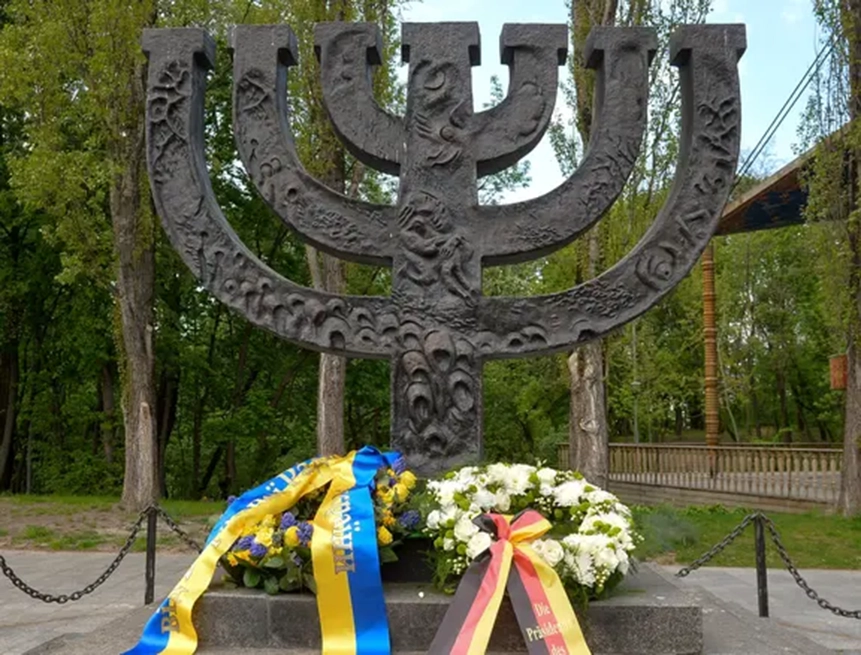
Dr. Yehor Vradii, deputy director of the Jewish Memory and Holocaust in Ukraine Museum in Dnipro and deputy director of Tkuma: Ukrainian Institute for Holocaust Studies, discusses how Ukrainians preserve the memory of Jewish tragedies.
On the historical memory of Ukrainians
Yelyzaveta Tsarehradska: After Russia's full-scale invasion, Ukrainian society seems to have started treating its heritage somewhat differently, more actively, if you will. What trends do you see in the field of memorialization?
Yehor Vradii: My opinions are subjective because I operate in a certain field with the hallmarks of a social bubble. I agree that Russia's full-scale invasion of Ukraine provided Ukrainian citizens and those who identify themselves as Ukrainians in the political sense of the word with an additional impetus to study the past in order to understand the present. However, I do think this process started earlier. It went through the stages of acceleration or slowing down but never stopped during this period.
War, especially full-scale war, affects the cohesion of a community, forcing it to repeatedly ask: "Who are we? Was it before, and what will our life be like during and after the war?"
Accordingly, history plays an essential role as a powerful tool and glue that binds generations and society in general, creating a sense of unity.
Memory of the Jewish tragedy
Yelyzaveta Tsarehradska: What about the memory of the Jewish people in Ukraine? Have you noticed any changes? It seems to me that overall, we came to see the Jewish tragedy differently.
Yehor Vradii: I think it would be legitimate to say that, like every group, the Jewish community of Ukraine (and worldwide) has come a certain way in comprehending the tragedy of the Holocaust in a broad sense and the process of integrating its memory into a wider social context. For the Jewish communities in the late 1980s and early 1990s, the experience of a revival in Ukraine and the integration of Holocaust memory into general memory had its own patterns and special features.
Since the early 21st century, Holocaust history — just like the history of another genocide, such as the deportation of the Crimean Tatars in 1944 — has become an integral part of Ukrainian history at various levels.
Crucially, this happened at the basic level. People can live their entire lives with a school-level knowledge of history. In independent Ukraine, this issue is integrated into school history and present in programs, textbooks, and many other things.
A certain group highlights sensitive pages of its history, the ones that cause pain and unity. For Ukrainian society in general, these pages include the Holodomor, the Holocaust, and the tragedy of the Crimean Tatars. These stories go through a stage of being perceived as group tragedies. At the same time, each group strives for its tragedy to be perceived by society as a common one. I am glad that Ukrainian society has taken this step over the past three decades and is coming to an understanding when an increasing number of people do not separate the Holocaust tragedy and do not talk about it as an exclusively Jewish tragedy. Instead, it is a tragedy and a difficult page of Ukrainian history in general. It's a tragedy of people who inhabited Ukraine, lived next door to other ethnic and religious groups, and became victims of the totalitarian regime.
The ongoing war against Ukraine shows that the aggressor country, which has violated all norms of international law, is attacking Ukrainianness, the Ukrainian nation as a political fact, regardless of its components: religious, ethnic, linguistic, etc.
Paradoxically, this war once again shows that Ukrainianness is, in a way, a political construct, but it's an identity with a political dimension.
On the coexistence of different ethnic groups in Ukraine
Yelyzaveta Tsarehradska: Your research interests include anti-Jewish pogroms in the 19th and 20th centuries and the history of radical political movements in the early 20th century. What drew you to these topics? Are there any traces or parallels that extend to our time?
Yehor Vradii: My interest in radical political movements of the early 20th century had a simple point of origin. As I studied history at Dnipro National University, I chose the biography of Nestor Makhno as the topic for my first term paper. Starting from my first tentative research papers, I discovered that the history of anarchism in Ukraine at the beginning of the 20th century was not researched much, except for a few studies.
Later, I prepared to research the social and psychological nature of anarchism as a political movement in the early 20th century until 1917. As I worked on this topic, I had to touch on the issue of coexistence, cooperation, and interaction between members of various ethnic groups within the left-wing radical movement: Ukrainians, Russians, Poles, Jews, and others. One of the litmus tests for these groups was the 1905–1906 events, particularly the anti-Jewish pogroms, which took place almost all over the so-called Pale of Settlement. This was the territory where Jews were allowed to settle in the Russian Empire due to its discrimination policy. Studying this part of history, I revealed various interesting aspects, and we can draw certain parallels even now.
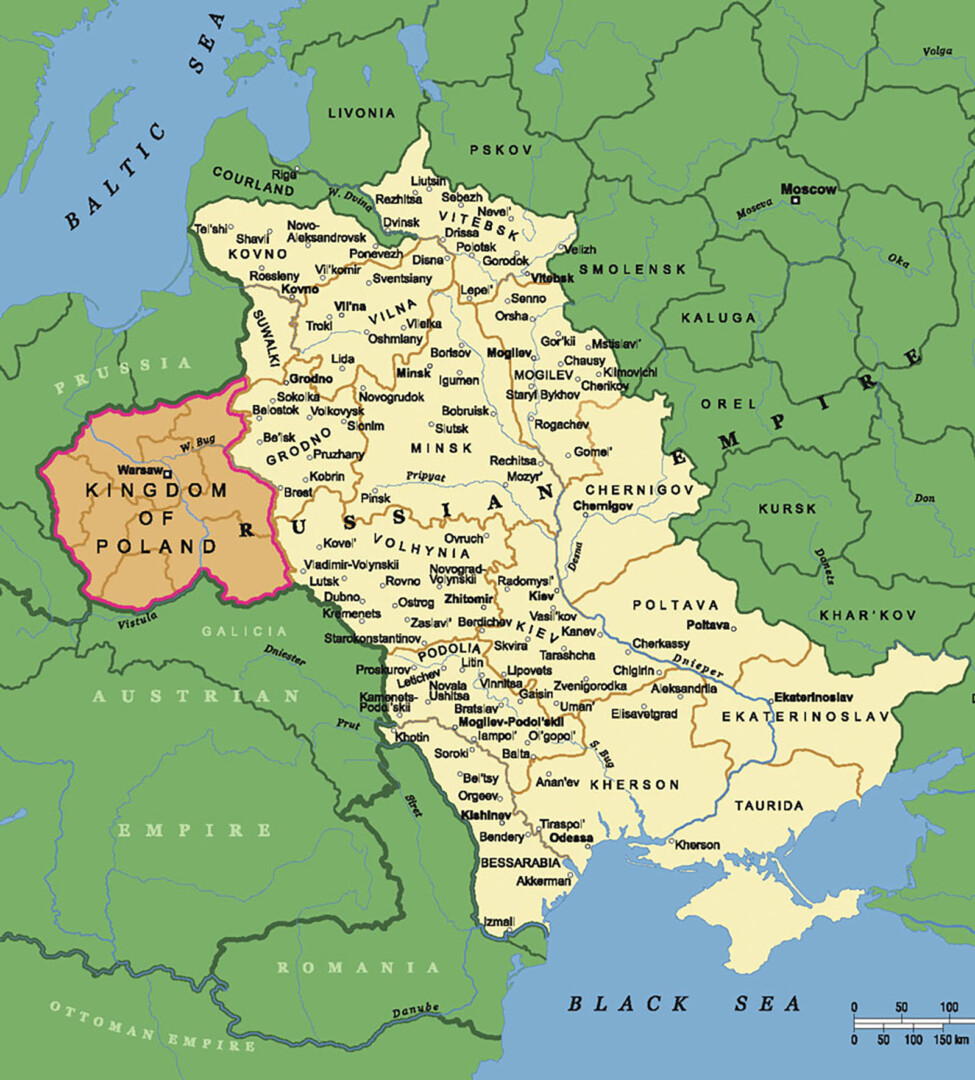
For example, the Russian Empire played the Orthodox population against others, i.e., non-Orthodox people, in Right-Bank Ukraine, along the Polish-Belarusian border. It can be clearly seen how it promoted the history of otherness, pointing to other ethnic groups, such as Poles and Jews. The Russian Empire spared no means in this propaganda and in fueling antisemitism and anti-Polonism. Curiously, it used Taras Shevchenko's works for propaganda purposes. In Ukraine, he is traditionally viewed as someone who gave voice to Ukrainian culture, worldview, and romanticism. The imperial authorities distributed, for example, Shevchenko's Haydamakas in Ukrainian and Russian across Podolia and Volhynia. This poem was extremely popular and was exploited as a simple means of conveying information to barely literate people with a low level of education. Haydamakas painted an image of Jews, Poles, etc. as being exclusively hostile. All this was closely intertwined with direct political events and pogroms in these areas in the early 20th century.
I am happy that when Ukraine gained independence in 1991 and during the difficult trials in 2014-2022, Ukrainian society proved time and time again that it was mature. It did not yield to outside instigation of interethnic, interreligious strife, etc. On the contrary, members of various groups in many cases rallied together as those who belonged to Ukraine as a country and state.
How the Russian Empire and the USSR tolerated intolerance toward Jews
Yelyzaveta Tsarehradska: I interviewed old people in the village where my maternal grandmother was born, asking them how they co-existed with the Jews. They could not really understand what I was asking about as it was something natural to them. So, why did the pogroms occur? Why did the Russian Empire succeed in instigating them in some regions?
Yehor Vradii: Your point does not raise any fundamental objections. I would just like to emphasize that, of course, the coexistence of people cannot be exclusively ideal and conflict-free. Conflicts happen regardless of ethnic origin. However, the framework and attitude promoted by the state are crucial in many processes.
The anti-Jewish pogroms of the early 20th century and the last third of the 19th century in the Russian Empire took place in a country where discrimination based on religion was recognized at the official, legislative level. The Jews belonged to the category of "foreigners," according to the legislation of the Russian Empire. Through such legal frameworks, the state created certain social expectations and a social image of what Jews had to be.
Cooperation, interaction, and civilized relations were absolutely normal at the everyday level and in personal contact. However, if the Jews crossed the boundaries of social expectations within which they lived for decades, if not centuries, for example, by engaging in some activities that society did not expect of them, and this happened at a time when some social processes were escalating, it immediately evoked internal protest in some parts of society. At the same time, the state fueled all these things.
You mentioned that there was a certain prejudice against the Jews. Let us also remember that after the Second World War, the Soviet state did everything possible to make those who had the courage to identify as Jews an exception rather than the rule.
The fight against cosmopolitanism, the "doctor's plot" in the late 1940s and early 1950s, and the powerful clampdown on the so-called Zionists in the late 1960s and late 1980s in the Soviet Union forced people to partly conceal their identity. Admitting that you were a Jew and not ashamed of your origin became an act of civil courage.
It was one way to stigmatize Jews, and society took notice. The state and the political regime can create a framework in which persecution, discrimination, etc., are sanctioned and normal.
The Holocaust, as a genocide against the Jews, involves not only the relationships and issues between the executioners (the Nazis) and the victims. It covers a broad scope of problems related to non-Jews who were eyewitnesses and accomplices — and not only in the negative context of the events in the occupied territory of Ukraine during the Second World War. It is crucial to remember that when the state sanctions violence against a group of people, it provokes a whole range of processes.
Russian émigré writer Sergei Dovlatov is often quoted in our country, especially his phrase about millions of denunciations and the people who wrote them during the Stalinist regime. It points to the shared responsibility of people living in society. On the other hand, had it not been for the state that created conditions under which writing denunciations was useful and normal, their numbers would likely have been much lower. That's the point I'm trying to make.
Memorializing Jewish memory
Yelyzaveta Tsarehradska: What memorialization policy should the state pursue? Does the current one meet your expectations? I very much believe in literature, but fiction is clearly insufficient for the whole task.
Yehor Vradii: Look, we can consider memorialization in several planes. In a narrow sense, it is about creating memory spaces, monuments, landscape memorials, and other places associated with the tragedy of Ukrainian Jews during the Holocaust.
A different approach seems more promising to me. I am pleased that the institutions where I work (the Jewish Memory and Holocaust in Ukraine Museum in Dnipro and Tkuma: Ukrainian Institute for Holocaust Studies) are active in education. Let me explain why. In one way or another, every person is a bearer and transmitter of some historical memory. The integration of the history of 20th-century tragedies and genocides that Ukraine experienced (the Holodomor, the Holocaust, the deportation of the Crimean Tatars, and the genocide against the Roma during the Nazi occupation) is an essential part of history that should be present in the educational process and informal educational activities.
For 22 years now, Tkuma: Ukrainian Institute for Holocaust Studies has held competitions for artistic and research works among school and university students, PhD students, and, very importantly, history teachers. I can already see certain outcomes. For example, some children who wrote their first academic papers in the ninth grade have by now graduated from history departments in Ukraine and abroad. They are already a generation of researchers, multipliers of historical knowledge in the future.
As far as fiction is concerned, I fully agree with you. It's a path of interest and digestible images. At the same time, we are faced with the problem of reading habits and reading culture in general becoming, I'm sorry to say, somewhat marginalized. Nevertheless, there are multiple works in modern Ukrainian literature that deal with the trauma of genocides, talk about these things, and integrate the history of genocides into the general memory. These works are of very high artistic quality. I would like to single out Sofia Andrukhovych's novel Amadoka that won the Encounter prize for fiction. This book engages with many layers of our history, particularly the history of Ukrainian-Jewish coexistence in various circumstances. It is an extraordinary book, and I would like to once again express my admiration for the author and the text.
I hope that important films will appear in Ukrainian cinema — and there are some signs of this happening — that will ask questions in the same way as, for example, in Polish cinema. The Polish film Ida (2014) addressed the issues of memory and searching for one's true self after the Holocaust. Films are an accessible channel. The problem with historians and researchers is that they often fail to reach the public at large, writing texts and research papers for their own professional circle. The vast majority of people rarely see or take an interest in them, and the texts themselves are not easy to understand.
This program is created with the support of Ukrainian Jewish Encounter (UJE), a Canadian charitable non-profit organization.
Originally appeared in Ukrainian (Hromadske Radio podcast) here.
This transcript has been edited for length and clarity.
Translated from the Ukrainian by Vasyl Starko.
NOTE: UJE does not necessarily endorse opinions expressed in articles and other materials published on its website and social media pages. Such materials are posted to promote discussion related to Ukrainian-Jewish interactions and relations. The website and social media pages will be places of information that reflect varied viewpoints.