




"Absolute misalliance" of the 19th century: the history of the Ukrainian-Jewish Rudnytsky family
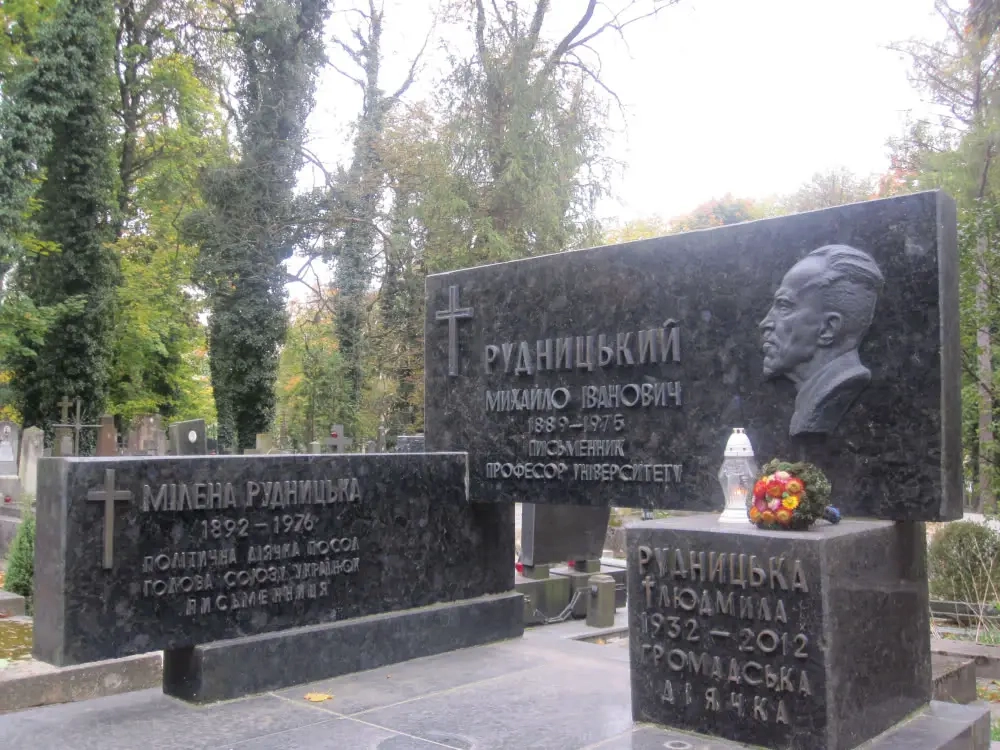
The story of the mixed marriage of Ivan Rudnytsky and Ida Spiegel, who gave birth to the prominent figures Mykhailo Rudnytsky, Ivan Kedryn-Rudnytsky, Milena Rudnytska, Antin Rudnytsky, and Volodymyr Rudnytsky.
Yelyzaveta Tsarehradska: Today’s guest of the Encounters program, Illia Chedoluma, defended a thesis about Mykhailo Rudnytsky, a Ukrainian literary critic of Jewish origin. Thinking about those in our audience who may not have heard about the man, let me begin by asking you to say a few words about Mykhailo Rudnytsky himself, his contribution, and the caliber of his personality.
Illia Chedoluma: The fact that we don’t know something is actually the norm. As I have long observed in scholarly activity, the more you study a subject, the more you understand how little you know. So, this is an absolutely natural thing.
The Rudnytsky family and its influence on Ukrainian history
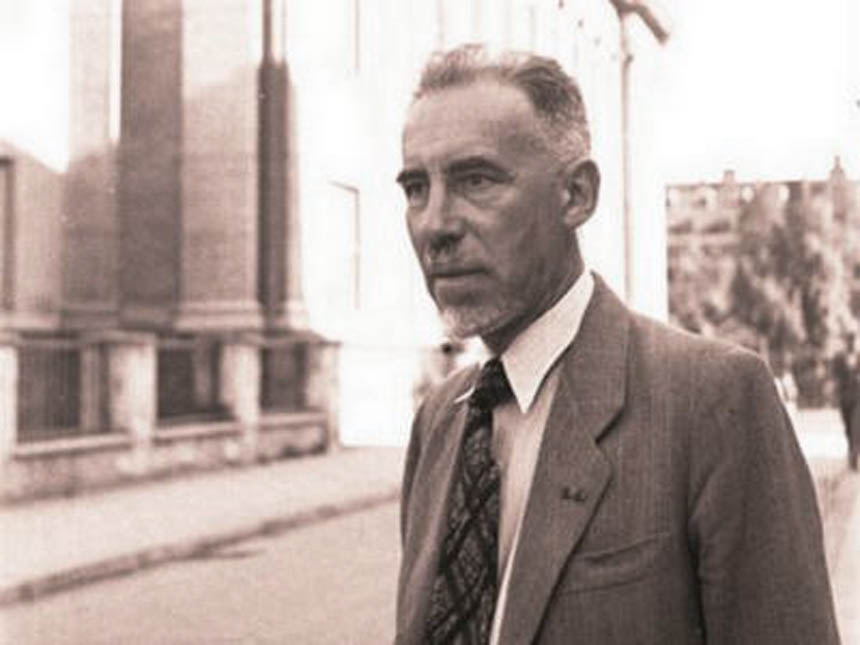
Illia Chedoluma: Mykhailo Rudnytsky is a very interesting figure. He was born in 1889 and died in 1975. Even these two dates alone show that he lived through several eras: the Habsburg Empire, a period of wars and revolutions, interwar Poland, Soviet occupation, Nazi occupation, and then again Soviet rule, including the Stalin, Khrushchev, and Brezhnev periods. The man experienced a lot in his life. He was a well-known literary critic and publicist who wrote widely on culture and art. In interwar Lviv, Mykhailo Rudnytsky was among the most famous publicists, even according to his critics.
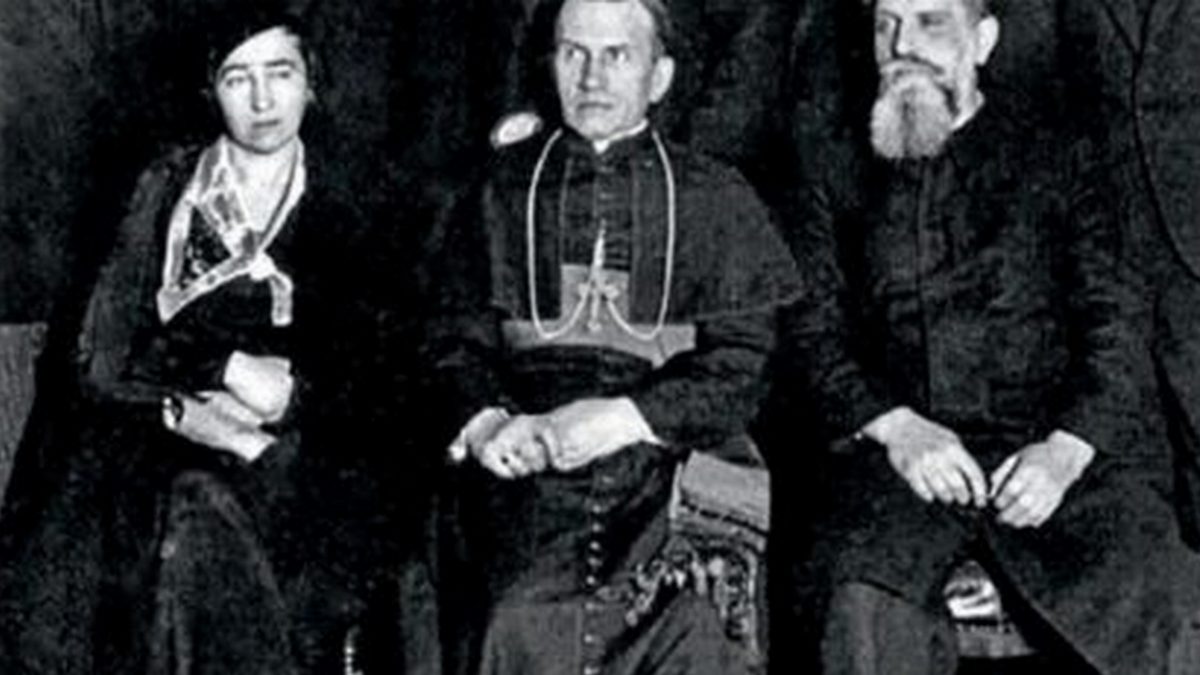
He came from a mixed family. His mother, Ida Spiegel, was a Jew from likely a more secular Jewish family: she converted to Christianity to marry Mykhailo Rudnytsky's father, Ivan Rudnytsky. The couple had children who would become prominent figures. Ivan Kedryn-Rudnytsky was a famous politician and journalist. Milena Rudnytska became a leading figure among Ukrainian women in the interwar period. Antin Rudnytsky was a renowned composer, while Volodymyr Rudnytsky made a career as a lawyer. Milena Rudnytska was the mother of Ivan Lysiak-Rudnytsky, one of the most famous Ukrainian historians of the 20th century. You can see what intellectual impact this family had in Ukrainian history.
Mixed marriages in Lviv in the 19th century
Yelyzaveta Tsarehradska: The Rudnytskys were a mixed family with Greek-Catholic and Jewish backgrounds. I felt indignant when I learned that ten years passed between Ida Spiegel meeting her future husband and their engagement. Was there a struggle between the families? How natural was this situation for Lviv at that time? To what extent were mixed marriages possible without the risk of becoming outsiders or being expelled from the family circle?
Illia Chedoluma: When we are indignant, as in this kind of situation, we look at people who lived more than 150 years ago from a modern perspective. As prominent historians of the 20th century write, the past is a completely different world and a distinct system of ideas. Let me start by saying that mixed marriages were not that uncommon in Lviv in the last third of the 19th century. However, nearly all of them were between Poles and Jews. It may be a little difficult for us to imagine now, but Lviv was a city of mostly Polish culture in the late 19th century. Those who entered into these mixed marriages went against traditions on both sides, Jewish and Christian, which was very hard to do back then.
Marriage as emancipation
Illia Chedoluma: The influence of Ukrainian culture, Ukrainian intelligentsia, and Ukrainian bourgeoisie was insignificant compared to the middle class during this period. It is understandable why Jews or people from Jewish families chose people of Polish culture. I say “Polish culture,” but this does not necessarily mean that those people were ethnic Poles. They could have been Ruthenians who adopted Polish culture. Thus, mixed marriages with Greek Catholics in Lviv were extremely rare. Such marriages were more common, surprising as it may be, in Galician villages.
The ethnographic expeditions carried out in the late 19th century, early 20th century, and then in the 2010s found evidence in the archives of Lviv University and other universities that such mixed marriages actually did occur in villages. However, for the marriage to be registered, the couple had to be of the same faith. Very rarely did people convert to Judaism. I am not aware of such cases. I mean when men converted to Judaism to marry a Jewish woman. In the vast majority of cases, Jewish women converted to Christianity to marry men.
Why did they do this? Scholars, including contemporary female historians, believe that one of the reasons was emancipation. Those women wanted to break free from the traditional system and norms of the last third of the 19th century. An opportunity to marry lawyers, doctors, and Christians was a chance to expand one's social horizons, so to speak. But, again, there were some nuances because people from such mixed marriages were a bit like outcasts. So, it’s a complex issue.
Ida Spiegel and Ivan Rudnytsky: was it "an absolute misalliance"?
Yelyzaveta Tsarehradska: Can we say that was the only way Ida Spiegel could elevate her social status? It seemed to me that, coming from a wealthy Jewish family in Lviv, she would have had the status. Or was it love after all?
Illia Chedoluma: I think that, as it usually happens in life, many elements were mixed together. I wouldn’t say Ida’s family was extremely wealthy. They were more middle class, i.e., not poor, because the children received a good education, but not extremely rich. I think her feelings had to do with her decision. If she had only wanted to break away from the family, she could have married inside the Jewish community, for example, tying the knot with a man who lived in another city or perhaps in Vienna. Crucially, this was not only the emancipation of Ida Spiegel from her family but also the emancipation of Ivan Rudnytsky, as he was under the same amount of pressure.
The Ruthenian nobility, which the Rudnytskys were, had entire generations of Greek Catholic priests, so marrying a Jewish woman was an absolute misalliance. I write in my book that Ivan Rudnytsky had to essentially wait for his mother to die before he could get married. His father lived for just two years after the marriage. So, he was already very old and agreed to this marriage in order to see his grandchildren.
However, Ivan Rudnytsky would not have been able to do this 30-40 years earlier. The reason is that he would most likely have been a priest, and marrying a Jewish woman, even a convert, would have been out of the question. But it was the second half of the 19th century, and the Galician Ruthenian intelligentsia appeared precisely in the 1870s and the 1880s. Many scholars, including Sviatoslav Pakholkiv, write about this. That was the period when the first generation of secular intelligentsia appeared. They made a living as lawyers and doctors and were financially independent from their parents.
They were still dependent in terms of mentality, traditions, and so on. This created a situation where Rudnytsky could not follow his heart and get married immediately as long as his mother was alive. However, he had an independent source of income and a profession that allowed him to wait until the situation changed and marriage was possible.
Ivan Rudnytsky: Jewish origin or Jewish identity?
Yelyzaveta Tsarehradska: Mykhailo Rudnytsky had Jewish roots and culture as his background. Can he be described precisely as a person of Jewish origin with a Jewish identity? And what about his oeuvre?
Illia Chedoluma: That’s a good question. I would divide it into two parts: Jewish origin and Jewish identity. Jewish origin is not the same as Jewish identity, because an ethnic Jew may not consider themselves a Jew. In the case of Mykhailo Rudnytsky, I did not find a single document that would show that he perceived himself as a Jew or a man of Jewish faith. In this sense, he was definitely not a person with a Jewish identity. But was his Jewish origin an important factor in his biography? I think so.
At the beginning of the book, I wrote about what you said about Polish culture and its influence. Many of the Rudnytskys’ acquaintances were also people from mixed families. These were often families of Jews and Poles, families of Polish culture but often of Jewish origin.
Dialogue of cultures
Illia Chedoluma: Assimilated Jews of Polish culture and Jewish origin often helped the Rudnytskys a lot. Mykhailo Rudnytsky got his first job in the bookstore of Bernard Połoniecki, who was absolutely a man of Polish culture and absolutely of Jewish origin. He was a relative of Mykhailo Rudnytsky's mother. Milena Rudnytska studied at a girls' gymnasium, where the vast majority of girls were, tellingly, from mixed Polish-Jewish families.
Interestingly, Mykhailo Rudnytsky advocated dialogue and the interaction of cultures in his interwar texts. He was one of the few Ukrainian authors who contributed to the Polish-language journal Chwila published by Jewish Zionists in Galicia. It was published mainly in Polish, even though there was also a separate Hebrew edition.
I believe that Mykhailo Rudnytsky’s origin influenced, for example, his understanding of the dialogue and interaction of cultures because he himself was, you might say, a product of such interaction. In addition, he collaborated extensively with Polish authors. His critics, including writers centered around Dmytro Dontsov and his Literary and Scholarly Herald (later simply Herald), often mentioned the Rudnytskys’ Jewish background and used it for criticism. There were many other authors like that. I dedicated a chapter in my book to exposing how their critics used the narrative about the Rudnytskys as a kind of “Trojan horse” that the Jews “planted in the Ukrainian national body” in their articles, brochures, and even private letters. In this sense, whether the Rudnytskys wanted it or not, their Jewish background was also a factor in the interwar discussions.
Colonial influences
Yelyzaveta Tsarehradska: Empires inevitably have colonial policies, and the imperial culture predominates, such as Polish culture in this case. And yet, I wonder how much more cultural figures with Jewish backgrounds could have produced if they had not been suppressed. What do you think?
Illia Chedoluma: I belong to those historians for whom the “what if” question is absolutely normal and very productive. I believe that the dictum “There is no subjunctive mood in history” is just a kind of cover for historians who are afraid, let’s put it this way, to ask uncomfortable questions and go beyond safe, well-known things.
You raised an interesting question: To what extent can an involvement in another culture diminish the person’s own Jewish identity? My straightforward answer is that I don’t know. But here’s the problem with colonial studies in Eastern Europe. Taking Lviv as an example, Polish culture dominated there, but the Poles were not the center of the Habsburg empire.
Secondly, we can also approach this issue from the opposite side. Perhaps inclusion in German, Polish, or Russian culture helped many authors, ethnic Jews, become famous. Being more widely known and reaching a wider circle of readers, they were able to familiarize as many people as possible with Jewish culture. For example, a number of Jewish authors from Eastern Europe later became world-famous, even winning the Nobel Prize. It’s hard to know whether they would have become so famous if things had happened differently.
They might have lost from the viewpoint of the Jewish tradition, but they could have gained through inclusion in modern processes and operating in imperial spaces. So, it’s a complex, multipolar process.
The influence of Ukrainian lands on world history
Yelyzaveta Tsarehradska: Thank you for this perspective. I think we have a very serious responsibility of learning about our artists and cultural figures. How prepared are we to dive in, immerse ourselves, and analyze these details in their biographies?
Illia Chedoluma: My position is that everything that happened on our lands, on Ukrainian lands, whether good or bad, is part of our heritage. The more elements, often even contradictory, we can synthesize, elaborate, and include in our narrative, the more complex our understanding of the past will be and the more multifaceted our worldview will be. This will affect even the organization of our society, enabling us to handle many challenges. Here is one example.
Ludwik Fleck and others
Illia Chedoluma: I recently wrote about Ludwik Fleck, a fascinating philosopher and prominent figure. He worked at Lviv University and in other scientific institutions. Thomas Kuhn, the author of The Structure of Scientific Revolutions, called Fleck his predecessor. That is, he influenced not only the European but also the global understanding of the philosophy of science.
Fleck was a philosopher and microbiologist. A Jew by origin, he survived Auschwitz and several concentration camps, later emigrated, and died in Israel. Fleck, Debora Vogel, and many other authors and writers are part of our heritage and culture. These figures will only enrich us, even if some elements are difficult or incomprehensible. For example, Jewish thinkers in Odesa and Lviv articulated, long before Theodor Herzl, the idea of creating an independent Jewish state in the Middle East, a prototype of modern Israel. Here, we see the influence of Ukrainian lands on world history.
This program is created with the support of Ukrainian Jewish Encounter (UJE), a Canadian charitable non-profit organization.
Originally appeared in Ukrainian (Hromadske Radio podcast) here.
This transcript has been edited for length and clarity.
Translated from the Ukrainian by Vasyl Starko.
NOTE: UJE does not necessarily endorse opinions expressed in articles and other materials published on its website and social media pages. Such materials are posted to promote discussion related to Ukrainian-Jewish interactions and relations. The website and social media pages will be places of information that reflect varied viewpoints.