




An American series skews Holocaust memory to the detriment of Ukraine
For all the advantages of the dramatic plot and talented acting in this American series, one cannot fail to note the gross distortions of historical truth in scenes depicting the Jewish pogrom in Lviv that occurred exactly 85 years ago, on 30 June 1941. These distortions raise questions about possibly deliberate falsifications and the filmmakers' desire to link modern Ukraine to the persecution of Jews.
We Were the Lucky Ones, a popular American historical eight-episode miniseries developed by Erica Lipez, is an adaptation of Georgia Hunter's book, inspired by her own family's struggle for survival during the Holocaust.
The series, which aired worldwide on television in 2024, centers on the Kurcs, a Jewish family from the Polish city of Radom, who find themselves in various cities across Poland on the eve of World War II. After the war begins, the family is split apart, its members ending up in ghettos in Poland, as well as in the USSR, Italy, Brazil, and North Africa. After the war, the survivors try to find each other and reunite.
Part of the Kurc family lived in Lviv in 1941. One of the most dramatic moments in the fourth episode is the Lviv pogrom of 30 June 1941, probably the world's first artistic cinematic depiction of this event.
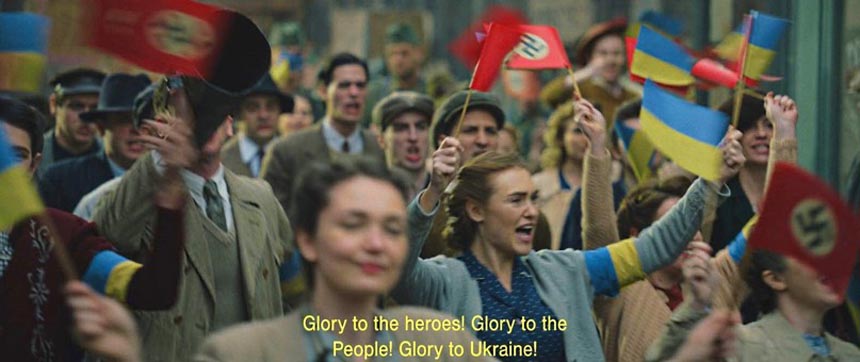
According to the plot, the Jewish characters are in Lviv at a time when Soviet troops have already fled the city, and German troops begin to enter the streets. As a historian who has read academic studies on the anti-Jewish violence of those days and seen dozens of photographs of the Lviv pogrom, I was struck by the numerous discrepancies and even falsifications in this American series. For example, a real historical photograph from 30 June 1941 shows pogromists escorting Jews through the streets of Lviv, while not a single Ukrainian flag is visible in the crowd of Lviv residents. In contrast, the same scene in the series is literally packed with Ukrainian flags held by dozens of people:
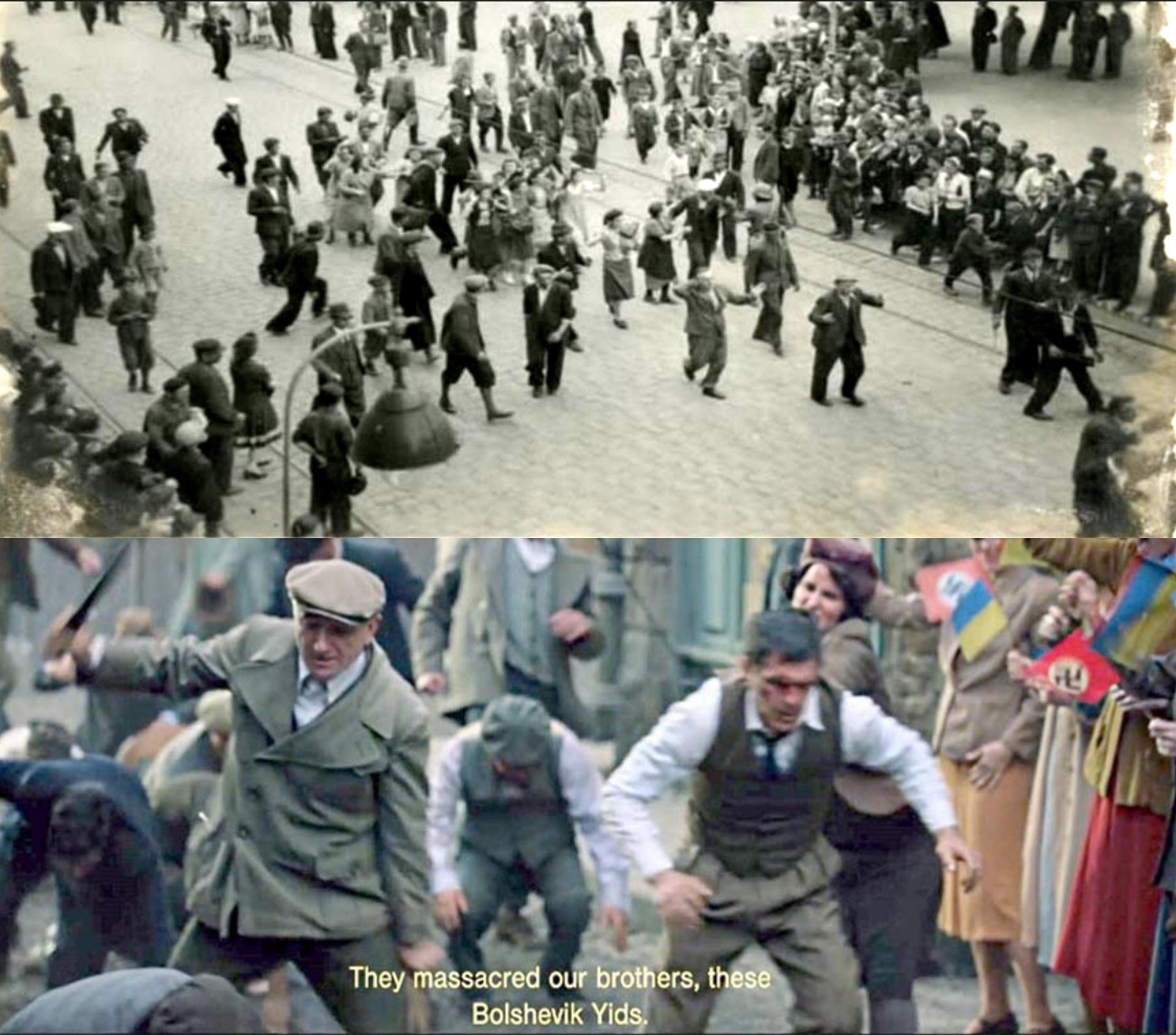
This is one of the most striking falsifications in the series: the Red Army and Stalin's political terror services have just left Lviv, but for some reason, the entire city is shown as already filled with Ukrainian flags. Even the heads of horses, bicycles, and shop signs are decorated with yellow and blue ribbons, while yellow and blue garlands hang across the street between the houses. The filmmakers apparently consciously combined Ukrainian flags with Nazi swastika-bearing banners, giving the audience the subconscious impression "Ukrainian = Nazi."
It is completely incomprehensible and historically inaccurate that, just a few hours after the Bolsheviks fled, thousands of Lviv residents would have mass quantities of yellow and blue flags along with Third Reich banners in their hands.
The most brutal scene of a Jewish woman being beaten on a street in Lviv includes a frame with as many as three Ukrainian flags at once and a bunch of yellow and blue flowers.
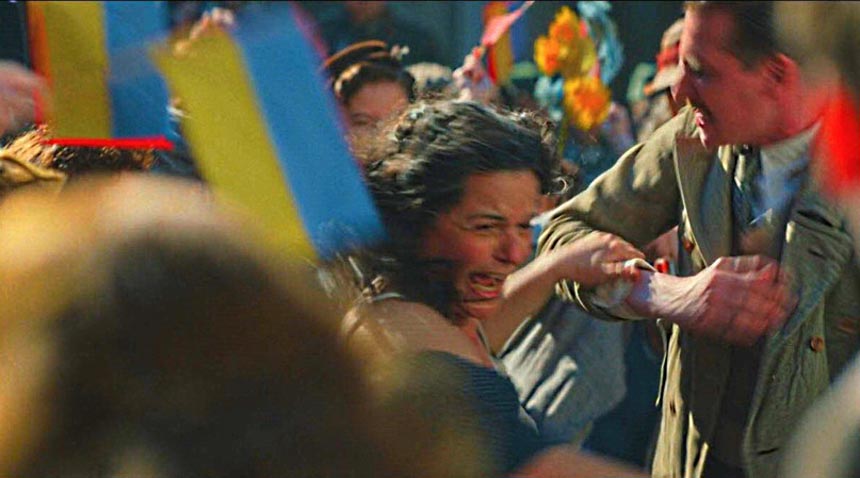
The crowd of townspeople, watching the Jews being beaten, repeatedly chants in a modern style: "Glory to Ukraine! Glory to our nation! Glory to the heroes!" However, no eyewitness accounts mention such chanting during the actual pogrom.
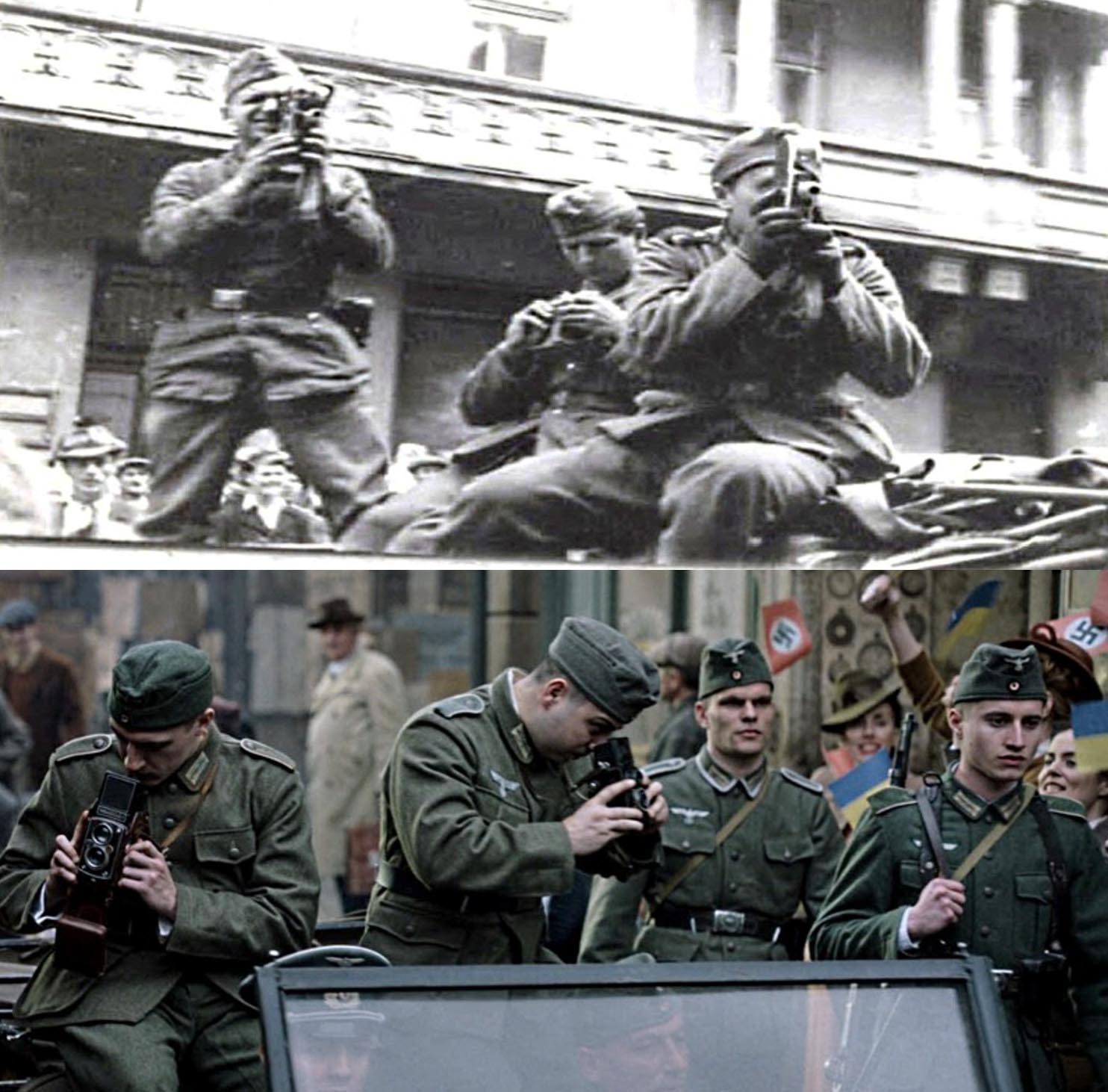
At the same time, the filmmakers appear to have studied historical materials about the Lviv pogrom. The series accurately shows the work of German cameramen from the Wehrmacht propaganda department, matching a documentary photograph taken on the streets of Lviv on 30 June 1941.
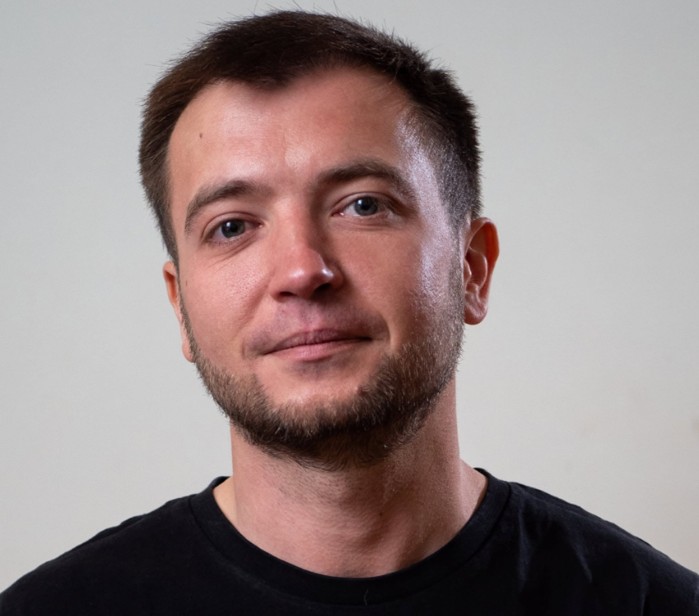
I turned to historian Andrii Usach, who has studied the materials from the Lviv pogrom for many years, and asked him to comment on this topic. He is the head of the NGO "After Silence" and a researcher at the Mykola Haievoi Center for Modern History at Ukrainian Catholic University, currently writing a dissertation titled "Local Collaboration and the Holocaust in Occupied Ukraine: Bar District, 1941–1944."
Below is his commentary after watching an excerpt from the series.
"What we now call the Lviv pogrom is more of a historiographical name for a series of acts of anti-Jewish violence that occurred in various places in Lviv from the midday of 30 June to the evening of 1 July 1941. Thanks to newsreel footage and photographs, this event in the history of the Holocaust in Ukraine is probably best documented visually.
Therefore, we can identify, with relative ease, the frames in the series that clearly match what we see in historical images:
- German cameramen in a car;
- A group of Jews forced to move on their knees through the city streets while being beaten;
- Men, and sometimes women, who actually beat the Jews;
- A half-naked woman begging for help.
Clearly, the filmmakers used real photographs from the time of the Lviv pogrom as references here.
Things shown in the film but absent from any historical images of that time that I know of:
- Crowds of people marching through the city with yellow-and-blue bunches of flowers and Ukrainian and Nazi flags. Nothing of that kind could be seen even in the photo taken on Rynok Square when Ukraine's independence was proclaimed there on 30 June 1941. There was nothing like that in the crowds at the sites of anti-Jewish violence: we have very clear photos of these people, and not a single flag or the like is to be seen there. In general, this huge number of flags looks unrealistic. Where would they have gotten them in Lviv on the first day of occupation?
- Such a large number of people, especially women, with armbands. Armbands appear very rarely in historical photos. Members of the newly formed Ukrainian militia had to wear them, and it is by these armbands that they can be identified in historical photos.
- Antisemitic German-language Nazi posters and a large Star of David on the storefront. This looks like something you would have found in Germany in the 1930s, but not in Lviv on the first day of the occupation.
- It is absolutely confusing why everything in the stores (signs, ads) is in Polish. This is absolutely unrealistic for Lviv, which was under Soviet rule from 1939 to 1941.
- There is a question of what was shouted during the pogrom. There were indeed shouts to the effect that "Jews wanted Stalin," yelling about "Jewish communists," etc. (I'm not quoting verbatim, but it's in the memoirs.) I don't remember reading in memoirs about people shouting "Glory to Ukraine!" or, in general, about any such organized civilian marches through the city.
- I was very confused by the fragment where some "officer" shoots a Jew. What kind of Polish uniform is he wearing? I didn't see any mentions whatsoever of anyone, except the Germans, using firearms to kill in Lviv. Moreover, the shooting was done mostly in prisons at the time.
It seems to me that this was the greater horror for the Jews — there were no obvious external signs distinguishing the pogromists or their supporters in the crowd. Kurt Levin described a situation when he was brought to the prison gates: "Christian neighbors — Poles and Ukrainians — stood around, shouting insults and inciting the crowd to do away with the 'Christ-killers and Jewish communists.' The crowd shouted joyfully as we were beaten."
The eyewitness Henryk Szyper emphasized that "Ukrainian militiamen and street riffraff of both nationalities [i.e., both Ukrainians and Poles — Sh.B.] attacked the Jews, abused them, and led them to prison yards."
In general, the crowd was mixed, Ukrainian and Polish, while the filmmakers used flags, armbands, and bouquets to make it look like it was Ukrainian, which in reality it was not. This is the most dubious and contrived moment in that fragment.
The statement that "those who committed the Lviv pogrom were Ukrainian nationalists" is nothing more than a convenient description. The truth is that it was a much larger phenomenon, involving far more people than there were nationalists in Lviv at that time.
Back then, the Ukrainian militia could include Ukrainian nationalists who had just escaped from prison, former Komsomol members who had quickly changed their colors, and simply opportunists who sought access to power.
As I found out, the list of the Ukrainian militia group on the day of the pogrom, from 30 June to 1 July 1941, included at least three men who had previously been Soviet militiamen. Such "professionals" would have found a job for themselves under any regime.
I think about the crowd in the following terms: there were Ukrainians among the pogromists; among them were Ukrainian militiamen, and among those militiamen were Ukrainian nationalists. The pogroms were part of a broader movement, not reducible to nationalists alone.
However, the creators of the series made the atmosphere of the pogrom and the pogromist crowd itself appear largely Ukrainian. This is not confirmed by any visual sources — photos or newsreels," says Andrii Usach.
All of the above leads to the following sad conclusion: a scene was purposefully included in this American series to link Ukraine's contemporary realities to the pogrom and deliberately emphasize the Ukrainian component among the participants in anti-Jewish violence.
Curiously, the Jewish characters in the series do not point out the nationality of the pogromists in any way, referring to them as "local residents" in their lines. Meanwhile, it is known that on the eve of World War II, Poles made up more than 52 percent of Lviv's population, with Jews accounting for about 30 percent and Ukrainians for 12–13 percent.
Rotten Tomatoes reported that 95 percent of the reviews for the series were positive, with an average rating of 8/10. Critics' consensus on the website states: "Equal parts harrowing and life-affirming, We Were the Lucky Ones is a sensitively told tale of perseverance given tear-inducing heart by its wonderful ensemble." Film critic Robert Daniels wrote in his review that the miniseries is "a defiant and harrowing, soul-shattering story — one that gives the full range of the horrors that occur when you've been displaced, unmoored, and dehumanized."
However, despite the generally positive reviews in the U.S., Russian propaganda can still use a fragment of this American series to denigrate Ukraine, supplying its footage with the comment: "Look how the Americans truthfully depict the mass participation of Ukrainians in this pogrom of the Lviv Jews!"
Academic papers by historians about those events are read only by a narrow circle of specialists, while such cinematic falsifications can influence the minds of millions of people worldwide — and turn them against Ukraine.
Text: Shimon Briman (Israel).
Photo: Stills from the series We Were the Lucky Ones.