




Inside Babyn Yar's new exhibition on Ukrainian Jews since 1920
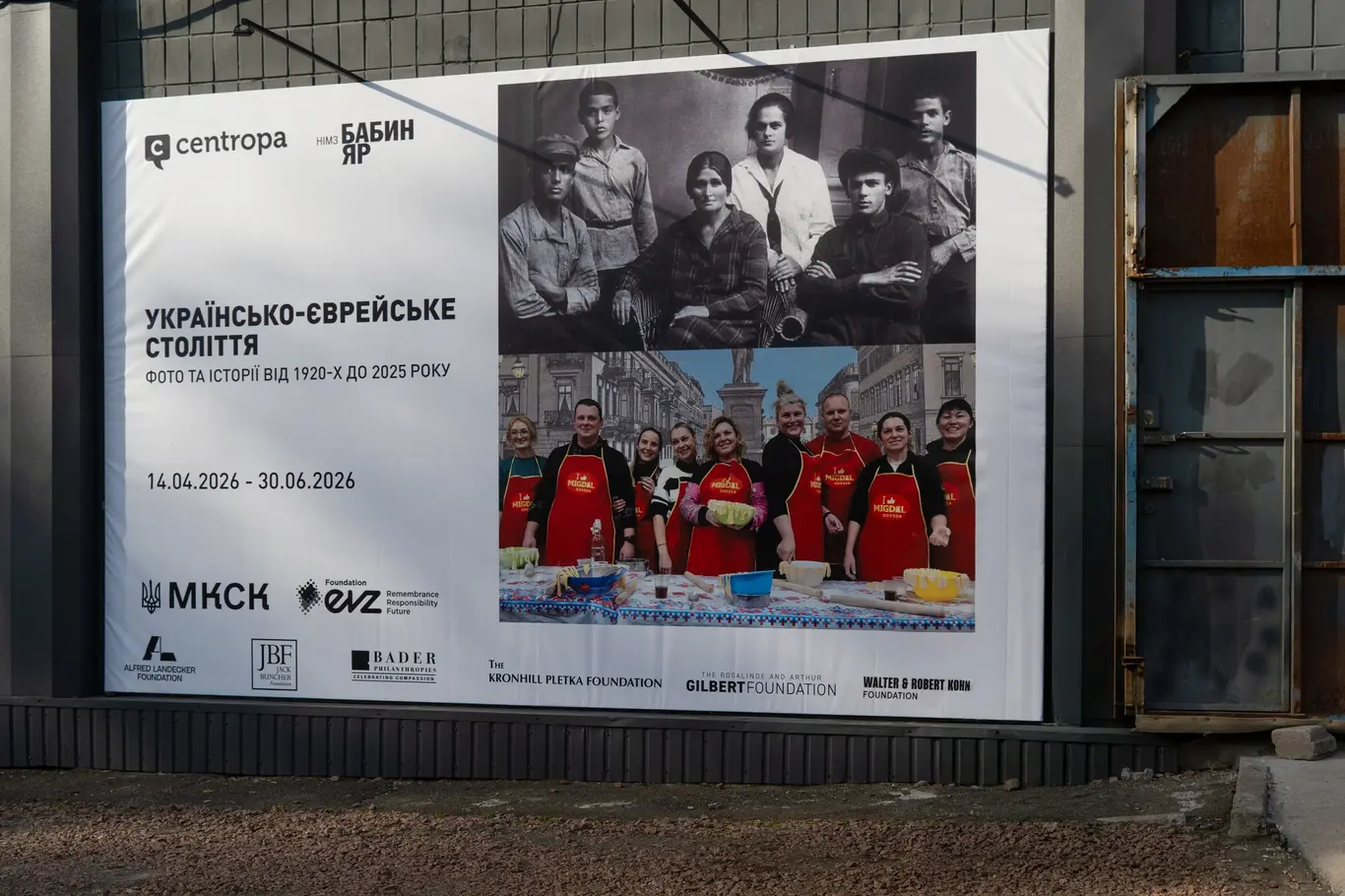
What materials anchor the exhibition "Ukrainian-Jewish Century: Photos and Stories from 1920 to 2025" at the Babyn Yar National Historical and Memorial Reserve? Do the layers of unfolding current events cloud our memory of past tragedies? Offering his insights is Dr. Yuri (Amir) Radchenko, a historian specializing in modern Jewish history and a research fellow at the Babyn Yar Reserve. He is also a doctoral candidate in World History at Oles Honchar National University and a fellow at the Mykola Haievoi Center for Modern History at the Ukrainian Catholic University. [Editor’s note: This interview originally aired on 16 April 2026.]
Memorial days in the Jewish tradition
Yelyzaveta Tsarehradska: Our conversation today is prompted by a compelling new exhibition on Ukrainian-Jewish history at the Babyn Yar Reserve, timed to coincide with Holocaust Martyrs' and Heroes' Remembrance Day. Every occasion of public remembrance serves to manifest specific societal values, so what is the central message we should take away from this one?
Yuri Radchenko: That question cuts to the heart of how the Shoah is commemorated, not just in Kyiv and Ukraine, but across Europe and globally. This day honors both the victims of the Shoah and the resistance against it. The tradition itself stems from Israeli state practices established in the late 1940s, which were subsequently adopted by Jewish communities worldwide. Within Jewish history and broader global traditions, there are various ways for memorializing the Shoah, the Holocaust, or the Churban. In Ukraine, for instance, our primary memorial day is September 29, which marks the initial mass shootings at Babyn Yar. This additional day of remembrance offers another opportunity to reflect on those lost and to examine the deeper historical context of Jewish life within Central and Eastern Europe, and Ukraine specifically.
Unveiling the new Babyn Yar exhibition
Yelyzaveta Tsarehradska: The exhibition is titled "Ukrainian-Jewish Century: Photos and Stories from 1920 to 2025." What are your immediate impressions of the display?
Yuri Radchenko: My perspective is admittedly close-to-home, shaped both by my work as a historian and my daily practice of Judaism. This exhibition rests on oral histories compiled by Centropa, an organization dedicated to preserving the memory and history of the Shoah and the broader history of Central and Eastern European Jewry. These interviews were recorded in the early 2000s, a critical window that saw a wave of late-stage documentation initiatives, much like the Shoah Foundation. In Ukraine, that effort was spearheaded by Leonid Finberg. Crucially, the project went beyond oral testimony to secure visual history, pairing photographs of individuals directly with their firsthand commentary.
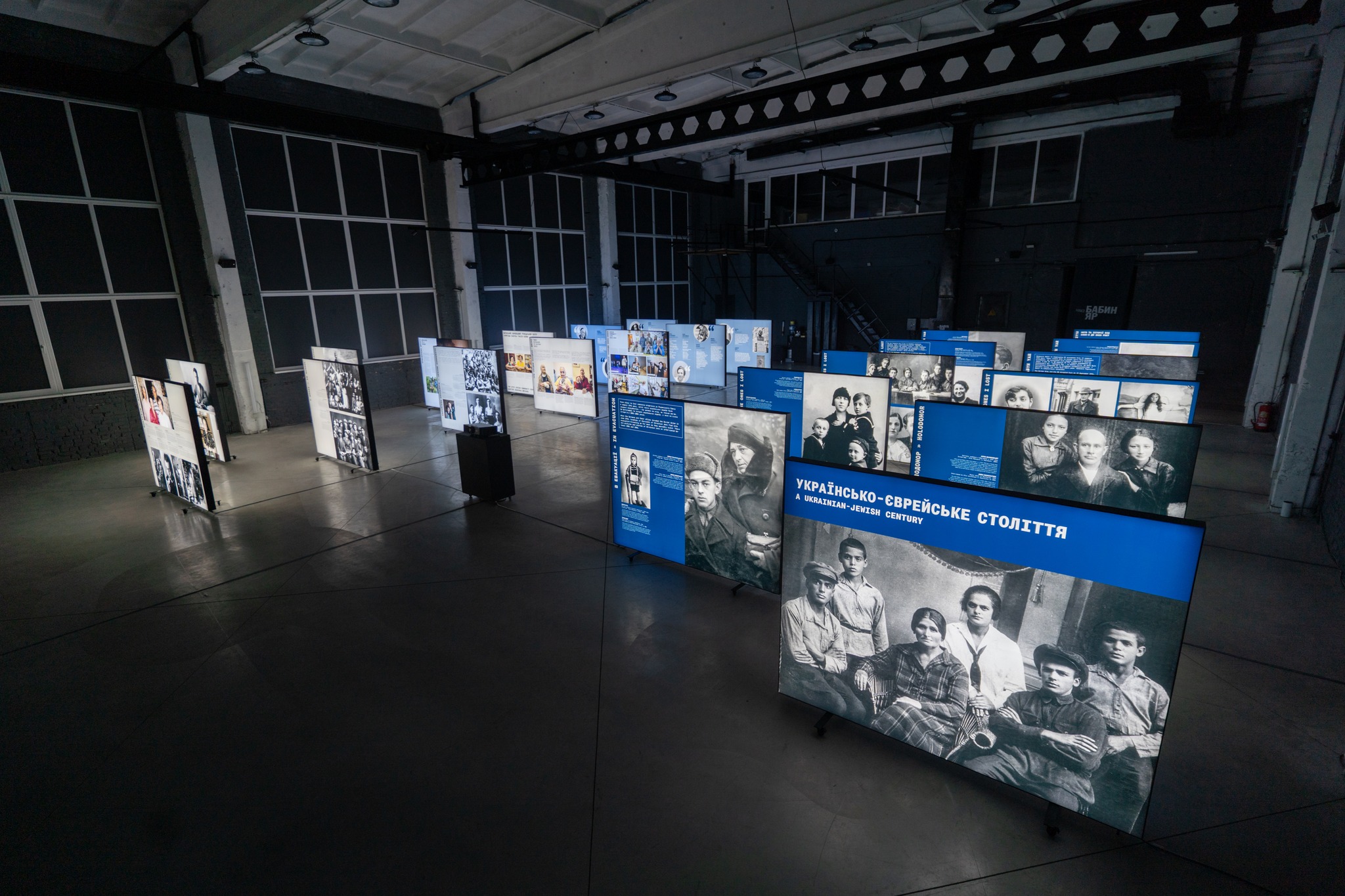
Ultimately, any exhibition is designed to recontextualize history through the lens of our current realities. The 1920s remain a fascinating chapter in the history of Soviet Ukraine and its Jewish population, a period defined by state-sponsored policies of Ukrainization and Yiddishization, when the Soviet regime granted a kind of carte blanche for national projects to develop within state structures.
Visually, the exhibition is exceptionally compelling, drawing on family archives that extend well beyond the 1920s threshold. The display features photographs from 1913 and 1916 that depict life under the twilight of the Russian Empire. It also offers rich visual documentation of Transcarpathia, a unique enclave that transitioned from the Austro-Hungarian Empire to interwar Czechoslovakia, wartime Hungary, and eventually Soviet Ukraine.
Equally striking are the photographs made by Edward Serotta in the 1990s. Serotta documented Jewish communities in Kyiv and beyond, capturing what many have labeled a "Jewish revival." Personally, I view that terminology with caution. From my perspective, this era was less a revival and more the blueprint for an entirely new Jewish culture in Ukraine — one heavily shaped by cultural imports from Israel and North America, including Canada and the United States. This external influence extends directly to local memorial practices; a prime example is the bullet-riddled Menorah monument at Babyn Yar, which directly mirrors Israeli commemorative traditions.
Furthermore, the exhibition features photographs Edward Serotta made on the ground during the full-scale invasion, documenting his travels through Jewish communities in Kyiv, Odesa, and Kharkiv. His lens captures a diverse spectrum, ranging from strictly orthodox to highly secularized communities, filming and photographing religious holidays wherever permitted. Ultimately, it serves as a powerful testament to shifting human destinies. One particularly striking narrative follows a family from Mariupol: the grandmother, a Holocaust survivor, was successfully evacuated from the besieged city only to pass away in Kyiv in 2024.
As a whole, the exhibition offers a compelling historical snapshot, though I believe there is room to expand. Personally, I would place a heavier emphasis on the 1920s and 1930s. That period saw the rollout of the OZET initiative, a massive state project aimed at the agrarianization of the Jewish population across southern Ukraine and the Crimea. This network of collective farms was largely funded by the American Jewish Joint Distribution Committee (Joint) and even attracted mountain Jews from the North Caucasus. Tragically, the very first victims of the Shoah on Ukrainian soil were recorded within those exact agricultural settlements. Ultimately, this exhibition recontextualizes a vital chapter of history, one intricately interwoven with the broader history of the Ukrainian people and the other nationalities living in this land.
Remembering past and present tragedies
Yelyzaveta Tsarehradska: Continuing this discussion, I want to share an anecdote. While I am wary of drawing direct parallels, I think the underlying sentiment will resonate. My husband lost a brother-in-arms who was killed at just 22 years old, but with whom we were quite close. A poignant moment occurred when another fellow soldier traveled to Kyiv to visit his grave. He brought his girlfriend, who had never met Dmytro during his lifetime. As we stood by the graveside, recalling his sense of humor and his distinct personality traits, she began to join our conversation, asking follow-up questions to understand who he was.
On the way back, I found myself reflecting once again on the mechanisms of remembrance, particularly because the issues of commemoration are now key for Ukraine. It seems to me that these raw, lived experiences form the vital fabric of how we sustain history, preserve memory, and chart a path forward. Tragedies that befell our country and our people decades ago risk losing their emotional resonance. It becomes increasingly difficult to deliver a poignant narrative that engages a contemporary audience. While that may sound somewhat cynical, projects that anchor themselves in living histories — using real faces, names, and firsthand recollections — seem to hold the key to active remembrance. Looking specifically at Ukrainian Jewry, how vital is this approach now?
Yurii Radchenko: The Jewish people have a variety of commemorative practices associated with tragedies. For instance, one of the earliest terms used to describe the catastrophe of 1933 to 1945 was Churban, a Hebrew word denoting absolute destruction, tragedy, or ruin. This term linked the horrors of the Holocaust to the ancient destruction of the First and Second Temples, establishing a year-long cycle of memorial days.
Today, the prevailing scholarly approach is to explore Jewish histories, cultures, and Jewish civilization as a whole. Yet, a persistent historical challenge remains: the new tragedies inevitably erode or marginalize the memory of earlier atrocities. A prime example is the wave of anti-Jewish pogroms that swept Central and Eastern Europe, specifically Ukraine and Poland, between 1917 and 1921. Prior to World War II, a protracted debate took place over establishing an official day of mourning for the victims. Today, however, that era remains severely underresearched in Ukraine, with only a handful of definitive studies available. Because the subsequent horrors of World War II unfolded directly before the local population's eyes, the earlier pogroms were eclipsed. The perceived urgency of codifying their memory simply evaporated, leaving that historical gap unfilled to this day. Ultimately, the most productive strategy is one that refuses to view the Shoah in isolation, instead linking it to the broader, turbulent landscape of the early 20th century.
Over time, however, collective memory inevitably fades among the general public who do not engage with this history through a professional, academic lens. A case in point is the modern understanding of Islamic-Jewish coexistence. A significant portion of the Jewish population in Israel and North America operates without deep historical context, often subscribing to the narrative of an inherent, eternal hostility between Islam and Judaism. Conversely, a counter-myth persistent within Arab nationalism posits that historical Islamic-Jewish relations were flawless. In reality, the historical truth lies somewhere in the middle. Over generations, the erasure of historical background becomes a standard, if unfortunate, societal pattern.
This is precisely why these kinds of exhibitions endure as vital historical markers. Preserving a visual record of real people, explicitly paired with their firsthand commentary, is incredibly powerful, especially now that artificial intelligence can animate static photographs — a trend I approach with skepticism, but still. Ultimately, initiatives like this are an investment less in the contemporary moment and more in the future. They create a permanent repository of raw material that scholars and the public will continue to analyze 20, 30, 50, or even 100 years from now.
The identities of Ukrainian Jewry
Yelyzaveta Tsarehradska: I view this exhibition and initiatives of its kind as a vital barometer of what contemporary Ukrainian Jewry represents today. From your vantage point, how active is the engagement of Ukrainian Jews within the country's current discourse and context? I realize "Ukrainian Jewry" remains a highly contested term. Yet, when I attempt to conceptualize what Ukraine would look like today had such a vast segment of its Jewish population not been systematically decimated during the Holocaust, the implications are profound. We would be looking at a radically different level of cultural pluralism and societal diversity. Is this a historical void that we still fail to articulate adequately?
Yuri Radchenko: Yes and no. It is a fascinating historical counterfactual — speculating on whether these people would have become Ukrainian Jews without the catastrophe of the Holocaust. I would also mention here some people who consciously chose a distinct Ukrainian-Jewish identity, such as writer Leonid Pervomaisky or poet Raisa Troianker, whose early work was focused on Ukrainian-Jewish cultural synthesis, even though she later pivoted away from that identity and relocated to northern Russia. However, a major historical challenge arises when we try to fit German-speaking populations into this context. How do we categorize someone like poet Rose Ausländer, whose life and literary output unfolded in Bukovyna, a region where the vernacular of the Jewish community was predominantly German?
This is precisely why it is essential to acknowledge the full spectrum of Jewish identities that historically coexisted on Ukrainian soil. For instance, I view the systematic erasure of Ilya Ehrenburg's memory in contemporary Ukraine — whether through lack of public discourse or the renaming of streets in his honor — as a misstep. While it is undeniable that Ehrenburg did not fit himself into the Ukrainian cultural context, that does not justify assigning his legacy to oblivion.
Identity has historically manifested in diverse forms. The way a distinct Ukrainian-Jewish identity takes shape is a fascinating, yet deeply personal process; it is impossible to peer inside an individual's consciousness to trace its exact parameters. What remains a fact, however, is that a vast number of Jewish people living in Ukraine today fully identify as Ukrainian Jews. That said, confirming the depth of this shift requires empirical sociology and rigorous public polling.
Amid the realities of the ongoing war, the demographic landscape has shifted dramatically. Numerous Jewish communities have effectively dissolved, primarily due to forced migration, while other regional hubs have conversely expanded. Because we are still living through this active crisis, it is premature to draw definitive conclusions. Nevertheless, since 2014, we have witnessed a significant wave of Jewish emigrants leaving Ukraine for Israel or Germany who maintain a staunchly pro-Ukrainian stance, effectively forming a powerful advocacy lobby abroad.
This program is created with the support of Ukrainian Jewish Encounter (UJE), a Canadian charitable non-profit organization.
Originally appeared in Ukrainian (Hromadske Radio podcast) here.
This transcript has been edited for length and clarity.
Translated from the Ukrainian by Vasyl Starko.