




Memory of Holocaust history decaying in Ukraine's regions
[Editor’s note: This interview originally aired in Ukrainian in October 2024.]
Olha Limonova, coordinator of the formal education department at the Ukrainian Center for Holocaust Studies, discusses problems and changes in Holocaust remembrance.
The Ukrainian Center for Holocaust Studies and its activities
Yelyzaveta Tsarehradska: As the name of your center suggests, it is focused on studying the history of the Holocaust. However, you have different areas of activity. Could you please tell us more about them?
Olha Limonova: Indeed, our center focuses mainly on studying the history of the Holocaust, but we also teach it and have recently preoccupied ourselves with preserving Holocaust memory. We have three areas of activity and engage leading scholars in these fields. Our center maintains constant international contacts with colleagues studying the history of the Holocaust in Europe, the United States of America, and Canada.
We work with teachers, organizing meaningful workshops for them, from two-day to week-long events, with the involvement of our partners. Our center is a non-governmental, non-profit organization, so no event occurs without our partners. We are deeply grateful to our permanent, time-tested partners who are known worldwide.
We also work with students. Our most powerful project to date invites students to engage with the history of the Holocaust. It is the All-Ukrainian Competition of Student Works, "History and Lessons of the Holocaust," and I have the honor of coordinating this year's edition.
We also implement numerous commemorative projects, such as the Stolpersteine project in Kyiv. It was launched in 2021, before the 80th anniversary of the Babyn Yar tragedy and Russia's full-scale invasion. We installed ten Stolpersteine throughout Kyiv, and then there was a break due to the invasion. However, the good news is that the project continues, with immediate plans to install four more stones.
This project involved teachers and students. Teams of educators and their students collected information and prepared the biographies of those to whom the Stolpersteine were dedicated. This information provided grounds for these persons to be honored this way in Kyiv. And it's great to see the project being continued.
Our center mounts exhibitions and opens memorial sites within the Memory Networks project. It is supported by our permanent partners, mainly from Germany, and involves Ukrainian educators and entire teams of their students. We have also produced some publications. The center cannot publish many books, but we try to bring out something new every year. These are, most often, translations in the "Library of Memories" series, bringing together the memoirs of Holocaust survivors.
Holocaust memory in the early years of Ukraine's independence
Yelyzaveta Tsarehradska: How have memorialization practices, from education to open events, developed in Ukraine since the 1990s? We seem to be beginning to understand how much had to be done back then, but it didn't happen due to various problems. Still, we need to have a record of what has been done.
Olha Limonova: I absolutely agree with you that too much work should have been done a long, long time ago. At the same time, it cannot be said that research into the history of the Holocaust was utterly neglected. There have been certain shifts since Ukraine regained its independence. As soon as independence was declared, a Menorah sign was unveiled in Babyn Yar in October 1991 to commemorate the Jewish victims. It emphasized that the vast majority, although not all, of the Babyn Yar victims were Jews.
However, those were just the first steps, even in research on Ukraine's history. There were many publications, but to be honest, not everyone was interested in Jewish topics or wanted to discuss and present them at academic conferences. When attempts were made to organize educational events for educators, you could hear: "Oh no, they're going to be talking about Jews again." The reaction was mixed.
In modern times, especially after the Revolution of Dignity, a complete re-evaluation took place, and the multiethnic nature of our state was recognized by many. Previously, segregation was clearly felt in that the Holocaust was perceived as part of Jewish history and the Holodomor as part of Ukraine's history. Thankfully, this is almost gone now. Educators and public figures increasingly realize that it is our shared history, and we cannot separate the history of Ukrainian Jews from that of Ukrainian Ukrainians. It is our shared history, shared pain, shared lessons, and shared topics for reappraisal. It also shows in commemoration.
The memorial Menorah sign I've mentioned was probably the only national manifestation of memory. Leonid Kravchuk spoke at the unveiling ceremony back then. If we look at the space of Babyn Yar in the 1990s and early 2000s, some memorial signs and monuments were installed, but this was done as private initiatives. For example, the Roma community erected a memorial to the Roma victims. Relatives of the deceased patients from the psychiatric hospital had their own monument put up. You can find monuments in Babyn Yar where it says they were erected with the help of a specific person, even identified by their last name.
On the one hand, all of this is very good because people wanted to tell the world about the problem and that it had to be mentioned and reconsidered. On the other hand, this led to chaotic Holocaust memorialization. Babyn Yar is generally the calling card of the Holocaust in Ukraine, but it became a display of commemorative disorder. It's as if someone said: let's cram as many scattered monuments as possible into one space, one park, and everyone would walk around and quietly remember the victims they preferred in their particular places. What has been lacking is a vision of a shared history and shared tragedy. So far, Babyn Yar has not become a place of tragedy for all Kyivans, regardless of religion, ethnicity, political views, etc.
Nevertheless, some progress in this area has been made by Ukrainian scholars, including representatives of the Ukrainian Center for Holocaust Studies led by our director, Dr. Anatoly Podolsky, and Mykhailo Tiahly, a leading researcher of the Roma genocide, who currently serves in the Armed Forces of Ukraine and is at the front. They are working to establish the idea of our shared history and Holocaust history in Ukraine as part of our country's history in people's minds and ensure that it is perceived properly. We want people to no longer view another memorial sign or monument unveiled in a town, city, or the capital as irrelevant to them. We want them to perceive it as their pain, their history, and their memory. Of course, we also need to talk about these things with students.
Holocaust in school education
Yelyzaveta Tsarehradska: What has changed in school education and the school curriculum? Any subject, history included, depends on the teacher and their charisma. History was taught with restraint in my school in Kyiv. The delivery was clear but somehow very formal. Emotional engagement was lacking, at least for me. I'd be interested in hearing your thoughts on this.
Olha Limonova: This is an extremely painful and urgent question. As with commemoration, there has also been a shift here. At least, the topic of the Holocaust is now distinct in the school curriculum. As recently as 15 years ago, the curriculum merely hinted at the Holocaust with one mention at best. The history of Ukraine as a subject had one multifaceted topic, "Nazi occupation regime on the territory of Ukraine." The Holocaust was tucked somewhere in the middle of it, among many other aspects, all extremely important, such as the lives of the Ostarbeiters and POWs fate of the prisoners of war.
At present, the Holocaust is a stand-alone topic in the curriculum, and we discuss it. Even the program of external independent evaluation now has a line that emphasizes that high-school graduates must know about the Holocaust, its main symbols, and the essence of what happened in Europe, including Ukraine.
The presentation of this topic in textbooks depends on the author. You nailed it by pointing to the role of the teacher. Meanwhile, how information is consumed often depends on the quality of a textbook. If we take the textbook edited by Ihor Shchupak, who heads the Tkuma Ukrainian Institute for Holocaust Studies, it presents information about the Holocaust correctly and in a balanced way. Children should not be traumatized by this information, but it needs to evoke feelings and empathy. Children need to understand that it was a tragedy. Similarly, new textbooks by Oleksandr Hisem and workbooks for them pay sufficient attention to this topic.
However, little time is reserved for explaining this painful page in a Ukrainian history class, not to mention world history, which has even fewer academic hours. This is where the personality of the teacher comes to the fore. If a teacher wants to integrate the topic of the Holocaust and explain it well to the students, opportunities are available. They just need to be discerned.
For example, law is studied at school as a subject and contains an entire section on human rights. This is where cases and examples could be provided in almost every lesson. The history of Ukraine has been combined with civic education into one new subject. Thus, we try to put the national-patriotic, civic component in place from the very beginning of the history course.
What you remember as a formal and restrained approach to teaching history was a reality. Before 2016 and even a bit later, Holocaust events were mentioned only as specific dates approached. It occurred in late September when we marked the Babyn Yar anniversary. Around that time, an instruction would come from the education department ordering all history teachers or class teachers to hold commemorative events. The same thing happened on International Holocaust Remembrance Day (27 January). The Holocaust, its victims, and the rescuers who made a significant contribution were mentioned and discussed on these two dates.
I remember that my heart bled on those days because the main thing was to take a photo at the event, post it on the school's website, or send it to the Department of Education for publication on its website. We saw precisely the same slides on smart boards without the slightest difference. There could be a different picture, but the inscription was the same. Happy, smiling children would stand around this picture to be photographed. You would look at this photo and understand there was no awareness of what happened or anything close to empathy.
Today's approaches are much less formal, as there is no longer such pressure from the educational authorities to make and send photo reports. Therefore, those teachers who are not familiar with or interested in this topic do not explain it. Honestly, I am very grateful to them for that because it is better not to say anything than to say: "Children, I was ordered to take an illustrative photo here, so let's pose." Even if children wanted to learn about the Holocaust in detail on their own or within their families, they would already have an impression that it was something unimportant and not worthy of particular attention.
In contrast, some teachers do conduct these activities. We now have more relevant dates as we mark the Day of the Righteous and the Day of Remembrance for Victims of Totalitarian Regimes. The Day of Remembrance and Commemoration for Victims of the Roma Genocide was finally introduced and is marked on 2 August. Those teachers who organize events do it consciously. They try to use didactic and methodological materials developed by our center and the Tkuma Institute. The Human Rights House Foundation and Nova Doba NGO provide materials teachers can use. The Institute of National Memory publishes something new every year. It is not formalized or republished information. On the contrary, an entire team creates new content to keep it relevant and up to date.
We can be proud of a shift in school education regarding the Holocaust that is happening thanks to engaged teachers and the efforts of many institutions and organizations.
Local memory of the Holocaust
Yelyzaveta Tsarehradska: According to Anatoly Podolsky, children in the regions know about the Babyn Yar tragedy but are not aware of the local Holocaust events, even though they happened in numerous towns and villages across the country. Why is that so? Are the teachers not interested, or do we have an even deeper problem, such as a lack of local historians?
Olha Limonova: Thank you for this excellent question. Indeed, all of Ukraine was under occupation, and there was not a single settlement without at least one case of the Holocaust. Jews lived everywhere. It is not only the history of Galicia, Kyiv, Kharkiv, or Odesa. It is the history of the Donbas and all of its cities, towns, and villages. It is the history of Podolia, Polissia, and Volyn. The Holocaust happened all over Ukraine because the entire country was under Nazi occupation.
Indeed, Babyn Yar is in the school curriculum, and everyone knows about it. Locally, Holocaust history is studied exclusively thanks to the efforts of teachers, local historians, directors of local history museums, etc., to whom I am deeply grateful. Such projects as the Memory Network were launched relatively recently. They have been around for quite a while but do not appear that old compared to Ukraine's independence. Such projects involve teachers and enable them to do research and spread the word in their local communities.
However, information is scarce. It often happened that Jewish families died, and memory of them vanished. We missed the period in the early 1990s when information had to be collected. Back then, the Steven Spielberg Foundation conducted interviews in Ukraine, including with Holocaust eyewitnesses and survivors, gathering as much information as possible. We learned a lot, but not everything. What can be done now? It's 2024, and we will not find eyewitnesses of those events. Even if they are still alive, they can hardly recollect those past events in detail. So, we have the same problem now as with the history of the Holodomor. Time was wasted when it was necessary to collect testimonies en masse, while the witnesses were still alive. Today, there is no one to interview.
People in some small settlements often have no idea that Jews lived there at some point. For example, one Canadian scholar with a Ukrainian background studies small towns in the Rivne region. He and his team come to a town about which they have definite information because local Holocaust survivors immigrated to, say, Canada and kept some documents and photos. Those photos show that a synagogue stood in a certain place in that town. However, it was destroyed a long time ago. The town's current residents have never seen it and have no idea it was there at one point. So, it comes as a big surprise to them when a Canadian historian arrives and tells them: a large choral synagogue stood here; there you had a small Jewish bazaar, and 40 percent of the population were, in fact, Jewish before the Second World War.
The situation is still very difficult today. The cities and towns in Galicia not only had a large percentage of Jewish population. Some were predominantly Jewish. However, not a single member of the Jewish community remained there after Operation Reinhardt, when residents of Galician villages, towns, and cities were taken to German death camps in Poland and killed there. After the Second World War, some surviving Jews returned home. They united, involved their émigré relatives and acquaintances, those who lived in Israel, and raised funds. They needed the money to somehow restore the synagogue or open a memorial.
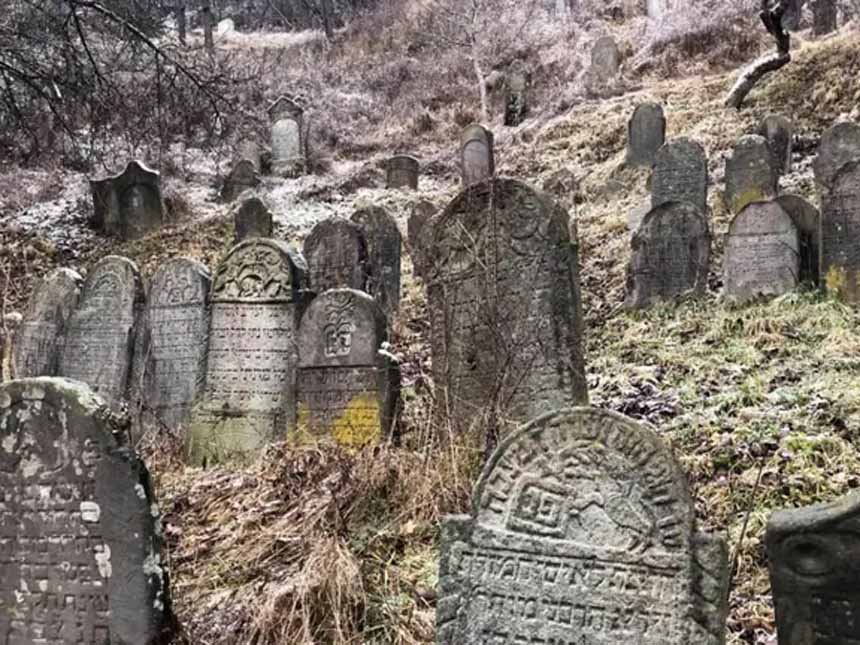
However, not a single Jewish community member has survived in most towns, and no one is there to tell this story and share these facts and events with the residents. High-school graduates have to be able to recognize the defense synagogue in Zhovkva as part of their external independent evaluation, but there is no Jewish community in this town anymore. The preservation of this defensive synagogue rests solely on the shoulders of enthusiastic teachers, educators, and scholars who try to preserve it. But they don't have the money it takes to restore such a huge and beautiful building.
Memory decays even where it still exists. Where there are material monuments, there are simply no funds. The Ukrainian and Polish communities know about it but are not interested in restoring this memory. There are simply no Jewish communities there, and thus memory decays. Even teachers are often unaware that their community has a Jewish history. Enthusiastic educators study local history, get their students involved, conduct interviews, etc., but those are isolated cases. Therefore, it is a crucial focus of our activities.
This program is created with the support of Ukrainian Jewish Encounter (UJE), a Canadian charitable non-profit organization.
Originally appeared in Ukrainian (Hromadske Radio podcast) here.
This transcript has been edited for length and clarity.
Translated from the Ukrainian by Vasyl Starko.
NOTE: UJE does not necessarily endorse opinions expressed in articles and other materials published on its website and social media pages. Such materials are posted to promote discussion related to Ukrainian-Jewish interactions and relations. The website and social media pages will be places of information that reflect varied viewpoints.