




"Israel will help Ukraine in the US, and Ukraine will help Israel in the EU"

Oleksii Honcharenko, a Ukrainian MP, visited Jerusalem after giving a speech in the European Parliament in support of Israel. The young politician shared his vision for the future of Ukraine-Israel relations.
Our dialogue took place following the Black Sea Security Forum, held in Odesa on Honcharenko's initiative on 29–31 May 2026. Israel was represented at the forum for the first time.
"Israel is easy to support in Ukraine and more difficult in Europe, where the atmosphere is different. But I hope that after EU integration, Ukraine will balance and improve Europe's attitude towards Israel," says Honcharenko.
Below is a verbatim statement by Oleksii Honcharenko.
"Ukraine and Israel are natural allies, because we are actually fighting against the same evil. We can be very useful. Israel can be a very strong lobbyist for Ukraine in the US, where the perception of Ukraine is worse today than before and worse than its perception in Europe. Meanwhile, Ukraine can be a very good lobbyist for Israel in Europe. We can be very mutually beneficial, helping each other on different continents. I think it is quite possible. And I don't just think that — I do it. We hope to see a reciprocal action from Israel.
Our Black Sea Security Forum was attended by American senators, MEPs, ministers, and Iranian Prince Reza Pahlavi. Rabbi Moshe Azman, a wonderful person, also gave a speech there. On my initiative, we invited Israeli speakers to the forum, and they were very well received. From Israel, lawyer Ariel Bulshtein, a strong thinker and a very intelligent person, spoke on one of the panels. I hope an entire Israeli delegation will come to the Odesa forum next year, especially given the city's importance in the history of Zionism and Israel.
When Iranian drones target Odesa and Iranian missiles target Israel, it is obvious to everyone that we are dealing with one axis of evil — Russia-Iran. I am absolutely convinced that Russia, to one degree or another, participated in or pushed Hamas to attack Israel on 7 October 2023, because Russia benefited the most from thе attack.
Thus, I believe that Ukraine and Israel have the same enemy and the same values. We are really two frontier countries. Ukraine is a frontier of such values as human rights, rule of law, and democracy in Eastern Europe, because they are not to be found either to the north or to the east of us — there are dictatorships there. Meanwhile, Israel is the only country in the Middle East that shares these values, and you are surrounded on all sides [by undemocratic countries — Sh.B.]. Therefore, this is our common strategic struggle, and we must support each other.
Regarding historical disputes [between Ukraine and Israel — Sh.B.], our entire Odesa forum is focused on the need to talk about the future rather than the past. Let's talk about the future, and let historians talk about the past. You can always find something bad in the past. So, I do not see any sense in all these disputes outside the history departments. But let's make sure these pages of history are not repeated. Let's build a better future together."
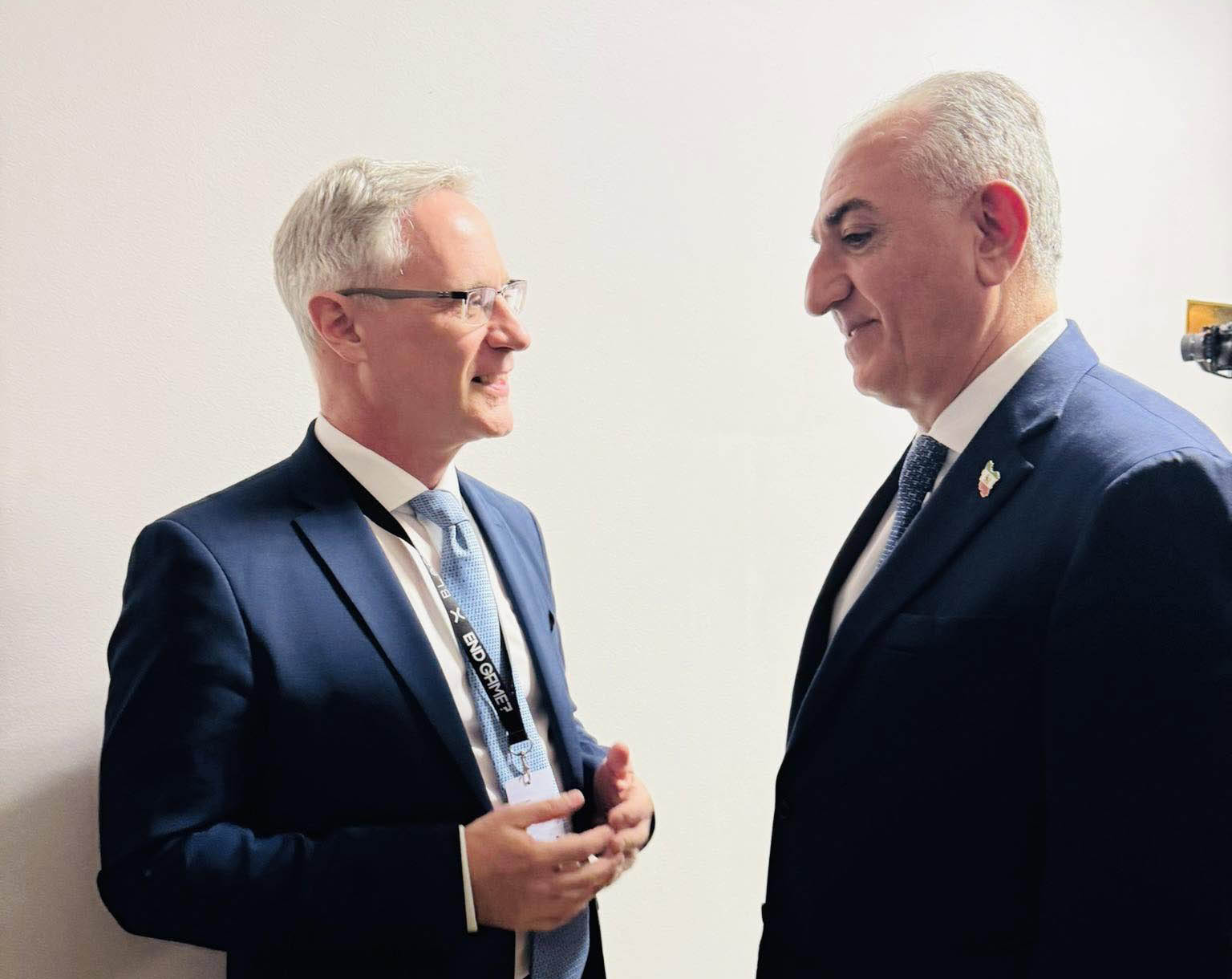
Israeli Ambassador to Ukraine Michael Brodsky took part in the Black Sea Security Forum for the first time. At the forum, he talked with the Iranian Crown Prince.
"I told Prince Pahlavi that we hope for regime change in Iran and that Israel will have normal relations with Iran. He fully supported this and said at the Odesa forum that three countries are fighting for freedom — Ukraine, Israel, and opposition Iran," Ambassador Brodsky noted in an interview with the UJE portal.
The Israeli diplomat said that air raid sirens sounded 20 times during the forum. Michael Brodsky visited a Jewish school in Odesa that had been badly damaged by a Russian missile attack.
Lawyer Ariel Bulshtein, a board member of the Jabotinsky Institute (Jabotinsky's life was linked to Odesa), attended the Black Sea Security Forum as the head of international relations of the Likud Party. He spoke on the panel titled "What does it mean to be a state?" alongside US Democratic Party politicians, Senator Richard Blumenthal and Congressman Jim Himes.
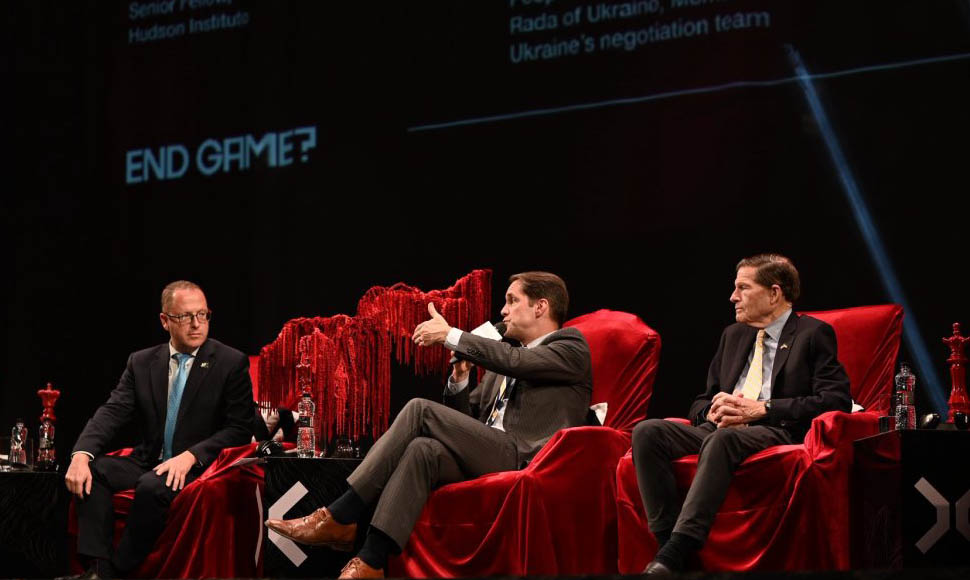
"Ukraine has ambitions to emerge from the war as an influential power in Eastern Europe, and Ukraine's military achievements give it hope for this. We discussed what it means to be a great power. I spoke about an important principle for understanding Israel: Steadfastness in defending national interests despite everything. The willingness to go against world trends and against the 'wishes' of even friends.
For example, in 1948, President Truman asked Ben-Gurion not to rush into declaring an independent Jewish state, because his generals and the State Department believed that the new country had no chance of withstanding an attack by Arab countries. But Ben-Gurion said, 'I'm going to do it anyway.'
There must be an understanding of the correctness of our path and the courage to say to our friends in the United States, 'No, we are doing this because it is in Israel's national interest and because it's the right thing to do.'
If the United States were to propose that Ukraine cede part of its territory 'for the sake of peace' today, then I, as an Israeli, would be the first to support Ukraine's answer 'No!' — because we do the same in Israel.
However, Ukraine can win the favor of the US administration without sacrificing its interests. It can do this not on its turf but on Israel's. On the turf that is important to Americans. Today, Ukraine can show such leadership by moving its embassy to Jerusalem, as the US did," Ariel Bulshtein said in an interview with UJE.
Text: Shimon Briman (Israel).
Photo: official page of the Black Sea Security Forum.
Translated from the Ukrainian by Vasyl Starko.