





Reznikov: "Ukraine and Israel must confront the axis of evil together"
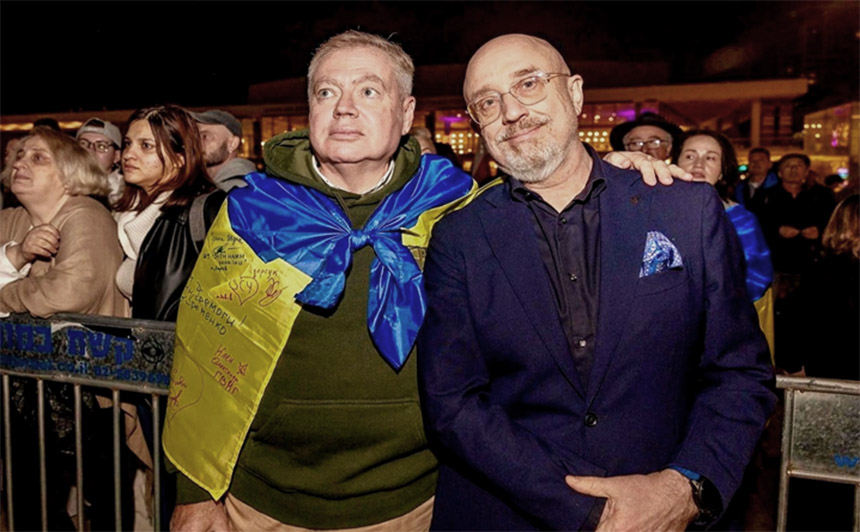
Former Ukrainian Defense Minister Oleksii Reznikov gave an exclusive interview to UJE, discussing the need for a close partnership between Ukraine, Israel, and the United States to confront the Russia-Iran axis of evil, sharing his experiences from the most difficult period of defending Ukraine against the Russian invasion, and outlining his place in history and plans for the future.
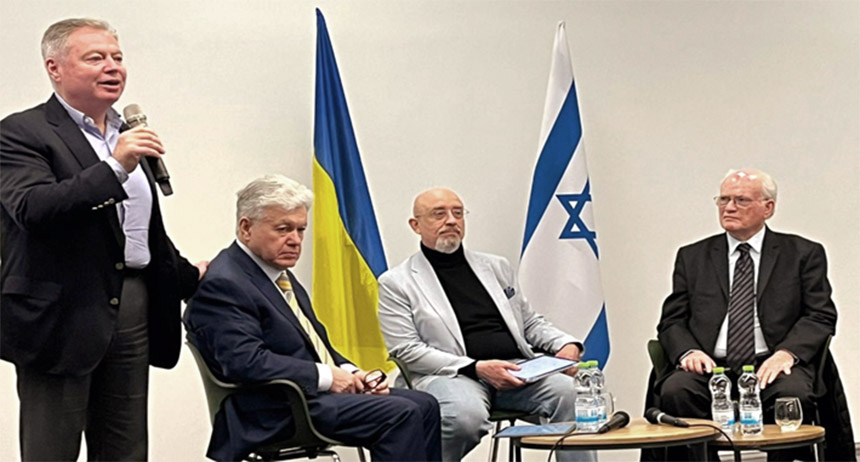
At the Strategic Israel-Ukraine Security Dialogue, a closed event held at ANU — Museum of the Jewish People in Tel Aviv, experts discussed new challenges to global security and deepening the strategic dialogue between Ukraine and Israel. The keynote speakers were Major General (ret.) Amos Gilead, Executive Director of the Institute for Policy and Strategy (Israel), and Oleksii Reznikov, who served as Ukraine's Minister of Defense in 2021–2023. The participants noted that military cooperation between the Russian Federation and Iran is creating additional risks for Europe and the Middle East, making coordination and experience exchange between Kyiv and Jerusalem increasingly relevant.
Reznikov experienced some "wartime adventures" in Israel: when he left for Ben Gurion Airport on the morning of 28 February, the first air raid sirens went off, and the airspace was closed due to the war with Iran. Having spent two days under missile attacks from Iran, he tried to reach Jordan, but the airspace there was also closed. Reznikov then traveled south through the Negev Desert, made arrangements with Bedouin camel drivers, crossed the border into Egypt in Sinai on foot, and returned by plane to Europe.
What Oleksii Reznikov said during the discussion in Tel Aviv about Iran posing a threat to both Ukraine and Israel suddenly burst into his life and the lives of millions of Israelis. Below is a summary of our dialogue, which covered a wide range of issues.
Shimon Briman: You spoke during a discussion about the potential for Ukraine-Israel cooperation in light of confrontation with Iran. What prospects do you see for our countries?
Oleksii Reznikov: In November 2021, I was appointed minister and immediately arrived in Israel to meet Defense Minister Benjamin Gantz. I visited the leaders of the Israeli military-industrial complex, saw interesting products from Elbit, Rafael, Aviation Industries, and another small-arms company. I understood that all of this was real, but it required permission from the Israeli government. We said there was no need for gifts — we were ready to buy. However, Ukraine did not get the green light then due to what I believe was a false cognitive belief that Israel was better off not quarreling with Russia and that this would cross "red lines." This paradigm of "not provoking the Russians" dominated at the time.
Events have changed a great deal over the past four years. Ukraine has come a long way in developing its defense capability. Again, the cognitive bias that Kyiv would fall in three days did not materialize, and we have been fighting back against this aggression for the fifth year.
After 7 October 2023, it became very obvious in Israel that we had common enemies. Today, Israel perceives the threat from Iran not as a theoretical but as a practical one. Iranian drones and Iranian missiles are flying here. Meanwhile, the Russians are launching these same Iranian drones against Ukraine. The Russians are transferring military technology and their war experience to Iran and other enemies of Israel — terrorist organizations. The axis of evil is obvious. The Iran-Russia alliance of evil is obvious.
So, I believe Ukraine and Israel should clearly help each other to resist this evil. This is a matter of survival for our countries and peoples. There is simply no other formula. The experience Ukraine's defense and security forces have accumulated by now is very useful for Israel.
Shimon Briman: What form could this take in practice? Joint production or Israel selling some types of weapons and technology to Ukraine?
Oleksii Reznikov: We should start by exchanging information between special and intelligence services and by exchanging technology, and then follow the scheme: "you have technical solutions here, while we have technical solutions there." Today, Ukraine is a military testing ground no less than Israel is. And Russia uses all types of weapons against Ukraine, except nuclear ones. So, it seems in both Ukraine's and Israel's common interests to join forces and maximize each country's defense capabilities
We need to start with information exchange and follow it up with mutual training — we can teach you this, and you can teach us something else. Next come technological solutions. Ukraine is already ahead in some military-technological solutions, while Israel is more advanced in some others. It is about creating joint R&D laboratories and joint production.
We can buy from Israel what we don't have, or Israel can sell it to our partners, and we will use it. But Israel can also buy some things from Ukraine if it wants to. Our first task is to protect peaceful cities and to close the sky. The main thing is that there must be a political will and a decision by the leadership of the State of Israel to engage in this kind of interaction with Ukraine. Private business will work it all out. The military structures and intelligence services of the two countries can cooperate if there is a political decision. They will reach agreements by working between themselves.
Shimon Briman: Were there any examples of such interaction between Israel and Ukraine when you were the Minister of Defense? For example, contacts between Israeli military structures, military industry, or intelligence services and Ukrainian partners? Or were they just some nice words?
Oleksii Reznikov: Those were words, after all. The contacts were very modest. But this does not mean that there was a stone wall between us. There were attempts at interaction, but at a very modest level.
Shimon Briman: I sometimes see hints in the media that, as they say, "when the war is over, we will be able to tell the truth about how Israel actually partnered with Ukraine militarily." Or fairytale stories about Israel "secretly installing the Iron Dome around Uman during a pilgrimage and then removing it."
Oleksii Reznikov: It sounds more like: "When the war is over, we'll figure out what to tell you" (laughs).
Shimon Briman: I have a question about your experience negotiating with the American military and politicians before and early in the war. What were the dynamics from the initial American attempts to give Ukraine almost nothing to the promotion of full military financing and sending heavy weapons?
Oleksii Reznikov: At the beginning, there was a static situation based on American reasoning: "Kyiv will fall in three days anyway." So, what's the point of investing in a neighbor who has been diagnosed by a doctor as having a terminal disease? So, on my first visit to Washington in November 2021, I voiced the request, "Give us at least some Stingers!" The answer was, literally, "It's impossible, but we advise you to dig trenches." However, in January 2022, we brought the first Stinger MANPADs from our Lithuanian partners, who had received U.S. permission to hand them over.
When Kyiv did not fall in three days, since Kyiv was not going to fall at all, it was a great surprise not only for Russians but also for our Western partners. They later told us that we had inspired them. Then serious progress began.
I clearly remember the meeting in Warsaw in March 2022, when Kyiv was still half-surrounded by the orcs. My colleague, Foreign Minister Dmytro Kuleba, and I met with Mr. [Anthony] Blinken and Mr. [Lloyd] Austin. President Biden joined us at the end of the meeting and talked to us for almost an hour. This was the turning point, after which the attitude changed dramatically. In April 2022, the first meeting was held at Ramstein Air Base, organized by us with the Americans taking the lead. What became known as the Ramstein Club was a unifying platform where we actively advocated for Ukraine's interests. And the Americans helped us there. As a result, we received so many types of weapons that no one had ever dreamed we could obtain.
Shimon Briman: So, as soon as the Americans saw your ability and willingness to resist and defend yourselves, they opened the "supply tap"?
Oleksii Reznikov: Yes, as soon as they saw that we would still fight ourselves, with what we had, and that we were not going to surrender, the opinion about us changed. The myth about the Russians as the "second or third strongest army in the world" was debunked, immediately improving the situation. But still, regarding any type of weapon, we had to give explanations to America and argue that it was not another red line.
Fortunately, today we have three types of weapons: the old Soviet weapon system, the modern NATO-standard weapon system, new electronic warfare technologies, and a wide range of robotic drone systems on land, at sea, and in the air.
Shimon Briman: What are the prospects for Ukraine producing its own missiles on its territory
Oleksii Reznikov: I think cruise missiles are a very promising thing. A cruise missile can fly at low altitudes and go wherever you say. There is a place for them, and there are prospects for their production. Believe me, these are not only Flamingo missiles.
Who would have thought that on 13 April 2022, two Ukrainian Neptune cruise missiles would sink the flagship of the Russian fleet with the ridiculous name Moscow in the Black Sea? This cruiser was created as a "hunter for American aircraft carriers"; it was a serious force. But two Ukrainian Neptune missiles sent it to the bottom, turning it into a future marine underwater museum-aquapark.
I am a diving enthusiast, and if you are also interested, I invite you to join me in underwater diving to visit Moscow after the end of this war. The depth there is up to 40 meters, so it is quite possible.
Shimon Briman: Thank you for the invitation to visit the Moscow underwater aquapark — it sounds very exciting. Speaking about Moscow, do you believe that the current negotiations with the Russian side can lead to the end of the war?
Oleksii Reznikov: All wars end with negotiations, so if we are talking about a theoretical formula now, then yes, negotiations can end the war, but it's a question of how ready all parties are to negotiate in good faith.
Shimon Briman: Is there pressure from the Americans, or does it all depend on the readiness of the Russian side?
Oleksii Reznikov: Trump demands and is interested in peace coming as soon as possible for his own domestic reasons. The Americans made their position very clear through their president, Mr. Trump, back in February 2025, at the famous Oval Office meeting between President Zelensky and President Trump. The meeting was very emotional. I have carefully reviewed it many times. I have been involved in negotiations my entire professional life as a lawyer and negotiator. There were very important signals there. The most important message from President Trump was "I am not a party to the conflict; I am a mediator; I am a broker." Although a lot depends on the mediator, it is still up to the parties who sit down at the negotiating table. So, everything here depends, of course, on Russia's position. Either they are sincerely ready for negotiations and the end of this war, or they are playing games and fooling others, including Washington.
Shimon Briman: There is a current trend of prominent military figures coming to power in Ukraine. For example, General Kyrylo Budanov has been moved from the Main Directorate of Intelligence to the Office of the President. Will this trend pick up after the war, as generals and officers return from the front and begin to aspire to positions of political power?
Oleksii Reznikov: Let me try to correct your statement. In my opinion, Budanov's example is unique; it is the opposite of a trend. Another example is General [Valerii] Zaluzhnyi becoming Ukraine's ambassador to the UK.
Since the invasion, Ukraine's Armed Forces and special services have grown from 261,000 to over 1 million service personnel. This means that civilians put on uniforms and went to defend the country. The war will end, and former civilians will leave the military and return to civilian life. It is reasonable to assume that they will want to become involved in public life. Someone will run for mayor or for a seat on a city council, a village council, or parliament. They will be active, experienced, and most importantly, respected in society. They will be veterans with combat experience.
Then, I have a counterquestion: are they former military people or former civilians who served in the military for a while? We have a democratic country in which former civilians became military personnel and will later become civilians again. The same thing as in Israel. So, I say: yes, of course, former servicepeople will go into politics, because they were civilians before that.
Shimon Briman: And how did you, as a civilian, become the Minister of Defense? How did you decide to pursue this office?
Oleksii Reznikov: I did not intend to or ask for this position. I was a negotiator and at the same time the Deputy Prime Minister. I was the deputy head of the Ukrainian delegation in the Minsk Process when we negotiated with the Russians. We sat at the negotiating table for two years and tried to peacefully resolve this story.
In August 2021, when we still hoped that there would be no invasion, President Zelensky offered me the position of Minister of Defense. I was, to put it mildly, very surprised. I said, "Volodymyr Oleksandrovych, I am a civilian. My army experience is just two years of conscription service, a long time ago. Yes, I have made 163 parachute jumps and 350 scuba dives. Yes, I can shoot a little, but I'm no commando. I'm a modest lawyer wearing glasses and a suit." The president persuaded me for a month and a half. He argued that, according to the law, we had civil democratic control — in line with NATO standards. And we needed reforms and interaction. So, I didn't have to be a military man.
We discussed the reforms we wanted to implement. I understood that I was getting the "Augean stables," accumulated over 30 years of chaos and the entire Soviet legacy. I was aware that I was joining an organization that was the largest employer in the country. But it never even occurred to me that there might be an open part of war. In contrast, my wife had misgivings and cried when she found out that I had agreed to accept the president's offer and become the Minister of Defense.
Naturally, I could not say no to the president. As a result, on 4 November 2021, the parliament voted in favor of my candidacy. This was three months before the invasion. But it still did not occur to me back then that I would have to engage in war and meet war.
Shimon Briman: I find it difficult to imagine the gigantic burden of responsibility that fell on your shoulders in 2021–2023. Did you feel any additional responsibility?
Oleksii Reznikov: Yes, I was given incredible responsibility. Therefore, I was looking for an opportunity to be as effective as possible where I had experience. This included interaction, communication, and negotiations. Back in November 2021, I met General Zaluzhnyi, the then Commander-in-Chief, and said, "Valerii Fedorovych, I am definitely not going to teach you how to fight, because you know how to do it. You have studied and prepared for this all your life. But I know from my legal experience how to interact and defend. So, I suggest that we interact and cooperate." We shook hands and toured all the main units and key headquarters. I met all the commanders. And my task was to help them.
Shimon Briman: So, at the first and most difficult stage of the war, you managed to establish partnership relations with the Commander-in-Chief. Did you have normal contact with him?
Oleksii Reznikov: I established a connection with the Commander-in-Chief before the invasion, during those three months. And this helped us face the war together. In contrast, I established contact with the defense ministers of our partner countries essentially "on the fly," living in a state of jet lag 24 hours a day.
Shimon Briman: Is Ukraine and NATO a case of "unrequited love"?
Oleksii Reznikov: Look, I understood that, as far as achieving one of our most ambitious goals was concerned, Ukraine could not quickly become a NATO member de jure. That's why I came up with a formula that we had to become a de facto NATO country. In terms of armaments, training, interaction, and respect for our country, I believe that Ukraine has become a de facto member of NATO. Moreover, in some areas, I think Ukraine is stronger and more experienced than many NATO countries.
Shimon Briman: What legacy will you leave behind — serving as the Minister of Defense during the most difficult period of the war? Or are you still hoping for even greater accomplishments and raising the bar in your career?
Oleksii Reznikov: You know, in December 2004, at the peak of the Orange Revolution, I defended, as a lawyer, the pro-European presidential candidate Viktor Yushchenko in the Supreme Court against election fraud committed in favor of the Kremlin-backed candidate Viktor Yanukovych.
Shimon Briman: Incidentally, I was in Kyiv at the time and saw those court sessions on TV.
Oleksii Reznikov: Then you could have seen me there; only I was not bald yet — I still had some hair. On 3 December 2004, the Supreme Court issued a landmark decision annulling the results of the second round and ordering a rerun. We won that court case.
Then, standing on the Maidan, when millions of people applauded my colleagues and me, I said to my partners at the law firm: "This must have been my historical mission. I probably won't experience anything cooler in this life." That's what it looked like to me in 2004. But God has a special sense of humor. He gave me new challenges. So, I believe that some new adventures still lie ahead for me. It may be related to Israel.
Shimon Briman: Could you be coming to us as Ukraine's new ambassador?
Oleksii Reznikov: Sending ambassadors to other countries is the prerogative of the president. In any case, I think it would definitely be easy for me to interact in Israel. Most importantly, it seems to me today that more and more people in Israel understand who their enemies are and who their true friends are. Ukraine and Israel are friends. We have common enemies, and we need to survive in this world together.
Shimon Briman: How do you see the future of our countries?
Oleksii Reznikov: I have been an optimist all my life. This allows me to survive. So, I optimistically claim that we will win this war. Ukraine will win its war, and Israel will win its war. In fact, this will be a joint victory of democracy over autocracy. I promise you that in our lifetimes we will see the collapse of the empire and the entire "axis of evil." That is the optimistic scenario I see.
Interview text: Shimon Briman (Israel).
Photo: Official FB page of the Embassy of Ukraine in Israel.