




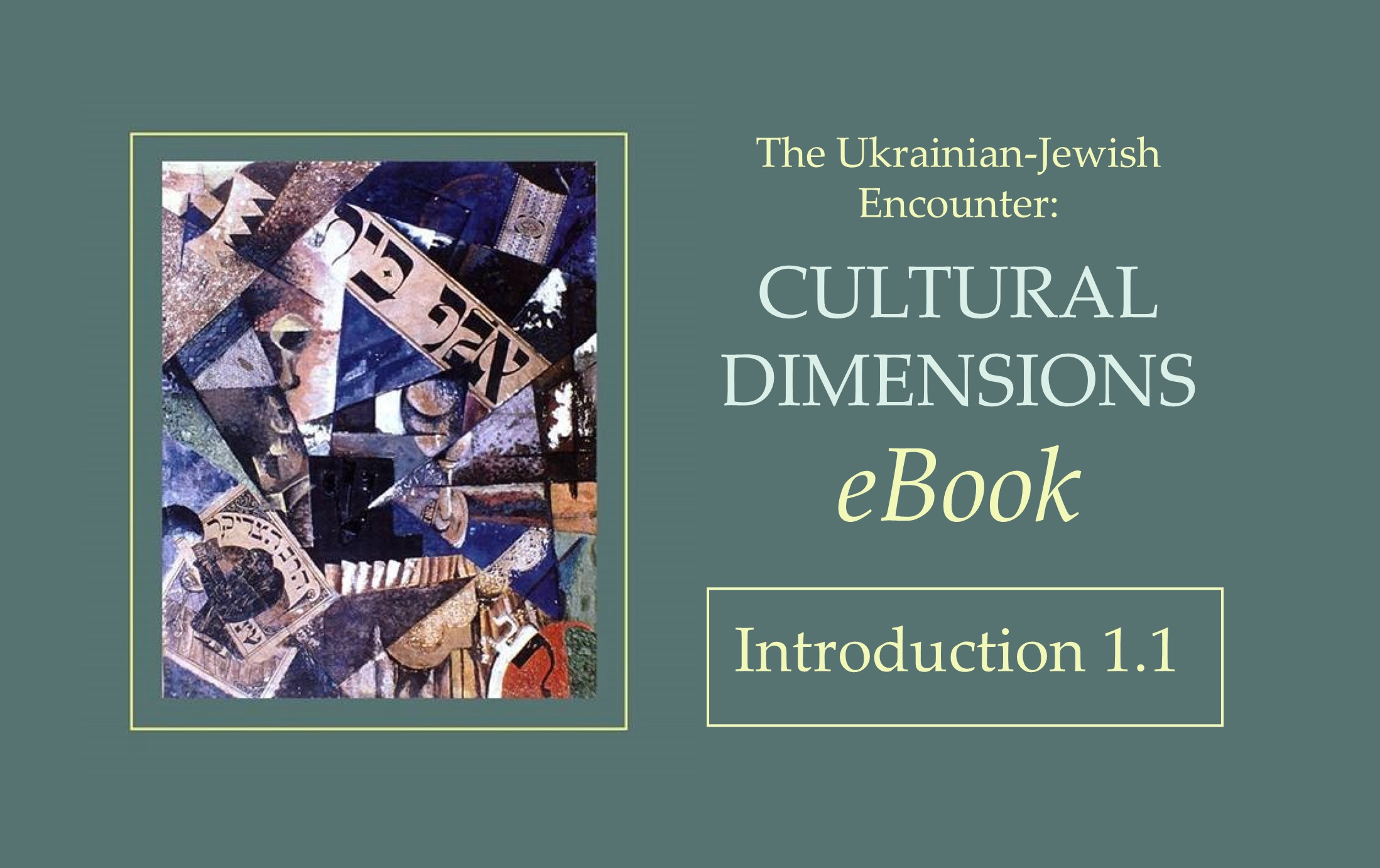
"The Ukrainian-Jewish Encounter: Cultural Dimensions": 1.1
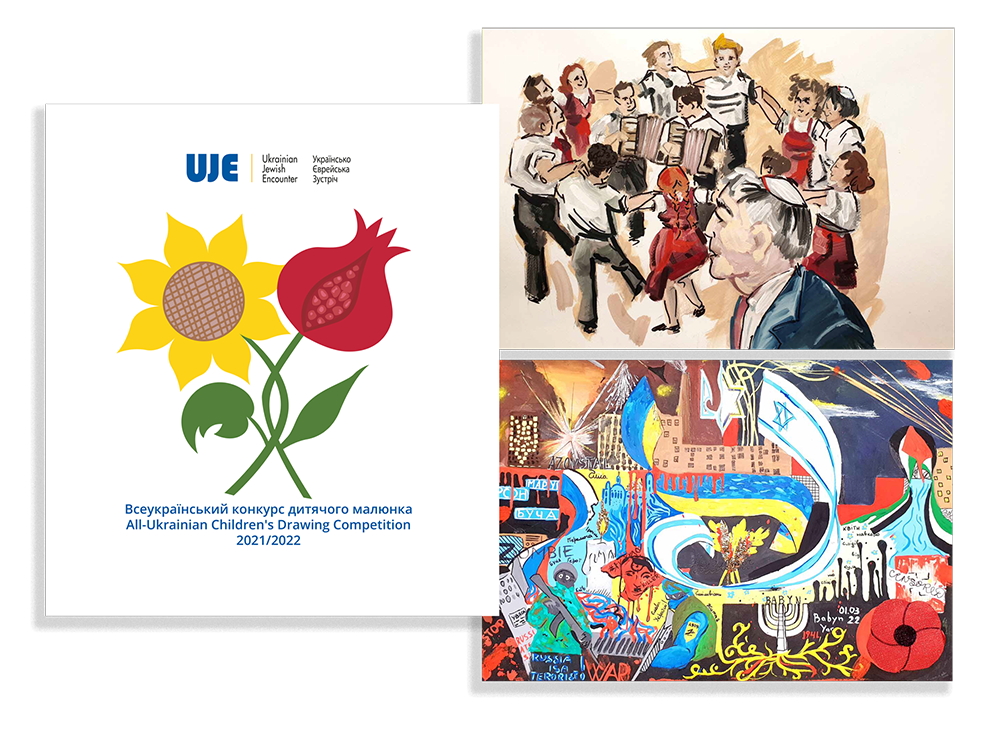
The Ukrainian Jewish Encounter was founded in 2008 with the goal of building stronger relations between Ukrainians and Jews, two peoples who, for centuries, lived side by side on the territory of what is modern-day Ukraine. Since then, in keeping with its motto, "Our stories are incomplete without each other," UJE has sponsored conferences, round-table discussions and research, as well as translations and publication of works the organization anticipates will promote a deeper understanding between the two peoples and an appreciation of their respective cultures.
We offer for the first time the book The Ukrainian-Jewish Encounter: Cultural Dimensions in an eBook format.
The book is a collection of essays that examine the interaction between the Ukrainian and Jewish cultures from the seventeenth century onwards. Written by leading experts from Ukraine, Israel, and other countries, the book presents a broad perspective on parallels and cross-cultural influences in various domains — including the visual arts, folklore, music, literature, and language. Several essays also focus on mutual representation — for example, perceptions of the "Other" as expressed in literary works or art history.
The richly illustrated volume contains a wealth of new information on these little-explored topics. The book appears as volume 25 in the series Jews and Slavs, published by the Hebrew University of Jerusalem since 1993. In several previous volumes, considerable attention is given to the defining role of the Old Testament in Ukrainian literature and art and to the depiction of Jewish life in Ukraine in the works of Nikolai Gogol, Taras Shevchenko, Ivan Franko, Lesia Ukrainka, Vladimir Korolenko, and other writers.
This collection of essays was co-edited by Wolf Moskovich, Professor Emeritus, Hebrew University of Jerusalem, and Alti Rodal, Co-Director of the Ukrainian Jewish Encounter, who also wrote the introduction to the volume. It was published in 2016 by Hebrew University of Jerusalem.
Click here for a pdf of the entire book.
Introduction 1.1
Alti Rodal (Co-Director, Ukrainian-Jewish Encounter
 There are a number of challenges, however, in fashioning an account of Ukrainian-Jewish cultural interaction that avoids generalizations and the distortion of historical realities. Firstly, one has to take into account the considerable diversity in cultural interaction in the different regions that constitute the territory of contemporary Ukraine. Both Jews and ethnic Ukrainians, as stateless peoples, each in their way, were at different times subjects of several empires, regimes, and dominant cultures — each of which had far-reaching impact on their lives, including their internal cultural experience and their interaction with others. Prior to the First World War, the experience of Jews living in Tsarist Russia's Pale of Settlement contrasted starkly with that of Jews living in the Habsburg-ruled Austro-Hungarian provinces of Galicia and Bukovina and the region of Carpathian Rus' — as elaborated in Paul Robert Magocsi's context-setting essay for this volume. During the interwar years, the Jews on the territory of present-day Ukraine found themselves residing in four countries — in Polish-ruled Galicia, Romanian-ruled Bukovina, the Soviet Union, and democratic Czechoslovakia. This fluid and diverse historical experience encompasses a range of cultural interaction that cannot be understood without an appreciation of the broader political and social contexts in which these two peoples lived. Key considerations in this regard are the degree to which Jews and Ukrainians identified with, or resisted being assimilated into, the various dominant cultures; and the extent to which they borrowed cultural features not only from each other but also from other groups inhabiting these multiethnic regions — in particular Poles, Russians, Romanians, Hungarians, ethnic Germans, Tatars, Armenians, and the Roma.
Another set of challenges relate to terminology and concepts, including, as noted by Magocsi, the very terms "Ukrainians" and "Ukrainian Jews." As he suggests, for the purpose of examining aspects of cultural interaction, it may be helpful to use the term "ethnic Ukrainians" to refer to those who identify as belonging to a Ukrainian "nationality" in the sense of an ethno-cultural collectivity (as distinct from citizens of the Ukrainian state), and to consider as "Ukrainian Jews" those Jews who had resided at some point in history on territories that comprise present-day Ukraine.
To enable a proper appreciation of the range of cultural interaction, it is also important to take into account the wide diversity within each of the two communities. Neither is homogeneous. Within each, there are marked differences in cultural expression, for example between those residing in large urban centres and the inhabitants of small towns and villages, and between those who are secular and those who are religiously traditional. Differences in socioeconomic status and education, and, as noted above, the degree of acculturation to dominant cultures are also critical factors influencing cultural expression and interaction with others.
A further challenge is that the term "culture" is in itself a generalized "umbrella" term embracing many different domains, such as art, music, folklore, language, literature, theatre, and cinema — to name only those emphasized in this volume. As each domain requires expert knowledge and interpretation, an examination of cultural interaction calls for a range of expertise and a multidisciplinary approach.
There are also challenges, and research opportunities, in that we are exploring relatively new terrain. To date there has been very little focused research on Ukrainian-Jewish cultural interaction, even though there are strong indications of mutual borrowing in a number of specific cultural domains, as demonstrated by the significant impact of the Ukrainian language on Yiddish, or the similarities in traditional music.
The pioneering conference entitled "The Ukrainian-Jewish Encounter: Cultural Interaction, Representation, and Memory," mounted by the Ukrainian Jewish Encounter initiative[1] in association with the Israel Museum and the Hebrew University in Jerusalem in October 2010, provided a forum for scholars from Israel, Ukraine, North America, and elsewhere, with expertise in a range of disciplines, to focus on aspects of Ukrainian-Jewish cultural interaction. The essays in this volume — largely based on the presentations given at the Jerusalem conference — treat a wide range of topics that may be grouped around the following three questions:
- In what ways did the Ukrainian and Jewish cultures, which existed in all their diversity side by side over centuries, influence each other? More specifically, what evidence is there of parallels or cross-cultural influences in particular cultural domains — for example in folklore, folk art, architecture, music, and language?
- What were the prevailing perceptions or images of the "Other" as depicted in the respective cultures — specifically in artistic representation, folklore, and literature?
- What approaches have been adopted by Jews and by non-Jews, both in the past and in recent years, to the study, preservation, remembrance, and revival of (or reconnection with) the Ukrainian-Jewish cultural heritage?
Cross-cultural Interaction
Responding to the first question above, many of the authors in this volume describe specific instances of cross-cultural influences, for example, Lyudmila Sholokhova on the influence of Ukrainian folk songs on Hasidic music; Wolf Moskovich on mutual borrowing between the Ukrainian and Yiddish languages, whether directly or through a third language; Boris Khaimovich on the presence of elements of Ukrainian folk art in synagogue wall paintings; and Thomas Hubka on the exterior architecture of eighteenth-century wooden synagogues as predominantly a product of the eastern European Polish/Ukrainian context.
Also worth mentioning in this regard is a paper presented at the Jerusalem conference by lryna Serheyeva (Vernadsky National Library, Kyiv). This paper (not included in this volume) describes the influence of Ukrainian folk art traditions on Jewish ornamental folk art, as illustrated in pinkasim (Jewish community record books) from various regions in Ukraine and dating from the late eighteenth to the first quarter of the twentieth centuries. The decorations on these pinkasim reflect elements reminiscent of medieval Hebrew manuscripts and the art of European Jewish printing, combined with the traditions of illumination of Ukrainian manuscripts and folk motifs characteristic of Ukrainian folk ornament and decorative art. This example of Ukrainian influence on Jewish cultural expression is particularly noteworthy, given the important place of the pinkasim in Jewish community life.
As might be expected, cross-cultural influences usually flowed from the majority Ukrainian culture to the minority Jewish culture, though there are many instances of reciprocal influences, as well as influences channelled to both peoples through a third culture — generally a politically dominant culture, such as the Polish, Russian, or Austrian. An example of the latter includes the parallel adoption within both Jewish and Ukrainian Christian art of the imperial double-headed eagle as an art motif to depict divine providence, as described by Ilia Rodov. Another shared response to the imperial context was the assertion of the respective national identities and aspirations of these two stateless peoples, expressed in the parallel cultural development of Ukrainian and Jewish "national styles" in art in the first decades of the twentieth century, as described by Vita Susak.
Such parallel developments often reflected actual interaction among artists of Jewish and Ukrainian background — especially evident in the modernist visual arts, such as the extraordinarily vibrant avant-garde scene in Kyiv in the 1910s and 1920s. Dmytro Horbachov in his essay describes the circle of young Kultur-Lige artists of Jewish background[2] who trained with prominent teachers of cubo-futurist modernism and abstractionism, and who, together with young artists of ethnic Ukrainian background, explored innovative ways of blending traditional folk motifs and local scenes with avant-garde ideas. Similarly, interaction among artisans at times took the form of working together on projects, such as wood carved items or wall paintings in churches and synagogues, as mentioned in Vita Susak's essay. In his essay on the construction of the Israelite Hospital in Lemberg/Lwów/Lviv, Sergey Kravtsov describes a direct interaction across ethnic boundaries within the "international" team that jointly carried out this landmark architectural project.
Other trends in cross-cultural influences indicate borrowing by both Ukrainians and Jews from common sources — such as from Roma music, from Russian or Polish folklore and literature, or from common biblical sources — as exemplified in the use of Jewish mythology in the cinematography of Oleksandr Dovzhenko (described in Serhii Trymbach's essay). These various facets of interaction underline the complex multicultural political contexts, as well as the shared ancient traditions that shaped both Jewish and ethnic Ukrainian cultural expression.
Two papers presented at the Jerusalem conference — one by Larisa Fialkova (University of Haifa), the other by David Assaf (Tel Aviv University) — are not included in this volume because of commitments to publish elsewhere. They should be mentioned in this introduction, however, because they illuminate significant aspects of cultural interaction in the realms of folklore and religious life on the territory of Ukraine.
Fialkova's paper examined how the legendary Ukrainian Robin Hood figure, Oleksa Dovbush, who is said to have roamed the Carpathian Mountains in the eighteenth century, is depicted in both Ukrainian and Jewish folklore and literature. Interestingly, the Jewish sources — in which Dovbush is said to have encountered the Ba'al Shem Tov, the legendary founder of the Hasidic movement ‒ are influenced by the Ukrainian sources, but introduce modifications and changes in emphasis. For example: the "noble robber" plunders the rich of all backgrounds, including wealthy Jews, but not poor Jews; there is mutual recognition by the two legendary heroes of each other's powers — the Ba'al Shem Tov acknowledging the prowess of the Ukrainian folk hero and Dovbush perceiving the holy Jew's spiritual force; and there are miraculous interventions and encounters in which the robber's worldview is changed, causing him to repent in the presence of the Jewish holy man. These legends are picked up, and modified once more, in post-World War II Jewish literature, including Israeli ballad poems and fiction and Yiddish poetry, generally produced by Jewish writers originating from towns in Galicia or other locations in Ukraine, in what Fialkova refers to as a "cross-cultural migration of plots and images" and "two sides of a single phenomenon in neighbouring cultures."[3]
Assaf's presentation on Hasidism in the Pale of Settlement refers to Ukraine as "the cradle of Hasidism…where its historic image was shaped." Assaf also notes, however, that the attempt to portray Hasidism — a Jewish revivalist movement that originated in Podolia and Volhynia in the mid-eighteenth century — within the framework of a political geographic entity is methodologically problematic, as this religious movement was not circumscribed by political boundaries. Other scholars have observed that while Hasidism drew its inspiration essentially from earlier Jewish sources (in particular the Kabbalah or Jewish esoteric mystical religious tradition), it also incorporated features prevalent in the surrounding cultures. For example, the traditions of faith healers and natural medicine, common in Ukrainian culture, have a direct parallel in Hasidism; and as the movement grew, other cross-cultural influences were manifest, such as the adaptation of Ukrainian folk melodies as Hasidic nigunim ("melodies"), described in Lyudmila Sholokhova's presentation in this volume. From a cultural perspective, it is noteworthy that Hasidism originated in and flourished on Ukrainian lands. Hasidic writings were published in dozens of Hebrew and Yiddish printing presses that functioned in towns in Ukraine beginning in the latter half of the nineteenth century, and major Hasidic dynasties and centers were established in over forty towns, as well as in over a hundred lesser centers across Ukraine.[4] As a result, this segment of the Jewish population figured prominently in daily Ukrainian-Jewish encounters, highlighting a strong sense of difference based on religious lifestyle, but also a degree of familiarity and a shared sense of attachment to faith and tradition. The Hasidic movement continued to flourish on Ukrainian territory that came under Soviet rule until the repression of religion in the late 1920s, and up to the beginning of World War II in Galicia, Bukovina, and Transcarpathia.
The Depiction of the "Other" in Cultural Output
Another set of essays addresses the question of the representation of the "Other" in cultural expression. Overall, the findings on how Jews are depicted in Ukrainian art, folklore, and literature indicate the prevalence of negative stereotypes, but also empathetic depictions — not very different from how Jews have been portrayed in the culture of most other European peoples.
In an earlier issue of Jews and Slavs,[5] John-Paul Himka examined the depiction of Jews in medieval and early modern Ukrainian iconography and found that a positive portrayal of the Jews is prevalent in the form of Old Testament figures, the Hebrew prophets in particular, and that Jewish elements are acknowledged in the appearance of Jesus and Mary, though not of the apostles. He also observed, however, that core themes in anti-Jewish polemics, such as Jews as Christ-killers and as enemies of Christianity, are also included in the iconographic imagery. On the other hand, he noted that Ukrainian icons have not incorporated many other anti-Jewish themes found in western European Christian art, such as the association of Jews with the Antichrist, or the blood libel. A future-oriented link in the sphere of religion may be made between Himka's essay and the concluding essay in this volume by Myroslav Marynovych on the potential of the Jewish-Christian dialogue since the 1960s — in particular, the new emphasis on the brotherly roots of the two religions since the Nostra Aetate document of the Second Vatican Council in 1965 — to contribute to the improvement of contemporary Ukrainian-Jewish relations.
Myroslav Shkandrij's findings are that the representation of Jews in Ukrainian literature of the last two centuries has included antisemitic stereotypes, but also empathetic depictions of Jews. He describes how several Ukrainian authors have gone further to challenge and transform prevailing stereotypes. Noteworthy also in the literary domain are instances of cooperation between Ukrainian and Jewish writers in Soviet Ukraine during the 1920s; prewar and postwar writers of Jewish background who have identified as Ukrainian; and the treatment of Holocaust-related themes in Ukrainian literature since independence.
In her focus on the literary depictions of Jews, Amelia Glaser examines the literary influence that the Ukrainian-born Russian writer Nikolai Gogol had on one of his readers, the celebrated Ukrainian-born Yiddish humourist Solomon Naumovich Rabinovich (Sholem Aleichem). While noting the commonalities in the use of humour and the adoption of the "tears through laughter" stance in the face of fateful situations, Glaser describes how the two authors inevitably depict Jews very differently, with Rabinovich creating characters that are at times a foil to Gogol's antisemitic caricatures. In addition to differing perspectives, Gogol and Sholem Aleichem reflect the realities of two different periods — the beginning of the nineteenth century and the early twentieth century — the latter marked by major socioeconomic upheavals and pogroms against Jews in the Russian Empire.
Yaroslav Hrytsak (Ukrainian Catholic University, Lviv) presented a paper at the conference on the depiction of Jews in Ukrainian folklore. [Regretfully, this paper is not included in the present volume because a completed version was not available in time for publication.] Drawing on Ivan Franko's rich collection of Galician Ruthenian folk proverbs, Hrytsak found many Judeophobic stereotypes, including the depiction of Jews as cowards, inept, impure, exploiters and tormentors of Christians, alien because of their religion, dishonest, inherently corrupt, and undeserving of sympathy. Hrytsak observed that the high concentration of Jews in Galicia, the widespread poverty among both Jews and Christian peasants in the region, and the challenges of modernization and nation building gave rise to anti-Jewish (as well as anti-Polish) sentiments, which were reflected in the local folklore. Hrytsak noted, however, that there were also proverbs that presented Jews in a positive manner, such as the superstition that seeing a Jew was a good luck omen, or admiration for the Jews' perseverance and righteous obedience to Jewish law. Also noteworthy, in Hrytsak's view, is the fact that despite the negative stereotypes in the folklore, there were relatively few anti-Jewish pogroms in Galicia in the last decades of the Habsburg Empire and in the immediate aftermath of its collapse — in sharp contrast to the large number of pogroms in neighbouring territories during this same period.
In order to include discussion of how ethnic Ukrainians are depicted in Jewish literature, summary highlights were provided at the Jerusalem conference of Israel Bartal's 1988 pioneering article ("On Top of a Volcano")[6], as well as other writings on this topic. Bartal's overall finding, based on his examination of eastern European Jewish literature written in Yiddish, Hebrew, as well as other languages, is that non-Jews are depicted "according to a system of ethnic stereotypes, and are incorporated into a set of standard models of the encounter between Jews and gentiles."[7] More specifically, the depiction of non-Jews in Jewish literature reveals a range of attitudes, including a lack of differentiation between members of one non-Jewish ethnic group and another (all referred to simply as goyim) and viewing non-dominant nationalities (such as Ukrainians) as part of the landscape or as part of the background to the social and economic activities of the shtetl [small town with a significant Jewish population]. Non-Jews also tend to be depicted in a fixed cast of settings (such as the marketplace) and as stock characters (such as the devoted maid who spoke Yiddish, the trustworthy village sorceress knowledgeable in folk medicine, and the shabbes-goy whose role was to light the oven on the Sabbath). Attitudes reflected in the literature range from an ideologically based admiration for peasants seen as productive and relating positively with nature and the land, to condescension and fear of the illiterate peasant prone to drunkenness and violence or the antisemitic government official. Also reflected in Jewish literature is the traditional recoiling from intimate relations (especially romantic ones) between Jews and non-Jews — in this case, Poles, Russians, and Ukrainians.
Two essays treat the topic of mutual representation of Jews and Ukrainians during and after World War II. Ola Hnatiuk's finding, based on an examination of the memoirs of contemporary Lviv citizens, is that their accounts of interethnic relations in the year 1939 — specifically between Ukrainians, Poles, and Jews — are shaped by the cultural identity of the authors and embedded stereotypes of the "Other." Ilana Rosen focuses on how former Carpatho-Rusyn Jews living in Israel remember prewar Ukrainian-Jewish relations, and notes the prevalence of perceptions of the non-Jewish neighbours as rural, traditional, and religious, and in some instances as exceptionally devoted and familiar with Jewish religious traditions. There is also, however, the remembrance of occasional charged encounters, though these are remembered with a tinge of humour.
The Study, Preservation, Commemoration, and Revival of Interest in the Ukrainian-Jewish Cultural Heritage
Responding to the third question that guided the Jerusalem conference on Ukrainian-Jewish culture, Valerii Dymshits's essay tracks the experience and elements of continuity and differences in three sets of ethnographic expeditions to shtetls in Podolia and Volhynia, which were undertaken in 1912/1914, in the 1980s, and more recently between 2004 and 2008. The focus is not only on approaches and findings relating to the study of the Jewish heritage, but also on the impact on those engaged in such study in strengthened connections to that heritage.
From another perspective, Benyamin Lukin's essay examines the approaches adopted by non-Jewish Ukrainian and Russian art historians in the Tsarist, Soviet, and post-Soviet periods to the collection, preservation, and study of traditional Jewish art forms produced on the territory of Ukraine. While indicating why there has been criticism of the studies produced by these art historians, Lukin recognizes the valuable contribution they have made to preserving the record of a world of Jewish creativity that was destroyed in the Holocaust, and also acknowledges further work in this field accomplished in independent Ukraine since 1991.
Two essays treat the subject of Judaica in contemporary museums in Ukraine. In his essay, Roman Chmelyk describes the history and contents of the rich Judaica collection at the Museum of Ethnography and Crafts in Lviv and the exhibitions that this museum has shown internationally since the 1990s. Leonid Finberg provides an overview of several newly established Jewish museums in Ukraine, including a description of their content, the background to their creation, the personalities involved, and the challenges they face. He also offers reflective observations on the role of museums in society and, in particular, of Jewish museums in post-Holocaust, post-Soviet Ukraine.
Taras Vozniak addresses an added question of contemporary relevance (and of particular interest to the Ukrainian Jewish Encounter) — the extent to which the Jewish cultural heritage on Ukrainian lands should be considered an integral part of the overall cultural heritage of contemporary Ukraine. In a sense, this possibility is challenged by the contemporary trend to stress divided memory in commemoration projects, such as those described by Georgii Kasianov in relation to Babyn Yar. Kasianov's essay describes how the mass killings that took place in 1941-43 at Babyn Yar were conceived and represented in commemorative projects — from determined avoidance of mentioning the Jewish victims in Soviet times, to the current manipulation of history through competing memory projects on this site since Ukrainian independence.
The articles in this volume highlight the richness and diversity of the relationship between Jews and Ukrainians in cultural domains, while also drawing attention to entrenched mutual stereotypes that have affected the Ukrainian-Jewish relationship over centuries. The organizers of the Jerusalem conference and the editors of this volume see their efforts in advancing the exploration of the complex and multifaceted cultural encounter of these two peoples as a way of increasing knowledge, enriching understanding, challenging preconceptions and stereotypes, and contributing to a truthful and empathetic accounting of the relationship in the past in order to open avenues for strengthened mutual understanding in the future.
[1] The Ukrainian Jewish Encounter (UJE) is a privately organized, multinational initiative launched in 2008 as a collaborative project involving Ukrainians of Jewish and Christian heritages, and others, in Ukraine, Israel, and the diasporas. Its work engages scholars, civic leaders, artists, governments, and the broader public in an effort to promote stronger and deeper relations between the two peoples, nurtured by an appreciation of the breadth complexity, and diversity of Ukrainian-Jewish relations over the centuries.
[2] The Kultur-Lige (Culture League) was the name of the umbrella institution, comprising a number of cultural, social, and civic organizations, founded in Kyiv in 1917, concur-rently with the proclamation of the Ukrainian National Republic by the Central Rada (Council). The aim was to nurture an autonomous Jewish culture alongside a strong Ukrainian national culture, as a way of counteracting the domination by Russian culture. The Kultur-Lige promoted the development of contemporary secular Yiddish culture in a number of spheres, including education, literature, theatre, art, and music. By the summer of 1918, the Kultur-Lige had gained a leading position in Ukrainian Jewish social and cultural life. Branches existed in over 100 Ukrainian towns and shtetls, where they founded and administered schools, kindergartens, evening courses for adults, libraries, drama studios, and music circles. The Kultur-Lige was best known for its independent publishing house, which put out a journal and books in Yiddish and Hebrew, and espe-cially for its art school and exhibitions. In an effort to create new Jewish art, members of the Kultur-Lige synthesized images of traditional art with Ukrainian avant-garde ideas. The Kyiv Kultur-Lige, which added to the richness and diversity of the city’s avant-garde artistic production, existed until 1925, when a number of its members left in reaction to its Sovietization, though the publishing house and art school survived into the thirties. See entry for “Kultur-lige” by Hillel Kazovsky in the YIVO Encyclopedia of Jews in East-ern Europe: http://www.yivoencyclopedia.org/article.aspx/Kultur-lige (accessed August 31, 2011); and “Kyiv to Paris: Ukrainian Art in the European Avant-Garde, 1905-1930,” by Myroslav Shkandrij: http://www.zoryafineart.com/publications/view/11.
[3] Fialkova, Larisa. “Oleksa Dovbush: An Alternative Biography of the Ukrainian Hero Based on Jewish Sources,” Fabula 52 (1/2) (2011): 92-108.
[4] Assaf’s account and related maps in the YIVO Encyclopedia entry on “Hasidism” indicate that there were some forty major Hasidic centers on the territory of present-day Ukraine, including: Bar, Belz, Berdichev, Bratslav, Chernobyl, Chortkiv, Horodenka, Kiev, Komarno, Korets, Kosov/Kosiv, Kuty, Medzhibizh, Mezhyrich, Munkatsh, Nadverne, Ostrog, Pohorbishch, Polnoye, Premishlan, Rashkev, Rovne, Ruzhyn, Sadagora, Sasov, Savran-Bendery, Shpole, Skver, Stepin, Stratin, Strelisk, Sudylkiv, Tolne, Tulchin, Uman, Vyzhnyts, Zhitomir, and Zhydachov. See http://www.yivoencyclopedia.org/arti cle.aspx/Hasidism. For an account of many smaller centers of Hasidism, see Marcin Wodziński, Uriel Gellman, “Toward a New Geography of Hasidism,” http://link.springer.com/article/10.1007/s10835-013-9185-7.
[5] "Jews in Ukrainian Sacral Art of the Fourteenth through Eighteenth Centuries," Jews and Slavs 19 (2008): 211-18.
[6] Bartal, Israel “On Top of a Volcano: Jewish-Ukrainian Co-existence as Depicted in Modern East European Jewish Literature,” in Jewish-Ukrainian Relations in Historical Perspective, eds. Peter J. Potichnyj and Howard Aster (Edmonton and Toronto: Canadian Institute of Ukrainian Studies, 1988).
[7] YIVO Encyclopedia of Jews in Eastern Europe, s.v. “Relations between Jews and Non-Jews: Literary Perspectives.”