




"The Ukrainian-Jewish Encounter: Cultural Dimensions": Part 1.2
The Ukrainian Jewish Encounter was founded in 2008 with the goal of building stronger relations between Ukrainians and Jews, two peoples who, for centuries, lived side by side on the territory of what is modern-day Ukraine. Since then, in keeping with its motto, "Our stories are incomplete without each other," UJE has sponsored conferences, round-table discussions and research, as well as translations and publication of works the organization anticipates will promote a deeper understanding between the two peoples and an appreciation of their respective cultures.
We offer for the first time the book The Ukrainian-Jewish Encounter: Cultural Dimensions in an eBook format.
The book is a collection of essays that examine the interaction between the Ukrainian and Jewish cultures from the seventeenth century onwards. Written by leading experts from Ukraine, Israel, and other countries, the book presents a broad perspective on parallels and cross-cultural influences in various domains — including the visual arts, folklore, music, literature, and language. Several essays also focus on mutual representation — for example, perceptions of the "Other" as expressed in literary works or art history.
The richly illustrated volume contains a wealth of new information on these little-explored topics. The book appears as volume 25 in the series Jews and Slavs, published by the Hebrew University of Jerusalem since 1993. In several previous volumes, considerable attention is given to the defining role of the Old Testament in Ukrainian literature and art and to the depiction of Jewish life in Ukraine in the works of Nikolai Gogol, Taras Shevchenko, Ivan Franko, Lesia Ukrainka, Vladimir Korolenko, and other writers.
This collection of essays was co-edited by Wolf Moskovich, Professor Emeritus, Hebrew University of Jerusalem, and Alti Rodal, Co-Director of the Ukrainian Jewish Encounter, who also wrote the introduction to the volume. It was published in 2016 by Hebrew University of Jerusalem.
Click here for a pdf of the entire book.
Part 1.2
Ukrainian and Jewish influences in the art and architecture of pre-modern wooden synagogues, 1600–1800
Thomas C. Hubka (University of Wisconsin-Milwaukee)
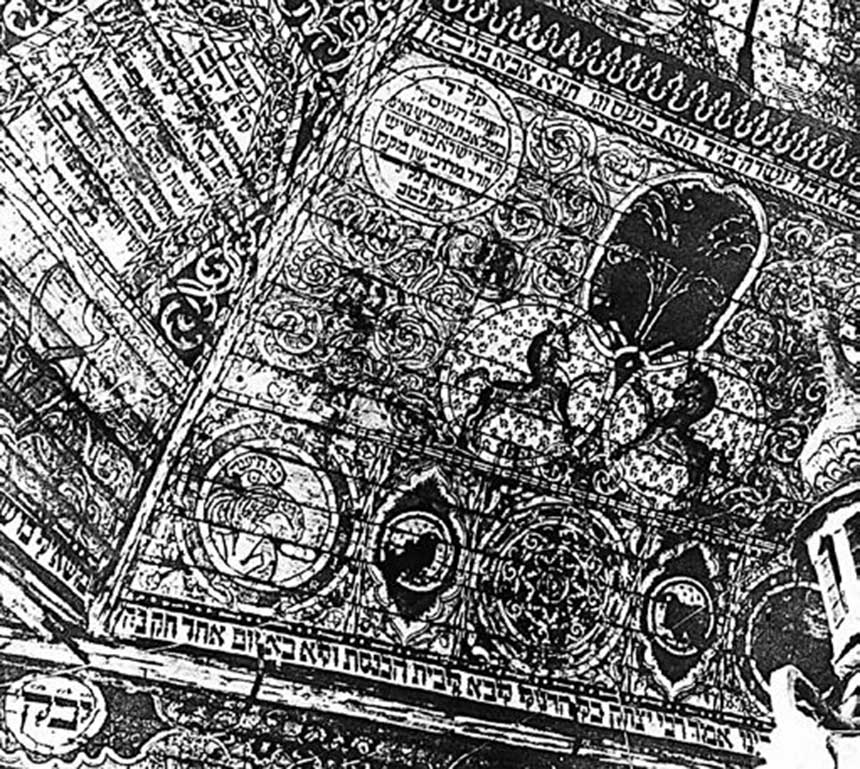
The wall paintings that blanket the prayer halls of eighteenth-century Polish/Ukrainian wooden synagogues reveal dense and variegated patterns of visual imagery and decorative motifs surrounding tablets inscribed with citations from religious texts (fig. 1). The paintings defy traditional aesthetic and thematic categories, as they interweave different types and styles of Jewish art. This paper offers a framework for interpreting this complex artistic ensemble composed of sources both Jewish and Gentile, Ukrainian and Polish, contemporary and archaic, local and foreign, and elite and vernacular. The intent of this article is to demonstrate that these diverse sources reflect their cosmopolitan, multicultural Ukrainian/Polish context and the complexity of the Jewish diaspora cultural experience. [1]
A context for interpretation
For over one hundred years, art and architecture historians have struggled to interpret the architecture and particularly the wall paintings of Ukrainian/Polish wooden synagogues (fig. 2). Before their almost total destruction by the Nazis beginning in 1939, these buildings and their paintings were documented by researchers who interpreted them as either a form of Ukrainian or Polish folk art, related to their eastern European cultural context, or as Jewish art, produced by a pre-emancipation shtetl Jewry. In both interpretations, the creation of this seemingly exotic synagogue art was often attributed to the negative pressures of impoverishment, pogroms, and exile, which were sometimes associated with messianic themes in Judaism. [2] Although recent scholarship has largely discredited this attribution of negative inspiration behind the creation of the wall paintings, there is still little consensus about their overall meaning and interpretation.
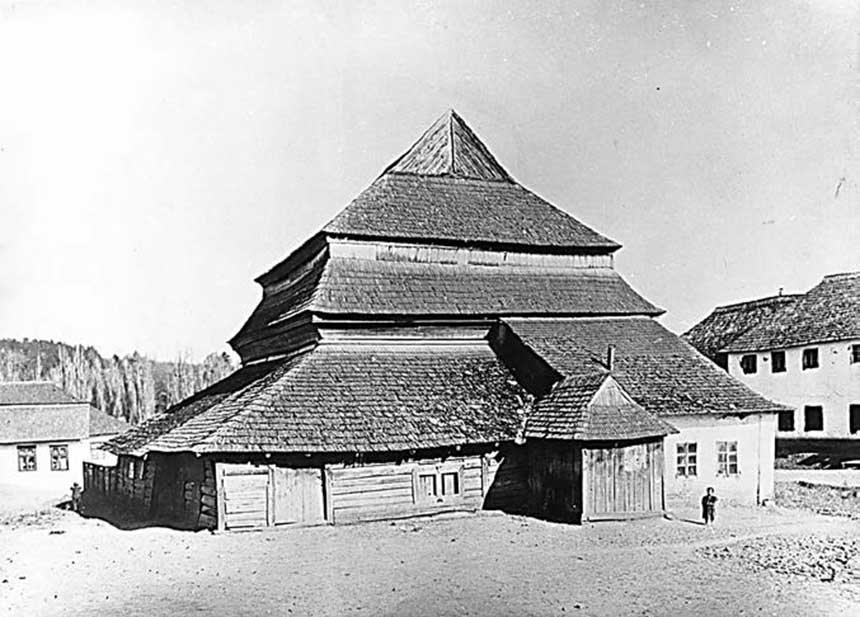
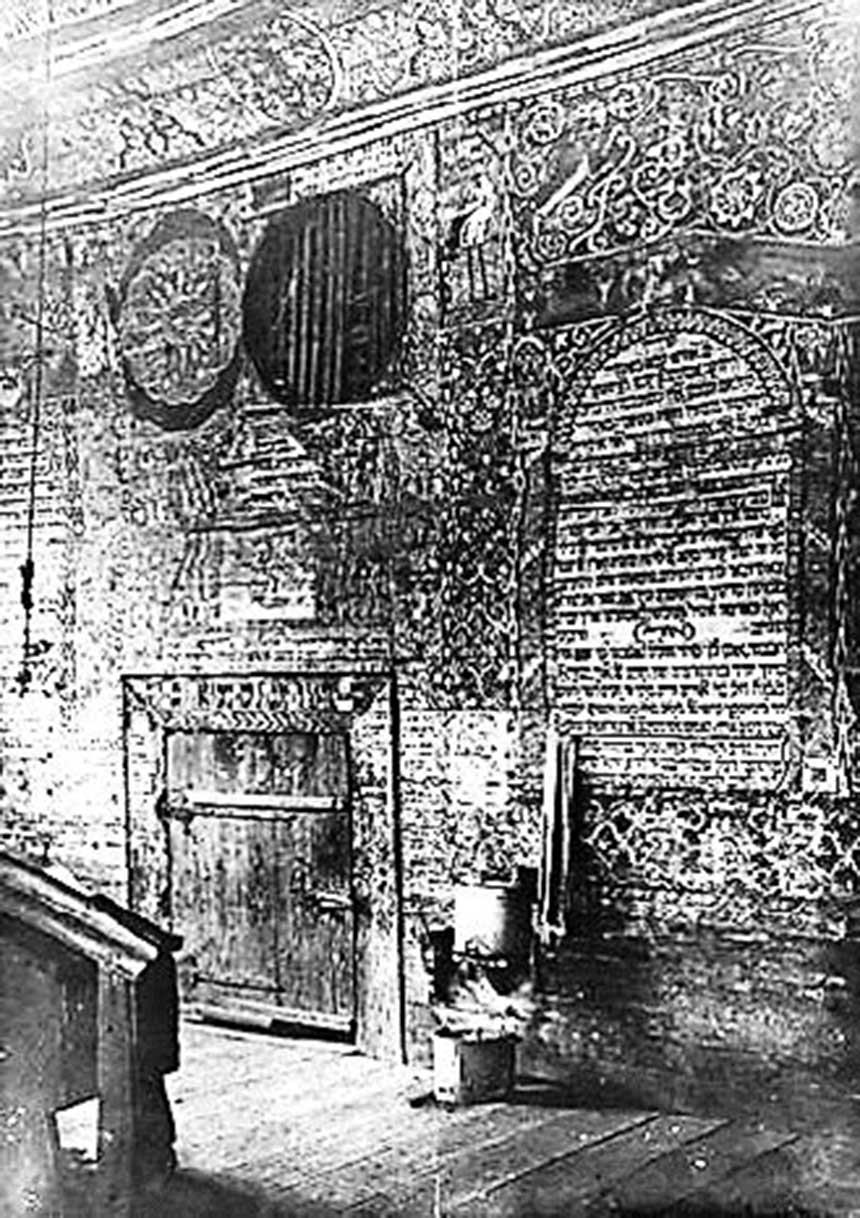
The wooden synagogues and their paintings can be interpreted from a range of analytical perspectives that differentiate between Ukrainian/Polish and Jewish contributions. One may broadly see this material-cultural combination as a dialectical relationship between exterior Ukrainian/Polish architecture and Jewish interior architecture and wall paintings (fig. 3). Yet upon closer inspection, this basic dialectical interpretation is more overlapping and complex. While the exotic-looking wooden exterior is a distinct product of its eastern European Ukrainian/Polish context, it is Polish/Ukrainian in an unmistakably Jewish way. On the inside, the prayer hall is a distinctly Jewish place of worship yet the interior architecture is also deeply informed by Polish/Ukrainian contributions to the overall spatial and decorative framework. This article focuses on the wall paintings — the most distinctly Jewish contribution of the interior. Yet, as we will see, it is a liturgical art reflective of its complex multicultural context, both Jewish and Ukrainian/Polish.
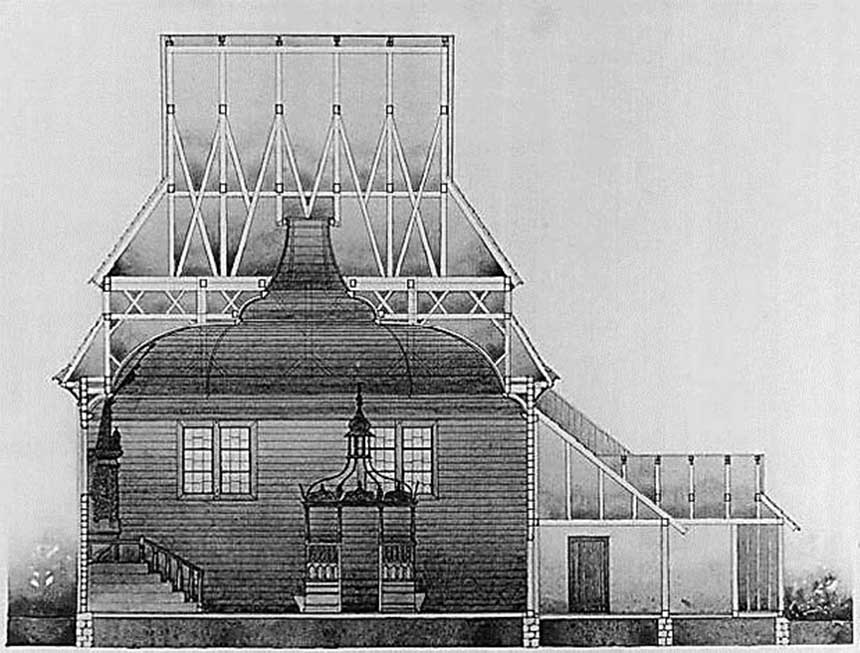
Underlying the analysis of the wall paintings are three assumptions or background premises developed in previous research. While these premises may certainly be debated, there is not sufficient time to present proofs or evidence for these assertions.
- The wall paintings are an expression of mainstream liturgical art.
The overall uniformity of the wall paintings over a wide area of the pre-nineteenth-century Polish-Lithuanian Commonwealth indicates that they were not produced by isolated, peripheral, or radical elements in the rabbinical/ political/commercial establishment, but rather by mainstream institutional constituencies within the communities, supportive of a professional class of Jewish artists, probably working in guild-like associations. [3] - Western/central Ukraine was a central locus, a hearth of Jewish liturgical artistic development.
While interior paintings have been recorded in wooden synagogues from all parts of the Polish-Lithuanian Commonwealth, the oldest and most unified expressions of these paintings were concentrated in the Lviv, Podolia, and Volhynia regions of present-day western/central Ukraine. [4] - This particular synagogue painting tradition was abandoned by the early nineteenth century.
The dominant forms of synagogue art declined rapidly in the latter half of the eighteenth century and were largely abandoned by 1800. This decline roughly coincided with the rise of the Haskalah and Hasidic movements. [5]
A multilayered hybridity
Two contrasting artistic sources or influences dominate the complex expression of the wooden synagogue paintings: 1) an older strata of Ashkenazi visual imagery closely related to the liturgical themes in the paintings, and 2) a diverse group of "cosmopolitan" artistic sources reflective of the full range and history of the multicultural Jewish diaspora experience.

Ashkenazi sources
For a period of almost three hundred years, beginning around 1350, waves of Germanic Jews immigrated eastward, thus creating by 1650 a critical mass of Ashkenazi Jewry in the eastern Ukrainian lands of the Polish state. Consequently, the artistic techniques and the symbolic content of the synagogue wall paintings suggest that these art forms were significantly influenced by late-medieval Ashkenazi traditions imported in eastern Europe.
The Jewish artists who created the wall paintings generally worked outside the major schools of Polish and regional eastern European art. They developed a sophisticated regional vocabulary based on their Ashkenazi heritage, while selectively and unevenly integrating a wide range of European and Islamic artistic motifs and techniques into their works. This semi-isolation of the Jewish liturgical artistic development helps to explain the presence of many archaic features in the seventeenth and eighteenth-century Ukrainian-Polish synagogue paintings. For example, most of the columns and arches forming the dominant decorative borders for the prayer inscriptions, a recurring motif in the eighteenth-century wooden synagogues, preserve Romanesque/Byzantine architectural details that had long been abandoned in European art as well as in Polish, Ukrainian, and eastern European vernacular art (fig. 4). [6]
Most scholars of the wall paintings have linked these pre-modern motifs to surviving examples of medieval Ashkenazi illuminated manuscript art. These pre-Renaissance influences also include some of the major artistic characteristics of the wall paintings, including: colour, composition, backgrounds, and a wide range of stylistic motifs. Two of the most dominant artistic motifs that continued from the medieval illuminated manuscripts are the architectural arch or gate motif and the extensive traditions of animal figure illumination. Both these dominant motifs continued and were further developed in the paintings of the Ukrainian wooden synagogues. [7]
Multicultural sources
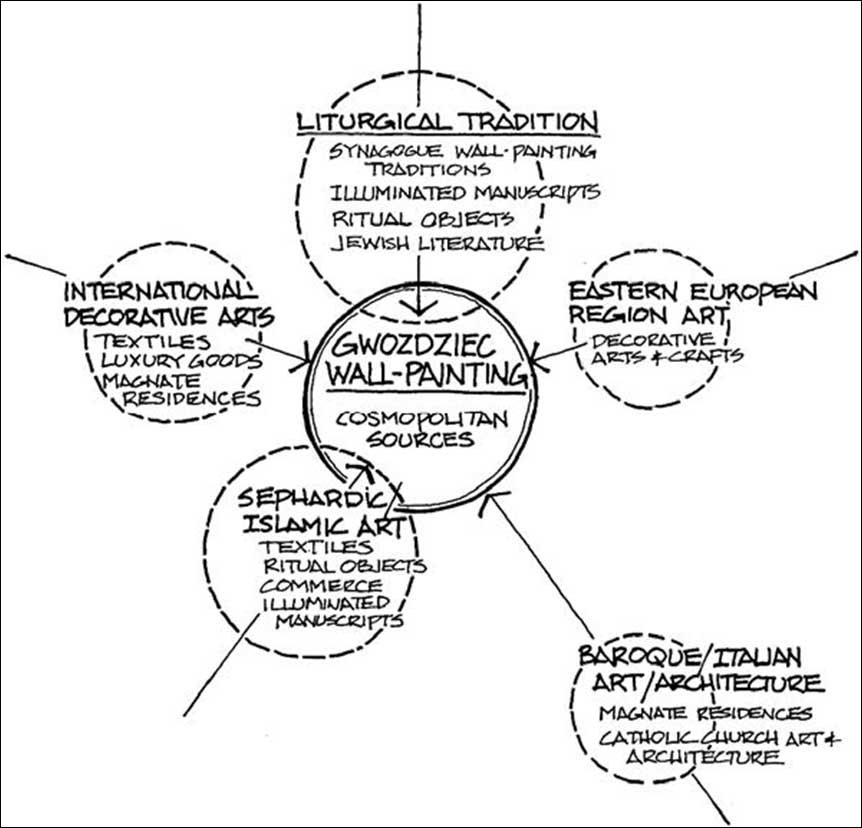
The overall significance of the medieval Ashkenazi artistic influences, however, should not obscure other significant sources that contributed to the total aesthetic ensemble of the paintings. A broad range of cultural influences reflective of the integrated and multicultural environment of Ashkenazi culture in Poland/Ukraine significantly contributed to the overall aesthetic character of the wall paintings. These influences include: 1) Sephardic/Islamic sources, principally from Ottoman lands; 2) Italian/Baroque stylistic influences of the Polish and Ukrainian nobility and the Catholic Church; 3) Ukrainian and eastern European folk or vernacular decorative motifs; and 4) International European decorative arts sources generated by the Polish and Ukrainian ruling magnates (fig. 5). These diverse sources combined with medieval Ashkenazi traditions to create a unique hybrid, Ukrainian/Polish Jewish synagogue art and architecture.
Sephardic and Islamic sources
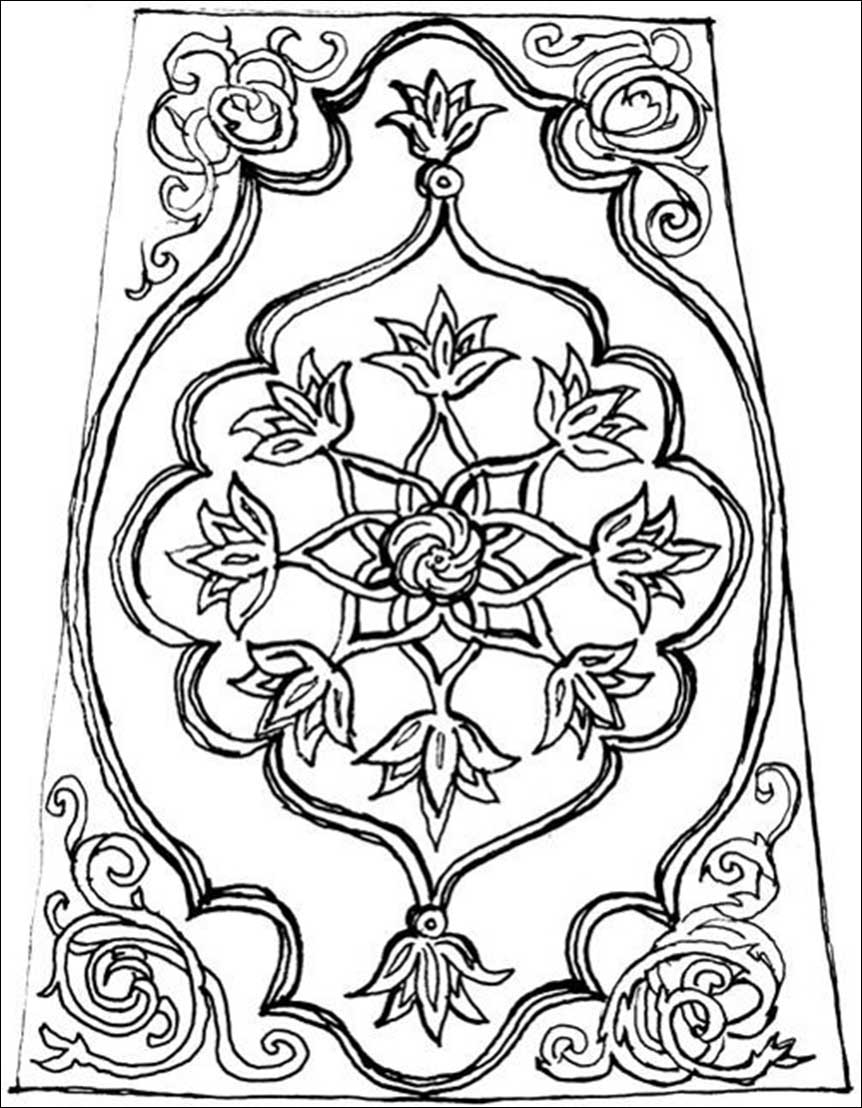
By the beginning of the eighteenth century, European Jewish communities had absorbed Islamic artistic traditions through numerous and long-term contacts with Jewish communities from Islamic lands. After more than ten centuries of Islamic rule, these communities had fully absorbed aspects of the Islamic decorative arts so that fundamental similarities had developed between the form and decoration of synagogue and mosque, including interior walls that were entirely covered with intricate, geometric patterns and scribal art. The influences of Sephardic communities, drawing on Islamic artistic tradition, account for some of the unique, non-European aesthetic qualities of the Ukrainian/Polish synagogue wall paintings. For example, early observers consistently associated the wooden synagogue’s dense wall paintings, despite some similarities to regional folk paintings, to oriental textiles, especially noting similarities in floral and geometric borders and backgrounds found in (fig. 6). Over time, the continuous usage of such arabesque motifs united Sephardic and Islamic artistic traditions, and is a clear example of the fluidity of artistic borrowing within the development of synagogue art. Another specific Islamic influence on the wall paintings of the synagogues was the image of the Islamic/Ottoman tent (fig. 7).
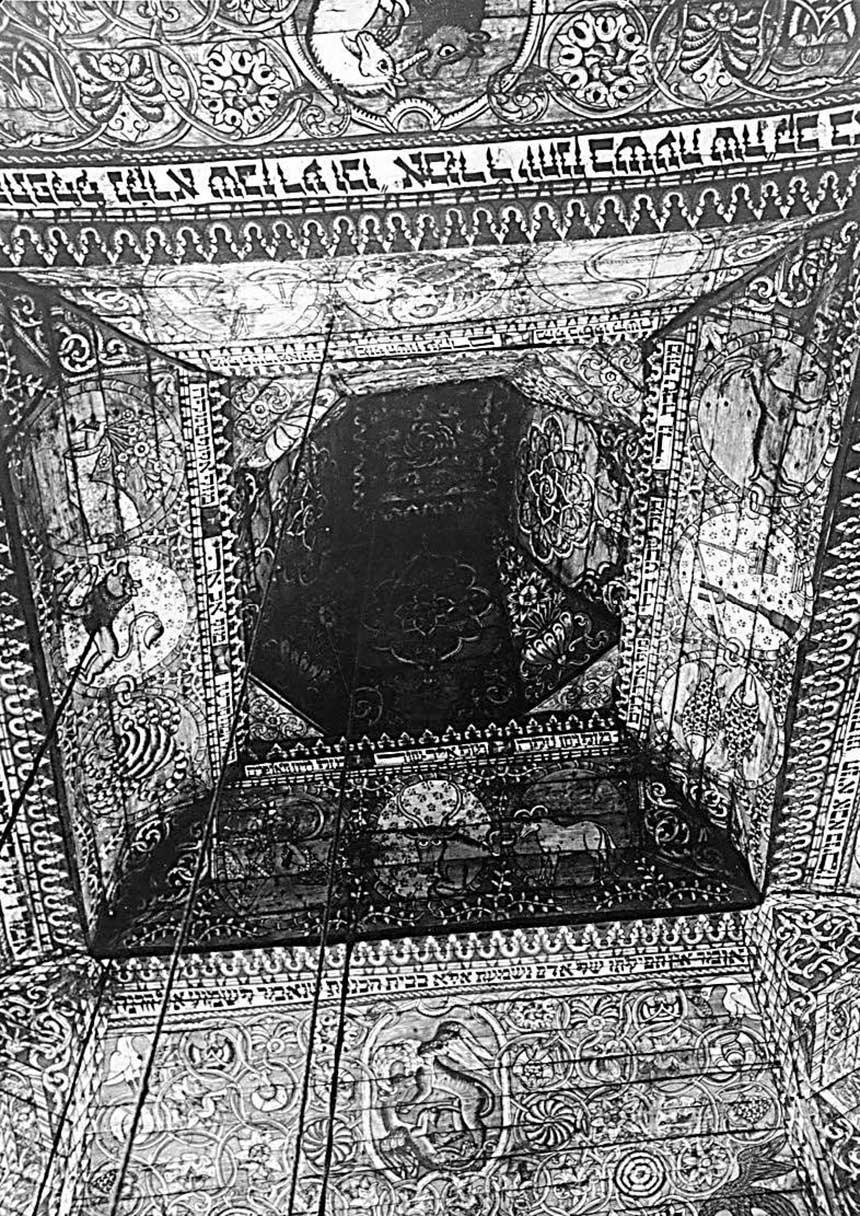
The textile patterns and construction of such tents influenced the decoration of many wooden synagogues, including the painting of many rope and border motifs characteristic of the Ottoman tent. Based on these and many other Ottoman "oriental" parallels, one might even describe the overall aesthetic quality of the typical wooden synagogue wall paintings as significantly influenced by the art forms of Sephardic/Islamic cultures. [8]
European decorative arts and regional vernacular sources
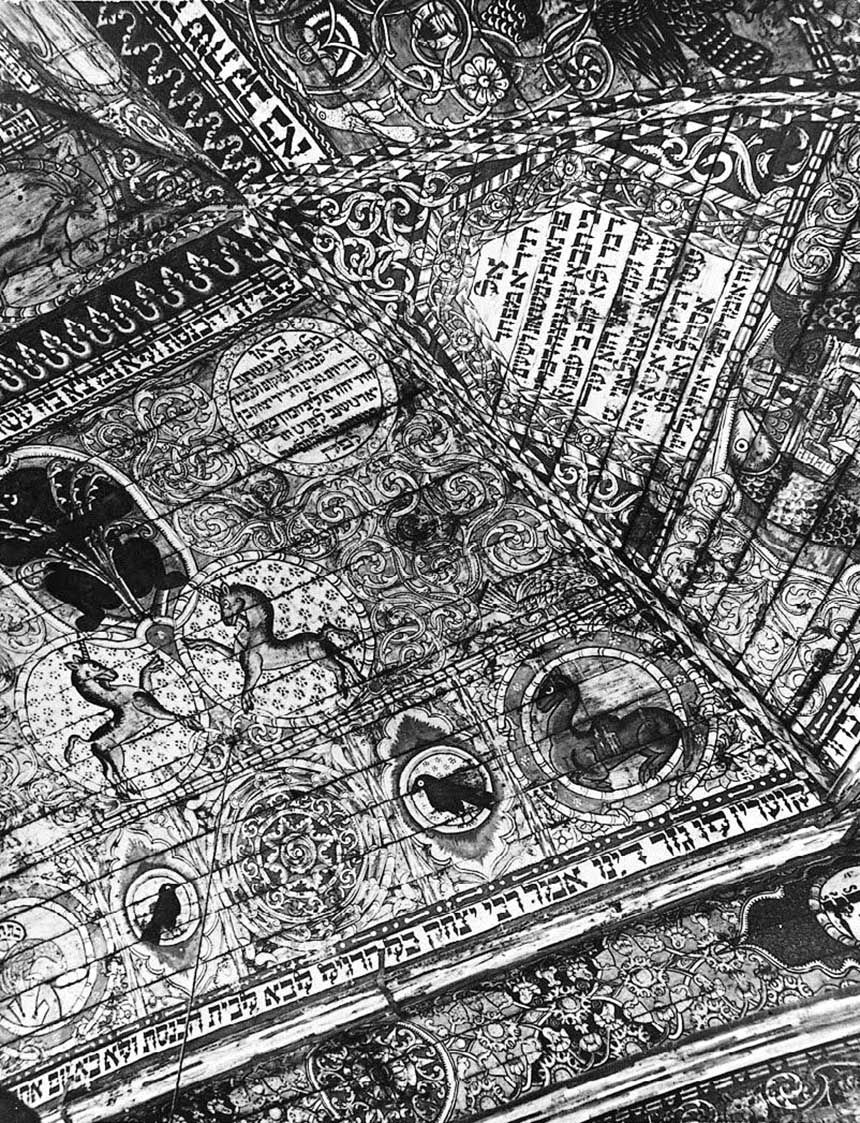
Many types of non-Jewish, European artistic influences are also evident in the wall paintings of the eighteenth-century Ukrainian and Polish synagogues. These influences may be divided between Ukrainian and eastern European regional-vernacular sources and international, European elite sources. Both sources are apparent in the decorative borders and background motifs of the wall paintings. While these motifs, in repetitive floral and geometric patterns, are not liturgically or symbolically significant, they are powerful aesthetic components of the wall paintings covering approximately forty to sixty percent of the interior surface of a typical wooden synagogue interior (fig. 8).
These complex compositions, often inspired by vegetation imagery, reveal a long-term intermingling of pre-modern and late-medieval Ukrainian vernacular approaches to visual organization and decoration of spaces. At the same time, many of the specific artistic motifs were relatively new. In the seventeenth and eighteenth centuries, an international commerce in decorative merchandise supplied the European nobility with a wide range of contemporary styles, including eastern textiles and carpets. These expensive goods came to the magnates of the Polish-Lithuanian Commonwealth through extensive trading networks between Europe and Asia, often facilitated by Jewish merchants, including exchange with Ottoman, Persian, and Indian centers of commerce.
Simultaneously, from the fifteenth to eighteenth centuries, a growing commerce in European manufactured textiles, many inspired by imported oriental textiles, also created a large volume of sophisticated fabrics available to the upper classes. It is the floral decorative patterns found in these contemporary fabrics that are closely related to several recurring motifs in the Ukrainian wooden synagogues and may have supplied the painters of the wooden synagogues with some of the floral motifs used in the background portions of the wall paintings, as well as the textiles for Torah ark curtains and valances. [9]
Cosmopolitan sources for synagogue wall paintings
The culturally heterogeneous artistic influences evident in the Ukrainian and Polish synagogue wall paintings are probably best described not as stylistic elements or artistic sources in the traditional sense, but as artistic extensions of a multicultural Ashkenazi community (fig. 9). This unique and cosmopolitan artistic culture developed over many centuries as an extension of communications, travel, and trade between Jewish diaspora communities throughout Europe, the Middle East, and North Africa. This hybrid mixture of cosmopolitan sources represents both what is most significant and what is uniquely Jewish about the wall paintings. Widely dispersed Jewish communities maintained contact with one another through commercial and family networks, including highly developed forms of communications and travel, including rabbinical communication, secular and religious educational exchanges, and scientific and medical communication, all facilitated by extensive traditions of written communication, including manuscript writing and book publishing.
These deeply embedded traditions of communication and travel among Jewish communities in the early-modern era created the necessary preconditions for the wide-ranging multicultural art and architecture of the wooden synagogues. Despite the image of small-town shtetl backwardness, these cosmopolitan traditions penetrated deeply into the upper levels of Jewish culture, the levels that presumably sponsored and produced the wall paintings of the wooden synagogues. The diversity of these multicultural sources included a bedrock of older Ashkenazi artistic traditions, which had evolved in contact, first with Germanic and then with Polish/Ukrainian eastern European folk and elite cultures. In an overview of these many influences, we must still conclude that Jewish artistic development before 1800 remained relatively isolated from the centers of Gentile artistic development and this isolation was especially true for the liturgical aspects of the wall paintings. Nevertheless, the artistic totality of the wooden synagogues’ paintings simultaneously represented a quiet and selective distillation of many local and international Ukrainian, Polish, and eastern European sources reflective of a unique and multicultural Jewish cosmopolitanism. [10]
In a final assessment of the meaning of wall paintings, we must always be aware that artistic development may, or may not, reflect deeper, collective developments within a particular culture and religion. In other words, Ashkenazi multicultural aesthetics may or may not be an accurate or direct reflection of the larger cultural or narrower liturgical development of the Jewish communities in Ukraine and Poland. In the case of the Ukrainian wooden synagogue wall paintings, however, I believe that future scholarship will reveal that they are remarkably accurate summaries of the multicultural hybridity of their Polish/Ukrainian/Ashkenazi communities,— communities both highly separated from and highly integrated within their Ukrainian and eastern European cultural context.
[1] Research for this article has been derived from Thomas C. Hubka, Resplendent Synagogue: Architecture and Worship in an Eighteenth-Century Polish Community (Hanover, NH: Brandeis University Press/University Press of New England, 2003).
Sources of photos: Memorial Book of the Community of Gwozdziec. Copies of the photos and drawing are held by the Tel Aviv Museum of Art. Black and white drawings by the author, Thomas C. Hubka.
[2] Hubka, Resplendent Synagogue, 77–79, 84–85.
[3] Ibid., 107–109.
[4] bid., 84–86.
[5] Ibid., 160–161.
[6] Ibid., 109–116.
[7] Ibid., 99–103.
[8] Ibid., 116–117.
[9] Ibid., 117–118.
[10] Ibid., 118–121.