




"The Ukrainian-Jewish Encounter: Cultural Dimensions": Part 1.3
The Ukrainian Jewish Encounter was founded in 2008 with the goal of building stronger relations between Ukrainians and Jews, two peoples who, for centuries, lived side by side on the territory of what is modern-day Ukraine. Since then, in keeping with its motto, "Our stories are incomplete without each other," UJE has sponsored conferences, round-table discussions and research, as well as translations and publication of works the organization anticipates will promote a deeper understanding between the two peoples and an appreciation of their respective cultures.
We offer for the first time the book The Ukrainian-Jewish Encounter: Cultural Dimensions in an eBook format.
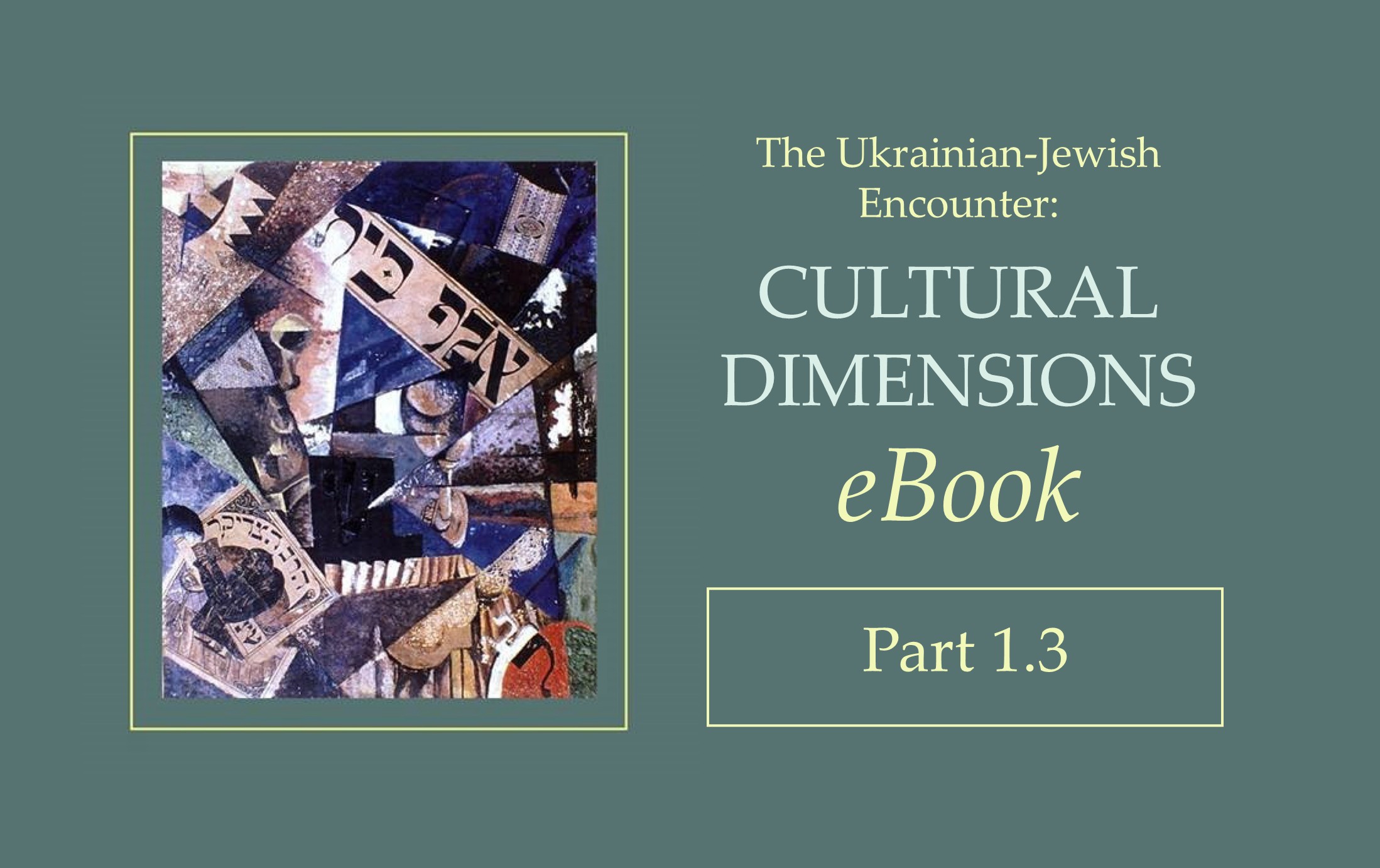
The book is a collection of essays that examine the interaction between the Ukrainian and Jewish cultures from the seventeenth century onwards. Written by leading experts from Ukraine, Israel, and other countries, the book presents a broad perspective on parallels and cross-cultural influences in various domains — including the visual arts, folklore, music, literature, and language. Several essays also focus on mutual representation — for example, perceptions of the "Other" as expressed in literary works or art history.
The richly illustrated volume contains a wealth of new information on these little-explored topics. The book appears as volume 25 in the series Jews and Slavs, published by the Hebrew University of Jerusalem since 1993. In several previous volumes, considerable attention is given to the defining role of the Old Testament in Ukrainian literature and art and to the depiction of Jewish life in Ukraine in the works of Nikolai Gogol, Taras Shevchenko, Ivan Franko, Lesia Ukrainka, Vladimir Korolenko, and other writers.
This collection of essays was co-edited by Wolf Moskovich, Professor Emeritus, Hebrew University of Jerusalem, and Alti Rodal, Co-Director of the Ukrainian Jewish Encounter, who also wrote the introduction to the volume. It was published in 2016 by Hebrew University of Jerusalem.
Click here for a pdf of the entire book.
Part 1.3
The synagogue wall paintings in Novoselytsia, Ukraine
Boris Khaimovich (Center for Jewish Art, Hebrew University of Jerusalem)
The synagogue murals in Novoselytsia, discovered in 2008, raise questions about their creation and the place of this artistic phenomenon within the Jewish tradition of synagogue art. [1] The tablet with the names of donors suggests that the synagogue was built in 1919. Archival documents confirm that the synagogue opened in 1920, when Novoselytsia was part of Romania's Bessarabia province. [2] The murals were probably made around the same time, since the list of donors also features the name of the person who had provided funds for the interior decorations (fig. 1). [3]
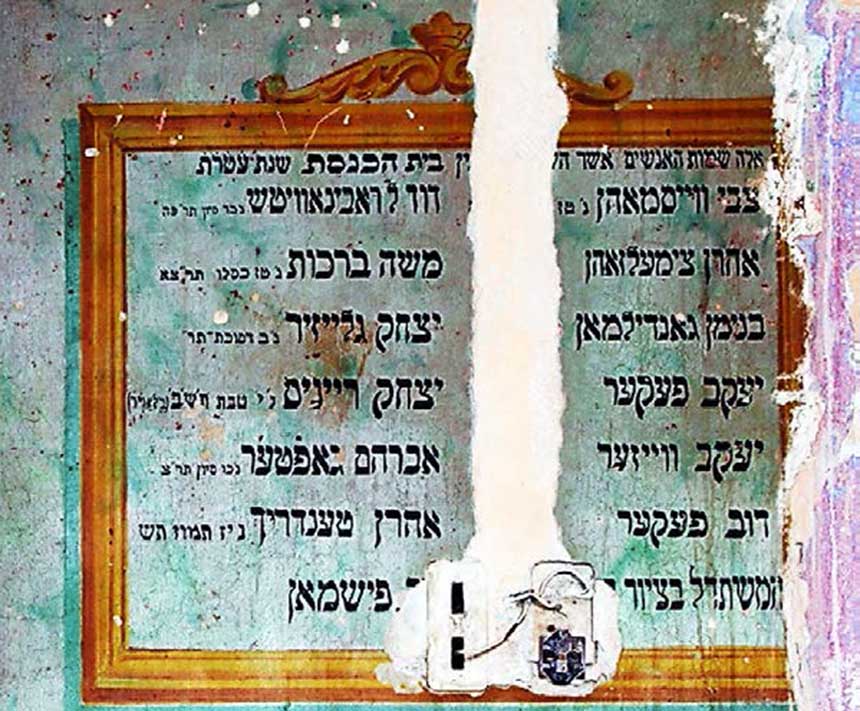
After the Second World War, the building was not used as a synagogue. The murals survived in their pristine form under a layer of plaster. Aside from some minor losses resulting from the reconstruction of the building, the composition was preserved almost entirely.
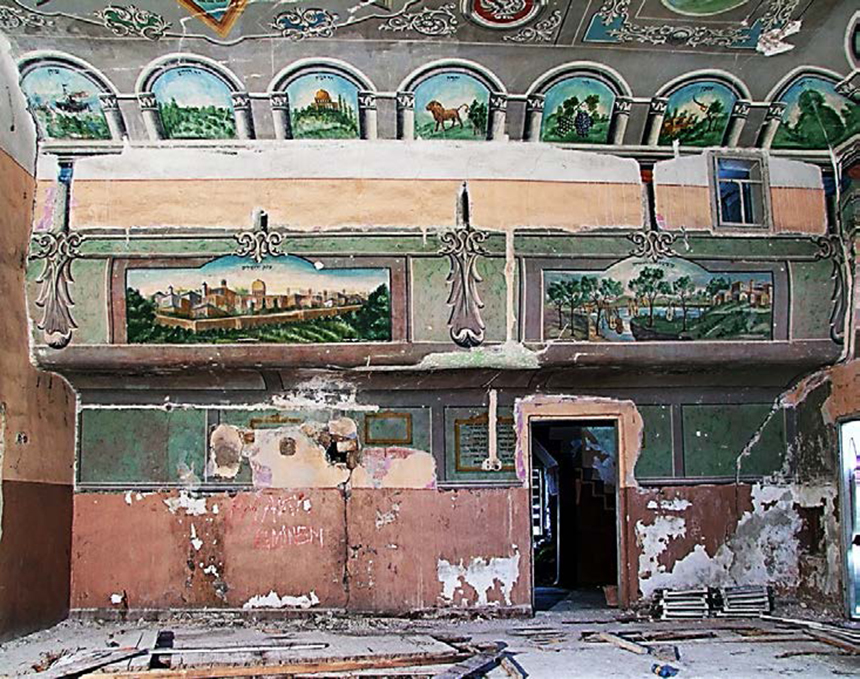
The murals decorate the ceiling and the walls of a relatively large prayer hall. The murals contain an extensive iconographical program, which is presented by narrative scenes, landscape, nature morte, and symbolic images.
The composition of the painting on the ceiling consisted of a system of concentric ornamental border edgings similar to the Chernivtsi (Yiddish: Tshernovits, Romanian: Cernăuţi) model, but with a heightened decorative effect. Baroque cartouches have been added, and the schematism and graphic rigidity characteristic of the Chernivtsi synagogue original are less noticeable.
The centre of the composition is taken up by a large vivid bunch of roses, daisies, and wild flowers displayed against the backdrop of the heavens with flying swallows. The bouquet is edged in with a border formed by a wreath of twelve medallions illustrating Psalm 150 (fig. 2).
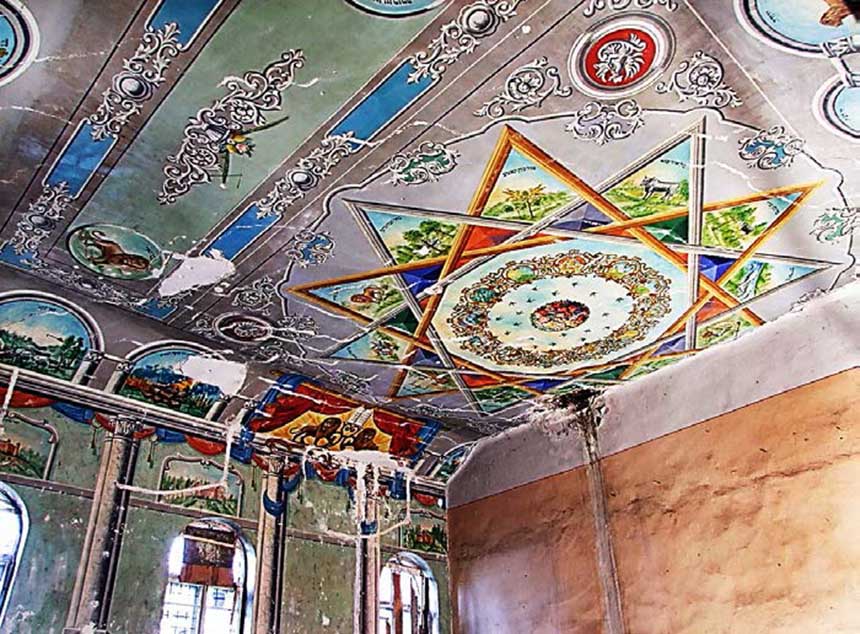
The entire composition is inscribed within the dodecagon, which consists of two hexagrams (possibly two stars of David) of contrasting colours. Each and every element of the geometrical figure is artistically conceptualized. The sharp angles of the big star contain signs of the Zodiac. In the corners of the square frame with the inscribed signs of the Zodiac, medallions are visible (only two survive) displaying the image of a crowned heraldic eagle blowing a shofar (ram's horn). The composition in the ceiling centre is flanked on the south and the north by two rectangular panels with images of the lulav and etrog, and four animals — a lion, eagle, panther, and deer, illustrating the well-known quote from the Mishna (Avot 5:32).
The composition on the walls is divided into upper and lower registers encompassing the prayer house along the perimeter. The scenes of the upper register are inscribed within the arch, while the scenes of the lower register are placed within the architectural frames. The spectacular décor of columns draped in purple and navy-blue fabric creates an atmosphere of palatial splendour.
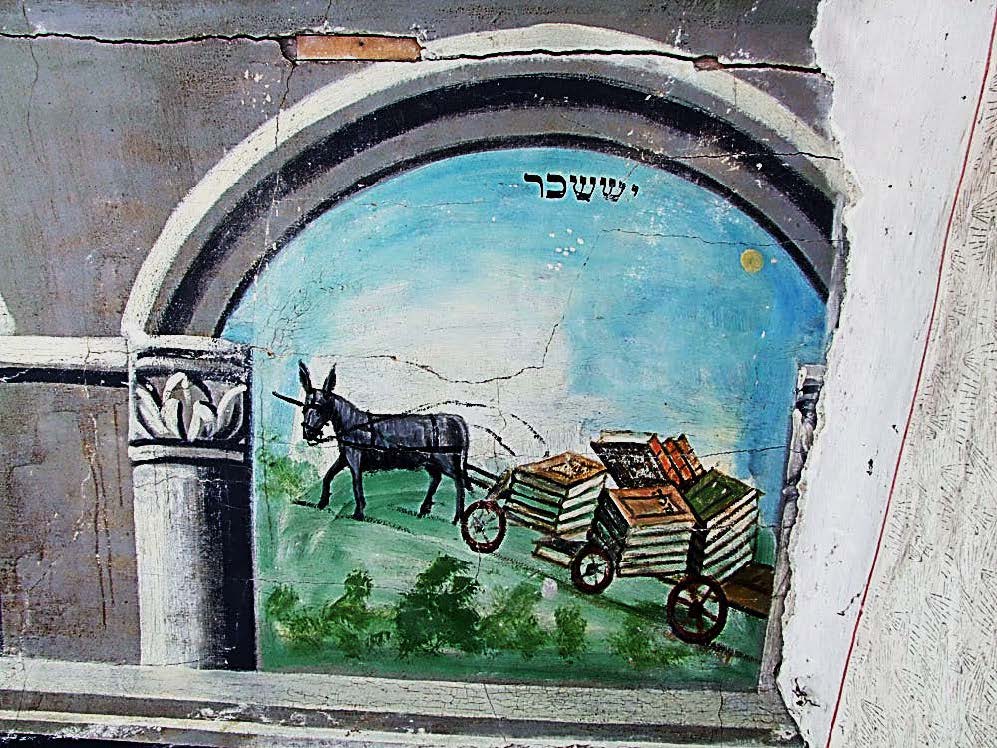
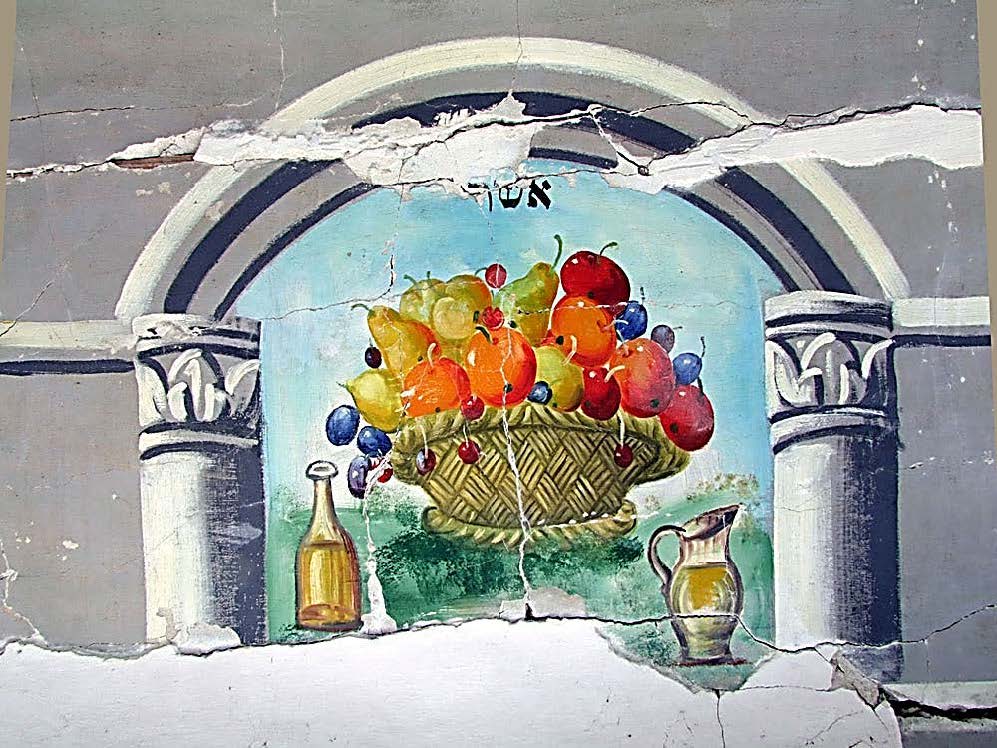
On the upper register of the wall, one cluster illustrates events connected with the seven biblical forefathers — Abraham, Isaac, Jacob, Moses, Aaron, Joseph, and David. The choice of the biblical characters was most likely dictated by traditional notions regarding the Ushpizin, the seven supernal guests who come to visit Jews in the sukkah, one for each of the seven days of the festival. The motif received wide application due to the practices of the local Hasidim. These scenes occupy a central place on both sides of the Torah Ark on the southwestern wall (fig.3). The images of the seven biblical characters are supplemented by depictions of the twelve Tribes of Israel (fig. 4). The images of the seven biblical characters are supplemented by depictions of the twelve Tribes of Israel (fig. 4). The master literally visualizes the text of biblical metaphors from the blessing of Jacob (Genesis 49:1–29), or the blessing of Moses (Deut. 33: 13) using a soft folk humour. The tribe of Dan is depicted as a huge snake spitting fire, the tribe of Issachar is depicted as a donkey pulling a cart with Talmud treatises (fig. 5), and the tribe of Asher is depicted in the form of a basket with fruit and white "Bessarabian" wine (fig.6).
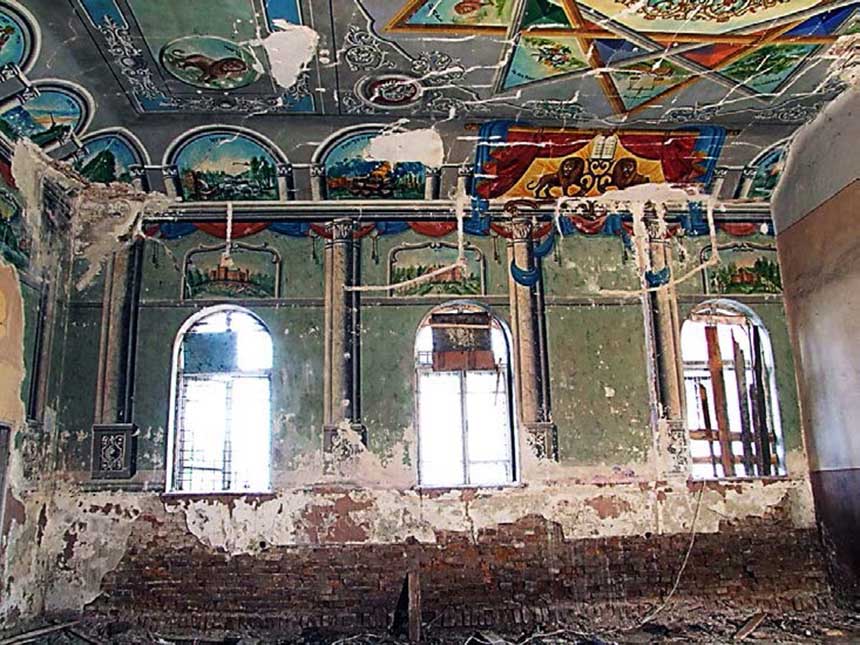
This register is supplemented by depictions of biblical mountains at the corners of all four walls. These include Mount Ararat, on which God made a covenant with Noah; Mount Sinai, where the Almighty made a covenant with Moses; Mount Moriah, the site of Solomon's Temple; the Mount of Olives, from where the Messiah will make his appearance; and, finally, the mountains Nevo and Gar, where Moses and Abraham found their final rest.
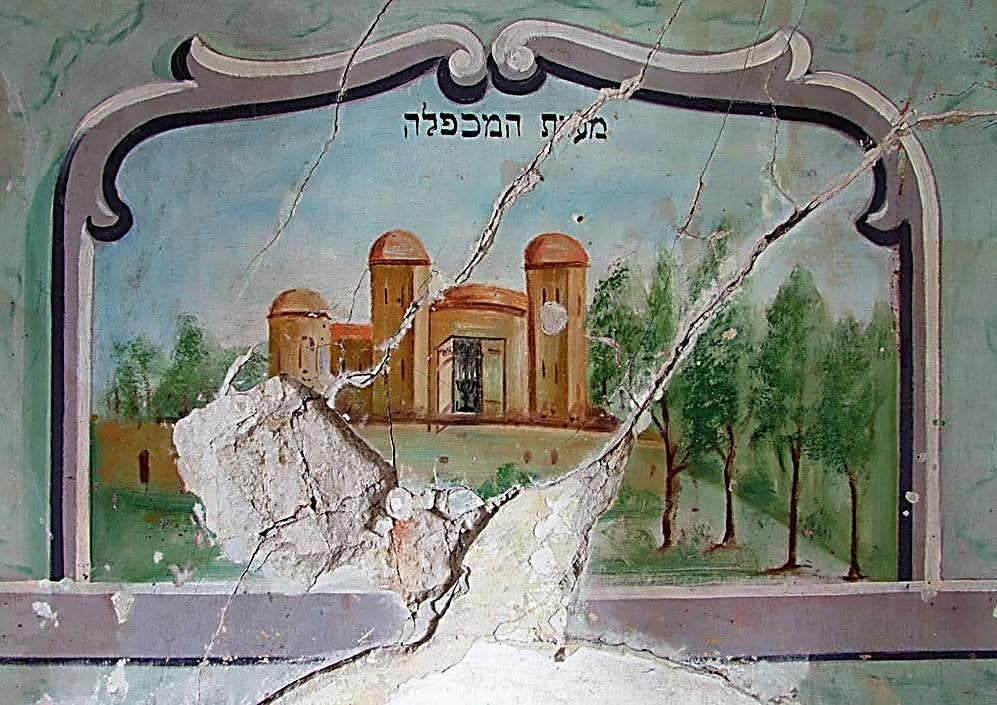
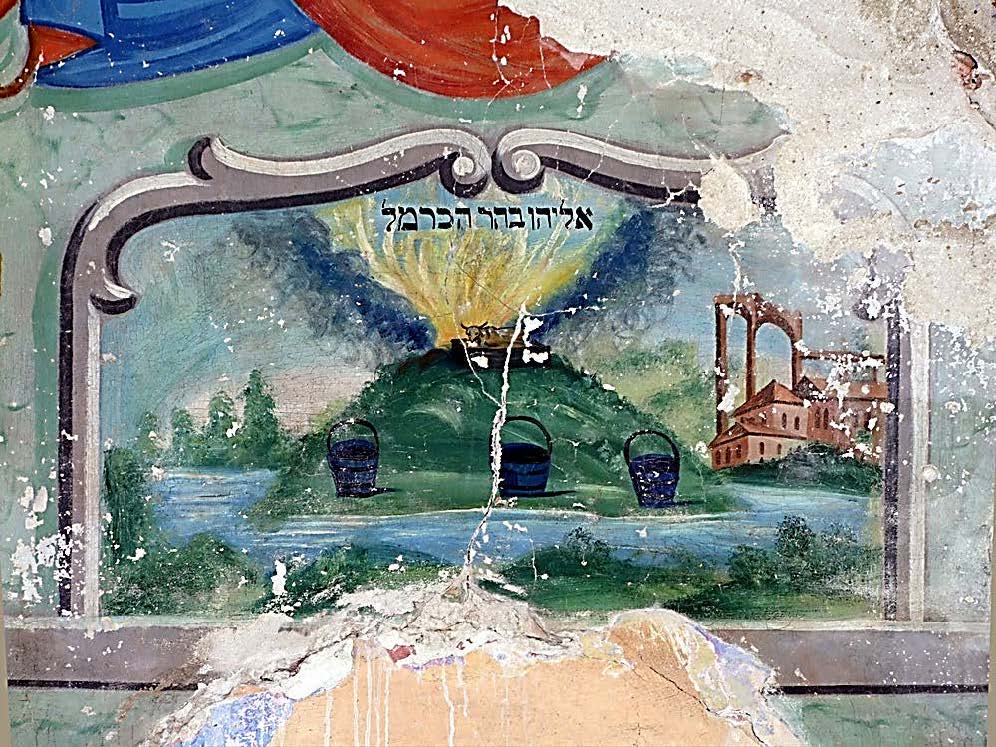
On the lower register are portrayals of the holy graves in the Land of Israel — the Cave of the Patriarchs (fig. 7), the Grave of the House of King David, the grave of the Prophet Samuel, and depictions of the town of Jericho. The same register features two scenes illustrating texts of the prophets Elijah and Jonah. As in the case of the depiction of events relating to the seven personages of the Ushpizin, the characters themselves are visually absent or partially concealed. The first scene, "Elijah on Mount Carmel," is a landscape (fig. 8). At the centre of the composition is depicted an altar with a burning bull on Mount Carmel.
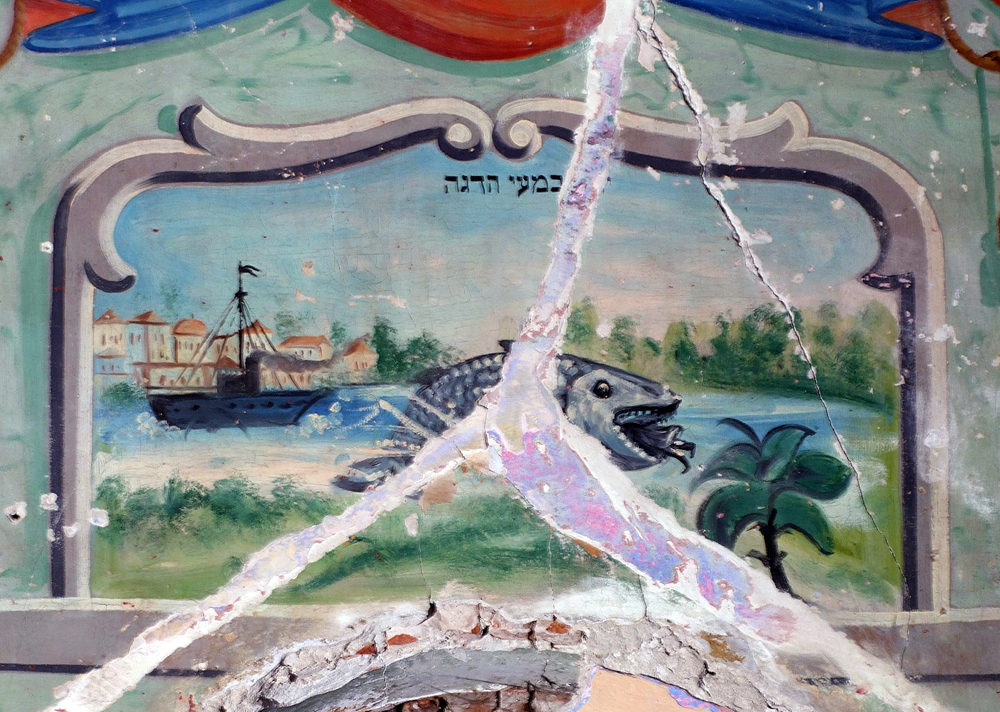
The mountain is surrounded by water. In the foreground are two blue buckets hinting at the miraculous nature of the event. To the side are buildings and the ruins of ancient arches. The other picture, "Jonah Inside the Belly of the Fish," is a genre scene. The legs of the prophet wearing Hasidic dress protrude from the mouth of the big fish (fig. 9). On the left side is the tall tree that would serve as a seat for the Prophet whom the fish subsequently spat out. And on the right side are the city Tarshish and the departing ship, from which the Prophet had been thrown into the sea.
The women's gallery features a diptych — two lyrical landscapes in lilac tones — illustrating popular phrases from Psalm 137 (fig. 10). The first is "By the Rivers of Babylon." The second is "If I Forget Thee Jerusalem." Together with the signs of Zodiac, these pictures are among the most traditional depictions in synagogue décor.
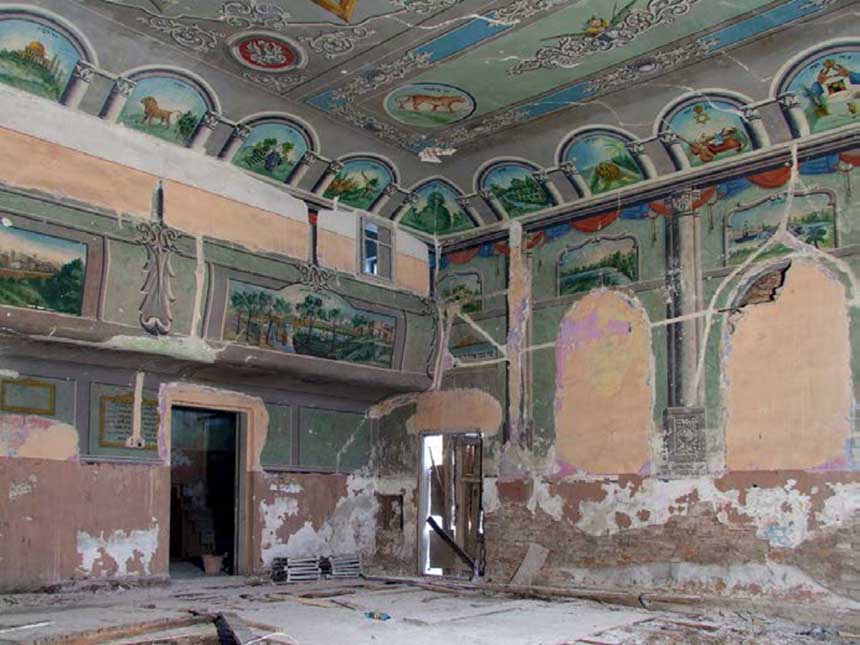
The wall paintings in Novoselytsia reflect the same iconographic tradition as the murals of the Chernivtsi synagogue Beit Tfila Benyamin, described in my earlier publication. The compositions on the ceiling as well as the "Ushpizin" cycle are virtually identical, as is the choice of motifs (Fig. 14). Yet there are some differences — particularly in relation to the iconographic details (for example, in the scenes depicting "The Guests of Abraham" and "The Cave of the Patriarchs"). With high probability we can assume that the murals in both synagogues were made by one master, or rather one master with his disciples.
An analysis of the synagogue wall paintings in Chernivtsi suggests that the combination of murals were aligned with the calendar cycle of the fall high holidays — Rosh Hashanah, Sukkot, and Yom Kippur. There is evidence for this in the details of the composition and the iconography of the motifs. Thus the Zodiac sign "Libra," corresponding to the Hebrew month Tishrei — the beginning of the new year — acquires the characteristic symbolism of the fall holidays, during which people's deeds are allegorically being weighed and registered in a special book in heaven (the prayer for Rosh Hashanah reads: "May you be inscribed in the Book of Life"). That is why the image of the scales is right next to the book. The same sign of the Zodiac is connected with the top of the Aron Kodesh, which has a sharp spire attached to it.
The "Ushpizin" artistic cycle is associated with the fall festival of Sukkot. The scene "Akeidat Yitzchak" (The Binding of Isaac) and the scene with the prophet Jonah relate to Rosh Hashanah. The composition also features the attributes of the Sukkot festival — the lulav and etrog. As noted above, in Novoselytsia these motifs are supplemented with heraldic eagles playing the shofar. Similarly, for the choice of other scenes with prophets and sacred places in Israel, the author seems to have relied on a section of the evening prayer from the Yom Kippur makhzor (prayer book): "May the One who answered Shmuel in Mizpah, respond to us! The one who answered Jonah in the belly of the fish…The One who answered Daniel in the lions' den…The One who answered Mordechai and Esther in the capital of Shushan…"
The new motif of the Twelve Tribes of Israel — which occupies a very prominent place in the murals of the synagogues in Novoselytsia and a number of other towns of the region (though not Chernivtsi), probably, also connected to the calendar cycle, especially with fest of Simchat Torah. It should note, that the iconography of the Twelve Tribes in Novoselytsia is quite different from the synagogues in Romania, where the symbols tend to include military paraphernalia and are often portrayed on hand-held flags or banners, corresponding to Zionist ideals. [4]
A comparison of the wall paintings in Novoselytsia with archival photographs and preserved murals in other synagogues in Ukraine and Romania suggests that the Novoselytsia wall paintings represent the most extensive artistic program, preserved today. This circumstance, as well as a specific place and time of their creation suggest a regional artistic canon.
The author has sought out witnesses to the history of the creation of these murals — some still among the living and others who have left behind memoirs. One of my informants was a native of Novoselytsia, Pearl Schwartz. Born in 1922 and now residing in Ramat-Gan, Israel, she has identified the artist who in the mid-1920s made the wall painting in one of the synagogues in Novoselytsia. Pearl remembered some of the key elements of this mural — the signs of the Zodiac on the ceiling and the symbols of the Tribes. The artist, whose name was Groizgrou, and who was from the town of Khotyn, carried out regular painting jobs. At the time he was a "middle-aged man with a thick beard." Pearl's reminiscences do not confirm which synagogue it was, but available documents suggest that during the 1920s only one synagogue had opened in Novoselytsia.
One should note that Khotyn, where Groizgrou came from, was at the time a cultural centre of the Jewish community of Bessarabia. Lazar Mikhailovich Gurfinkel (b. 1924), a long-term resident of Khotyn who now lives in Chernivtsi, also remembered Groizgrou ("they mostly called him Groizgru"). The latter did house painting also for Gurfinkel's well-to-do family, and it was known in Khotyn that Groizgrou used to do wall paintings in synagogues throughout the region. He himself liked to mention that as a young man he painted the Great Synagogue in Chernivtsi.
One can assume that Groizgrou was most likely a simple house painter and self-taught artist, and most likely not the original creator of the sophisticated program of synagogue wall paintings in this region, but that he was rather following an established tradition. The memorial book Sefer Kehilat Khotyn mentions another master from Khotyn — Farber (or Lerner), who painted the Hasidic kloyz (a private house of prayer and study) that belonged to the Boyan Hasidim. The text reads: "The kloyz was decorated with Kabbalistic paintings — constellations and signs of tribes — all works by the master Shalom Farber (Lerner)." [5] Even though the book also referred to other synagogues in Khotyn, the paintings of the kloyz were nonetheless identified as a special phenomenon. It is also noteworthy that the Hasidic connection of the kloyz was highlighted. The synagogue in Novoselytsia, whose wall paintings apparently resembled murals in the Khotyn kloyz, did not belong to Boyan Hasidim. But in Novoselytsia itself there was also a Hasidic kloyz.
The town (now village) of Boyan (Boiany), where a son of Rabbi Israel Friedman (the founder of the Ruzhin Hasidic dynasty) settled in the mid-nineteenth century, lies right next to Novoselytsia. In Boyan he established a Hasidic community, of which he became the leader. Simultaneously his new adherents opened a Hasidic kloyz in Novoselytsia. Here is what Shlomo Dorner, whose father was a founder of the kloyz wrote about this episode:
The synagogue of the Boyan Hasidim was built at the start of the "war" for the throne of the Admor (acronym for the leader of a Hasidic community) Rabbi Abraham Jacob Friedman. The rabbinical decree did not allow his son Rabbi Itzhak to succeed to the throne. He was ordered to leave the court in Sadagora and to relocate to Boyan, where the local Hasidim built him a palace with a "small shrine" (synagogue) for the Torah and prayers. Many of his father's Hasidic followers went with him. That was in the year 1886. Thus was born the dynasty of the Boyan Hasidim, which was subsequently transplanted to America by the son (of the founder of the dynasty) Rabbi Mordechai. One should mention that a group of the Boyan Hasidim also appeared in our town. They were decent and prosperous people who built a new "kloyz" in honour of the Boyan Rebbe (leader of a Hasidic community). They were Israel Kanner–the first gabai (assistant to a rabbi), Yosi and Yeshayahu Edelman, Mori Pinkhas and his brother Haim Polikman, Aaron Hoikhman, Mordechai Frenkel, Moshe Zilberman, David Bogorad, David Kolker, Noah Roiter, Pinkhas and Reuven Kopman, Michael Koner and Naftali Rozin. All of them donated money for the construction of the synagogue, but they also had to obtain a loan. After the construction, began the epoch of decoration. Israel Kanner personally designed the interior and created ornaments for the aron-kodesh, amud (cantor's desk or lecturn) and ceiling. [6]
This unique text not only identifies (for the first time) the ideologue and creator of the program of synagogue murals, but also points to the spiritual trend behind the wall paintings. The former resident of Chernivtsi David Tal, who now lives in Jerusalem, remembered that when he was a child, his father, a member of the Boyan Hasidic community, took him to the residence of the Boyan Rebbe.
The walls of the buildings bore depictions of the signs of the Zodiac, symbols of the Twelve Tribes, Joseph with haystacks, the staff of Moshe, etc. [7] The wall paintings of another synagogue of the Boyan Hasidim survived in the town Buhuşi in Southem Bukovina. In general, both the composition and the iconography of the murals are analogous to those in the above-mentioned kloyz and the paintings in Novoselytsia.
Thus we can speak about the existence of a special program of wall paintings that is identified with a specific spiritual movement and ideology of the Boyan Hasidic court. The model most likely related not only to the Boyan Hasidic community but also to the "metropolis" of Sadagora. As is known, the ideologies of the two courts were practically identical. The separation occurred as a result of the division of power — more specifically the succession to the "throne." Members of the Friedman dynasty who had retreated to Boyan staked equal claims to the God-given status of their authority.
Israel Kafri, whose father was close to the Boyan Rebbe, formulated this position in the following manner: "The Admor in Boyan was Rabbi Itzhak Friedman, the grandson of Rabbi Israel of Ruzhin, the founder of the dynasty. He traced his lineage all the way back to King David and for this reason considered himself King of his generation. They viewed their own dynasty as a continuation of the royal line of Judah, blessed by the forefather Jacob. This meant that the kin would retain authority until the arrival of the Messiah." [8]
Similarly, David Assaf underlines the messianic subtext of the Ruzhin dynasty's claims to the throne of King David: "The conception of the royal authority of Rabbi Israel (of Ruzhin) rested first and foremost on the tradition of establishing a lineage to King David. This was significant for two reasons: first, the claim to the crown of the King; secondly, the claim to the crown of the Messiah, or at least a hint at the latter." [9]
The claims to a special regal lineage served as a perfect justification for the love of things glamorous, the construction of palaces, the employment of a vast coterie of servants, and, naturally, the elaborate ornamentation of residences and synagogues. The murals perhaps served as a most vivid embodiment of this spirit.
The "creator of the program," Israel Kanner, who lived in the "province," likely took his cues from the artistic style of the "metropolis" — the residence of the dynasty's founder. That is how traditional mechanisms of cultural borrowing generally function — the "province" orients itself towards the "metropole."
The artist who painted the Novoselytsia synagogue — in a manner so similar to the Chernivtsi synagogue Beit Tfila, which was painted later — most likely followed the regional tradition that had become the canonical model.
Naturally, the semantic clusters in the program of the murals are not one-dimensional. The dominant motif of the fall holidays (described above) is not the sole element of the ideological program informing the wall paintings.
By uniting in one register several different narrative cycles, the artist effectively created two new narratives: the main biblical narrative — God's eternal Covenant with the People of Israel, and the narrative of David's Kingdom in the Holy Land promised by the Almighty to the descendants of Israel. These ideas are reflected in the illustrations to Psalm 137, in the recurring depiction of the Temple, in the portrayal of the Mount of Olives where the Messiah will arrive inaugurating the restoration of the Kingdom of Israel, and in the images of the City of Palm Trees — Jericho — whose fall signalled the conquest of the Land of Israel. [10] Equally noteworthy is the special landscape iconography of the tribes, whereby symbols of the tribes form the landscape of the Land of Israel. Thus the camp of Gad features a white-blue Zionist banner; Benjamin the wolf appears against the backdrop of the blazing cupola of the Temple in Jerusalem; Reuben is represented by the landscape of the Holy Land with "the streaming Jordan" and palm trees; and Levi hints at the scouts (meraglim), carrying the fruits of the Land of Israel.
The idea of "David's Kingdom" is also evident in the choice of holy places, which are distinct from the murals in Romania's synagogues. These include the Cave of the Patriarchs, the Grave of the Prophet Samuel, and the Graves of the House of King David. [11] The composition also contains the picture of the Throne of King Solomon, which not only hints at the Jewish King, the son of David and the builder of the Temple, but also imparts to the entire composition an ideology and aura of regal authority. One should note that the Throne of Solomon is portrayed according to the canon of the Midrash tradition with figures of lions on the stairs. [12] Thus we have a panoramic picture unfolding in front of us, which includes the biblical topography (Mount Ararat, Mount Sinai, Mount Moriah,
the Mount of Olives, Mount Nevo and the Mount Hor); the holy places of the Land of Israel (graves and cities); the biblical Patriarchs, the Tribes of Israel, the Prophets, and the Kings.
Whereas in the top section of the panorama the artist presented the divine cosmos, in the lower section one finds the human cosmos, the biblical land, and the biblical history proceeding from the past to the future. This multilayered and thoroughly thought out composition does not resemble decorative panels or illustrative "pictures" that are not unified by a common idea, such as those found on the walls of many synagogues in today's Poland and Romania.
In our view, the ideas that inspired the Ruzhin and Boyan Hasidism exerted a powerful influence on the program of these murals and the choice of motifs. The strong connection that the Ruzhin Hasidim and their descendants felt for the Land of Israel is well known. Preparations for the departure to the "Yishuv" (the Jewish community that lived in Palestine prior to the establishment of the State of Israel) and the construction of the Ruzhin court in Israel were important indicators of the vision of the Friedman dynasty. [13] Rabbi Israel Friedman allocated funds for the purchase of land for the construction of the synagogue "Tiferet Israel." [14] Following the completion of the synagogue the representative of the Admor from Boyan, Nisan Bak, became its long-term gabai. Nisan Bak was the son of the renowned typographer Israel Bak. It was in the typography shop of the elder Bak that the first printed lithographs with the images of the Holy Land made their appearance, including those of the Cave of the Patriarchs and the Graves of the House of King David and the Prophet Samuel, which subsequently became models for synagogue wall paintings, including for those in Novoselytsia. [15] Interestingly, a great-grandson of Nisan Bak was the artist who renovated the murals in Tiferet Israel and painted many synagogues in Israel, whose program bears similarities with the synagogue wall paintings in Novoselytsia (and Chernivtsi). [16]
In conclusion we would like to emphasize that the idea of "Kingdom" was reflected not only in the iconography, but also in the glamorous style of the wall paintings themselves. The stylistics of the images, the elaborate décor of azure and purple tones, and the palatial splendour of the entire composition of the Novoselytsia murals present us with what was likely a remarkable relic of the "palace style" of the Boyan Hasidim, reproduced in the late nineteenth century by Kanner, and which has become a common artistic heritage.
It should be noted, however, that the most vivid elements of this decorative style were not borrowed from "high art" but from the folk art of the region. In their use of contrasting red and blue hues, multicoloured geometric patterns, floral bouquets made up of roses and wild flowers and the swallows flying in the blue sky, these Jewish masters were very close to the folk art of their Ukrainian and Moldovan neighbours. The murals in Novoselytsia illustrate the influence of local folk art not only in the use of folk decoration, but also in the inclusion in the composition of favourite genres of ambient folk cultures, such as "still life" and animals. It is worth examining from this perspective the symbol of the tribe of "Asher" — a luscious still life of ripe fruit with decanters of yellow Carpathian wine, or the characteristic iconography of animals, such as the deer, lion, and eagle. In addition to being motifs of the Mishna, these were also among the favourite images decorating the facades of Ukrainian and Jewish houses and taverns. It was these animals, birds, and flowers that the Ukrainian art historian K. Shyrotsky had described as shared elements of the folk art of Ukrainians and Jews in southern Podolia. [17] But even then, at the beginning of the twentieth century, this folk art was already regarded as history: "Old-timers tell us much about how the houses were decorated in the nineteenth century, and the popularity in Right Bank Ukraine of the so-called mal'ovani ("painted") taverns. These taverns were often managed by Jews, who were familiar with the tastes of the local people and knew how to approach them. Besides, the decorative art of Jews who lived among Ukrainian tribes from ancient times was closely related to Ukrainian folk art." [18]
[1] The murals were discovered in 2008 in the course of an ethnographic expedition of the Russian State University for the Humanities. In 2009 a team of restorers from Kyiv led by Y. Livshits cleaned these murals. See: Livshits, Yulii. "Na grani zabveniia,", Yehupets’ No.19 (Kyiv: Dukh i Litera, 2010).
[2] Central Archive for the History of Jewish People, Jerusalem, RU 1761.
[3] “contributed to the painting...Fishman"
[4] The Twelve Tribes theme became particularly widespread during the 1920s, but the first compositions with the Twelve Tribes may have appeared earlier, when lithographic “Mizrach”s printed in Jerusalem and in Europe (Breslau, Prague) began to circulate throughout Eastern Europe. The Israeli art historian Shalom Sabar has shown that the gestation of the Twelve Tribes cycle begins with the festive flags made for the Simchat Torah celebration. See: Shalom Sabar, "The History of the Simchat Torah Flag: From Ritual Object to National Symbol and Back," The Flags of Simchat Torah: From Popular Jewish Art to Hebrew-Israeli Culture, Eretz Israel Museum (Tel Aviv, 2012), p.13.
[5] Shitnovitser, Shlomo Sefer Kehilat Khotyn (Bessarabia). Irgun Yotsei Khotyn be-Israel, 1974, 53.
[6] Dorner, Shlomo. Novoselitsa (Tel Aviv, 1983), 22.
[7] Khaimovich, 24.
[8] Kafri, I. Yalkut Ayarat Hateomim Novoselitsa (Shamir Publishers, 1963), 30.
[9] The reference is to the Hebrew original of David Assaf's The Regal Way: The Life and Times of Rabbi Israel of Ruzhin, trans. David Louvish (Stanford, CA: Stanford University Press, 2002) [Derekh Hamelekh: Rabbi Israel me-Ruzhin u-Mkomo be-Toldot ha-Hasidut (Jerusalem, 1997), 307.
[10] The name of Jericho, the City of Palm Trees, is taken from the Bible: "And possessed the city of palm trees" (Judges 3:13). The depiction of Jericho among the holy sites goes back to the medieval tradition. See: Rachel Sarfati, "The Illustration of Yihus ha-Avot: Folk Art from the Holy Land," in Offerings from Jerusalem: Portrayals of Holy Places by Jewish Artists (Jerusalem: The Israel Museum, 1996).
[11] From the book, Shivhei ha-Ari (Jerusalem, 1864).
[12] Midrash Bamidbar Rabbah (Wilna, 1887), 12:17; Midrash Ester Rabbati (Wilna, 1829), 1.1:12.
[13] Beit Hamidrash Hagadol Hatzer Hakodesh Sadigora (Jerusalem, 2000).
[14] Assaf, 297.
[15] Genachowski, Dov. "Pictures of Holy Places as a Fundraising Aid," in Offerings from Jerusalem: Portrayals of Holy Places by Jewish Artists (Jerusalem: The Israel Museum, 1996).
[16] Bein Hurva le-Tiferet. Catalogue curated by Galia Gavish for an exhibit at the Isaac Kaplan Old Yishuv Court Museum (Jerusalem, 2000), 3.
[17] Shyrotsky, K. Ocherki po istorii dekorativnogo iskusstva Ukrainy (Kyiv, 1914) 39–40.
[18] Shyrotsky, 25.