




"Babyn Yar: History and Memory" — Chapter 10

The Ukrainian Jewish Encounter was founded in 2008 with the goal of building stronger relations between Ukrainians and Jews, two peoples who, for centuries, lived side by side on the territory of what is modern-day Ukraine. Since then, in keeping with its motto, "Our stories are incomplete without each other," UJE has sponsored conferences, round-table discussions and research, as well as translations and publication of works the organization anticipates will promote a deeper understanding between the two peoples and an appreciation of their respective cultures.
We offer for the first time the book Babyn Yar: History and Memory in eBook format.
A ravine on the outskirts of Kyiv on September 29-30, 1941, was witness to one of the great atrocities of the Holocaust. There, over a two-day period, nearly 34,000 Kyiv Jews were shot to death in one of the first major events that has become known as the “Holocaust by Bullets”.
With deep compassion and understanding, a group of internationally-renowned scholars discuss the treatment of Babyn Yar in culture, music, and the arts from Stalinist times to our own. Beyond the detailed and harrowing accounts of what took place in Kyiv in late September 1941, the essays in this volume realize the importance of preserving Babyn Yar as a symbol of the Holocaust and other tragedies of the twentieth century.
Babyn Yar: History and Memory was edited by Paul Robert Magocsi, Professor Emeritus of history and political science at the University of Toronto, where from 1980 to 2025 he held the professorial Chair of Ukrainian Studies and Vladislav Hrynevych, Leading Scholar at the Kuras Institute for Political and Ethnic Studies, Ukraine.
The book (Ukrainian version) was published in conjunction with a series of events sponsored by UJE to commemorate the 75th anniversary of Babyn Yar. Published in 2016 by Dukh i Litra.
Publication of the English version (2023) was made possible by the generous support of the Ukrainian Jewish Encounter, Toronto, Canada. Distributed by the University of Toronto Press for the Chair of Ukrainian Studies, University of Toronto,
(The editors appreciate the support of the sponsor and acknowledge that the views expressed herein are not necessarily those of the Ukrainian Jewish Encounter.)
Chapter 10
Click here for a pdf of the entire book.
Babyn Yar in cinema
Karel C. Berkhoff
Some fiction films make the past come alive and attract large audiences, including the very many people who do not wish to watch documentaries or to read. They allow them to empathize with the people from the past. This is also the case with films about genocide and crimes against humanity, such as the Holocaust. Even critics of the American television series Holocaust and the film Schindler's List often admit that these opened the eyes of many poorly informed people. It offered what the Dutch writer Jessica Durlacher has called emotional knowledge. [1]
Meanwhile, many prominent intellectuals and thinkers have warned against mixing fiction novels or films with the Holocaust. The strongest objections are religious. Elie Wiesel, American citizen and the world's best-known Holocaust survivor, appreciates that some fiction films about the Holocaust move people and are not laden with what he calls "cheap sentimentality." But the "sacred" Holocaust may never be insulted, and here he refers specifically to Kyiv: "To direct the massacre of Babi Yar smells of blasphemy. To make up extras as corpses is obscene." [2]
Whether one agrees with Wiesel or not, Holocaust films do require special caution on the part of their creators. Fiction about genocide is unlike other kinds of fiction. Filmmakers (and writers) use their imagination, but the facts of the genocide, to the extent that historians have discovered them, remain important. Moreover, viewers should be disturbed. In short, extreme inaccuracy, including happy endings, and voyeurism (as if watching a slasher movie) ought to be avoided. The question arises: how has Babyn Yar faired on screens? With some exceptions, such as a Soviet Ukrainian documentary from the 1980s, the following discussion deals with cinematic attempts to reenact Babyn Yar.
Babyn Yar in passing and as site of re-enactment
Babyn Yar was first filmed, without sound, in November 1943 for a Russian-language film, Victory in Right-Bank Ukraine and the Expulsion of the German Invaders from the Boundaries of Soviet Ukrainian Lands. It was directed by Alexander Dovzhenko and Yuliia Solntseva and shown in Soviet cinemas in 1945. The segment used in this film lasted only nineteen seconds and showed the mass grave and some corpses, while a voice-over said:
In Babyn Yar alone, the murderers shot more than one hundred thousand ill-fated citizens. Babies in arms were buried alive in the earth with their murdered mothers, and the earth could be seen rippling, shuddering from the movements of living people. Here people cried, screamed, cursed, and bid final farewells. Here small children saw sights unknown to the imagination of the great Dante, who wrote the Inferno. [3]
Jews were not mentioned at all, matching the official line of the Soviet Information Bureau and the tendency of the rest of the Soviet media.
Early in 1946, the theme of Babyn Yar reappeared briefly twice on screens. A special edition of the Soviet Ukrainian newsreel "Radianska Ukraïna" included Dina Pronicheva, a woman who had survived the shootings of 1941. The image and sound were recorded during her testimony on January 24 of that year at a Soviet military tribunal in Kyiv. (The accused were one Austrian and fourteen Germans, most of whom were hung.) Far less compelling on Babyn Yar, for lacking a survivor's voice, was Film Documents of the German Fascist Invaders' Atrocities, a documentary hastily prepared in 1945 for the Nuremberg Tribunal of the Major War Criminals before the International Military Tribunal, and shown there on February 19, 1946. It only included half a minute of footage of Babyn Yar.
The real surprise of the 1940s was a Russian-language fiction film produced by the Kyiv Film Studios, today the Dovzhenko Studios: Nepokorennye (The Unvanquished), shown in Soviet cinemas in late 1945. The film was remarkable because it showed a procession of Jews being led to their death and then their murder in a massive Nazi shooting. No fiction film anywhere in the world had ever done either. The film was also unique in Soviet cinema of those days for insisting that the victims were Jews, and for not claiming that suffering could somehow be balanced by vengeance or victory. Director Mark Donskoi was an award-winning filmmaker, who during the war had been filming propaganda shorts (boevye kinosborniki) and the fiction film Raduga (The Rainbow), but none of these had said a thing about the persecution and murder of the Jews.
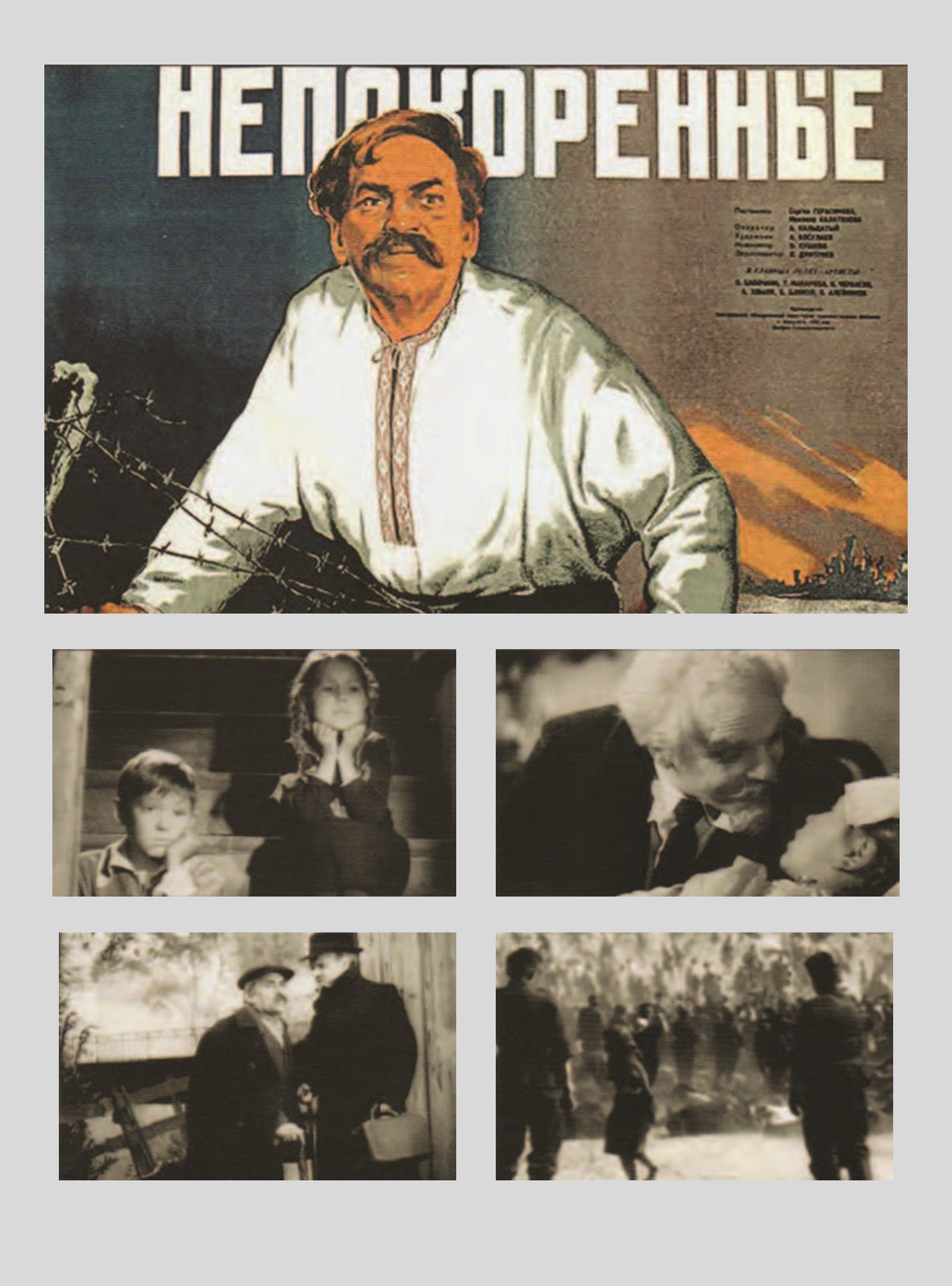
The film, The Unvanquished, derived from a novel, Semia Tarasa (Taras's Family), that was serialized in the main Soviet newspaper Pravda in 1943. The novel, by one of Pravda's own correspondents, the Russian Boris Gorbatov, was also read out on the radio and appeared as a book with a new title, The Unvanquished, in a large print run. It describes life and death in the fictional Donbas town of Kamennyi Brod after the arrival of the Germans and Italians in July 1942 and ends with liberation by the Red Army. Much of the content derived from Gorbatov's impressions of his native city of Luhansk (then called Voroshylovhrad), where he met acquaintances who had survived Nazi rule and read the notes made by a former underground activist.
The story's main character is Taras Yatsenko, a sixty-year-old metal worker with a strong faith in the Soviet system. With him are his wife, daughter, and two daughters-in-law and their children. His three sons have left home, however: one is carrying out a Communist party order to conduct underground work; another is a prisoner of war in German hands who manages to rejoin the Red Army; and the third survives the Battle of Stalingrad. In the film, the town is unnamed. The words Ukraine or Ukrainians are absent, but so is any glorification of the Russian people. Nevertheless, one sees much that suggests a Ukrainian setting and heritage; for instance, Taras's family is shown reading Nikolai Gogol's story Taras Bulba.
In Gorbatov's novel, the Holocaust appears briefly but distinctly. An elderly doctor called Aron Davidovich Fishman used to treat Taras's family. Now he wears a bandage with a Star of David. Upon seeing this, Taras bows deeply to acknowledge "you and your suffering." Later, Dr. Fishman walks with other Jews toward his death, guarded by auxiliary policemen and German submachine gunners. The novel put it as follows: these Jews shall be shot outside the city but "don't know and don't believe" it. Again, Taras is a witness; he says to himself, "Goodbye Doctor Aron Davidovich! Don't condemn me; I cannot save you. We ourselves are awaiting execution." [4]
Donskoi's film The Unvanquished showed both scenes. Taras was played by the Ukrainian Amvrosii Buchma (simultaneously artistic director of the Kyiv Film Studios), Fishman by the Yiddish Lithuanian actor Veniamin Zuskin. In the film as in the novel, Taras is the only non-Jewish person seen as reacting to the upcoming massacre. His behavior as he sees the death march surprises the doctor: "Are you bowing for me?" The reply: "I bow for your suffering, doctor." [5]
The novel and the film also depict a young Jewish girl who is hidden by many. In effect, every night she is passed on to another family. It is pure chance that she is captured in Taras's house. Unrealistically, no one is punished. Unlike in the novel, her murder is prevented by an auxiliary policeman who is a secret informant of the Soviet partisans.
Donskoi's film reenacted a mass shooting. It probably mattered that Gorbatov had just visited the liberated Nazi death camp of Majdanek, and that Donskoi was a Jew from Odessa, whose Jewish inhabitants had been murdered. From June 1944, he moved freely about Kyiv as a "special war correspondent," speaking about Babyn Yar with locals, including even survivors, and with a cameraman who had filmed there. As Donskoi later recalled: "At every step we met people who became our assistants, people who reestablished the truth and who understood the nature of the Germans all too deeply and exactly." [6]
Filming at the real Babyn Yar took place in October 1944. No one expressed any concern with on-site re-enactment atop the human remains of the real victims. But Donskoi did not aim to reenact the Babyn Yar massacre. Instead, evidently inspired by the Odessa Steps sequence in Sergei Eisenstein's Battleship "Potemkin", the killers are a line of advancing soldiers who shoot Jews who are standing at the same level, facing them. A wounded girl stumbles toward her executioners. Also, unlike the reality of Babyn Yar of September 1941, Donskoi's film has Jews wearing armbands; guards in uniforms of the Ukrainian Police; and does not show undressing. In the short Babyn Yar scene, the images of murder are interspersed with images of dark clouds, and there is loud music.
Like Gorbatov's novel, Donskoi's 90-minute film, The Unvanquished, is remarkable in another way. The Jewish victims are presented as largely passive and are not condemned for this. At the shooting, they just stand and wait and utter no words of defiance or patriotism. Instead, there are images of implied prayer.
The last half hour of the film does not have anything about Jews and is optimistic. Taras begins a journey and meets people from all walks of life. In the novel, he is looking for food and for "unravaged land." [7] The film does not really explain why he leaves, but repeats the term "unravaged land," which, perhaps intentionally, brings to mind the Jewish notion of the Promised Land. [8] The individual quest becomes a group journey whereby Ukrainians from different regions are somehow placed in the role of the murdered Jews.
In June 1945, the Artistic Council of the State Committee for Cinematography — Goskino, which was the body governing the Soviet film industry, convened to pass judgment which could either make or break the film. Almost all members of the council said they did not understand Taras's journey, and some expressed unease with the execution scene. One film director (Ivan Pyrev) opposed what he called singling out Jewish victims. But the novelist Gorbatov intervened: he had no complaints about the way his novel was adapted. Support for the film was also expressed by Eisenstein and Mikhail Romm, a director who said it was about time for Soviet films to talk about "the extermination of three and a half million Jews." [9] The Artistic Council's meeting, chaired by Ivan Bolshakov, decided in favor of mass release and even praised the execution scene. At the same time, however, the resolution that was adopted foreshadowed the attack on Jewish identity of the late 1940s, since it referred only to "Soviet citizens" and complained that the film's makers had been "carried away with the development of secondary characters" — that is, the Jews. [10]
Mark Donskoi's The Unvanquished premiered in eleven Moscow cinema theaters on October 15, 1945. It was shown in several of these until the end of November. Its time in Kyiv was much shorter, however. Within days after the premiere in four theaters on October 23, two theaters withdrew the film and by November 3, it was fully gone. The problem was that when distribution began, the film contrasted with the state's official dogmas and artistic guidelines. Hence, it received an ambivalent review in Pravda, which described the victims as too passive – "Aron Davidovich submits to his fate too much." [11] In other words, that part of the film had nothing to uplift the viewer.
In 1947, Stalin abolished the celebrations of Victory Day, and any realistic depictions of war losses became taboo. The next year, he began persecuting prominent Jews under the guise of a campaign against "cosmopolitanism." This led to the murder of Solomon Mikhoels, director of the Moscow State Jewish Theater, who was replaced by Veniamin Zuskin. He, too, faced the same fate as his predecessor. On the night of December 24, 1948, the MGB awoke Zuskin from a hospital bed and arrested him. Eventually, the man who had played the victim of the Nazi shooting in The Unvanquished was himself shot on August 12, 1952. As for Donskoi, he was lucky in merely being told to leave Moscow and settle in Kyiv.
Outside the Soviet Union, The Unvanquished was praised at the Venice Film Festival in September 1946. British distributors declined the film, but it was shown in Poland, East Germany, France, and Italy. A shortened version (82 minutes) premiered in New York City as The Taras Family on December 7, 1946. The New York Times praised it, called the shooting scene both "dramatic and horrible." [12] The show-business daily Variety was also impressed by the scene, despite what it called sloppy camera work.
In the 1960s, The Unvanquished was shown on Soviet television, but with cuts. The original film is little known outside eastern Europe, as there exist no copies with a translation. But the execution scene has received a life of its own. First it appeared in the Russian-language documentary Deti iz bezdny (Children from the Abyss, directed by Pavel Chukhraj, 2000), which was shown on Ukrainian television and also worldwide as part of the mini-series Broken Silence, produced by Steven Spielberg. A documentary from France, Einsatzgruppen: The Death Commandos (released French and English versions in 2009), presented the scene as historical footage, its writer and director Michaël Prazan wrongfully convinced that the footage was actually filmed in 1941 and only recently discovered.
Re-enactment for American television
For more than three decades, no new cinematographic material depicting Babyn Yar appeared anywhere. Footage of the unsanctioned commemoration of 1966 was confiscated. In 1967, the Leningrad film studios offered to make a film on the basis of Anatoly Kuznetsov's book on Babyn Yar, but nothing came of the plan after the Moscow-based State Committee for Cinematography replied that this was a matter for the Ukrainians. During the following two decades, no one dared propose a fiction film about Babyn Yar. The new initiative came from across the Atlantic: in the 1970s and 1980s, two large American productions included brief re-enactments. The first was the 9.5-hour-long television mini-series Holocaust, first broadcast by the NBC channel on four evenings in April 1978. Holocaust was directed by Marvin J. Chomsky, who used a script written by the Jewish American novelist Gerald Green. It told an implausible, continent-wide story from the perspective of two fictional German families: the Weiss family, Jewish, unsuspecting and all but one murdered; and the non-Jewish Dorf family, ambitious and callous.
The Babyn Yar shooting scene, filmed at an undisclosed location, lasted four minutes and appeared in part 2, The Road to Babi Yar, which aired on April 17, 1978. The perspective was that of onlookers, alternating between that of two Jews and two SS men. The first two were the fictional Rudi Weiss from Germany and Helena Slomová from Slovakia. One of the two Germans was supposed to be Paul Blobel, the actual commander of Sonderkommando 4a, the SS unit that played a leading role at Babyn Yar (along with the Staff of the Einsatzgruppe C and German police battalions 45 and 303). Blobel's role was played by the Irish actor Thomas McKenn. The other German, Blobel's fictional SS colleague Erik Dorf, was played by the American Michael Moriarty. Each pair observes from high above the shooting site, which is depicted as an even ground full of trees.
The first to arrive are auxiliary policemen, who, as Dorf notes, "don't march very well, do they?" Blobel responds, dismissively, "Ukrainians." More than thirty-thousand Jews are down there, he says. Dorf finds it "astonishing how they cooperate," which, Blobel add, "proves they don't deserve to live. Ah, there they come." [13]
The viewer then gets a view of Jews who surrender clothing and two brief glances at the rear of naked people, who are shot from behind. We see no beatings, no blood, and hear no screams. The victims seemingly endure the horror in silence. (In that sense, an earlier scene in Holocaust, of an SS shooting of Jews in a Ukrainian village, where Dorf is initiated into murder, was much more shocking.) Rudi, who alone of the Weiss family will survive the Holocaust, urges Helena to stop watching and says, "No one will believe any of this. They'll say, we lie. Because nobody could do this to other people."
The mini-series won awards, was seen by hundreds of millions of watchers globally, and helped turn the word "Holocaust" into the standard term for Nazi German persecution and murder of the Jews. Soviet citizens never got to see it.
The second American re-enactment of Babyn Yar, also not available in the Soviet Union, could be seen in the thirty-hour television series War and Remembrance, first aired by the ABC channel in 1988. War and Remembrance was presented as an adventure about Americans in World War II, but it included vivid reproductions of mass murder. Among other things, the ambitious television drama shows how a Jewish-American woman is deported from Italy and how Jews are murdered in a gas chamber reconstructed by the film crew in Birkenau just fifty meters away from the ruins of Crematorium IV. The producer and director of the series was Dan Curtis, who co-wrote the script with the highly successful historical novelist Herman Wouk, the son of Jewish immigrants from Belarus. When Wouk adapted his novel of 1978 of the same name, he wanted "to make those great and terrible days live again, graphically and truthfully," in "entertainment on the grand scale." Thus he hoped to influence a large audience: "It may grieve the judicious that the great public learns much of its history from works of entertainment. But such is the case." [14] For the Holocaust scenes, the series' producers were advised by the Simon Wiesenthal Center for Holocaust Studies, including its founder, Rabbi Marvin Hier. The series was also, as the credits stated, recommended by the National Education Association and the American Federation of Teachers.
The Babyn Yar scene was filmed in Communist Yugoslavia, in a quarry, using five hundred extras including children, who rehearsed for a week. The scene was broadcast on November 23, 1988, as part of an eleven-minute section entitled "White Russia" in Episode 7. ABC kept its promise not to cut anything. Lasting four minutes, the massacre scene is entirely narrated from the perspective of Blobel, played by the British actor Kenneth Colley. In Belarus in the middle of 1943, this SS man has just proudly shown a German visitor how his organization forces prisoners to unearth and burn the corpses of murdered Jews. In a car on the way back from this brief tour, Blobel then tells him how bad things used to be back in 1941. Horrific images of the Babyn Yar massacre are shown, including the undressing, beating, lines before the entry of the ravine, and shootings. Jews tumble down and SS men walk over bodies to finish off survivors. Many naked people are seen.
The camera watches from various angles, mostly from the ground. Among those who force the Jews to undress are auxiliary policemen in uniforms which they actually could not have worn at the time. Blobel looks on in distress. He is not horrified, but rather worried about the inefficiency. The procedure was a "botch," he says, for Ukrainian and German "sightseers" were allowed to stand next to the killings (which was historically inaccurate). [15] Indeed, we are shown civilian onlookers, including a man taking pictures and — ludicrously — a woman eating ice cream. And, as Blobel recalls in a voice-over, the clothes of the victims were thrown into the mass grave on top of the bodies. They went to waste. (This was not historically accurate either.) The re-enactment ends before the shootings are over, and does not show what happened to the clothes.
Despite some errors, War and Remembrance's section on Babyn Yar was vivid and in many ways realistic. It seems that the scriptwriter had closely read Anatoly Kuznetsov's book Babyn Yar, with its narrative of the story of survivor Dina Pronicheva. For years the scene could only be seen by purchasing the full, expensive set of DVDs, but sections now appear on YouTube.
One man's truth and Soviet lessons
In the mid-1970s, in Kyiv, the Jewish theatrical director, scenario writer, and author Aleksandr Shlaen began urging the authorities to allow him to make a documentary film about Babyn Yar. This was not a logical step for then, as always, the Soviet leadership refused to acknowledge that the massacre of September 1941 was an unparalleled war crime, namely, an attempt to kill every single Jew in the city at the time. But to Shlaen it was personal, for his grandmother and aunt had died at Babyn Yar.
Several years later, Shlaen's project took off. The Communist party of Ukraine had been ordered by Moscow to step up its propaganda against "Zionism," and one of its responses was to order a documentary that would "expose the slanderous inventions of the Zionists regarding Babyn Yar." The CPU also ordered documentaries about "the crimes of the Ukrainian bourgeois nationalists (including against Jews), and their servility toward Hitlerite fascism during the Second World War." [16] Evidently, the authorities felt that a film about Babyn Yar could strike hard at both Jewish and Ukrainian opponents of the Soviet system. That Shlaen's goal was different — a film about Jews murdered simply because of their Jewishness — at first did not seem problematic to him.
The film director Vladimir Georgienko searched for materials and filmed survivors, witnesses, as well as the Russian poet Evgenii Evtushenko at the ravine. The documentary film, completed in 1980, with commentary in Ukrainian and following Shlaen's script, was called Babyn Yar: pravda pro trahediiu (Babyn Yar: The Truth about the Tragedy). It was an emotional work that ended with the words: "At Babyn Yar, over 150,000 Jews were annihilated by the Nazis in the first five days. One hundred and three weeks of Babyn Yar followed." [17]
But the authorities changed their minds. Shlaen was taken off the project and was replaced by the prominent writer Vitalii Korotych, who oversaw a radical revision of the film and included extra scenes. Korotych, who wrote and read the voice-over, also appeared on screen himself. The final product, a 55-minute Russian-language television documentary Babii Yar: uroki istorii (Babyn Yar: The Lessons of History), was broadcast on September 29, 1981 on the Soviet Union Channel 1. Production credits for the country's one and only released documentary about Babyn Yar were attributed to Korotych, Georgienko, Shlaen, Anatolii Vashchenko, Khem Solganik, and unnamed "others." [18]
Unlike Georgienko's original version based on Shlaen's script, the new film was not about Jews but about the universal evil of mass murder, whereby Babyn Yar was presented as its "most flagrant experiment." [19] Some 200,000 people were buried at the ravine, it was claimed. The film included contemporary narratives by survivors and also footage from the 1940s: Pronicheva testifying at the Kyiv tribunal, and footage filmed at Babyn Yar with sound early in 1944 of Efim Vilkis (misidentified as Vladimir Davydov), who was a survivor of the corpse burnings. Auxiliary Ukrainian policemen were not mentioned.
When Soviet Ukraine's Ministry of Foreign Affairs demanded that an English version be shown in the West and at the United Nations, it became Babi Yar: Lessons of History. Korotych also provided the voice-over, but it was at 42 minutes much shorter than the original. It now included a passage about Anatol Kabaida, in 1942 the commander of the Staff of Kyiv's auxiliary police. According to Korotych's commentary: "Today, Zionists are ready to embrace those who yesterday organized pogroms. Today they chew the same gum and [use] the same words. Today we see the merging of all anti-Soviet forces." [20] This was part of the KGB's campaign against contacts between the Jewish and Ukrainian diasporas.
The film was rebroadcast in September 1986. The original version surfaced only in September 1991, one month after Ukraine declared its independence. The showing on Ukrainian television accompanied the first-ever official national commemoration of the Babyn Yar massacre.
A full history of the production and its various versions still remains to be written. It is clear, however, that Shlaen had asked the Public Prosecutor to prevent the showing of Korotych's version, but to no avail. According to Shlaen's widow, the art historian Alla Revenko, he was punished for his intransigence with accusations of Zionism, the opening of a criminal case against him, a home search by KGB officers who attempted to plant drugs, and a blacklist. Subsequently, no one offered him any cinema work. In 1992, using previously unused material, Georgienko released another television documentary, in Ukrainian, Zhinky z vulytsi Babyn Yar (The Women from Babyn Yar Street), about four non-Jewish women who had seen some of the shootings.
The Ladies' Tailor
The one and only Soviet Ukrainian film explicitly intending to reenact the Babyn Yar massacre was called Damskii portnoi (The Ladies' Tailor). Released in 1990, it is still the best-known Russian-language film about the Holocaust. The film was based on the 1980 play, also called The Ladies' Tailor, by the Jewish playwright Alexander Borshchagovskiy. The play (staged by the Jewish Drama Ensemble in Moscow for just one week in October 1980) is set in Kyiv on the night before the morning of September 29, 1941, with two flash-forwards about the initial escape, and then arrest, of a Jewish girl, the tailor's granddaughter.
Together with the Jewish Ukrainian director Leonid Horovets/Gorovets, Borshchagovskiy turned the play into a film script. Funding was secured (from the "Progress" Cooperative), but the Kyiv Film Studios refused any involvement with a movie about Jews. Consequently, Horovets found a private producer in Moscow, Fora-Film, which worked without any government interference. Filming took just four months in 1990, including in Kyiv. There is a scene with a Jewish man being shot in the street, but not the main massacre itself. The action centers on the evening before the deportation.
The leading role is performed by Innokentii Smoktunovskii, a famous actor of Belarusian origin, who for his performance earned the "Nika" Prize for best male actor. Smoktunovskii himself contributed to the publicity materials with the words: "Forgive us, brothers and sisters! Forgive us that we remained alive and could not save you!" [21]
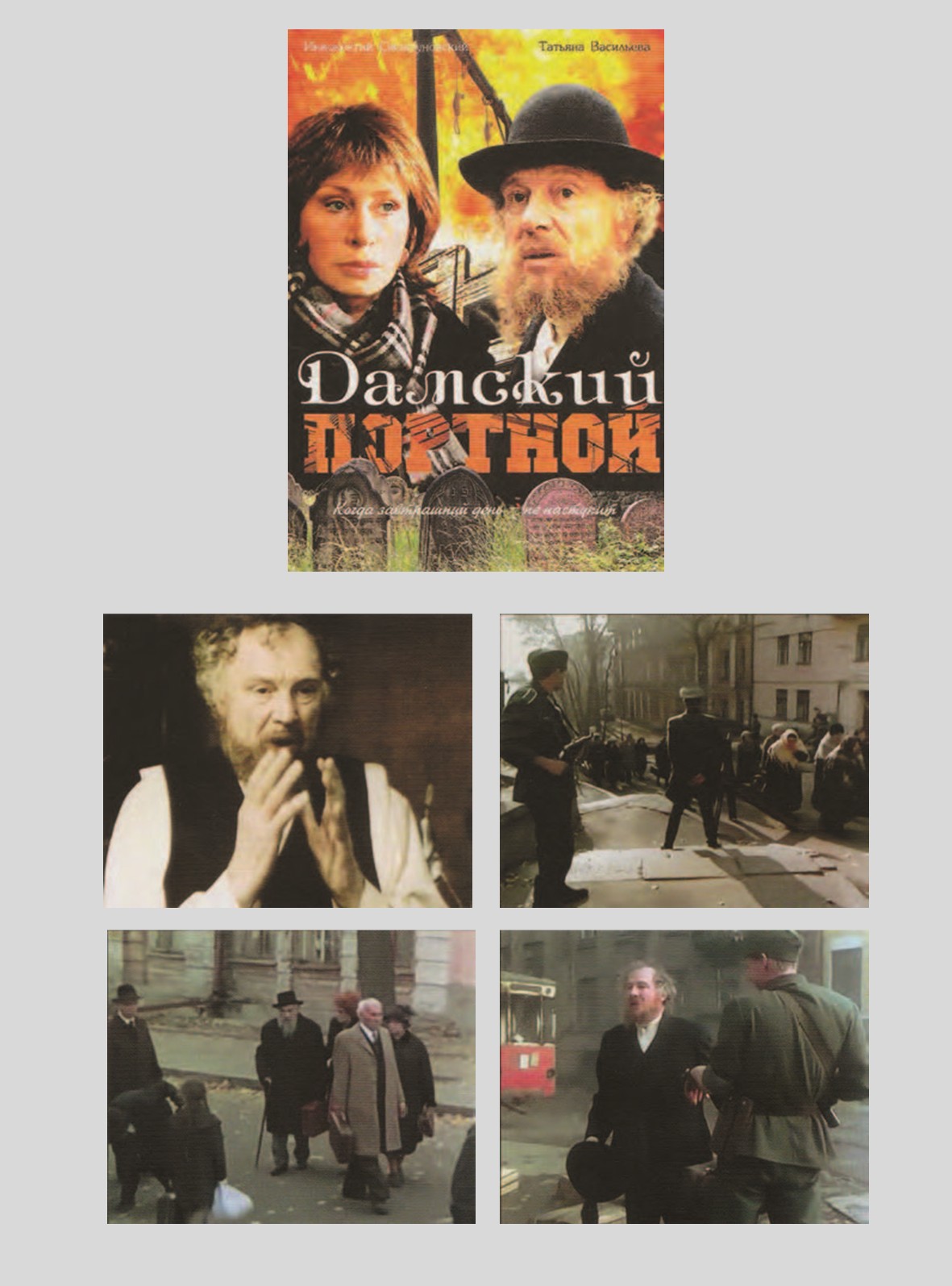
Isaac's daughter Sonia is optimistic: she believes the Germans will send the Jews to a happier place. But Isaac's daughter-in-law Ira realistically expects them to be killed. A key scene is the funeral of the son of their neighbors, a Jew who was just shot for trespassing the curfew. Then follows a scene in which Isaac envisions marchers dressed in white.
The film shows the march of the doomed. Because the producers could not find buses to get the extras from the studio to the location, those who arrived came with the metro fully clothed as the characters they were playing and wearing Nazi uniforms. An elderly woman who saw the crew in action came forward to say she had survived the Nazis and was allowed to join the crowd scene.
The march toward the ravine is depicted from the front, as the Jews walk up toward it. We see present-day cars and busy traffic in the background. Horovets deliberately left the contemporary cars in the final cut, because he felt that their presence suggests a relationship to the present. Indeed, the film offers many parallels to the contemporary mass emigration from Ukraine of Soviet Jews, keeping in mind that non-Jewish characters envy the Jews who supposedly will emigrate. Ukrainian auxiliary policemen are not shown at all in the film, probably because of the tense situation in Ukraine in 1990.
As customary in Soviet films about Nazi crimes, The Ladies' Tailor includes still pictures from the extermination camps. The film also refers to the crimes of Stalinism. Isaac's apartment block custodian, Anton Horbunov, is antisemitic, immoral, and mistreats his wife and his Jewish tenants. But at one stage, he directly addresses the viewer and explains that he was deported in the 1930s for being a so-called kulak. He tells how in exile he became a Gulag guard and was forced to commit crimes. In other words, here Stalin's regime gets part of the blame for his behavior.
All light is overexposed, and the film is shot darkly, whereby the non-Jews almost always, and symbolically, remain in darkness. Horbunov's wife Nastia is a pleasant person, however. She begs Ira to leave her uncircumcised son behind, but to no avail. She then joins the march. Her husband runs after her, shouting: "But she is not a Jew," and is shot dead on the spot. [22]
The Ladies' Tailor premiered in Moscow in 1990 one week after the director migrated to Israel. It was reviewed widely but was not shown beyond festivals. Television reruns made it familiar, however. Outside Russia and Ukraine, it was only on sale in the United States, where the National Center for Jewish Film offered a shortened version on DVD with subtitles. Despite its stereotypical characters and slow pace, no other fiction film in Russian or Ukrainian dealing with Babyn Yar is better known than The Ladies' Tailor.
Ukrainian and German failures
Two other full-length feature films produced a little over a decade later were failures. Although some praised these films when they appeared, today they have no defenders. Both entitled Babyn Yar, they appeared in Ukraine (2002) and Germany (2003).
Babii Yar (2002) is a Russian-language television film directed by the Ukrainian directors Mykola Zasieiev-Rudenko and Oksana Kovaliova and produced by "AV TV" Studio. Zasieiev-Rudenko had walked around with the script for seven years when Vadim Rabinovich, businessman and president of the All-Ukrainian Jewish Congress, put up the funds. Ukraine's first lady Liudmyla Kuchma also seems to have given important assistance. Zasieiev-Rudenko said it was the story of his courtyard, where there used to live a seven-year-old Jewish girl who he lost at Babyn Yar.
The film tells the story of a Jewish survivor played by a star of Soviet cinema, Elina Bystritskaia (born in Kyiv in 1928 from Jewish parents), and one of the German killers. Eleonora Kolmer narrowly survived the Babyn Yar massacre, but lost her parents, sister, and son there. Interspersed with flashbacks from September 1941 (discussed below), a truly unlikely story unfolds. On a specifically shown date, 25 September 2001, Eleonora has arrived in Kyiv, this time as an Israeli diplomat back in her native city to commemorate Babyn Yar. Her first shock is seeing the TV Center at Melnikova Street, a "monstrosity on top of human bones," as her voice-over says. [23] At the monument for the murdered children, she meets a German called Erwin Tanz, played by Igor Vasilev. Tanz speaks fluent Russian, and she accepts from him a gift: a drawing that he made of her on the plane to Kyiv. I was shot here, she says, and walks away.
Eleonora reunites with the woman who saved her in 1941, but central to the film is the strange relationship with Tanz, who even lives on the same hotel floor. In their final meeting, on 2 October, Eleonora confronts him with a drawing that she found at a local museum, made by a German of her and her son at Babyn Yar right before the shots ran out. "I curse you," she says.
Director Zasieiev-Rudenko offers the former Nazi a platform to explain and — the German hopes — to defend himself. He has been struggling with himself ever since, and wonders: "Why remember the past?" But once more at the Babyn Yar memorial, Tanz starts hallucinating and, to a voice-over reading the Einsatzgruppe report of October 1941, envisions a crowd including small children and his wartime self drawing near. Now his conscience really hurts and, screaming in anguish, he wants to die. The younger Eleonora appears with her son, of whom he asks forgiveness. He collapses and dies. The next day, on the plane, Eleonora catches the television news: last night, a German citizen called Erwin Tanz died at the Babyn Yar monument from a heart attack. She says to herself: "Death is forgiveness. But I cannot forgive, for my country [Israel] is in mortal danger. We must not allow a new Babyn Yar." [24] Across from her sits a young man with a swastika.
Flashbacks filmed in black and white are scattered throughout the film. Eleonora, as played by Vlada Volianskaia, crawls out of the mass grave (15 seconds) and is sheltered by a nearby girl whose father is a fully uniformed policeman. Later there are a few seconds of Eleonora's friend and sister screaming before being killed, and eight minutes of the massacre in a very artificial setting (seemingly a large photograph of the slopes of Babyn Yar). A uniformed auxiliary policeman is present as the younger Tanz leisurely takes his time to draw a portrait of Eleonora and her son, proclaiming that now he is God, and, finally, shooting the Jews in front of him. The film does not explain why the elder Tanz travels to Kyiv and its story is too implausible overall to enable one to suspend disbelief. Moreover, the camera work and the settings often look unprofessional and there is far too much mediocre and repetitive music, even over important voice-overs.
Babii Yar's first broadcast on Ukrainian television was aired on the Kyiv-based Era channel in the early morning. Israeli television also showed the Russian-language film. Overall, its reception has been highly negative. There also arose ugly situations, which to date have not yet been clarified. For instance, in 2003 the film was suddenly dropped from the main competition at the Cinematic Forum "Vmeste" in Yalta, and then bestowed with a new prize, "For Deep Revelation of One of the Tragic Pages of Humankind during the Second World War." [25]
The only Western full-length film re-enactment of Babyn Yar premiered in Germany on 3 July 2003 under the title: Babij Jar: Das vergessene Verbrechen (Babyn Yar: The Forgotten Crime). Two Americans collaborated on this project: Stephen Glantz wrote the screenplay, and Jeff Kanew was the director. The main force behind the film, however, was its highly successful producer, Artur Brauner, a Holocaust survivor from Poland who had lost relatives (on his mother's side) at Babyn Yar. Brauner's ambitious aim was to improve upon the films Schindler's List and The Pianist, which he deemed unrealistic. He believed that Germans and others had "forgotten" Babyn Yar. (To be sure, such as notion was not uncommon in Germany, as confirmed by the subtitle of a documentary about Babyn Yar shown on national German television in January 2012, which was described as a "forgotten massacre.") Braun's goal was nothing less than the creation of a timeless memorial — a "document that will be available a hundred, even two hundred years from now." [26]
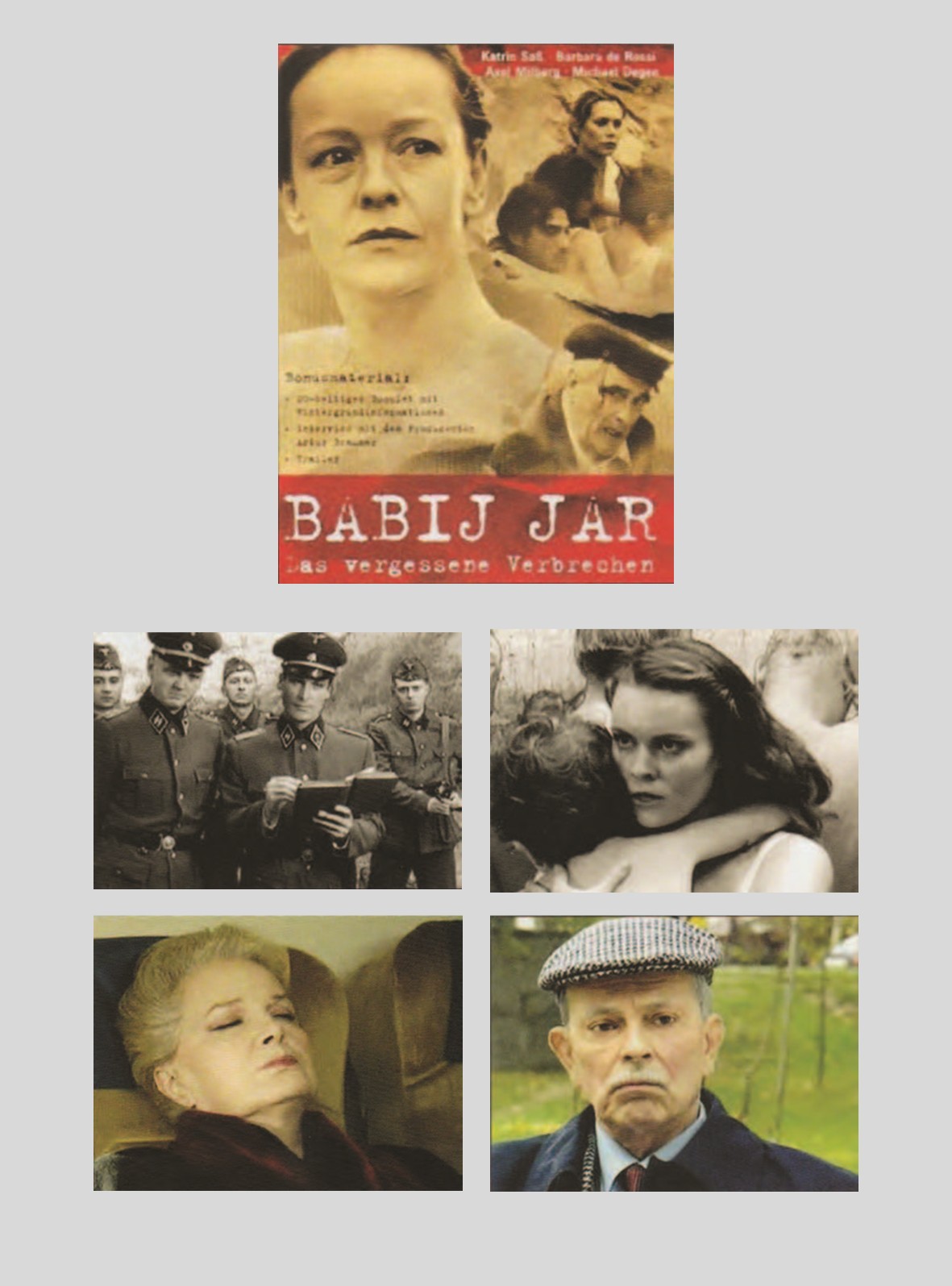
Yet seemingly not a single historian was consulted. How, otherwise, can one explain the many historical errors and Braun's own statement that only one Jew by the name of Anatoly Kuznetsov survived Babyn Yar? Like all the re-enactments preceding it, the film does not show or refer to the great fire in Kyiv that preceded the 29–30 September 1941 massacre of the Jews, and emboldened the Nazis to carry it out at soon and in a single stroke.
The cast was international, but all the actors speak or were overdubbed in German. It was filmed in Belarus with the low budget of 5 million euros, which seemingly forced the producers to insert some images from the low-quality wartime German newsreel. This, in turn, required the entire film to be in sepia.
From the beginning of Babij Jar, sometime in 1941, the viewer follows two families who live next to each other, one Ukrainian, one Jewish, and also the commander Paul Blobel (played by the German actor Axel Milberg) and his entourage. If Brauner's aim was realism, he failed. In occupied Kyiv, a Ukrainian woman, Lena Onufriienko (played by Katrin Sass, known from the film Goodbye Lenin) suddenly becomes antisemitic and denounces her Jewish neighbors as partisans. But because this denunciation is for the wrong reasons, the Nazis send her to her death at Babyn Yar as well, on the very first day of the massacre. That is a highly unlikely turn of events.
The massacre itself takes up a large part of the film's 108 minutes. The main Jewish characters end up dead in the ravine with their clothes on. The bodies in the ravine show little blood, are quiet, and do not move. As in almost all other re-enactments, the auxiliary policemen wear uniforms of the auxiliary police.
The failure of the film, as noted in almost every review, stands out all the more when compared to Brauner's 2008 production, The Last Train, about the deportation of Jews from Berlin. That film is of high quality and does not repel the viewer, as does Babij Jar, in which all the characters all are stereotypes. For instance, on the very eve of the massacre, Blobel makes a phone call home and ask his wife how his little child is doing.
Often, a bird flies high and a cawing sound is heard; we are supposed to think it is a crow (even though crows cannot glide) and sense all the better the horrors shown. Intermixed in the massacre scene is a flash-forward: a happy scene in which Lena's son Stepan gets married to Franka, the Jewish refugee from western Ukraine. The addition of this "optimistic" scene in between the long scenes of horror is probably the film's greatest flaw.
The film Babij Jar left German movie theatres, probably forever, after having drawn 9,418 viewers. It was shown on German television from January 2005 until the outset of 2008. The DVD produced in 2004 has subtitles in English and Dutch, although the film remained virtually unknown outside Germany until 2011, when it began circulating on YouTube. Screenshots often appear online without captions explaining that they show a re-enactment.
In 2009, the American Anatoly Fradis, who worked in film in Moscow until his emigration in 1979, purchased the film rights to Anatoly Kuznetsov's book. As announced in Variety, Fradis was to coproduce this drama with Barry Lewinson, who would also direct it on a budget of 35 million dollars provided by Russians, Ukrainians, and Poles. The film was to be filmed in Romania and Ukraine, but for reasons not reported — probably a lack of finances — nothing became of the plan.
The mythological "Death Match"
There exists various films and documentaries about a so-called death match in Nazi-occupied Kyiv. The story is that soccer players from Kyiv's prewar Dynamo team, now on a team called Start, beat a German team in a match held in August 1942. The German authorities had ordered Start to lose, or else its players would be killed. Indeed, they were sent to the Syrets camp near Babyn Yar and shot. This Soviet myth has been disproved many times. The Start team did play and win ten matches in July and August 1942; but its final game was not against Germans and the reasons for the arrests, and the execution of some of the players half a year later, have remained unclear.
In 1962, one popular Soviet film, Tretii taim (The Third Half), directed by Evgenii Karelov and based on a script by Alexander Borshchagovskiy, told the soccer match story, but did not depict any shootings. Fifty years later, on May 1, 2012, a two-hour-long film called The Match by the Russian director Andrei Maliukov was released in Russia; soon followed by a four-part television series that added an hour to the original version. The film was funded by Russian producers and the Russian government, but support from officials in President Viktor Yanukovych's Ukraine had enabled all filming to take place in Ukrainian localities: Kharkiv, Vasylkiv, and a quarry near Kyiv.
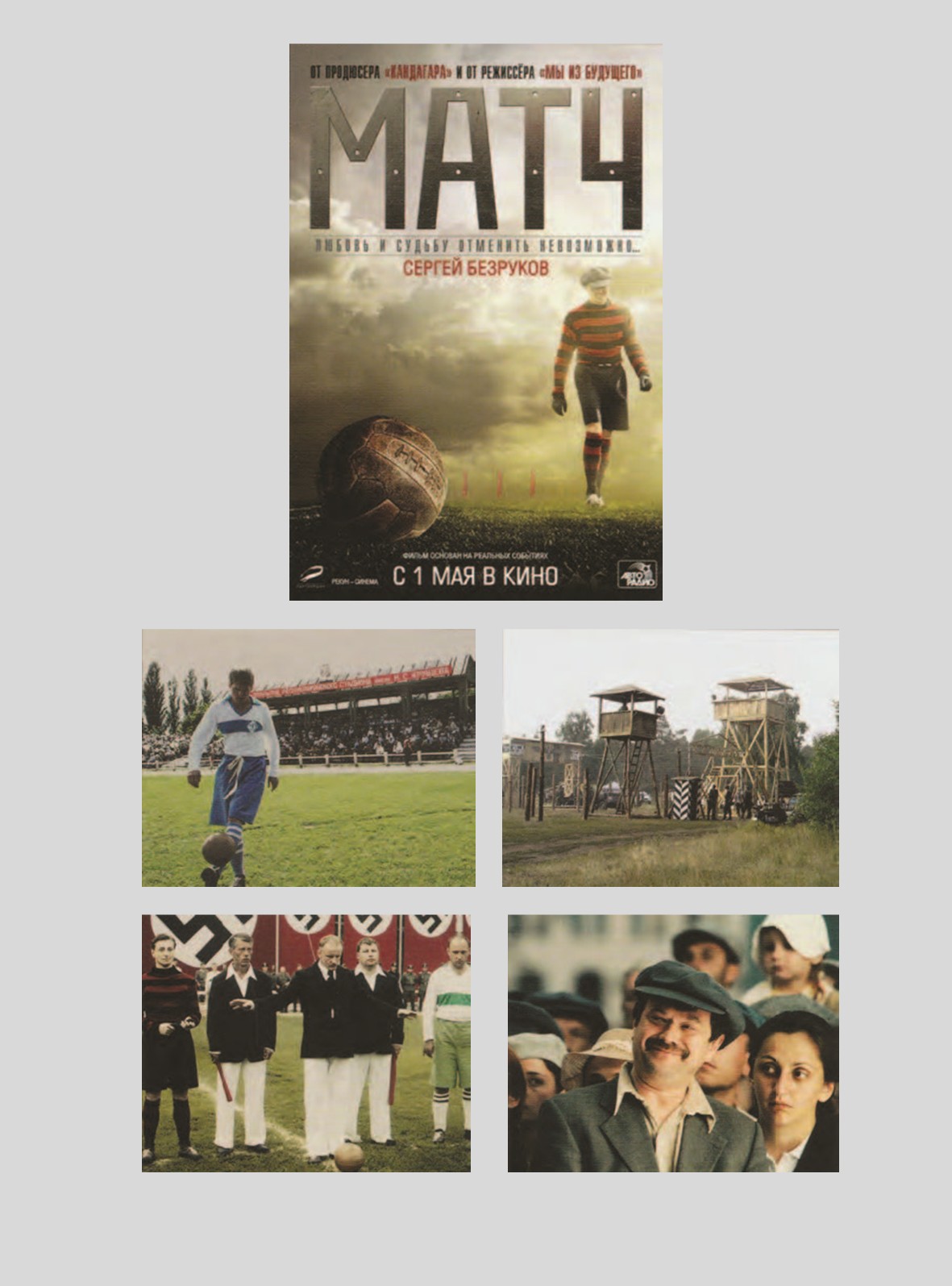
Set in June and September 1941 and in May 1942, The Match contains a re-enactment of the murder of Babyn Yar's "other," non-Jewish victims. This was the first time the theme of Babyn Yar's "other" victims, such as the Roma and Ukrainian nationalist activists, was portrayed on film. For six minutes, we see the ravine being prepared for what a German calls a rehearsal. Then psychiatric patients are violently evicted and shot in a specifically dug pit, with the scene done partly in slow motion. Germans with rifles are the main killers, but Ukrainian auxiliaries with blue-and-yellow armbands and weapons of their own assist and seem to enjoy their task. One of them actually shoots to kill.
The Match also offers the first depiction of explosions of Soviet mines which preceded the main massacre, and of spontaneous anti-Jewish violence. Shouting "They burned our Kyiv!" auxiliary policemen loot a synagogue and beat Jews. A German arrives on the scene and warns the rabbi that a real pogrom is at hand. Presenting it as good news, he adds that in two days, however, the Germans will "evacuate" the Jews to Germany for work. [27]
Eventually, well-dressed Jews, who despite the presence of auxiliaries are initially in good spirits, walk toward Babyn Yar. They must undress and are beaten (six minutes in total). The shootings themselves are not depicted; there is only the gruesome aftermath — heaps of shoes, jewelry, and naked corpses (two minutes).
The hunt for escaped Jews has some strange aspects. When an informant notices that a Jewish girl lives all alone in a house and receives food there, the Germans are not informed at all. Her father, Mikhail Svirskii (played by Vladimir Nevelskii), wore a kipah before the German invasion; now he walks the streets openly and even plays in soccer matches.
The film's main topic, however, is the death match. As early as September 1941, soccer player Nikolai Ranevich (played by Sergei Bezrukov) is released from a POW camp thanks to the mayor, who was approached by Ranevich's fiancée, Anna (played by Elizaveta Boiarskaia). She gives in to the demand to reward the mayor by marrying him.
Meanwhile, Ranevich, while working at a bread factory, develops a strong soccer team. On the eve of a replay against German players, Eberhardt's associate Brinkmann arrests Ranevich and warns him: he must ensure a victory for Germany, otherwise he, his team, and Anna will be killed. Once Ranevich notices her in the audience of the match, his natural cheerfulness and political maturity return. "Some things are worth dying for," he tells his teammates. All agree enthusiastically, no questions asked, and celebrate wildly when they win. Then follows a message on screen that "After the match, Nikolai and his comrades were allowed to live for seven happy days." [28]
Because of its anachronisms and other flaws, the film does not convince, whether in reenacting Babyn Yar, wartime soccer, or even wartime Kyiv in general. The love story is also far-fetched, and it is studiously neutral about the questionable relationships of its two main women characters, Anna and a nurse who accepts the courtship from Hans, the supervisor of shootings at Babyn Yar. The Match is best known, however, for its unmistakable anti-Ukrainian tone. When mayor "Barazii" (as the credits call him, played by the Ukrainian actor Stanislav Boklan) addresses German Commander of Kyiv, Eberhardt, in Ukrainian, an interpreter gruffly orders him to switch to Russian. Contrary to fact, public announcements during the soccer matches are in German and Russian, not Ukrainian. Ukrainian speakers are unsympathetic or worse, except for an elderly man who helps a Jewish girl in hiding, and one of the soccer players. But this Mykola says that he is a proud "Soviet sportsman." [29]
Ukrainian nationalism of any kind is considered marginal and ideologically deeply mistaken. The mayor, appointed by the Organization of Ukrainian Nationalists, favors another local soccer team, Rukh, which he calls Ukraine's "national team," although no one cheers for it. It is only out of love that he helps Anna to evade the Germans and rescue the Jewish girl.
Another odious Ukrainian is modeled on an actual Kyivan soccer player, Heorhii Shevtsov. He is the leader of the Rukh team, plays dishonestly, drinks too much, and smokes. But worst of all is building custodian Deshchenia (played by the Ukrainian actor Ostap Stupka). Deshchenia dons a yellow-and-blue armband, saying in Ukrainian, "There will be order" [30]; then he helps to murder the psychiatric patients. This antisemite with a "Ukrainian" moustache is not really an adult. Ranevich's moral authority weighs so heavily on him that he does not dare denounce either Ranevich (a Communist and NKVD man), or any member of the Jewish Svirskii family. When Germans arrest him, he screams out in panic. In April 2012 (just weeks before Ukraine would be co-hosting the UEFA European Championship), the Ukrainian State Film Agency blocked the release of The Match. Then, in September 2014, it fully banned television broadcasts or sale of the film.
Re-enactment in documentaries
A detailed analysis of the large number of documentaries from various countries that somehow deal with Babyn Yar has yet to be undertaken. There are, for instance, the US-based History Channel's Who Destroyed Kiev?, an episode in its History's Mysteries Series (2000), and the German ARD public television channel's Babij Jar: Das vergessene Massaker (Babyn Yar: The Forgotten Massacre, 2012). Ukrainian documentaries include Aleksandr Chaika's Babii Yar (2004), and an episode directed by Oleksandr Makhonko of the Velyka viina (Great War) series (2013). Babyn Yar has also been a prominent part of general documentaries, such as Serhii Bukovskyi's Spell Your Name (2006), coproduced by Steven Spielberg and Viktor Pinchuk and distributed widely.
Various documentary filmmakers have not been deterred by the failed efforts at re-enactment of Babyn Yar. On 22 June 2010, the official Day of Sorrow and Commemoration of the Victims of War, Ukraine's television Channel 1 showed Kyiv: Pochatok viiny (Kyiv: The Start of the War), a 55-minute film about Soviet and Nazi terror in the city and at Babyn Yar, where the "fascists" shot "over 100,000 adults and children of various nationalities." [31] Consultants were two staff members of the Museum of the History of Kyiv, Dmytro Malakov and Tetiana Yevstafieva. At the end, the actress Rymma Ziubina performs a reading of a Ukrainian translation of Dina Pronicheva's testimony, while a male actor plays an auxiliary policeman with a cap. A British-American documentary, The Unseen Holocaust (2013), has a two-minute re-enactment of Pronicheva's ordeal. The shooters wear helmets and fire only single shots, from guns or rifles. A female voice-over reads what are claimed to be Pronicheva's words.
That same year, in November, the 27-minute Russian television documentary, Babii Yar: poslednie svideliti (Babyn Yar: The Last Witnesses) was aired. It was written and directed by Sergei Logovchenko, produced by Maksim Rybakov, and presented and presumably financed by Aleksandr Diukov's Historical Memory Foundation. The project was supported by Ilia Levitas, director of the Memory of Babyn Yar Foundation and president of the Jewish Council of Ukraine. The film, shown on Russian television and immediately placed online as well, is noteworthy because it offers not only interviews with the survivor Raisa Maistrenko and non-Jewish witnesses, but also convincing re-enactments by young actors.
Neverthless, Babyn Yar: The Last Witnesses is a very flawed product. The voice-over complains about slander against "the Red Army, the partisans, the defense industry, not to mention the Kremlin leadership," the slander being that "the Reich, the Wehrmacht, and the SS" were "innocent victims of Soviet propaganda." [32] Who says this absurdity is not specified, nor can it be. The film also presents Holocaust deniers as highly influential and in urgent need of refutation. Finally, there is an unsurprising but unconvincing link to the present: "In Ukraine, nationalism has raised its head — nationalism in its most frenzied form." It does not take long for the self-satisfied male voice-over, the constant music, and the flashy cuts to irritate the viewer.
We have found that while the former killing site itself was used to film, for the first time in the world, Jews being led by Germans to their death as a group, the first re-enactments explicitly set at Babyn Yar were American productions, unseen in the Ukraine at the time of release. The first full-length feature film about Babyn Yar was a Ukrainian product from the period when the country was heading for independence. Unfortunately, other attempts at re-enactment made since then have been artistic failures that do all but provide emotional knowledge, or they are marred by an overly politicized context. Thus, there is little cause for satisfaction. The wait is now for the results of work by the German-based acclaimed Ukrainian director Serhii Loznytsia, who for some time has been working on a film about Babyn Yar based on a script of his own.
Endnotes
[1] Jessica Durlacher, Op scherp [On Edge] (Amsterdam: De Bezige Bij, 2001).
[2] Annette Insdorf, Indelible Shadows: Film and the Holocaust, 3rd ed. (Cambridge: Cambridge University Press, 2003, or. 1983), p. xii.
[3] Jeremy Hicks, First Films of the Holocaust: Soviet Cinema and the Genocide of the Jews, 1939–1946 (Pittsburgh: University of Pittsburgh Press, 2012), p. 130.
[4] Boris Gorbatov, Nepokorennye: (Sem'ia Tarasa) (Moscow: Izdatel'stvo "Pravda, " 1945), pp. 23–24 and 44–45.
[5] The scene can be viewed at https://phantomholocaust.org/films/the-unvanquished/ [last accessed June 3, 2021].
[6] Hicks, First Films of the Holocaust, p. 142.
[7] Gorbatov, Nepokorennye, pp. 83–84.
[8] Olga Gershenson, The Phantom Holocaust: Soviet Cinea and Jewish Catastrophe (New Brunswick, N.J.: Rutgers University Press, 2013), p. 47.
[9] Gershenson, The Phantom Holocaust, p. 50; Hicks, First Films of the Holocaust, p. 144.
[10] Gershenson, The Phantom Holocaust, p. 52.
[11] Hicks, First Films of the Holocaust, pp. 152–153.
[12] Hicks, First Films of the Holocaust, p. 153.
[13] DVD set "Holocaust " (Dutch Filmworks B.V., 2008), chapter 13.
[14] Booklet included in DVD set Herman Wouk's War and Remembrance (Orland Park, Ill.: MPI Home Video, [2008?]).
[15] DVD set Herman Wouk's War and Remembrance (Orland Park, Ill.: MPI Home Video, [2008?]), part VII, chapter 4.
[16] V. R. Nakhmanovych, "Bukovyns'kyi kurin' i masovi rozstrily ievreïv Kyieva voseny 1941 r., " Ukraïns'kyi istorychnyi zhurnal, LI, 3 (Kyiv, 2007), p. 90.
[17] DVD with copy of the film (donated by Alla Revenko), archive of the author.
[18] Film 2677, "Babi Yar. Lessons of History, " United Holocaust Memorial Museum, RG-60.4200, available for viewing online at https://collections.ushmm.org/search/catalog/irn1002768 [last accessed June 3, 2021]
[19] Film 2677, "Babi Yar. Lessons of History. "
[20] Film 2677, "Babi Yar. Lessons of History. "
[21] Booklet with DVD, Ladies' Tailor (Waltham, Mass.: National Center for Jewish Film, n.d.).
[22] The quotation is from the DVD. My description is based on Gershenson, The Phantom Holocaust, 206-222, and Judith Deutsch Kornblatt, "'Ladies' Tailor' and the end of Soviet Jewry, " Jewish Social Studies, V, 3 (Stanford, CA, 1999), pp. 180–195.
[23] "Babii Iar, " viewed at https://www.youtube.com/watch?v=Qks1TyoWl8E [last accessed June 3, 2021].
[24] "Babii Iar. "
[25] Interview with Elina Bystritskaia in Evreiskii obozrevatel' (Kyiv), no. 6/246, June 2013, online at https://jew-observer.com/lica/ya-vsegda-byla-samodostatochnoj/ [last accessed June 3, 2021].
[26] "Presseheft " for "Babij Jar. Das vergessene Verbrechen, " archive of the author.
[27] "Match, " part 2 (here, from 14:19), available at https://www.youtube.com/watch?v=BCcAAeQTdZo [last accessed June 3, 2021].
[28] "Match, " part 4, available at https://www.youtube.com/watch?v=eMahe01GabY [last accessed June 3, 2021].
[29] "Match, " part 3 (here at 28:24), at https://www.youtube.com/watch?v=t_DGQlIwnhA [last accessed June 3, 2021].
[30] "Match, " part 1 (here at 35:16), at https://www.youtube.com/watch?v=56h4Y-x8xWU [last accessed June 3, 2021].
[31] Viewed online from a link that as of 2021 is no longer active.
[32] DVD of the film, which is also available for viewing at https://www.youtube.com/watch?v=KfjOWYASSB0 [last accessed June 3, 2021].