




"Babyn Yar: History and Memory" — Chapter 12
The Ukrainian Jewish Encounter was founded in 2008 with the goal of building stronger relations between Ukrainians and Jews, two peoples who, for centuries, lived side by side on the territory of what is modern-day Ukraine. Since then, in keeping with its motto, "Our stories are incomplete without each other," UJE has sponsored conferences, round-table discussions and research, as well as translations and publication of works the organization anticipates will promote a deeper understanding between the two peoples and an appreciation of their respective cultures.
We offer for the first time the book Babyn Yar: History and Memory in eBook format.
A ravine on the outskirts of Kyiv on September 29-30, 1941, was witness to one of the great atrocities of the Holocaust. There, over a two-day period, nearly 34,000 Kyiv Jews were shot to death in one of the first major events that has become known as the “Holocaust by Bullets”.
With deep compassion and understanding, a group of internationally-renowned scholars discuss the treatment of Babyn Yar in culture, music, and the arts from Stalinist times to our own. Beyond the detailed and harrowing accounts of what took place in Kyiv in late September 1941, the essays in this volume realize the importance of preserving Babyn Yar as a symbol of the Holocaust and other tragedies of the twentieth century.
Babyn Yar: History and Memory was edited by Paul Robert Magocsi, Professor Emeritus of history and political science at the University of Toronto, where from 1980 to 2025 he held the professorial Chair of Ukrainian Studies and Vladislav Hrynevych, Leading Scholar at the Kuras Institute for Political and Ethnic Studies, Ukraine.
The book (Ukrainian version) was published in conjunction with a series of events sponsored by UJE to commemorate the 75th anniversary of Babyn Yar. Published in 2016 by Dukh i Litra.
Publication of the English version (2023) was made possible by the generous support of the Ukrainian Jewish Encounter, Toronto, Canada. Distributed by the University of Toronto Press for the Chair of Ukrainian Studies, University of Toronto,
(The editors appreciate the support of the sponsor and acknowledge that the views expressed herein are not necessarily those of the Ukrainian Jewish Encounter.)
Chapter 12
Click here for a pdf of the entire book.
Babyn Yar in music
Natalia Semenenko
Artists play a special role in the social perception of the Babyn Yar tragedy. Feeling the pain of this loss keenly, it is artists who, for the most part, are the first to display courage and take on the responsibility to grasp tragic events of the past. In revealing these events by artistic means, they often anticipate by entire decades the eventual reaction of official state institutions. Sensing with their exposed nerve endings the contradictory and tragic nature of contemporary existence, and with the aid of individual artistic-stylistic devices, artists do not simply recreate a panoramic picture of the world or a certain fragment of history; they also act as a powerful generator of new and timely spiritual meanings.
Music is the universal language of mankind, which can exert a fundamental impact on mass consciousness. An outstanding musical composition is capable of shattering an official code that has been imposed on society, and breaching cultural barriers. And, in penetrating the philosophical depths of human existence, it is capable of preparing collective awareness for radical transformations, thereby responding to the challenges of the age. The sacred memory of the innocent victims of the Holocaust, the largest mass grave of which in Ukrainian lands is Babyn Yar, has been preserved for the coming generations by emblematic musical works written by foreign and Ukrainian composers. Each artist who has touched on this tragic theme has relived, recast, and defined for himself the genre and array of expressive devices in order to create a musical memorial to Babyn Yar. Recognizing music's ability to carry out the functions of a commentary, social pamphlet, and political appeal, various composers have demonstrated solidarity during the creative process to create compositions that are in harmony with his own time.
The Holocaust in music
The phenomenon of musical representations of the Holocaust began with the cantata, A Survivor from Warsaw (Ein Überlebender aus Warschau, 1947), composed by the Austrian-Jewish-American composer Arnold Schoenberg. This seven-minute composition, whose premiere took place in 1948, essentially marked the opening of the world's catalogue of musical works devoted to this vitally important theme.
The cantata was commissioned by the Koussevitzky Music Foundation. Embedded in Schoenberg's composition are documentary sources that, in keeping with the composer's conception, are transformed into the story of a prisoner from the Warsaw ghetto, who somehow survived miraculously. The narrator's account, as the personification of the image of an eyewitness of those horrific events, is performed in English. The recitative clarity of the narrator's part is achieved thanks to the extraordinary psychological veracity of the recreated state of a man who has been condemned to death. The coarse shouts of the sergeant (rendered in German), the officer's commands, and the order to bring the prisoners to the gas chamber harshly interrupt the voice of the narrator, who in the final, tragic moments of his life recalls his relatives who disappeared without a trace.
The arresting, dominant emotion of the entire work is the singing of the ancient Hebrew hymn Shema Yisroel,[1] which in its choral rendition becomes a symbol of the Jewish people's spiritual consolidation, even at the dramatic moment of their execution. This biblical poem is recited by Jews both as an everyday prayer and as an entreaty before imminent death. The men's choir sings in ancient Hebrew, and the prayer is strengthened by the penetrating tone of the trombone. With sparse instrumental timbres the composer paints a realistic picture of everyday life in the concentration camp: The trumpet solo recreates the morning wake-up signal, the anxious throbbing of the small drum becomes a unique code of the camp atmosphere — of spiritual unease, nervousness, tension, danger, and — finally — a presentiment of death.[2]
After a lengthy interval of nearly two decades, in 1965 the composer Günter Kochan premiered his cantata, Die Asche von Birkenau, which was followed a year later by the premier of the collaborative cantata, the Jüdische Chronik, an artistic effort spearheaded by the East German composer and conductor Paul Dessau. The impetus for the Jüdische Chronik was given by a series of anti-Jewish terrorist acts, particularly the defacement in 1959 of a synagogue that had just been restored in Cologne, West Germany. These distressing events spurred Dessau into writing a five-part cantata, whose text recalls various episodes from the persecution of the Jews during the Holocaust. Joining the musical project on Dessau's invitation were composers from both West Germany (Boris Blacher, Karl Amadeus Hartmann, and Hans Werner Henze) and East Germany (Rudolf Wagner-Régeny and the librettist Jens Gerlach). [3]
Dmytro Klebanov
The very first composer to create a musical reading devoted to the unprecedented extermination of Jews in Babyn Yar was the Jewish composer Dmytro Klebanov from Kharkiv, Ukraine. In 1945, after returning from evacuation to his native city, the composer learned of the mass destruction of the Jews in Kyiv. Disturbed and shocked to the core by the news, he resolved to commemorate the martyrdom of the innocent victims in music and composed Symphony # 1: In Memory of the Martyrs of Babyn Yar. This was truly a heroic act on the composer's part. In a sense, it was a singular act in anticipation of musical works of the highest quality, which were created in the following decades on the way to establishing a panoramic musical interpretation of the Holocaust theme dispersed in time.
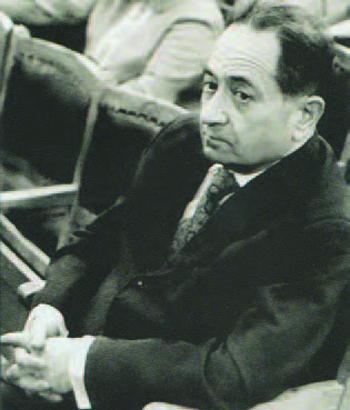
Klebanov was a pioneer among Soviet artists in general and in Ukraine in particular. He was someone who had the audacity to proclaim at the top of his voice the tragedy of Babyn Yar through purely symphonic devices (without the use of any texts with concrete subject and thematic reference points), and thus to open people's eyes to this vicious Nazi crime. At the same time, the composer sought to ensure that his musical material corresponded as much as possible both to historical events and to the imagistic richness of the content of his work. Before writing his symphony, Klebanov made a thorough study of all printed sources that were available in Ukraine at the time: recordings of Jewish folk melodies, ancient religious chants (dating to the Old Testament times of King David)), religious hymns, etc. He also sought the advice of the well-known Kharkiv choir conductor and expert on the Jewish musical treasury, Zynovii Zahranychnyi.[4]
The "biography" of Klebanov's symphony, like that of the composer himself, was complicated. The very run-up to its public presentation was a source of considerable stress for Klebanov. Figuratively speaking, the final rehearsal took place in an emotionally charged atmosphere. The Communist party leadership of Soviet Ukraine and the curators of the concert and theater industry (essentially censors) were indignant and genuinely perturbed by the music's "nationalistic sound," in particular because the score was woven out of typical and easily identifiable Jewish folkloric intonations and steeped in distinctively Jewish melodies and rhythms. Symphonic development unfolded on a foundation of the colorful Jewish Freygish scale (altered Phrygian scale). The culmination of the final movement, which includes a part for solo soprano, was reminiscent of the function of the hazzan (cantor), the improviser and performer of traditional and new Jewish prayers. The finale immediately elicited in informed listeners associations with the mourning ritual prayer Kaddish.[5] The music spoke to everyone in the language of grief. This was indeed a requiem for the Jews who were murdered in Babyn Yar.[6]
Despite various complications, the Kharkiv premiere of Klebanov's symphony, In Memory of the Martyrs of Babyn Yar, took place in 1947. The following year it was performed in Kyiv under the direction of the acclaimed conductor Natan Rakhlin. By 1949, however, at the height of a widespread campaign against so-called cosmopolitanism, Klebanov became the target of ideological pressure. His symphony was condemned as a work "imbued with the spirit of bourgeois nationalism and cosmopolitanism" and that was "replete with biblical motifs and steeped in tragic doom." Although Klebanov as composer and pedagogue was quite famous by this time, he was nonetheless dismissed from his posts as chairman of the Department of Composition at the Kharkiv Conservatory and head of the Kharkiv branch of the Union of Composers of Ukraine. The process of granting him the title of professor was delayed for decades. All performances of the Babyn Yar symphony were banned, and for decades its score lay gathering dust in a drawer, with no prospects that it would ever be performed.
Wide public recognition came to Dmytro Klebanov's symphony only after the composer's death. On 29 September 1990, the day set aside to honor the victims of Babyn Yar, the work was performed by the National Symphony Orchestra of Ukraine under the direction of Ihor Blazhkov, the discoverer and promoter of numerous "forgotten" scores. (The conductor Blazhkov, a friend of the late composer, regarded the revival of the Babyn Yar symphony as his own moral obligation in tribute to the memory of its creator). Shortly afterwards fans of Klebanov's composer's works based in Zhytomyr became acquainted with the symphony, which was performed by the same group of musicians. Eventually, Ukrainian Radio made a recording of the symphony.[7]
Thus, thanks to Dmytro Klebanov, a stable foundation was laid for future musical commemorations of Babyn Yar, something that various composers developed assiduously over the next several decades. Some of them relied on Klebanov's first efforts. Today, listeners of Klebanov's Babyn Yar symphony are struck by the richness of its musical tapestry, replete with the lush intonations of Jewish folk songs, and by the wealth of motifs from synagogue chants.
Dmitrii Shostakovich
The Soviet composer Dmitrii Shostakovich was fated to carry out the noble mission of introducing the Babyn Yar theme into the global musical space. His Symphony No. 13 (subtitled Babi Yar, in keeping with the title its first movement), is based on a poem by Yevgeny Yevtushenko. Sounding like a warning signal, Shostakovich's work alerted the international cultural community and progressive public to the tragic events that took place in Kyiv in September 1941.
Preparations for the first performance were hindered by numerous obstacles. From the outset there were lengthy, tense negotiations between the composer on one hand, and Soviet government officials, orchestral conductors, and soloists on the other. The search for a solo bass voice was particularly complicated. Shostakovich had his eye on the renowned Ukrainian bass Borys Hmyria, with whom he enjoyed close collegial relations with the composer and who was the foremost performer of many of Shostakovych's vocal chamber works. Unfortunately, Hmyria, who was very much aware of the authorities' prejudiced attitude toward him (because the singer had continued living in Ukraine when it was occupied by the Germans during World War II), was forced to heed the "recommendations" of the party leadership and refrain from taking part in the project. Neither was Shostakovich able to enlist the collaboration of the famous conductor Yevgeny Mravinskii, who had conducted the premiere performances of all his symphonies.[8]
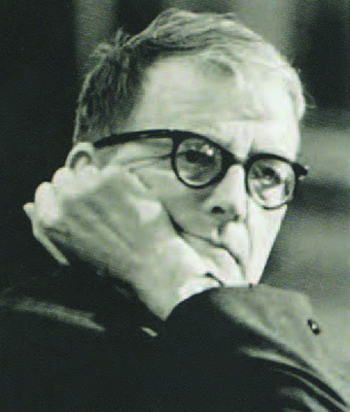
The premiere of Symphony No. 13 finally took place in Moscow on 18 December 1962, under the direction of Kirill Kondrashin and featuring the bass Vitalii Gromadskii. Music lovers' responses to the work were ecstatic. "This music contains the entire, immense amplitude of our life, from profound disappointments and tragic conflicts to enlightenment and proud hopes," declared the legendary cellist, conductor, and citizen of the world Mstislav Rostropovich after attending the premiere of Shostakovich's symphony.[9]
The symphony begins with the distant, measured sound of bells, which is layered over the ostinato of stringed instruments in a low register, and gradually acquires power with the sound of brass instruments. The gloomy and sinister tone of the introduction is emphasized by the sound of a wailing wind. The severely restrained voices of the men's choir seem to be reading out the verdict handed down to those who have been condemned to death, and they are reinforced by sorrowful motifs in the low sounds of the bassoon, contrabassoon, and bass clarinet, together creating a generally menacing atmosphere of utter horror and torpor.[10]
Shostakovich's symphony was performed a second time in March 1963, in Minsk. Thereafter the work was unofficially banned. Nevertheless, a record was released in the West, based on a recording made at the Moscow concert and smuggled abroad. Within the Soviet Union itself, the score and a vinyl record appeared only nine years later, but it was another version, featuring changes to the text of the first part. However, several subsequent performances, especially the one that took place in 1966, during the Shostakovich music festival in Leningrad, invariably attracted a negative reaction from the Soviet authorities.
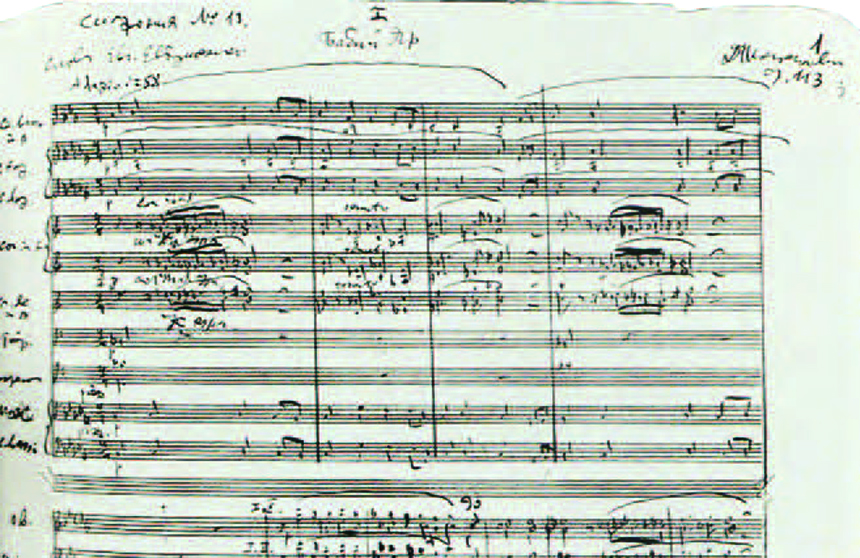
Until the end of Shostakovich's life, Symphony No. 13 remained a work whose performances the Soviet leaders sought to hinder. But their efforts were in vain. Moreover, the authorities never dared to ban it outright, and the work was preserved in the repertoire of the Gorky and Novosibirsk symphony orchestras and of the Moscow Philharmonic Orchestra (until Kondrashin's emigration). It was performed many times in the finest concert halls throughout the world: in France (conducted by Daniel Barenboim); in Germany (Kurt Masur, Leipzig); and in the United States (Kurt Masur, Boston, and from 1988, Mstislav Rostropovich conducting the New York Symphony Orchestra).[11] In Ukraine, Symphony No. 13 was first performed in 1988 in Kyiv by the State Academic Orchestra, under the direction of Volodymyr Kozhukhar, the Dumka Capella, and the soloist Anatolii Safiullin. Shostakovich's requiem to the innocent victims of Babyn Yar is now part of the treasury of world musical culture.[12]
Yevhen Stankovych
An important, contemporary musical work in which the Babyn Yar theme is highlighted monumentally and panoramically and interpreted artistically and aesthetically is by the distinguished Ukrainian composer Yevhen Stankovych. His Babyn Yar (Kaddish Requiem), set to a poem written by the eminent poet Dmytro Pavlychko, correlates with the tragedy through its sound as well as humanitarian and historical content.
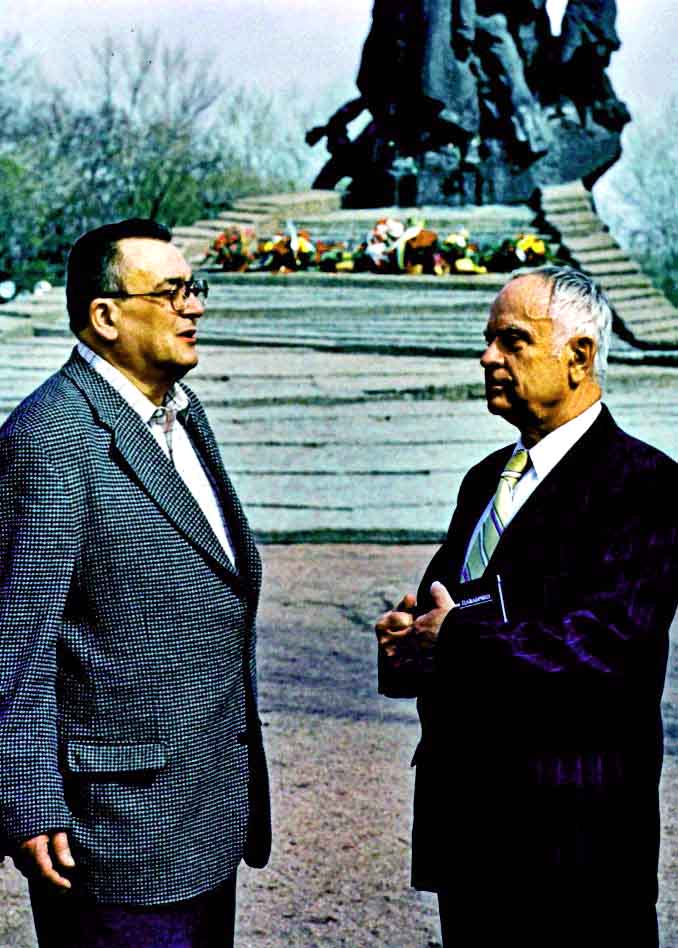
The writing of this epic, dramatic work was timed to coincide with the fiftieth anniversary of the Babyn Yar tragedy and, as the composer noted, was specially commissioned for the occasion by the Ukrainian government. Stankovych's creative process was facilitated by his prior consultations with the rabbi of the Podil synagogue in Kyiv, who acquainted him with the logic and, most importantly, the texts of the commemorative prayer. Subsequently, the prayer was translated into Ukrainian and provided to Pavlychko so that he could create the versified foundation of the work.[13]
The premiere of this multipart work was held on 23 June 1991 in the Column Hall of the National Philharmonic of Ukraine. It was performed by the country's leading ensembles and soloists: the Symphony Orchestra of the National Philharmonic of Ukraine conducted by Mykola Diadiura; the Dumka Academic Capella conducted by Yevhen Savchuk; the soloists Serhii Mahera and Dmytro Popov; and the narrator Oleh Savkin. The performance of Babyn Yar by the Dumka Capella and the symphony orchestra conducted by Volodymyr Kozhukhar, which took place at the Babyn Yar site during the ceremony to honor the memory of those who lost their lives there, was unforgettable. In this once ill-omened place, Stankovych's music sounded like a long-awaited panakhyda (commemorative church service) for the victims of Nazism.
Notwithstanding such an immense number of performers, consisting of a mixed choir, symphony orchestra, a tenor, bass, and narrator, the composer did not opt for the traditional route of using the verbal structures of the Roman Catholic funeral genre of the requiem mass. Instead, he offered his own secular interpretation of a mass for the dead. While Stankovych's music may elicit certain analogies with Catholic canonical parts of a requiem, running throughout the musical texture of the requiem are intonations of Ukrainian and Oriental songs constructed through the use of contemporary composition devices. The composer called his work a panakhyda for the victims of fascism. In a masterful way he synthesized the traditions of writing requiems in various religions and cultures (Jewish, Catholic, Orthodox). The vocal intonations of Ukrainian and Jewish folklore imbue this requiem with particular expressiveness and emotion.
The boundless despair and a heightened, tragic world perception that are embedded in the musical and poetic texts are counterbalanced by a general philosophical interpretation of those horrific events, which instantly raises this work to a world-class level. The author of the versified text, the Ukrainian poet Dmytro Pavlychko, acknowledged that by the time he was invited to create a text for Yevhen Stankovych's Babyn Yar he was already very familiar with Jewish themes, having published a poetry cycle entitled Yevreiski melodii (Jewish Melodies). The poet regarded his collaboration with the composer as a priority and emphasized that "Ukrainians revealed the great martyrdom of the sons and daughters of Israel."[14]
The composition of Stankovych's sprawling, seven-part requiem, featuring a lengthy orchestral introduction, expresses the never-ending, sorrowful gait of a condemned person and the despair and horror experienced by the throngs of people about to be put to death. During its performance this work exerts a genuinely hypnotic effect on listeners, who are left with the impression of being privy to a great mystery. The majestic mosaic of the seven parts — The Lord of Light, Here We Lie, Judgment Will Come, Bent by the Autumn Wind, Gray-Haired Moses, Rejoice, and Great God — which move from one into the other, seems to be threaded into a historical chronograph that has been channeled from the distant past to the present day. To listeners it reveals a kaleidoscope of practically realistically sensed gradations of human suffering, despair, sorrow, pain, grief, spiritual protest, and psychological devastation. The realistic nature of the pictures of the mass executions of the victims of Nazism nearly reach the naturalistic limits of pictorial veracity (especially in the orchestral fragments of parts 2 and 5). The idea of the inevitability of divine punishment for this terrible crime against humanity is conveyed with extraordinary expressiveness, creative power, and conviction by the choristers as they chant the words, "Judgment will come," in part 3. And yet several more parts lie ahead, in which the composer, with the aid of the choir and various symphonic devices, creates a worthy musical monument to those who perished in Babyn Yar.
As soon as the Babyn Yar Kaddish Requiem was completed, several standard performances took place (both the full version and individual parts), which were timed to coincide with various anniversaries of the tragedy. The performance that took place in Jerusalem on 6 October 2011 at Yad Vashem, Israel's official memorial to the victims of the Holocaust, was, according to the composer, the most symbolic and relevant. The particular atmosphere of the memorial itself inspired the Ukrainian performers to the highest degree of artistic self-devotion. The brilliant cohort of world-class musicians featuring the magnificent Dumka Capella, a recognized representative of Ukraine's age-old national traditions of choral singing; the superb Jerusalem Symphony Orchestra; and one of Ukraine's finest conductors, Volodymyr Sirenko, worked together seamlessly to imbue their performance with a high level of emotion. The audience, among whom were high-ranking government officials and musical figures from Ukraine and Israel, was sincerely moved by the performance, which fostered a sense of psychological unity among the listeners.
During the performance at Yad Vashem, the composer specifically requested that the audience refrain from applauding. Consequently, the multipart vocal and symphonic tapestry was emancipated from the format of established concert standards, thereby emphasizing the sacred and ritual essence of the work. The fact that fifteen years later Stankovych composed a new version of his score, timing it to coincide with another anniversary of Babyn Yar, proves that this theme has taken a firm hold of the composer, who continues to seek and refine new devices for his artistic interpretation of the tragedy.[15]
Anyone listening to Stankovych's Babyn Yar Kaddish Requiem cannot fail to note the distinctive effect of interactivity. There is an absolutely realistic sense that the audience is present at the dreadful events that took place in Babyn Yar, with its stupefying scenes of mass murder of innocent victims by the Nazis. When this work is performed in a concert hall, an extremely powerful energy field is created in the audience. It is a kind of psychological state that borders on a genuinely emotional shock similar to the one that occurs while watching documentary film footage or a historical epic about the dramatic conflicts that have occurred throughout history. The intonational and dramatic conception reinforces the general thrust of the work, which calls for reconciliation and tolerance among people. The performance of the text in two languages, Ukrainian and Hebrew, imbues the work with particular artistic conviction.
Volodymyr Ptushkin
In 1999, the eminent Kharkiv composer and People's Artist of Ukraine Volodymyr Ptushkin, a pupil of Dmytro Klebanov, wrote the Ukrainian Requiem. The idea to write such a work was the brainchild of Volodymyr Lukashev, artistic director of the National Philharmonic of Ukraine. Deeply impressed by Krzysztof Penderecki's Polish Requiem, Ptushkin instantly sensed that an analogous work was lacking in contemporary Ukrainian music.[16]
For the textual basis of his work the composer chose the poems of the well-known dissident poet and Shevchenko Literary Prize laureate Stepan Sapeliak. Ptushkin recently admitted that he was captivated by the particular acuity of Sapeliak's images and symbols as well as by the brilliant sound of the national mentality inherent in his poetry. Ultimately, it was precisely these poetic works that helped the composer create a graceful musical and poetic composition featuring the boldly defined contours of the requiem genre.[17]
The Canadian literary specialist Ariadna Shum accurately described the poet's distinctive voice: "There is great power in the poems of Stepan Sapeliak. They act with that force of content which is offered by form in visual reading, but they have a much stronger impact when they are read out loud. They require a very good reader, who would convey all the nuances of the deep poetical thought in a highly sophisticated form that is powerful in its sincerity."[18] Sapeliak's poetry found just such an accomplished interpreter in the person of the composer Volodymyr Ptushkin, who deeply absorbed the psychological acuity, sincere frankness, and primeval folkloric abundance of Sapeliak's poems. For each poetic phrase the composer found a corresponding musical and intonational counterpart, emphasizing and granting additional power to the impact on the audience of the unique and distinctive poetry:
Drink, little reapers, and blow the small horn!
A war from the heavens is coming…
The narrator reads:
This is Babyn Yar. This day is still burnt by the sun
And the mourning wall of lamentation …
And those skeletal tracks rip at the time of the past and unnatural things.
We remain.
That cordage of scars, dreadful echoes.
And the scroll of memory . . .
We remain. And the sky . . . And punishment . . .
And shadows on tar. And . . . do not kill . . . [19]
Every poetic phrase holds within it a powerful store of accumulated, explosive energy that, like a coiled spring, is released swiftly and "fires" into the consciousness of every listener. Sapeliak's poetic voice is a truly unique phenomenon in contemporary Ukrainian literature. His poetry is not marked by traditional rhymes and meters. On the contrary, he directs attention through the singular and unexpected nature of his structure and the whimsical and flexible melodics of his strophe. In its internal workings it can break up into laconic phrases of unequal length that interweave spiritual foundations, seemingly existing outside the verbal form of feeling. It is this intonation of agitated and awakened awareness that by definition cannot have syntactical barriers and clear-cut strophes. This is improvisation that is born spontaneously in the depths of a heart filled with high spirituality and magical power, transcending the limits of the existence of the word itself. Ptushkin was enchanted precisely by this magic and the concentrated energy of Sapeliak's poetry. From the outset it was dear to him and comprehensible, and because of this it was entirely natural for the composer and the poet to embark on a creative collaboration on the Babyn Yar theme as fellow artists and thinkers. The composer became, first and foremost, a retranslator of the poet's eschatological moods.
Ptushkin's central image is that of a "black world." In the listener's imagination the choir's creeping intonations, undulating like snakes and scattered throughout various choral groupings, elicit a bleak picture of physical and spiritual paralysis and hopelessness that has also overwhelmed the surrounding world and the throngs of people who have been condemned to death. The gradual supercharging of the dynamics of choral sonority leads to a maximum splash of drama. The angry shouts of individual male singers and the accusatory rejoinders of the narrator ring out, until finally the choir, in solid accord, chants the words, "Re-ply wi-th a ho-ly st-ar."
Ptushkin creatively transformed the ancient folkloric genre of lamentation that always accompanied the ritual funeral ceremonies of traditional folklore. In a dramatically justified and subtle fashion, the composer uses the clear and pure timbre of children's voices (choir), which contrasts with the generally gloomy tonality of the music, and emphasizes the tragic nature and atmosphere of the total darkness of the surrounding reality. This part concludes with the ringing of distant bells, against whose background the sorrowful motif is heard again: "And the world is black, black." A sense of the sacred power of poetic thoughts and the penetrating sound of unusual and brilliantly national images from Sapeliak's versified texts are reflected, as though in a mirror, in Ptushkin's music. This is an observation which music critics were quick to point out.
The main principle underpinning the creation of the musical score of Ptushkin's Ukrainian Requiem is the memorialization of victims of the twentieth century.To achieve this the composer chose a national foundation of intonational material performed by a mezzo-soprano, baritone, narrator, mixed and children's choirs, and symphony orchestra.
The nine parts of the Ukrainian Requiem (Introduction; 1. Prologue; 2. The Voice of '33; 3. Troparion of Repentance; 4. Lamentation; 5. Babyn Yar; 6. The Guernica of Chornobyl; 7. Bells Are Ringing; 8. The Voice of Faith; 9. Epilogue) resemble pictures filled with dramatic content devoted to tragic pages in the history of the Ukrainian people in the twentieth century: wars, the Holodomor, Babyn Iar, and Chornobyl. The fifth — central — part of Ptushkin's requiem is Babyn Yar. The composer's use of theatrical devices during the performative interpretation of the Ukrainian Requiem score and part 5 in particular, became an act of homage to contemporary trends of holding concerts of vocal and symphonic works.[20]
The world premiere of the Ukrainian Requiem was held on 30 April 2002 in Kharkiv. The Kyiv premiere took place over a year later, on 30 October 2003, as part of the Kyiv Music Fest, featuring the National Philharmonic of Ukraine under the direction of Mykola Diadiura, with the participation of the Khreshchatyk Municipal Chamber Chorus conducted by Larysa Bukhonska, the Skvorushka Children's Choir conducted by People's Artist of Ukraine Volodymyr Lukashev, and the director-producer Iryna Nesterenko. Ptushkin's Ukrainian Requiem garnered many positive reactions and recognition from the music community. On 26 April 2007, it was performed to great acclaim in Kyiv by the Chamber Orchestra and choir of the Military Music Center of the Land Forces of Ukraine's Armed Forces, under the direction of two eminent conductors, Oleksandr Shevchuk and Maryna Honcharenko. The concert featured the soloists Roman Strakhov and Myroslava Havryliuk, both winners of international competitions, and the narrator, Volodymyr Baniuk.
Dmytro Kytsenko
A qualitatively new page in Ukrainian composers' musical commemorations of Babyn Yar was written in the twenty-first century, when the composer Dmytro Kytsenko created an instrumental work for chamber orchestra and piano. Although his work contains no versified texts referring to the theme, it is entitled Babyn Yar. Kytsenko was born in Ukraine, studied music in Kishinev, Moldova, and from 2002 to 2010 he lived and worked in Kyiv. The following year he moved to Canada.
Kytsenko composed his 13-minute work in 2006, during his Kyiv period. The premiere of Babyn Yar, which took place that year in Kyiv on 15 November, was performed by the Kyiv Camerata under the direction of Valerii Matiukhin.[21]
Like his predecessors, Kytsenko devoted much time to a detailed study of documented testimonies of the Babyn Yar tragedy and a search for surviving eyewitnesses. This is entirely understandable, inasmuch as the process of delving into such a complex topic, one that was passed over in silence for many decades and which to this day has not been completely analyzed, meant that the composer needed to systematize the information acquired not only from printed sources but also from film footage and photographs as well as the invaluable testimonies from eyewitnesses of the tragedy or the relatives of the murdered victims.
Kytsenko's work is distinguished by the extreme laconism of his musical expression. His music is marked by an exemplary economy of intonational devices; there is no place in it for expressiveness, anguish, and naturalistic lamentation. The emotional tone of Babyn Yar is noble in its restraint, even somewhat austere. The composer utilizes certain musical symbols and codes based on familiar motifs, which elicit associations that "play" on the general idea of the work and enliven the audience's response.
At the beginning of his composition Kytsenko introduces an epigram in the form of a motif from a Jewish folksong that serves as a kind of guidepost to the work's central idea. Listeners can also detect the magnificent motif from Mozart's Requiem, Lacrimosa dies illa, as a symbol of universal sorrow and mourning for the murdered victims. Thus, the presence of the archtypical requiem genre, which is not declared in the title of the work, becomes once again an active device for marking the image-bearing content of Kytsenko's work. In the middle part the composer embeds into the musical texture the melody of an ancient Jewish song of a blind beggar, "I Beg Alms," which is similar to folk lamentations. In the maestro's hands it develops (from one voice in the original song) into a harmonically enriched version. Assigned to the thick, mellow, and dark timbre of the cello, this melody acquires concentrated and dramatic coloration.
For his musical interpretation of the Babyn Yar theme Kytsenko enlists a number of contemporary audiovisual devices. In 2011 millions of Internet users had an opportunity to offer their opinions on the contemporary version of his work, which was accompanied by a video featuring documentary film footage and photographs. The music score thus gained a new, audiovisual, quality and acquired a new range of influence on listeners — and now, viewers. The composer created an artistic intertext that at its heart rests upon the specific features of the screen arts. The introduction into the music score of photographs and film footage maximally strengthens the impression of what is seen and heard at the same time. In such an interpretation, the tragedy of the Jewish people acquires a truly global sound and scale, and the magnitude of its impact increases immeasurably.[22]
Newsreels depict the ruins of buildings left on Khreshchatyk Boulevard after it was mined, a close-up of the text of the Nazis' 28 September 1941 cynical order to the Jewish population of Kyiv, and mountains of bodies piled up by the side of a road. All these images are spiked, as though onto a ramrod, into the penetrating, unhurried sound of violins and altos conveying the desperate groans of masses of people condemned to death. We hear the echoing of a mournful bell, then we see a full-screen shot of barbed wire and, for the purpose of contrast, the naïve, trusting, and defenseless faces of children and the grieving looks of their mothers, who are bent in sorrow over them, unable to protect and save them. Other shots show Nazi soldiers herding people to the Babyn Yar ravine, with body after body falling into it. At this precise moment we hear the single, piercing sound of a violin, which gradually broadens and swells into orchestral sounds. Finally, it fills the entire surrounding space until powerful piano chords — like a volley of cannon fire, like a symbol of blind, pitiless, and destructive power — create an auditory background to pictures displaying piles of clothing and footwear taken from people who have already been shot. And when listeners have no more strength and emotions left after gazing upon these inhuman sufferings, they hear the motif of the Lacrimosa, whose sounds, like crystal tears, fall on that evil place where, it seems, woe, fear, and despair have become etched forever on the earth of Babyn Yar. The lonely figure of a woman rooted in her grief, bending over the ravine, over the mass grave, and the meager intonations of stringed instruments seem to hang the air. Time has stopped in order for us to focus our attention on the photographs of the victims who were massacred in Babyn Yar.
The unique concept of this work, the composer's utmost attention to the image-bearing and auditory spheres, the philosophical nature of his musical thinking, and the organic interweaving of music and visual elements lead to the conviction that Kytsenko's work has opened up new prospects for composers to embark on a radical contemporization of the format of academic-class musical works that from now on can be aimed at the entire world, as this happened with Babyn Yar.
The art of cinephony
It would appear that the audiovisual version of Kytsenko's Babyn Yar is logically leading future organizers of artistic events connected with the commemorations of the Tragedy to an understanding of the fact that the musical and visual realization of the universal theme of Babyn Yar should take place on a significantly larger scale and, accordingly, that such artistic endeavors should garner greater public recognition. This can happen only with the use of the cinephonic format, as was the case with Shostakovich's Symphony No. 7, which was performed during the commemoration of the anniversary of World War II. [23]
Cinephony is a new genre of art combining symphonic orchestral pieces with video. The use of historical newsreel shots is aimed at ensuring the veracity of an author's conception. The immersion into cinephony is achieved when the individual attending a cultural event enters a different psychological state. The viewer/listener becomes a witness and, simultaneously, virtual coparticipant in certain historical conflicts and events. In that way, music and newsreel sequences create a whole artistic complex. The results of scientific research suggest that auditory and visual perceptions penetrate the sole zone of 90-percent resonance. The distinguished American psychologist Rudolph Arnheim has written that the perception of time-based arts, such as music and dance, is mediated by visual thinking that organizes time sequences within a spatial complex. The impression gained from something heard and seen a single time becomes immeasurably more three-dimensional and holographic because, according to the American neuropsychologist Jarrid Levy, the left hemisphere of the brain arranges spatial information in a time sequence, and the right hemisphere — in spatiality.
It would appear that there are sufficient arguments for advocating this way of presenting a work of music and, perhaps, a composition comprised of fragments taken from the works of various composers. Essentially, the short duration (thirteen minutes) of Dmytro Kytsenko's composition for string orchestra and piano in its audiovisual version has sparked a new synthesized genre of contemporary music signifying an experimental and fundamentally modern approach to the Babyn Yar theme. It is clear that this theme has not lost its importance and topicality.
Coda
The musical works created by the composers discussed in this chapter attest to their artistic insight into past events and their determination to rethink the tragedy of Babyn Yar on the highest energy level. Above all, this process has taken place as a result of the need to make their presence felt and to leave behind their own personal musical commentary. Each of these composers succeeded in choosing an absolutely unique emotional key for recreating the palette of tragic moods, sorrow, and bright sadness as a token of remembrance of the souls that were mercilessly killed at Babyn Yar.
The memory of the innocent, murdered victims of Babyn Yar, a name that has become a sorrowful emblem of a national catastrophe and suffering, remains holy in human consciousness throughout the ages. With the approach of every anniversary of this tragedy, the pain becomes more acute and anger blazes in the hearts of people and the handful of surviving eyewitnesses. And so, for future generations the artistic milestones of collective memory are all the more precious.
Through the universal language of music, composers have built a monumental, solemn arc uniting the tragic past and understanding of the present, and thereby having assured the linear progression of historical events. The images of Babyn Yar are eternal stigmata on the body of Ukraine. It is therefore not surprising that their tragic nature will always appear before the inner vision of composers, who are aware of the supreme mission of artists and art in this land. NOTES
[1] The biblical verse Sh'ma Yisra'eil Adonai Eloheinu Adonai echad (Hear, Israel, the L-d is our G-d, the L-d is One) reflects most accurately the Jewish symbol of faith: the monotheism of Judaism. For two thousand years Jewish martyrs have gone to their death uttering the words of the Shema. The faithful say this prayer four times a day, and by tradition it is also said prior to a peaceful death.
[2] Abby Anderton, "A discourse on Arnold Schoenberg's A Survivor from Warsaw and Dmitiri Shostakovich's Thirteenth Symphony (Babi Yar)" (Bucknell University Music Department, B.A. Honors thesis, 2006).
[3] Emi Volodarsky [Amy Lynn Wlodarski], "Muzykal'nye pamiatniki Kholokosta: Klassicheskaia muzyka," Music and the Holocaust, 10 July 2021, https://holocaustmusic.ort.org/ru/pamjat-okholokoste/memorials/
[4] Irma Zolotovyts'ka, Dmytro Klebanov: tvorchyi portret kompozytora (Kyiv: Muzychna Ukraïna, 1980).
[5] The Kaddish prayer was written in Aramaic more than two thousand years ago. Several variants are said during every community service. Three of them are also said in memory of the deceased. However, the prayer itself is not about death. Its central theme is the magnification and sanctification of G-d, which is reflected in the opening words: Yit'gadal v'yit'kadash sh'mei raba (May His great Name grow exalted and sanctified).
[6] Olena Roshchenko, "Pam'iati muchenykiv Babynoho Iaru: represovana symphonia," Muzyka, No. 4 (Kyiv, 2016), pp. 31–33.
[7] Marina Sutorikhina, "Kak simfoniia stala Kramol'noi, Vozrozhdenie (Jerusalem), September 1990; Tatiana Frumkis, "Trudnosti udesiateriali moiu energiiu . . .," Evreiskaia gazeta, 10 January 2011; Olena Roshchenko, "Ukraïns'ka symfoniia pam'iati muchenykiv Babynoho Iaru: dolia avtora ta ioho tvoru," Kul'tura Ukraïny, No. 56 (Kharkiv, 2017), pp. 215–224.
[8] Sofiia Kkhentova, Plamia Bab'iego Iara: 13-ia simfoniia D.D. Shostakovicha (Saint Petersburg, 1997).
[9] Cited in R. Blokker and R. Dearling, The Music of Dmitri Shostakovich: The Symphonies (London: Tantivy Press, 1979).
[10] Karen Kopp, Form und Gehalt der Symphonien des Dmitrij Schostakowitsch (Bonn: Vlg. Für Systematische Musikwissenschaft, 1990).
[11] Inessa Dvuzhil'na, "pamiat' o bab'iem Iare v zvukakh muzyki," Chasopys Natsional'noï muzychnoï akademiï imeni P.I. Chaikovs'koho 1 (26) (Kyiv, 2015), pp. 106–119.
[12] Feliks Roziner, "Trinadtsataia Shostakovicha," in Effrem Baukh, ed., Babii Iar (Izrael: Bat-Iam, 1981), pp. 99-104.
[13] Interview with Ievhen Stankovych, the author's personal archive, 12 April 2015.
[14]Cited in Anna Lunina, "Kadysh-rekviiem 'Babyn Iar' Ievhana Stankovycha: natsional'na trahediia mynuloho kriz' pryzmu suchasnosti," in Ievhen Stankovych, Babyn Iar [Noty]: kadysh-rekviiem dlia chytsia, solistiv, zmishanoho khoru ta velykoho symfonichnoho orkestru (Kyiv: Muzychna Ukraïna, 2016), pp. 3–11.
[15] Vasyl' Bedzir, "Ievhen Stankovych: 'Meni lehshe, nizh dekomu, bo muzyka-internatsional'na'," Uriadovyi kurier (Kyiv), 14 May 2011.
[16] Interview with Volodymyr Lukashov, the author's personal archive, 23 April 2015.
[17] Interview with Volodymyr Ptushkin, the author's personal archive, 24 August and 30 October 2015.
[18] Ariiadna Shum "Poeziia Stepana Sapeliaka," in Stepan Sapeliak, Bez shabli i Vitchyzny (Toronto: Ucrainica, 1989), p.11.
[19] Cited in ibid. See also Iryna Verbyts'ka, "Ukraïns'kyi rekviiem V. Ptushkina: sproba modeliuvannia zhanry," in Muzychne i teatral'ne mystetytsvo Ukraïny u dolidzhenniakh moldykh mystetstvoznavtsiv (Kyïv, 2004), pp. 6–8.
[20] Iryna Verbyts'ka, "Traktuvannia zhanru rekviiemu u tvorchosti kompozytoriv kharkivs'koï shkoly," in Problemy vzaiemodiï mystetstva, pedahohiky ta teoriï i praktyky osvity: zb[irnyk] nauk[ovykh] prats', No. 13 (Kharkiv: KhDUM im. I.P. Kotliarevs'koho, 2004), pp. 290–298.
[21] Interview with Valerii Matiukhin, the author's personal archive, 26 September 2015.
[22] G. Kocharova, "Kontseptsii i struktura mul'timediinogo audiovizual'nogo proizvedeniia," in Muzyka v prostranstve mediakul'tury: sb[ornik] statei po materialam Mezhdunarodnoi nauchno-prakticheskoi konferentsii, 4 aprelia 2014 goda (Krasnodar, 2014), pp. 294–301.
[23] Natalia Semenenko, "Pro mystetstvo buty pershym," Den' (Kyiv), 1 September 2011.