




"Babyn Yar: History and Memory" — Chapter 6
The Ukrainian Jewish Encounter was founded in 2008 with the goal of building stronger relations between Ukrainians and Jews, two peoples who, for centuries, lived side by side on the territory of what is modern-day Ukraine. Since then, in keeping with its motto, "Our stories are incomplete without each other," UJE has sponsored conferences, round-table discussions and research, as well as translations and publication of works the organization anticipates will promote a deeper understanding between the two peoples and an appreciation of their respective cultures.
We offer for the first time the book Babyn Yar: History and Memory in eBook format.
A ravine on the outskirts of Kyiv on September 29-30, 1941, was witness to one of the great atrocities of the Holocaust. There, over a two-day period, nearly 34,000 Kyiv Jews were shot to death in one of the first major events that has become known as the “Holocaust by Bullets”.
With deep compassion and understanding, a group of internationally-renowned scholars discuss the treatment of Babyn Yar in culture, music, and the arts from Stalinist times to our own. Beyond the detailed and harrowing accounts of what took place in Kyiv in late September 1941, the essays in this volume realize the importance of preserving Babyn Yar as a symbol of the Holocaust and other tragedies of the twentieth century.
Babyn Yar: History and Memory was edited by Paul Robert Magocsi, Professor Emeritus of history and political science at the University of Toronto, where from 1980 to 2025 he held the professorial Chair of Ukrainian Studies and Vladislav Hrynevych, Leading Scholar at the Kuras Institute for Political and Ethnic Studies, Ukraine.
The book (Ukrainian version) was published in conjunction with a series of events sponsored by UJE to commemorate the 75th anniversary of Babyn Yar. Published in 2016 by Dukh i Litra.
Publication of the English version (2023) was made possible by the generous support of the Ukrainian Jewish Encounter, Toronto, Canada. Distributed by the University of Toronto Press for the Chair of Ukrainian Studies, University of Toronto,
(The editors appreciate the support of the sponsor and acknowledge that the views expressed herein are not necessarily those of the Ukrainian Jewish Encounter.)
Chapter 6
Click here for a pdf of the entire book.
Babyn yar after Babyn Yar
Vladyslav Hrynevych
Babyn Yar was part of the family memories of many Kyivites who lived through the German occupation. My grandmother and mother told me about this tragedy when I was a child. My family lived on Zhylianska Street, near the city's central railway station, so they were among the first to see the soldiers of the Wehrmacht arriving on trains. Columns of German infantry entered the city through the Podil district, from where they headed to Khreshchatyk Boulevard. The soldiers were well dressed and equipped, and thus were markedly different from the Red Army units that had just abandoned Kyiv. The preponderant majority of city residents reacted very warily to the Germans' arrival. However, some welcomed them as "liberators" with bread and salt. In some areas women danced and sang on the streets, rejoicing at the "flight of the Bolsheviks." When a group of soldiers entered my grandmother's yard, Khaia, her elderly neighbor, addressed them in Yiddish and offered to clean their cauldrons. Seating herself comfortably on the ground, the old woman scrubbed the soldiers' cauldrons thoroughly with sand in the naïve expectation, probably shared by others, that "civilized Europe had arrived," which would put an end to the "barbarism of the communists."
The tragedy of the Jews: from incomplete to complete suppression
My mother also recounted how she had accompanied her classmate Mania, who lived in a private house behind the Lybid River, to Babyn Yar. My grandmother often purchased bags of manure for the garden from Mania's father, which he delivered on his cart. It was on this scrupulously cleaned cart loaded with bundles of simple belongings that Mania, her father, and grandmother drove past my family's house on 29 September 1941, on their way to Babyn Yar. My classmate told me that the Germans were sending the Jews to Palestine, so they were heading to the station to board trains. My mother climbed onto the cart next to her classmate and rode with her to Lukianivka, where she was stopped by a police cordon. A policeman said to my mother: "Leave, little girl, you cannot proceed any further." "I am accompanying Mania," she replied. "Get off, you can't go past this point," the policeman replied severely.
Soon afterwards the residents of Kyiv heard the sound of machine guns firing from Babyn Yar. Rumors began circulating throughout the city that the Germans were shooting the unfortunate Jews. This was confirmed later by women whom the occupiers had forced to sort through the clothing, footwear, and other belongings of the executed people. One of them lived in my mother's building.
The residents of Kyiv were stunned and terrified by the news of the mass murder of the Jews. People now realized what could be expected of the Germans' "new order." A survey on the public mood during this period, prepared by the Security Police and the SD in Kyiv, cited a popular saying: "The Germans have come — gut. The Jews — kaput, the gypsies too. Later for the Ukrainians."[1] Realizing the danger looming over the civilian population, people whispered to each other that "They'll start with the Jews and continue with the Ukrainians."[2]
For my family, the next two years of the German occupation turned into a permanent struggle for survival. Hunger, roundups at bazaars after which you could end up in a gas chamber, prohibitions and intimidation, constant news about shootings, and the seizure of hostages were the features of the daily life of the average resident of Kyiv.
Of course, it was impossible to conceal such a large-scale crime as Babyn Yar. News of the mass murder of the Jews trickled from behind the front line, spread first and foremost by ordinary people who had managed to leave occupied Kyiv. Reports about Babyn Yar also appeared in the press, initially the foreign press. On 19 November 1941 the central Soviet print media, the newspapers Pravda and Izvestiia, published information from the New York offices of the Telegraph Agency of the Soviet Union (TASS) about the execution by the Germans of 52,000 Jewish men, women, and children.[3]
The Soviet leadership was already receiving news about the brutal murders of the Jews by the Nazis on the occupied territories from military intelligence and the NKVD in the summer of 1941.[4]
Considering the prewar Soviet practice of destroying millions of innocent people in the Soviet Union, it is unlikely that Stalin was shocked by this news. At the same time, it is highly probable that before the war began the Soviet leadership was fully aware that a possible German occupation represented a clear treat specifically to Jews, if only because special NKVD reports about the Germans' reprisals against the Jews in Germany began appearing regularly, starting in the late 1930s. Based on censored correspondence, letters exchanged between Soviet Jews and their relatives living abroad, these special reports featured crystal-clear descriptions of the Nazis' antisemitic policies and practices, such as, "What Hitler is doing with the Jews defies description," "Jews are being persecuted and restricted in everything," "The Jews in Germany are doomed," and "People are dying because of one accursed person that is sowing all the evil and hatred […] this is not a human but a devil."[5] Adopting preventive measures to preserve the lives of the condemned Jews — women, elderly people, and children, whose husbands, sons, and fathers had gone to the front at the start of the war — was clearly not one of Stalin's priorities. This is corroborated not only by the Soviet authorities' failure to inform their citizens about the anti-Jewish orientation of Hitler's policy but also by their decision to organize an evacuation that was aimed above all at safeguarding tangible assets.
Nevertheless, one should not downplay the importance of the public declarations and official documents that the Soviet leadership issued at the beginning of the war in connection with the horrific Nazi crimes against the Jews in the occupied territories. On 7 January 1942 Pravda published a Note issued by Viacheslav Molotov, People's Commissar of Foreign Affairs of the USSR, condemning the shootings of Jews in Kyiv, Lviv, Odesa, Kamianets-Podilskyi, Dnipropetrovsk, Mariupol, and Kerch:
A horrific massacre and pogroms were committed by the Nazi invaders in the Ukrainian capital of Kyiv…. A large number of Jews, including women and children of different ages, were assembled; before the shooting everyone was stripped naked and beaten…. They were shot with submachine guns. There were many mass murders…in other Ukrainian cities, and these bloody executions were especially directed against unarmed and defenseless Jews.[6]
On 18 December 1942 the Soviet government signed the Joint Declaration of the governments of Belgium, Great Britain, Holland, Greece, Luxemburg, Norway, Poland, the United States, Czechoslovakia, Yugoslavia, and the French National Committee condemning the barbarous policy of the coldblooded extermination of Europe's Jewish population.[7] The next day Pravda published a corresponding declaration prepared by the Information Bureau of the People's Commissariat of Foreign Affairs condemning the "special plan for the total extermination of the Jewish population in the occupied territory of Europe." The declaration emphasized that the "Jewish minority of the Soviet population…has suffered particularly grievously."[8] The historian Hennadii Kostyrchenko writes that this document was the last one in which the Soviet leadership assessed the Nazis' crime against the Jews in historically adequate terms.[9] It is revealing that, regardless of widespread Soviet practice, this important declaration was not reprinted in other periodicals, and Pravda's contribution went no further than this declaration; this attests to the newspaper's subordination to exclusively foreign-policy goals.
After Kyiv was liberated in early November 1943, the Extraordinary State Commission for the Investigation of the Crimes of the German-Fascist Invaders and Their Accomplices (NDK) began its work in the city. Established a year earlier, the NDK's goal was to record the crimes committed by the Nazis and to inform the public about them. However, from the very outset the committee did not demonstrate sufficient thoroughness, but its main drawback was that it did not function independently but acted as a political tool of the Soviet government. The concealment of Stalinist crimes and the Soviet government's efforts to distract the public's attention from them played a key role in its activities. For example, as a result of the commission's 1943 "investigation" into the mass burials that were discovered in the Bykivnia woods near Kyiv (where before the war the NKVD secretly buried tens of thousands of executed victims of the Great Terror, as well as Red Army soldiers who were shot after having broken out of encirclement in September 1941), the commission arrived at the "truthful findings" that the mass graves contained the bodies of the "prisoners of the camps [located] in the village of Darnytsia Kyiv oblast" who had been shot by German occupiers.[10] In January 1944 the "Special Commission for Establishing and Investigating the Circumstances surrounding the Shooting of Captured Polish Officers by the German-Fascist Invaders in Katyn Forest," which was created within the NDK, also confirmed this "crime of the German-fascist occupiers against the Poles,"[11] which was a blatant act of deliberate falsification.
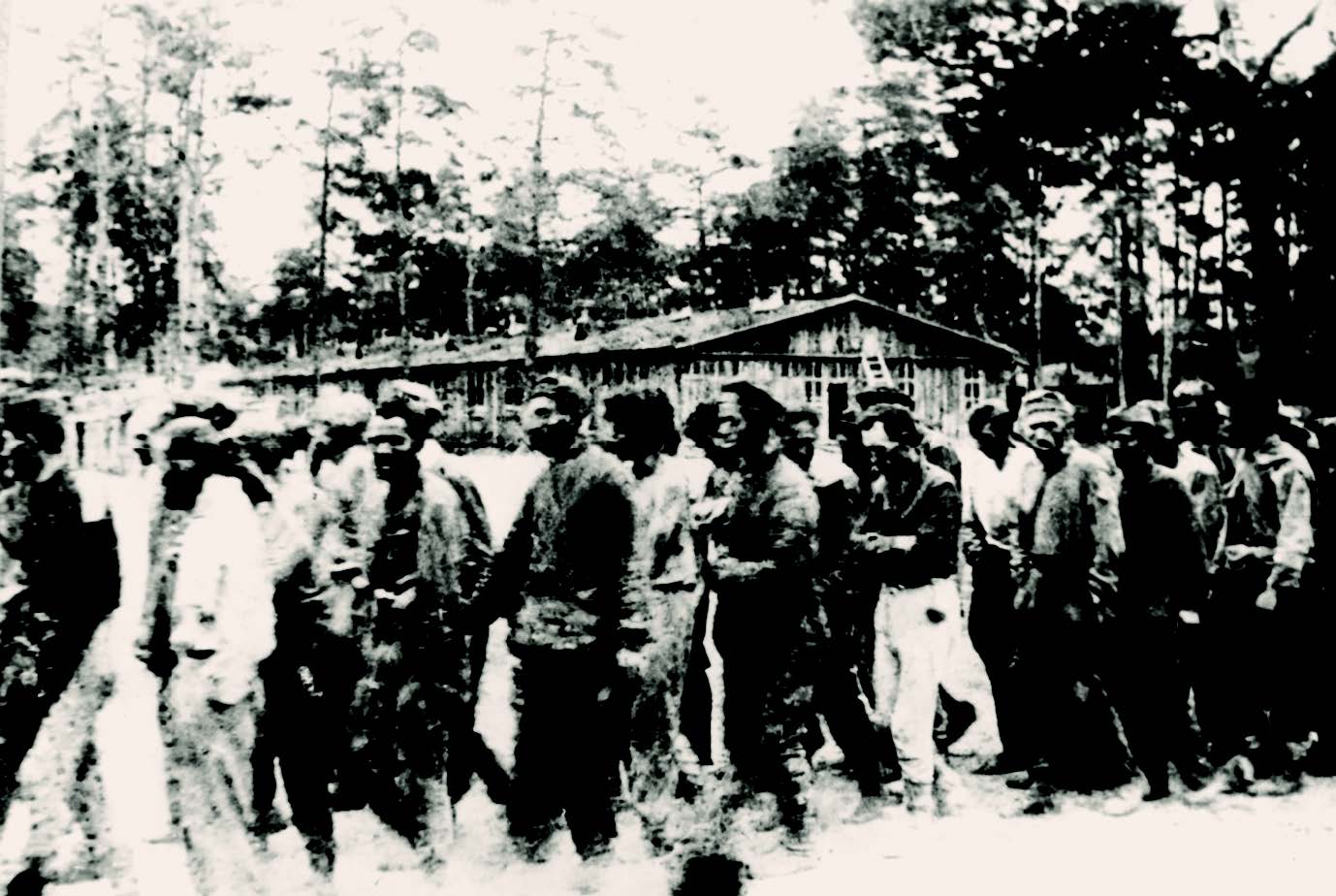
The NDK undertook practically no large-scale excavations and exhumations of human remains in Babyn Yar. Instead, the public learned that in the summer of 1943, when the front was approaching the Dnipro River, the Nazis formed a special Sonderkommando unit headed by SS Standartenführer Paul Blobel, which was tasked with destroying all traces of the Nazis' crimes. Under the Germans' supervision, prisoners of war from the Syrets concentration camp were forced to exhume corpses in Babyn Yar, the anti-tank trench, and the area near the Pavlov Psychiatric Hospital and then burn them in large, open ovens, after which they spread the ashes over the ravine. The prisoners, realizing that they were building the last oven for themselves, made a desperate attempt to escape; only 18 out of 327 prisoners succeeded in escaping. These former prisoners recounted the horrors that they had witnessed and in which they had been forced to participate. Their testimonies formed the basis of the commission's findings.[12]
A considerable amount of information about the mass killings of Jews in Babyn Yar also emerged during the trials of the Nazis and their accomplices — former policemen, traitors, and others — which took place immediately after the liberation of Kyiv. The pre-trial investigations revealed the circumstances surrounding the Nazis' non-stop executions in Babyn Yar of prisoners of war, communists, and underground members, as well as the dramatic circumstances relating to some local residents' attempts to save Jews and to the incitement to or involvement in Nazi crimes against others of some city residents. The testimonies of the witnesses P. Savytska, L. Hryhurko, and N. Tkachenko, for example, are revealing in this connection. Until 17 January 1943 these three individuals hid I. Brodsky, a Jewish prisoner of war, until he was denounced by a woman named Shymanska, whose husband served in the Gestapo. For giving assistance to a Jew, all three were arrested but managed to avoid execution. Brodsky, too, survived and subsequently appeared as a witness.[13]
On 12 December 1943 Bondarenko, the head of the NKGB Directorate for Kyiv oblast (UNKGB), sent a memorandum to Serhii Savchenko, People's Commissar of State Security of the Ukrainian SSR, entitled "About the Atrocities of the German-Fascist Occupiers in the City of Kyiv," which clearly indicated that in Babyn Yar the Nazis committed an act of horrific violence against Jews only because they were Jews. The memorandum states:
Demonstrating special hatred toward the Jewish nationality, the German-fascist bandits in the city of Kyiv destroyed nearly all the Jews.
At the end of September 1941 a German commandant issued a directive ordering the entire Jewish population, including women and children and elderly people, to assemble with all their valuables and property at the Jewish Cemetery, as though they were being sent to the camps. […]
At the cemetery German soldiers and policemen committed mass robbery; they confiscated all items and valuables from those who had assembled.
After the robbery, all the Jews were led in groups of 100–200 people toward Babyn Yar [located] on the outskirts of the city.
A mass murder of Jews was carried out in Babyn Yar. They were stripped naked and forced to run along the ravine; at this time they were shot with submachine guns and machine guns. Then the killed and wounded, among whom were children who were still alive, were thrown into the ravine and buried. For a long time afterwards groans were heard coming from the ravine; the layer of earth underneath those who had been shot stirred from the movement of living bodies.
Many people, sensing their death, lost consciousness, tore their hair out, pleaded for mercy, but they received blows in response..
Thus, in Babyn Yar in late September 1941, nearly 70,000 Jews were shot over the space of several days.
During the entire period of the German occupation of Kyiv, Babyn Yar was a permanent site where the shootings of Soviet people were carried out.
According to preliminary estimates, it has been determined that, in addition to 70,000 Jews, nearly 20,000 captured fighters and commanders of the Red Army and nearly 10,000 communists, Komsomol members, [and] non-party Soviet patriots were shot in Babyn Yar during the occupation.[14]
In January the head of the UNKGB for Kyiv oblast also informed Savchenko about the execution of three German accomplices who were directly involved in the Babyn Yar tragedy.[15] In accordance with the sentence handed down by the court-martial of the 8th Guards Tank Corps, Yegor Ustinov (a Russian peasant from Tula oblast, a carpenter by trade), Nikifor Yushkov (a Russian peasant from Orlov oblast, a painter by trade), and Venedykt Baranov (a poor Ukrainian peasant from Vinnytsia oblast, who was employed as a fire protection worker) were hanged on Verkhnii Val Street in the presence of 500 Kyivites. In late September 1941 the three men had hunted down and brutally killed unfortunate Jews who had not obeyed the Nazis' order to go to Babyn Yar. Witnesses testified that the accused buried alive seven people, mostly women. On 30 September one of the criminals, Baranov, dragged a sick, old woman from her bed, dragged her from the fifth floor to the street, then drove her to a garden on Verkhnii Val Street, where the criminals were killing and burying people who were still alive. The next day Baranov discovered a Jewish woman. He "broke into her apartment, looted it, tried to cut her throat with a dull pen knife, after which he threw her out of the window onto the street."[16] Then he buried her in that same garden.
On 19 January 1944 Amaiak Kobulov, Deputy People's Commissar of the NKGB of the USSR, sent a memorandum to the NDK based on the above-mentioned report prepared by the UNKGB for Kyiv oblast dated 12 December 1943. The memorandum reiterated, albeit in an abbreviated form, information about the mass extermination of Jews in Babyn Yar. "The occupiers demonstrated particular brutality in relation to the Jews, having destroyed the entire Jewish population of the city during the occupation."[17]
By the time the memorandum was received, the Extraordinary State Commission had already prepared and disseminated its own draft among its members, in which the tragic fate of the Kyivan Jews was not concealed. In part it read: "The Hitlerite bandits committed a mass, brutal destruction of the Jewish population. They hung announcements ordering all Jews to go to the corner of Melnikova and Dokterevska [actually Dorohozhytska] streets on 29 September 1941, taking with them documents, money, and valuable items. The executioners herded the Jews who had assembled to Babyn Yar, they confiscated all their valuables and then shot them."[18]
The commission sent the prepared document to Moscow, where problems began to crop up with in connection with its recopying and harmonization in keeping with "political expediency." The text was read personally by Viacheslav Molotov and Nikita Khrushchev. After coordination with the top-ranking figures in the country, Georgii Aleksandrov, the head of the Propaganda and Agitation Department of the CC AUCP(B), edited the document, from which even passing references to Jews were deleted. The final document was endorsed by the commission in Kyiv, as well as by the distinguished Ukrainian poets Maksym Rylsky and Pavlo Tychyna.[19]
In late February 1944 the Soviet press published the Extraordinary State Commission's announcement "About the Destruction and Atrocities Perpetrated by the German-Fascist Invaders in the City of Kyiv." The text noted in part: "On 29 September 1941 the Hitlerite bandits herded thousands of innocent Soviet citizens to the corner of Melnykov and Dokterevska streets. The executioners led those who had assembled to Babyn Yar. . . . People recounted seeing the Germans throwing infants into the ravine and burying them alive together with their parents, who were killed and wounded. 'You could see a layer of earth stirring from the movement of people who were still alive'."[20]
In taking this unambiguous step toward erasing the memory and the destruction of Jewish identity, the Stalinist government thus depersonalized the Jewish victims of the Babyn Yar tragedy. Subsequently, Stalinist propaganda and the Soviet nationality policy in general were increasingly characterized by the practice of dispensing limited amounts of information or blatantly concealing official data on the anti-Jewish nature of Nazi crimes. The situation reached the point that during the war it was forbidden to publish posters about Jewish war heroes and make any references in newspapers to Jews who had been awarded medals for courage and bravery in battle.
Nonetheless, a certain duality existed. On the one hand, in order to mislead the Western democracies, from time-to-time Stalinist propaganda mentioned the extermination of the Jews, especially if they were Jewish victims outside the USSR. On the other, the Stalinist government took into consideration "the possibility of the intensification of antisemitic moods" among its population, and therefore tacitly banned all discussion of the murder of Soviet Jews by the Nazis. In their efforts to conceal the "Jewish topic" for reasons connected with the resolution of "political tasks," the Soviet government and the Soviet press operated in a fashion somewhat similar to the Western media at the time, in which the Nazis' unprecedented destruction of Jews was not overly emphasized (so as "not to provoke antisemitism"). The essential difference between the West and the USSR lay in the fact that toward the end of the war all mentions of Jews in the context of Nazi crimes practically disappeared from Soviet newspapers, and were supplanted by the faceless euphemism "peaceful Soviet citizens."
After returning to the territories that had been under German occupation and the influence of German propaganda for two years, the Soviet government searched for effective ways to re-legitimize itself. This pertained especially to Ukraine, where in the prewar decades the Soviet government was uncomfortably aware of the Ukrainians' low level of loyalty to the Soviet Union. The Soviet security organs, which scrupulously recorded the public mood in the Ukrainian SSR, noted a dichotomy of feelings among Ukrainians, especially in rural areas. On the one hand, they felt relief and joy at having been liberated from the German occupiers; on the other, they felt alarm and fear because of the return of the "Soviets." Ordinary citizens characterized their attitude to the Nazi and Soviet governments with the unambiguous saying, "Let this pass, and may that not return."[21]
Given these sentiments existing against the background of the concealment of the anti-Jewish component of Nazi crimes, the Stalinist government sought to appeal powerfully to Ukrainians' national sentiments, presenting itself as their liberator and defender. Typical in this connection was the preamble to the report prepared by the NDK on the crimes perpetrated by the Nazis in Kyiv. Clearly emphasizing the "crimes of the fascist bandits" against the Ukrainians, it noted that they were treated like "aliens," and discussed the policy of the "Germanization of the Ukrainian people," the suppression and destruction of Ukrainian culture, etc. However, the very structure of the "Announcement" indicated that neither the Ukrainians, nor the Jews, or the loss of human life in general were recognized and presented as the main war losses. Anyone reading this announcement in the press could not help noticing that the first part of the document was not devoted to war deaths but to the destruction of industry, transport, the municipal economy, and the looting of cultural and historical treasures.[22]
On the other hand, in concealing the Jewish component of the Nazis' crimes, the Stalinist government tried "not to add grist to the mill" of Goebbelsian propaganda and avoided providing "superfluous pretexts" that would "confirm" the myth that the Soviet government represented the rule of the "Judeo-commune." In this case, obviously, the Soviet authorities reckoned on the antisemitic moods that were widespread among part of the Ukrainian population. However, it turned out that owing to its fear of nourishing such sentiments, the Soviet government resorted to actions that were essentially antisemitic. In fact, current research shows that a substantial number of Soviet political figures, including Stalin himself, were not lacking in antisemitic prejudices. The next few years, which were marked by the policy of state antisemitism, confirmed this unmistakably.
Return of the Jews to Kyiv: antisemitism after the Holocaust
On the eve of the German invasion, there were 224,236 Jews living in Kyiv, which represented one quarter of the city's population.[23] When the war broke out, some were mobilized or evacuated to the rear areas of the USSR. Most of the Jews who remained in the city and were killed were those who had the least connection to some kind of Soviet government institution, as well as elderly and sick people and children. After Babyn Yar, the once bustling and colorful Jewish life in Kyiv practically disappeared. After the Nazis were expelled from the city, Kyivan Jews began to flock back to their native city. It goes without saying that the mass grave known as Babyn Yar was immediately treated as a place of memory of the Jews who had perished there. Like the Holocaust in general, Babyn Yar became a factor unifying various strata of the Jewish community.
From the very outset, the formation of Jewish memory pertaining to Babyn Yar was influenced by various factors: historical, political, and emotional-psychological. Above all, the families of the victims felt shock, pain, and indignation at the concealment of the Jewish tragedy and the ban preventing Jews from expressing their grief publicly. At the same time, the Babyn Yar tragedy as a symbol prompted people to begin living again, for despite everything, life had to go on.
The Ukrainian-born Yiddish writer Itsik Kipnis wrote the following in an essay entitled "Sered ievreïv" (Among the Jews): "My enemies will not be able to say: 'Babyn Yar is the last refuge of the Jewish people. The final point of Jewish existence.' The last word[s] with which the history of the Jewish people ends [are] 'Am Yisrael chai!' 'The people of Israel live'!"[24]
The popularity of this idea within the Jewish milieu was demonstrated unambiguously by the performances in Kyiv of the Ukrainian State Jewish Theater in 1945 (after the evacuation, the theater was ordered to move to Chernivtsi). When the curtain parted for the performance of Moshe Pinchevsky's play Ia zhyvu (I Live) and an inscription appeared with the words "Am Yisrael chai!" the audience gave a standing ovation.[25]
According to research carried out by the Holocaust historian Mordechai Altschuler, during the postwar years Jewish religious communities were often the initiators of commemorative activities aimed at honoring the memory of Holocaust victims.[26] In various locales where the Nazis had committed mass murders of Jews these communities collected and published lists of victims, held commemorative ceremonies in synagogues, and tried to organize memorial gatherings. One such rally was convened in Kharkiv in May 1945, on the third anniversary of the murders of Jews in that city. However, this was an exception to the rule, and the Soviet authorities soon began treating any outdoor mass assemblies of Jews as manifestations of "political unreliability" and "Jewish nationalism," and promptly banned them.
This happened in Kyiv on the third anniversary of the Babyn Yar tragedy. One of the initiators of a mourning rally was the famous Yiddish poet Dovid Hofshteyn, who spent several months gearing himself up mentally for this event. He recalled later: "I prepared myself for months. I prepared myself for shock, for sufferings. For months I suppressed the first cry that was supposed to break out of me at the very moment that I would see everything that I already knew: our calamity, our catastrophe in its fullest extent."
On 29 September 1944 the Soviet government banned a mass gathering of Jews in Babyn Yar, treating the mourning rally as a manifestation of "Jewish chauvinism" and as an event "fanning antisemitism." Despite the ban, people flocked throughout the day to the site of the tragedy to mourn and remember their relatives in the hopes of alleviating somewhat their pain and despair. Grasping this need, the directors of some institutions permitted their Jewish employees to leave work early that day. Nesia Elgert, who by some miracle survived Babyn Yar together with her son and after the liberation of Kyiv worked in a local institution, was also allowed to leave work in order "to give her a chance to go to the 'vale of tears' to sob out her grief."[27]
A spontaneous mourning procession of Kyiv's Jews to the symbolic grave of their loved ones in Babyn Yar, which took place in the early postwar years, was described by the writer Itsik Kipnis:
29 September. People are coming to Babyn Yar from all corners of the city.
In the depths of my soul I am praying for only one thing: my friends, do not travel by streetcar, only on foot. We shall go along that road, along those streets that were filled to the edges with our still-living brothers. […].
We are approaching the city suburb. Small groups of people from various parts of the city join us. We recognize one another. Those who do not know the route do not ask — everyone is going there.
People are proceeding in a crowd, hardly anyone is talking. […].
We draw close. Quiet weeping is already heard from there. Everyone's faces are darkening, becoming tenser. Weaker people do not endure, and strangled groans and sobs are heard.
The sandy cliffs are crumbling beneath our feet and dragging us down, down. Deep, overgrown cliffs, pits, bushes.
'Where are we?'
Is this the place?
Our legs are collapsing beneath us…
There are already people here. They came earlier than we did. No one greets each other. And if someone happens to do this, no answer is given. Everyone's hearts and gazes are aimed at one large, overgrown ravine that resembles a square goblet, the only difference being that on the bottom of it there is no wine left undrunk, only blood that has lost its color from the rains and snow. […]
A few 'living' eyewitnesses remain: charred logs incompletely burned by fire. They recount that which human thought is incapable of grasping and what words cannot describe. People are standing around them since morning. Everyone's eyes are red from tears, hearts are incandescent from crying. And they wait. They do not want to go. Maybe someone will come and respond with at least one word.[28]
However, the majority of the Ukrainian population, which had experienced great tribulations and suffered many losses, was not prepared either to understand or feel the Jews' pain. Neither did the Soviet practice of concealing the Jewish tragedy elicit any astonishment. In the minds of average Ukrainians, this governmental policy fully conformed to the Soviet authorities' policy of concealing and denying the famine in Ukraine that claimed millions of lives in the early 1930s. Moreover, details pertaining to the merciless destruction not only of Jews in Babyn Yar but also prisoners of war, mentally ill people, and ordinary Ukrainians, Russians, Poles, and others, which were made public after Kyiv was liberated, formed the perception that Babyn Yar was a place of many tragedies, and in this context the desperate appeals of Jews to understand the unprecedented nature of the Nazi crime against them were often perceived as the Jews' own inability and reluctance to feel the pain of "others."
For the most part, the Jews' return to Kyiv did not elicit the support of the city residents, one reason being antisemitic feelings within a segment of the population, which were intensified by the German occupation and the impact of German propaganda, became palpable. There were also certain contradictions stemming from problems connected with the difficult, everyday life in the postwar years. After the war a significant part of Kyiv lay in ruins, and there was a dire lack of suitable housing. A considerable number of homes that were owned by Jews before the war had been looted by their neighbors and now had new owners, who based their right of occupation of these premises on the fact that they remained and had survived the occupation. The attempts by Jews to regain their houses, after all they had gone through during the war, often led to conflicts. The same may be said of their efforts to regain jobs they had before the war. For the most part, their various appeals to fairness, mercy, or professional qualifications had no effect. Instead, new accusations against the Jews emerged along the lines of: "they had hidden in the hinterland" and yet now they were demanding "some kind of rights."
At the same time, Jews' attitudes to their fellow Kyivites were also none too friendly. In addition to the extremely painful problems of daily life, the "shadow of Babyn Yar" also lay behind this unfriendliness, as Jews frequently regarded their former neighbors as having been involved, either indirectly or directly, in the killings of their families and friends. Also shocking were blatant manifestations of antisemitism that went unpunished; for example, the public use of the word zhid, offensive to the Jews, which was unimaginable before the war.
On 8 September 1944 Komarov, the head of the militia directorate for the city of Kyiv, prepared a report recording, as of the summer of 1944, manifestations of "antisemitic counterrevolutionary incidents aimed at exacerbating [tensions] between the Ukrainians and the Jewish nationality and the opposite, the Jewish nationality and the Ukrainians."[29] On 13 October 1944 the NKGB of the Ukrainian SSR sent Nikita Khrushchev, first secretary of the CC CP(B)U, a special report on manifestations of antisemitism in Ukraine. The document emphasized the rise of "antisemitic manifestations" in the republic, which "in individual cases have a tendency toward flagrant actions of a pogromist nature."[30] The reasons for this were attributed first and foremost to German propaganda, both "German-fascist" and that of the "Ukrainian nationalists." The Soviet secret police also informed the Ukrainian leader about discrimination against Jews (above all, in the refusal to offer them employment), citing concrete examples of everyday antisemitism.
The document also reported on the spread of "provocative rumors" by individual Jews about the antisemitic policy of the Soviet Ukrainian government and its leader Khrushchev, who, it was claimed, was supposed to be removed from his post for condoning antisemitism. Another section of the document reported "nationalistic manifestations on the part of individual members of the Jewish population," for example, conversations to the effect that "Jews in America live far better than [Jews] in the USSR,"[31] sympathy for the Zionist movement, and even the secret compilation of lists of Jews who want to emigrate from the USSR to America, to Palestine, or elsewhere.
On Khrushchev's directive, the secretary of the CC CP(B)U Demian Korotchenko instructed the deputies of heads of Central Committee departments (Organizational Instruction; Cadres; Propaganda and Agitation) to open an investigation. The findings were ready by November. The special report that had been sent by the NKGB was called erroneous and treated as a document that distorted the real mood among the population of Ukraine; in essence, it reflected the moods of Zionist elements that were disseminating "provocative rumors." The NKGB was advised to expose more effectively and isolate "German agents and organizations of Ukrainian nationalists, who are trying to sow national strife," and to improve its work of exposing and putting a stop to the activities of "Zionist elements." The findings included frank criticism of the head of the Cadre Service for countenancing shortcomings in his work with cadres; he was ordered to dismiss the author of the memorandum, Gersonsky, who, as deputy head of the 2nd Directorate of the NKGB of the Ukrainian SSR, was responsible for "work with the operational servicing of the intelligentsia."[32]
Some Jews, encountering manifestations of antisemitism and government apathy day after day, continued to complain to the local and republican authorities; they even wrote to Moscow. Others bottled up their feelings and secretly dreamed of going to Palestine. However, some Jews, mainly veterans who had passed through the crucible of war, were ready to take up arms against their abusers.
In the summer of 1944, an incident took place in the raion division of the NKGB for Kyiv's Zaliznychnyi district, which involved the assistant of the commander of the 191st Guards Air Regiment, Senior Lieutenant Petro Kovtun, who was of Jewish background. Kovtun began his army service in 1941, and he came to Kyiv on business. He appeared at the raion division in a state of semi-inebriation, in the company of a woman named Chemikhova, with whom he began arguing; he even tried to shoot her with his pistol. After he was disarmed, the officer began yelling: "I came from the front to defend the Jewish people, and I will deal with the union of Rus′ people who destroyed the Jews." [33] Kovtun was detained, and the military prosecutor's office of the Kyiv garrison launched an investigation.
Another incident involving a Jewish soldier who used his service weapon against his abusers led to tragic consequences. On 4 September 1945 two Ukrainian Red Army soldiers on a short furlough, Ivan Hrabar, and Junior Lieutenant Mykola Melnykov, who were both tipsy, assaulted Senior Lieutenant of the NKGB Yosyf Rozenshtein, who was dressed in plainclothes and heading home from the bread shop. The soldiers made some antisemitic remarks and then began beating the officer. Passersby came to his aid and stopped the fight. Rozenshtein went home in a fury, put on his military uniform, and went to the courtyard of the building where Hrabar's mother lived, and shot both of his abusers at close range. The mother's cries drew a crowd of people, antisemitic remarks were heard, and Rozenshtein's wife and a Jewish passerby were beaten severely. It was determined that earlier the apartment's previous owner had demanded that Hrabar's mother be ordered to vacate her home. Several days before the tragedy unfolded, her son, the soldier, had gone to the prosecutor's office, where he failed in his attempt to help her mother keep her apartment. He told the prosecutor: "We are fighting, and the Jews are occupying our apartments."[34]
Given the alarming atmosphere in the city, on 5 September party workers made the rounds of various institutions and enterprises, where they engaged in "explanatory work." The two murdered soldiers were buried on 7 September. Nearly 300 people took part in the funeral procession that began at Zhovtnevyi Hospital and ended at Lukianivka Cemetery. Despite the presence of an NKVD escort, it proved impossible to prevent violence. At first the participants of the procession beat two Jewish passersby: Viktor Tomsky, who worked in the Committee for Art Affairs, and Yakiv Shvartsman, an employee of the oblast department for deaf-mutes. Later, Yosyf Markov, an official employed by the marketplace office, was beaten near Halytskyi Market. Finally, on Dmytrivska Street, some people from the procession who had spotted a Jew standing at the window of a building on Dmytrivska Street began throwing rocks at the windows. The Soviet secret police tried to detain a woman, but a group of soldiers and civilians stopped them and then beat another Jewish passerby.[35]
This event literally shook the city, and the Jews of Kyiv were frightened. In order to prevent further clashes, the authorities intensified police patrols in various parts of the city. As a result of the publicity, on 5 and 8 September the People's Commissar of Internal Affairs of the Ukrainian SSR and his deputy sent special reports with the details of the tragedy to the higher republican leadership. Meanwhile, this incident prompted several Jewish veterans to write an emotional letter to Stalin. Emphasizing the "unbridled antisemitism" in Kyiv, they informed the Soviet leader about the pogrom that had taken place on the day of the two soldiers' funeral. More than a hundred Jews were beaten, thirty-six of whom had to be hospitalized with severe injuries. Five died that day (according to the researcher Mykhailo Mitsel, this information is not supported by archival documents).[36] The authors of the letter explained the killing of the "two antisemites" by the murderer's affective state, caused by rampant antisemitism and the inaction of the Soviet Ukrainian government. Nevertheless, on 1 October 1945, Yosyf Rozenshtein was sentenced to death by a military tribunal.
Although the motive behind this tragic story lay in the sphere of everyday life, its causes ran deeper and attested clearly to the tensions existing in Ukrainian-Jewish relations. To a certain extent the tragedy was also the direct result of the implementation of the government's unpublicized policy of "squeezing" Jews out of Kyiv and Ukraine in general. The "philosophy" behind this policy was explicitly elucidated by Khrushchev himself during his conversation with the old communist Ruzha-Godes, who had survived the German occupation by disguising herself under the name of Khelmynska, but could not find employment after the return of Soviet power because she was Jewish. "In the past Jews committed quite a few sins against the Ukrainian people," Khrushchev told her. "The people hate them for this. In our Ukraine we do not need Jews. . . .It would be better [for them] not to return here. It would be better if they went to Birobidzhan. . . .This is Ukraine here. And we are not interested in seeing the Ukrainian people interpreting the return of Soviet power as the return of the Jews."[37]
The following questions should be asked. Did Khrushchev's position reflect only his personal views? Could he have implemented such a policy at his own, without the approval of the Moscow center, assuming he, as the leader of the Ukrainian SSR, was able to act freely at his own discretion? Archival documents indicate clearly that before any decisions were approved in Soviet Ukraine, even those pertaining to the creation in 1944 of the medal "For the Liberation of Ukraine," the top Communist leadership of Soviet Ukraine always had to consult first with The Leader (Stalin, incidentally, refused to approve the creation of that medal). It is hardly possible, therefore, that Khrushchev was in any position to adopt decisions about restricting access to Kyiv for Jews after they returned from evacuation, or about banning Jews from positions in the Communist party Central Committee, in People's Commissariats or other offices. There is no doubt whatsoever that the antisemitic policy was not a "Ukrainian initiative." While it is likely that the Ukrainian authorities were indeed zealous executors of this policy, but in no way were they its ideological masterminds. It is obvious that by the end of the war and in the first postwar years the model of the policy of antisemitism which soon led to a real bacchanal throughout the Soviet Union began functioning precisely in Ukraine.
On 17–28 January 1946 a public trial took place in Kyiv in connection with the crimes committed by the Germans on the territory of the Ukrainian SSR. The defendants in the case were General Major Paul Scheer, the head of the police in Kyiv, and fifteen other people. The trial proceedings were widely publicized in the central and republican press. Reports were prepared by the Ukrainian writer Yurii Smolych and the Ukrainian poet Volodymyr Sosiura, and numerous photographers and cameramen were enlisted to take pictures.
One of the witnesses was Dina Pronicheva (Dina Myronivna Wasserman), who survived miraculously. She gave a detailed account of the terrifying day of 29 September 1941, clearly noting that the Nazis' crime targeted Jews specifically.[38] In the opening statement for the prosecution, the deputy prosecutor-general of the Red Army, General-Major Aleksandr Cheptsov, declared that "more than four million Soviet citizens, including elderly people, women, and children" were killed and tortured in Ukraine by the Nazis during the German occupation. He called Babyn Yar a grave in which "195,000 victims of bloody fascist terror" were laid to rest.[39] At 5:00 p.m. on 29 January twelve war criminals were executed on the main square of the city in the presence of a large crowd of people.
Two weeks later, during the Nuremberg trials, evidence about the grievous crimes against the civilian population of the USSR was presented by Lev Smirnov, deputy prosecutor for the Soviet Union. He announced that the Extraordinary State Commission had drawn up 54,784 indictments, and he spoke about the atrocities perpetrated by the Nazi criminals. He also presented a document numbered SSSR-9, an announcement published earlier by the NKD about the events that took place on 29 September 1941 in Babyn Yar, where "thousands of innocent Soviet civilians" were killed.[40]
The German historian Tanja Penter writes that the postwar trials of German war criminals and their accomplices became one of the ways of legitimizing the Stalinist regime both in Soviet society and abroad.[41] Where the Nuremburg trials were concerned, attempts were also made to ensure the "legal consolidation" of the Germans' responsibility for crimes that had been committed by Stalin, particularly the Katyn massacre. As in the case of the mass murders in Katyn, even though the Soviets did not provide sufficient evidence concerning Babyn Yar, no doubts about the Nazis' responsibility for this tragedy surfaced during the Nuremburg trials. In Nuremberg Stalin thus failed in his attempt to shift responsibility for his own crimes in Katyn on the Nazis.
State antisemitism: erasing the memory of the Jewish tragedy
During the first postwar years, Jewish communities began adopting active measures to commemorate the victims of the Holocaust but encountered unexpected and harsh resistance from the Soviet authorities. From that point onwards and for many subsequent decades Jewish efforts to preserve this memory and attempts to erase it marked the relations between the Jewish population and the Soviet government.
In 1946 Jews in Ternopil collected funds to tidy up the graves of people who were shot by the Nazis. A monument bearing the following inscription was erected: "Eternal memory and glory to the Jews who were killed by the German fascists." This instantly became the subject of a review that took place during a meeting at the office of the Ternopil oblast committee of the CP(B)U.[42] Most likely the inscription on the monument was altered. That same year the municipal council of Kamianets-Podilsky forbade the Jews to hold a mourning day to mark the shootings of their coreligionists by the Nazis. For more than three years the municipal government refused to replace the city's stone sidewalks that were paved with gravestones taken from the Jewish cemetery. In July 1948 the Jewish community sent a complaint to the heads of the Supreme Soviet of the USSR, the CC AUCP(B), and the CC CP(B)U.[43]
Proposals had been put forward even during the war years to erect a monument to Jews who perished during World War II and in Babyn Yar (this issue was brought up by Ilya Ehrenburg in particular). Meanwhile, given Kyiv's status as the capital city of Soviet Ukraine, responsibility for efforts to honor the victims' memory passed to the republican government. It goes without saying that the government of the Ukrainian SSR adhered to the official treatment of Babyn Yar as a place where the Nazis murdered "innocent Soviet citizens," without singling out the distinctive fate of the Jews.
On 13 March 1945 the Council of People's Commissars and the CC CP(B)U issued a resolution "About the Erection of a Monument on the Territory of Babyn Yar," which proposed to use the preliminary design and model developed by Oleksandr Vlasov, the chief architect of Kyiv, appoint a sculptor and commission technical drawings, and allocate funds from the republican budget for the monument.[44] Shortly afterwards the Directorate of Architecture contacted Mykola Bazhan, the deputy head of the Council of Ministers of the Ukrainian SSR, in connection with the construction in 1945 of twenty-four installations in Kyiv, including the monument in Babyn Yar. The monument was supposed to be built over a two-year period, 1945–1947, at a cost of three million rubles, half of which amount was allocated for 1946.[45]
The sculptor chosen for the project was A. Kruglov, and the artistic sketches were probably done by Vasyl Ovchynnykov, the director of the Museum of Western and Oriental Art. The municipal party committee also ordered Vlasov to plan the spatial layout of the monument and to tidy up the entire area of Babyn Yar by designing paths, planting trees, and the like. Although, judging by everything, the project design did not feature any distinctively Jewish ethnic symbols, they may have featured in Ovchynnykov's sketches; in any event, the people depicted in the series of paintings on the Babyn Yar theme, which he had completed during this period, had Jewish features. However, the monument project was initially delayed and then collapsed altogether. With the upsurge of antisemitic policies in the Soviet Union during the struggle against "cosmopolitanism" and "Jewish dominance," the commemoration of Jewish victims of the Nazis became virtually impossible. As noted by the historian Mykhailo Mitsel, 1947 marked the beginning of the Soviet government's refusal to allow its citizens to erect Jewish monuments to victims of the Nazis in various oblasts of Ukraine, including Poltava, Kyiv, and Chernihiv.[46]
External political events had an unexpectedly powerful impact on the fate of Soviet Jewry. Seeking to expel Great Britain from Palestine, weaken its position in the Near and Middle East, and create opportunities for penetrating this strategically important region, Stalin initially gave his full support to the idea of founding the State of Israel. On 17 May 1948 the Soviet Union was the first country in the world to recognize the new state, and later condemned the incursion of Arab forces into its territory, and even provided military assistance to Israel (via Czechoslovakia).
Soviet Jews welcomed the news of the founding of Israel with great enthusiasm. This was noted even by the members of Stalin's circle. The wife of National Commissar Kliment Voroshilov, Ekaterina Gorbman, having learnt the news, ecstatically exclaimed that now we, too, have our own fatherland! Friendliness was also shown to Golda Meir, the chargé d'affaires ad interim for the State of Israel, who was a native of Kyiv. Polina Zhemchuzhina, the wife of Viacheslav Molotov, conversed with the diplomat in the language of their parents, Yiddish. In May 1948 the Soviet government even permitted the celebration of the Jewish New Year, Rosh Hashanah, on a grand scale. Tens of thousands of Jews gathered for the celebration in and around the Choral Synagogue in Moscow, which was attended by Meir. Euphoria reigned when the shofar (ram's horn) blew, and people began exchanging wishes to celebrate the holiday "next year in Jerusalem."[47]
However, as soon as it became clear that the Jewish state was preparing to ally itself with the United States, Stalin's attitude to Israel changed radically. This had an immediate effect on the fate of Soviet Jews, whose sympathies toward Israel began to be perceived as potentially dangerous and as manifestations of disloyalty and Zionism.
Communist ideologists' view of the emergence of a "second fatherland of the Jews" as a powerful source of the growth of national awareness among Soviet Jews was not unjustified. Their misgivings were confirmed in 1948, in connection with the Israelis' victory in the war of independence. Many Jews did not disguise their willingness to fight for Israel, and there was obvious pride in this victory. These events also encouraged members of the Jewish community to embark on bolder efforts to champion their right to revive Jewish national culture in the USSR. The Stalinist government's response was to launch large-scale repressions against Jews, which were introduced in the propagandistic packaging of a campaign against "rootless cosmopolitans" and "Jewish bourgeois nationalists."
On 16 September 1948 Dovid Hofshteyn, the Yiddish poet, translator, and member of the presidium of the Jewish Anti-Fascist Committee (JAC), was arrested in Kyiv on charges of espion-age. His "Zionist moods" had long been under the watchful eye of the Soviet secret police (after the proclamation of the State of Israel, Hofshteyn, among other things, proposed to open a Department of Hebrew at the Academy of Sciences of the Ukrainian SSR).[48] The entire committee, whose activities had long been a thorn in the side of the Soviet authorities, was also targeted.
Since its founding in 1942, the JAC had pursued the goal of establishing international contacts with Jewish communities that were part of the anti-Nazi coalition. Much was done in this direction during the war years. In 1943 the committee's head, the actor and director Solomon Mikhoels, and the writer Itsik Fefer toured the United States, Great Britain, Canada, and Mexico, where they established contact with reputable organizations and gave speeches at well-attended rallies, appealing for help for the USSR. These activities led to some definite results (for example, the Soviets signed an agreement with the American Jewish Joint Distribution Committee about the provision of relief, via the Red Cross, to the Soviet population without distinction on the grounds of nationality, however). Supporting the founding of the State of Israel, the members of the JAC also appealed to the highest Soviet and party leadership to create Jewish autonomy in the Crimea. The Soviet leadership itself actively exploited the committee as a source of information about Israel and the moods among Jews living abroad.[49]
During the war the Jewish Anti-Fascist Committee had worked tirelessly on a "Black Book," a collection of documents and eyewitness testimonies about the Nazi genocide of the Jews. The representatives of Jewish civic organizations in the United States, Great Britain, and Palestine were invited to take part in this large-scale project, whose goal was to document fully the extermination of the Jews by the Nazis, expressions of human solidarity, that is, the rescue of Jews by Poles, Ukrainians, Belarusans, and Russians, and the Jewish anti-Nazi resistance movement and its struggle against the enemy. Naturally, the Babyn Yar tragedy was regarded as one of the most important topics. At the same time, the compilers of the book, among them the writer Vasily Grossman, wanted to pay tribute not so much to those who had managed to survive as to "the 99 percent of those who were brought to Babyn Yar." In other words, the compilers sought "to present a picture of what happened to those who are silent and can no longer say anything now."[50] Work on the manuscript was completed in the fall of 1945, and one copy was sent to the Soviet prosecution at the Nuremburg trials. The book was published immediately in the United States. In the Soviet Union, however, the manuscript was sent to the printers. The work of typesetting it began but was soon halted. On 3 February 1947 the chief Soviet ideologist Georgii Aleksandrov sent a letter to Andrei Zhdanov, secretary of the CC AUCP(B), about the inadvisability of publishing the "Black Book," reproaching the compilers for presenting a "false picture," especially where Ukraine was concerned, that the Nazis "looted and destroyed only Jews."[51] On 7 October 1947 the Directorate of Propaganda and Agitation of the CC AUCP(В) issued its final decision on the publication: "The book contains serious political errors…owing to which this 'Black Book' cannot be published."[52]
In January 1948 Solomon Mikhoels was killed in Minsk by Soviet secret police agents, who staged the murder as a car accident (he was hit by a heavy truck). This event was the prelude to the liquidation of the JAC and the launch of repressions targeting its members. On 20 November 1948 the Politburo of the CC AUCP(B) approved a resolution entitled "About the Jewish Anti-Fascist Committee," which was confirmed by a decision passed by the Council of Ministers of the USSR. The Ministry of State Security was instructed at once to disband the organization, now deemed as a "center of anti-Soviet propaganda" that "regularly supplies anti-Soviet information to foreign intelligence agencies" (the order was signed personally by Stalin).[53]
On 3 January 1949 the CC AUCP(B) circulated a secret letter to all oblast and territorial party committees as well as to the central committees of all the Union republics, informing them about the disbanding of the Jewish Anti-Fascist Committee, which was found to be an "espionage organization of Jewish nationalists."[54] This signaled the start of the all-out liquidation of Jewish cultural and scholarly institutions and mass arrests.
On 8 February 1949, responding to the proposal of the writer Aleksamdr Fadeev, head of the Union of Writers of the USSR, the Politburo of the CC AUCP(B) issued a special resolution disbanding the Association of Jewish Writers in Moscow (45 members), in Kyiv (26 members), and in Minsk (6 members). The Yiddish literary almanacs Heimland (The Homeland) published in Moscow and Der Shtern (The Star) published in Kyiv were also closed down,[55] and Radio Moscow's Yiddish broadcasts ceased in mid-February. In agreement with the CC AUCP(B), the Soviet censorship office Glavlit began removing books by Jewish writers from libraries and the book trade network (the "list of banned literature" compiled by the censors contained 540 titles). In addition, the NKVD fabricated a case involving a "Zionist conspiracy" in the Soviet Union, and dozens of famous Jewish writers, publishers, theatrical figures, and scientists were put behind bars.
In Soviet Ukraine the Sixteenth Congress of the CP(B)U held in January 1949 gave impetus to the launch of a struggle against "rootless cosmopolitans."[56] The search for "enemies" and the struggle against "Jewish dominance" encompassed practically every educational, scholarly, and cultural institution and organization in the republic. As a result, the publication of all Yiddish-language newspapers, magazines, and books ceased, and Jewish literature and textbooks were removed from library collections. One after the other, Jewish theaters based in Kyiv, Kharkiv, Odesa, and Chernivtsi were closed down. In Kyiv the Ukrainian Theatrical Society and the Kyiv Conservatory were denigrated as "centers where cosmopolitans were concentrated. In the Academy of Sciences of the Ukrainian SSR the struggle against "Jewish dominance" resulted in the complete destruction of the Office for the Study of Jewish Literature, Language, and Folklore.
Established in 1936 as a result of the reorganization of the Institute of Jewish Culture, the Office for the Study of Jewish Literature, Language, and Folklore was a unique scholarly institution, whose mandate was to preserve the Yiddish cultural heritage. Dozens of eminent scholars, linguists, and writers worked there, grouped in three sections: Linguistics, Literature, and Folklore (there were plans to open a fourth section, History). It was headed by Illia (Elye) Spivak, a distinguished linguist and member of the Jewish Anti-Fascist Committee.[57]
During the war years the Office was evacuated to the city of Ufa, where it continued its scholarly activities. After it moved back to Kyiv in 1944, a commission was formed within the Office for the collection of documentary materials and memoirs slated for the "Black Book," especially those pertaining to the Babyn Yar tragedy. On the basis of these materials, a number of articles were written for the Yiddish-language newspaper Eynikayt (Unity). The Office's scholarly associates also did much to expand the collections of folkloric materials. According to some testimonies, they also recorded Yiddish songs about Babyn Yar. In November 1944 a group of scholars headed by the eminent musicologist Moisei Berehovsky went on a folkloric expedition to Chernivtsi, where they recorded 120 new songs, 50 of which they heard from survivors of Jewish ghettos. Based in the Ukrainian capital after the war, the Office for the Study of Jewish Literature, Language, and Folklore revived the tradition of holding creative evenings and encounters with Jewish writers, poets, composers, and singers. These events were extraordinarily popular and attracted large audiences. Kyivites had the opportunity to see performances by such illustrious members of the creative Jewish intelligentsia as the poet Perets Markish, the composer Zinovii Kompaniiets, and many others.[58]
In early January 1949 the Presidium of the Academy of Sciences of the Ukrainian SSR sent an official letter to Leonid Melnykov, first secretary of the CC CP(B)U, proposing that this institution be liquidated at once. The letter stated in part: "The Office's practice of conducting special work on questions of Jewish culture with the Jewish population by creating active members does not foster the inculcation of Soviet patriotism in the Jewish population, but leads to the disunity of the Soviet people, and therefore it is harmful." [59] That month the Office was disbanded, and most of its associates were repressed, including Illia Spivak, who died in prison shortly afterwards.
A secret trial of the Jewish Anti-Fascist Committee began in May 1952. By the summer of that year the Military Collegium of the Supreme Court of the USSR handed down death sentences to thirteen defendants, five of whom were from Ukraine (the writers and poets Dovid Bergelson, Dovid Hofshteyn, Leyb Kvitko, Perets Markish, and Itsik Fefer). They were all executed in August 1952.[60]
Within and outside the "JAC context" thousands of educational, scholarly, and cultural figures, particularly those who sought to preserve the memory of the Jewish tragedy that took place in Babyn Yar, were targeted by accusations of "rootless cosmopolitanism."[61] Thus, in addition to the repressions against Jewish artists, writers, and composers, the very memory of Babyn Yar was suppressed. To this day no one knows what happened to the documented testimonies about Babyn Yar or the numerous folkloric materials that were moved from Kyiv to Moscow by the Office for Jewish History and Culture. Performances of Dmytro Klebanov's symphony, In Memory of the Martyrs of Babyn Yar, were banned for many decades, and Vasyl Ovchynnykov's series of paintings entitled Babyn Yar was almost completely destroyed. Since Ovchynnykov was an ethnic Ukrainian, he could not be accused of "rootless cosmopolitanism"; instead, his works were criticized mercilessly for "distortions of the images of Soviet people."[62]
The wave of violence unleashed by the Stalinist regime continued to gain momentum. In early 1953 Pravda reported the discovery of a "monstrous conspiracy" in which many well-known Kremlin doctors allegedly took part. This was the pretext for unleashing the next antisemitic campaign known as the "Doctors' Plot." The Soviet authorities claimed that by issuing incorrect diagnoses and applying improper medical treatments, the "killers in white coats" tried to murder leading political and military figures. According to the Pravda report, "Most of the members of the group were connected with the international Jewish bourgeois-nationalist organization 'Joint'."[63]
Stalin's death in March 1953 saved Soviet Jewry from a new wave of mass terror. The end of the tyrant's rule signaled the return from imprisonment of individuals who had managed to survive and opened up prospects for finding new ways to honor the Jewish victims of the Holocaust, including those who perished in Babyn Yar.
After Stalin: memory and the struggle for freedom and dignity
In 1956 the Moscow-based publishing house Sovetskii Pisatel′ released Ilya Ehrenburg's novel, Ottepel (The Thaw). Hopes for changes for the better after Stalin's death resound both in the book's title and the character's speeches: "It seems everything has changed," "New people are needed," "We need our own, Soviet humanism," "The time has come to start this," "People have stood up straight. They grumble, but this is a sign of health".[64] These expectations were reinforced by the denunciation of Stalin's cult of personality at the Twentieth Congress of the CPSU (February 1956), the rehabilitation of those who had been repressed, a certain liberalization of sociopolitical life, and improvement of the political climate in the country. Thus, it was understandable that many Jews hoped that, along with the cessation of the absurd "killer doctors" case, the looming changes would also put an end to the state policy of antisemitism.
The first decade after Stalin's death went down in history as the "Thaw." However, the anticipated, radical changes for the better never materialized because the system of power in the USSR remained unaltered. This applied fully to the "Jewish question," as openly aggressive Stalinist antisemitism was supplanted by the policy of concealed state antisemitism. One clear manifestation of this policy was the fifth line (piataia grafa) that defined the bearer's nationality in Soviet passports, which served as an unspoken pretext for barring Jews' access to certain schools of higher education, employment opportunities, and movement up the career ladder. Year after year in the Soviet Union the linguistic assimilation — Russification — of Jews intensified, and the disregard of national-cultural features and needs as well as the restriction and infringements of religious freedom remained the stuff of daily reality. Like the permanent defamation of imaginary "internal" and "external" enemies, the accusation of "international Zionism" was typical of the latter category.
The period of the "Thaw" did not bring any changes to the state's interpretations of the Babyn Yar tragedy. As was the case during the Stalinist period, the mass killings of Jews in September 1941 merely because they were Jews were suppressed and obfuscated by the fuzzy formula "the killing of peaceful Soviet citizens." There was occasional talk of another "reason" why a monument specifically dedicated to the exterminated Jews was not necessary. Kyiv's own writer and war veteran Viktor Nekrasov himself recalled the following comments: "What monument? To whom? Monuments are erected to heroes. But these people went voluntarily, like rabbits into the jaws of a boa constrictor."[65]
At the same time, public expressions by Jews of their personal attitude to the Babyn Yar tragedy were constantly treated as "fomenting Jewish nationalism" and were thus persecuted. Typical in this regard was an incident that took place in 1959, during the Kyiv performances of the popular singer Nechama Lifshitz, who sang the Yiddish lullaby "Babi Yar" (music: Rivke Boiarska; lyrics: Shike [Ovsii] Driz): "I would hang the cradle from a beam, / And I would rock, I would rock my little boy Yankel./But the house vanished in the flames of a fire,/How can I rock my little boy, my dearest one? . . . I would cut off my braids, my longest ones, / And hang the cradle from them. / But I don't know where the little bones of my children are now, / Help me, mothers, help me, / To cry out my song. / Help me, mothers, help me. / To lull Babi Yar to sleep." [66]
As reported in Lifshitz's memoirs, when she began singing the lullaby, silence descended on the hall and the Kyiv audience rose to its feet. The next day the singer was summoned before the Central Committee of the Communist Party of Ukraine (CPU), after which the rest of her concerts in the Ukrainian capital were cancelled and she was forbidden to perform for a period of one year. [67]
Throughout the 1950s, under the guise of planning new transport routes and constructing residential areas in Kyiv, actives measures were adopted with the goal of physically liquidating Babyn Yar, which was viewed as an "inconvenient place." For this purpose, pulp consisting of sandy clay was pumped intensively into the ravine. In late 1958 the Kyiv municipal council passed another decision to dump fill into Babyn Yar.
Members of the public constantly protested against this. For example, Viktor Nekrasov, the Kyiv writer and war veteran who had fought at Stalingrad, published an article in October 1959 entitled "Why was this not done?" in the popular Moscow periodical Literaturnaia gazeta (Literary Gazette). In it Nekrasov demanded an end to the abuse of the memory of those who had perished in Babyn Yar and called for their commemoration. "Who could have come up with the idea to fill the ravine, and frolic and play soccer on the site of the greatest tragedy?" Nekrasov asks. "No, this cannot be allowed. When a person dies, s/he is buried, and a marker is erected on the grave. Did the 195,000 Kyivites who were shot brutally in Babyn Yar, in Syrets, in Darnytsia, St. Cyril's Hospital, at the Cave Monastery, at Lukianivka Cemetery not merit this tribute of respect? [68]
But such appeals failed to bring results. Furthermore, on 4 January 1960, in approving the resolution "About the Ordering of Affairs Pertaining to the Construction of Monuments on the Territory of the Ukrainian SSR," the CC CPU and the Council of Ministers of the Ukrainian SSR officially rescinded its earlier resolution, passed in 1945, about constructing a monument to the victims of the Nazis in Babyn Yar because, as it was claimed, this required significant expenditures on anti-erosion works. [69]
As in previous years, the work of dumping fill into Babyn Yar continued, without adhering to crucial technical requirements. This labor continued until 13 March 1961, when disaster struck. Liquid pulp broke through a dam, and a thick wall of pulp four meters high and twenty meters wide went hurtling down with a deafening sound, destroying everything in its path. It flooded part of the Kurenivka district, killing people and destroying residential buildings. It was morning, so many people were getting ready to go to work or on their way. Rescuers had to dig out the bodies of people from places where they were caught in private homes, streetcars, and telephone booths.
The Kurenivka tragedy
Destruction caused by a river of mud (Kyiv, March 1961)
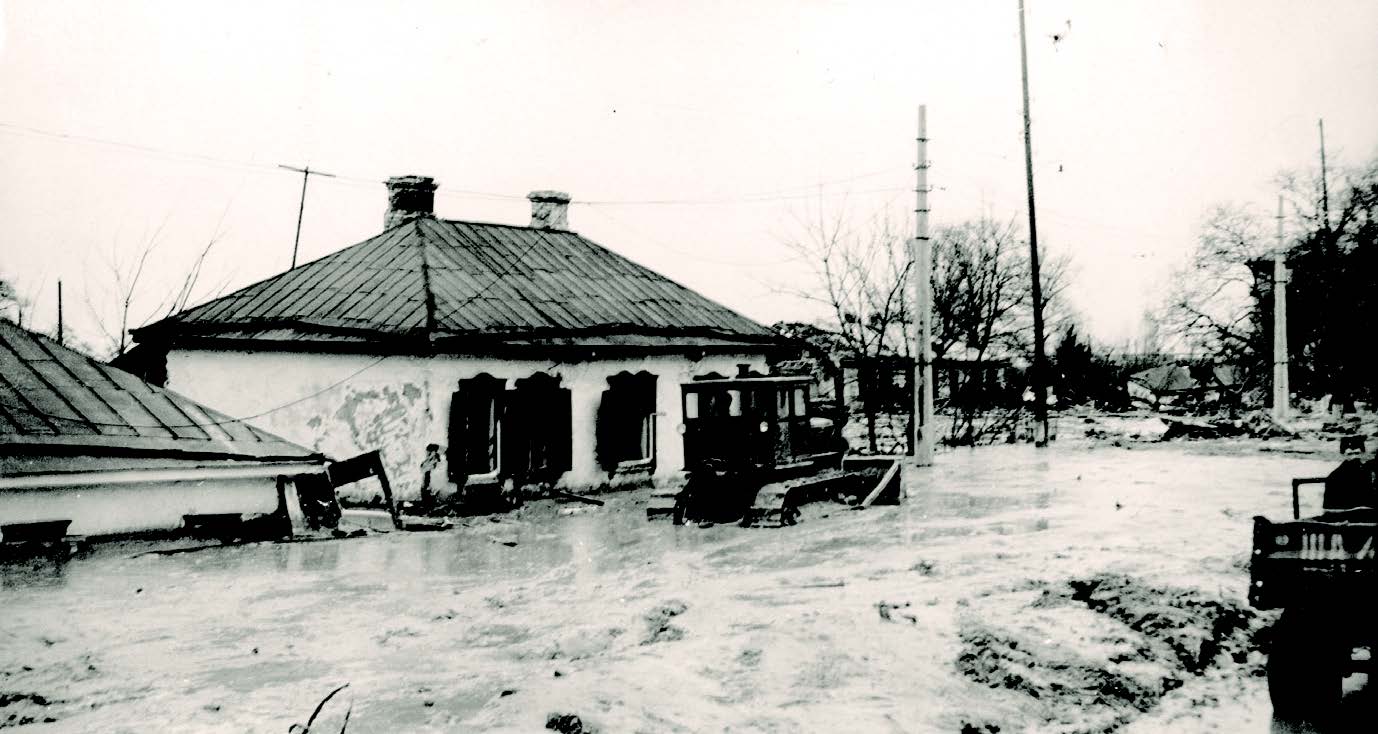
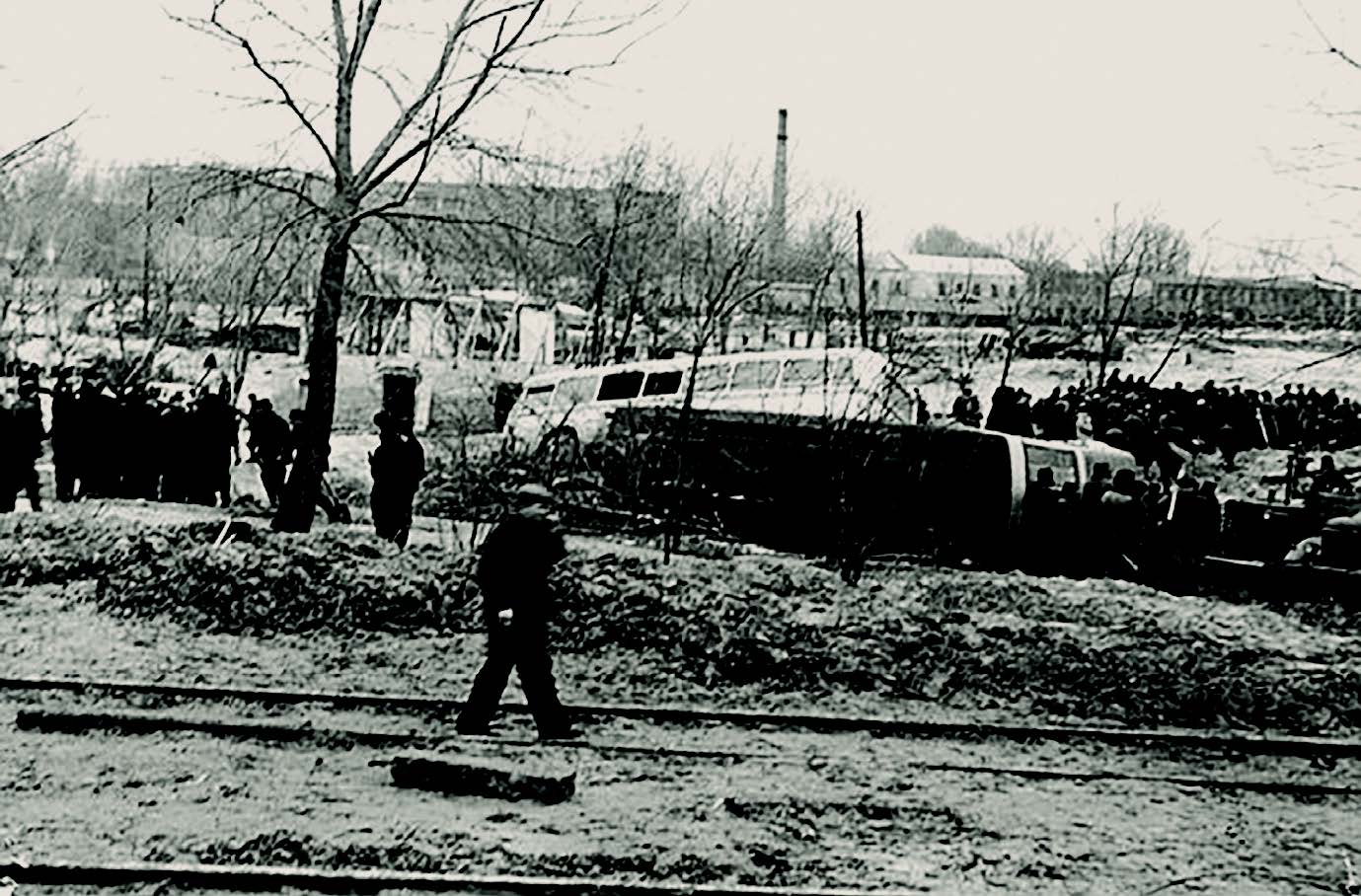
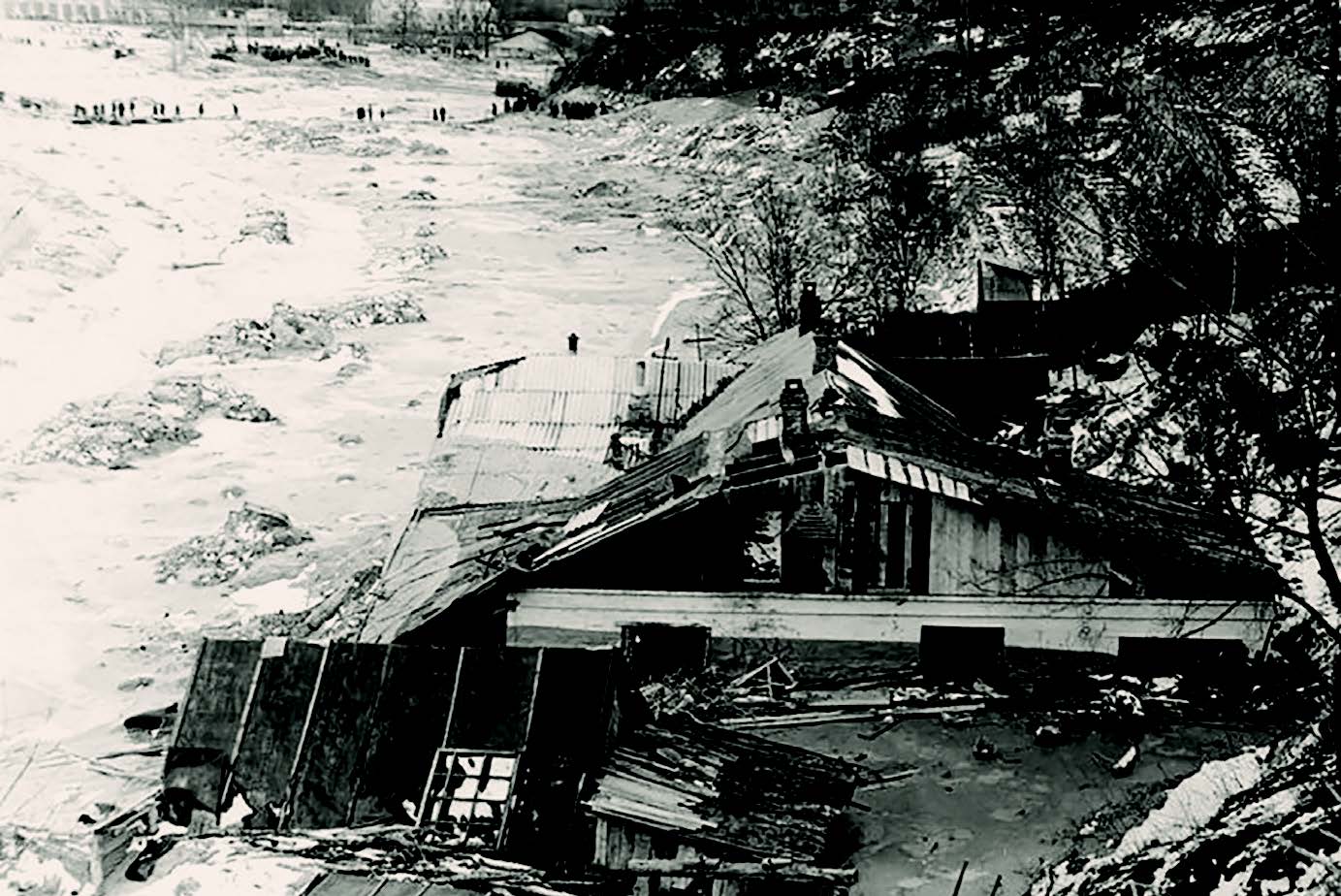
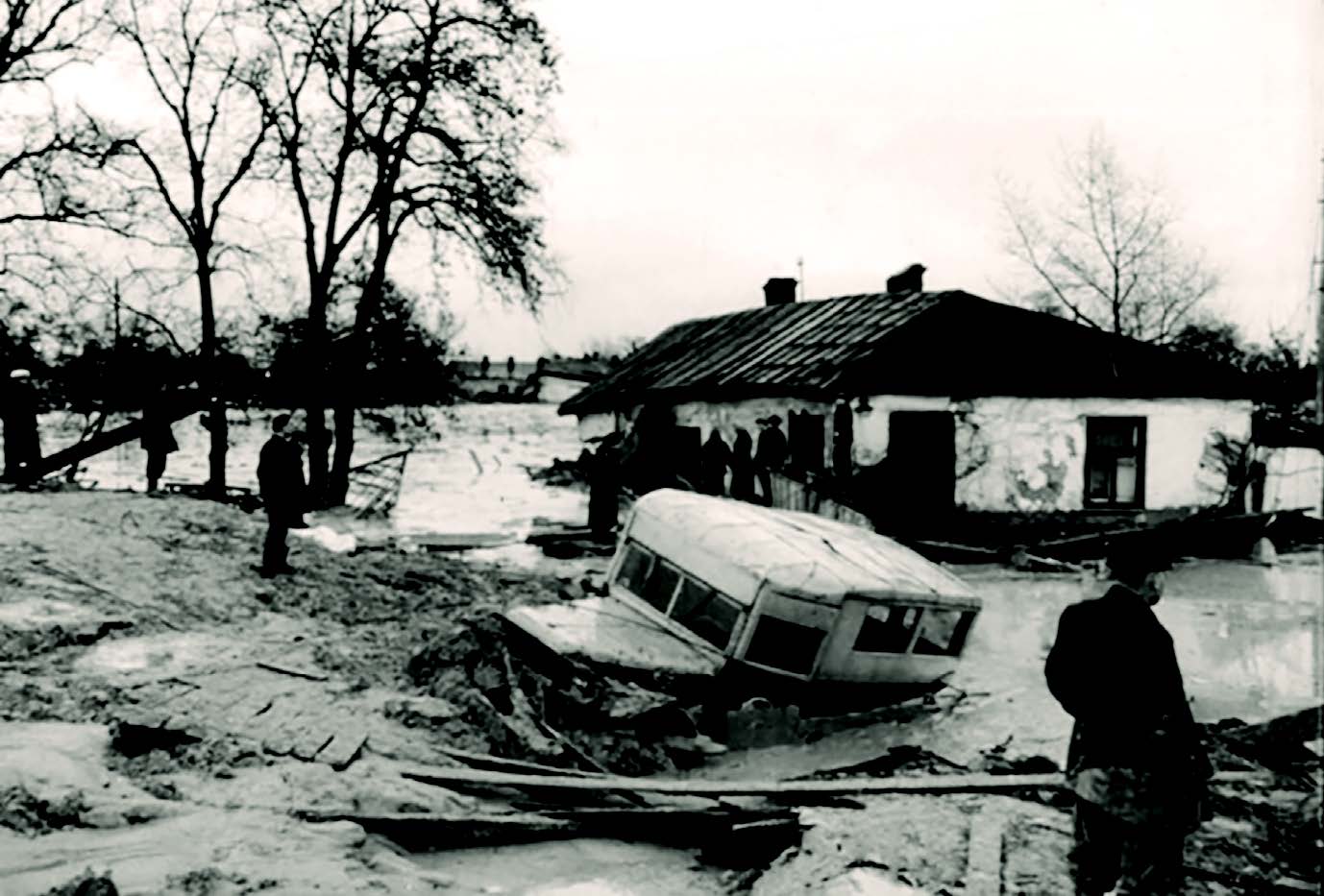
According to official data, 145 people were killed in the Kurenivka mudslide. Unofficial data indicated 1,500. [70] The avalanche of mud destroyed 68 residential buildings, 13 administrative-industrial buildings, and a streetcar depot. The KGB then began monitoring the public mood, later reporting "unhealthy opinions," particularly those expressed by Kyivan Jews, to the CC CPU: "A monument should have been erected there instead of launching this kind of development"; "They made up their minds to build a rotten tract instead of constructing a monument to the Jews who were killed there"; "It was the bodies of Jews who were shot by the Germans during the occupation in the city of Kyiv which had risen up"; "They should not have desecrated the memory of those who were killed in Babyn Yar; that's why this disaster happened." [71]
After the Kurenivka tragedy, the Soviet authorities still refused to abandon the idea of redeveloping the Babyn Yar area. The development of the residential area in Syrets continued, and construction began on a new circle (ring) road. In 1962 it was decided to liquidate the cemeteries located on Melnikova Street and build a sports complex. Then the Jewish Cemetery was destroyed, and a sports complex was built there. The construction of a television tower began in the old section of the Military (Bratske) Cemetery. When the cemetery was being dismantled, local residents were invited to move the remains of their family members to another cemetery. Some people did so, but many Jewish people who might have overseen the move of their relatives' remains were not alive either because the Nazis had exterminated entire families in Babyn Yar. The atheistic Soviet government finally ordered the cemetery to be razed, and these "nobodies' graves" were bulldozed into the ground. Exceptions were made when the construction work exposed the remains of Nazi victims; by a decision of the Kyiv executive committee, they were all subject to burial in Lukianivka Cemetery.
Meanwhile, the 20th anniversary of the Babyn Yar tragedy was approaching. In the summer of 1961, the poet Yevgeny Yevtushenko was in Kyiv, where he visited the site of the massacre together with the young writer Anatoly Kuznetsov. Yevtushenko recalled later that he was deeply moved by what he saw:
I knew that there was no monument there, but I had expected to see some kind of commemorative marker or some kind of tended spot. And suddenly I saw a very ordinary landfill that had been turned into a sandwich of garbage with a bad smell…. Before our eyes, trucks were arriving and dumping more and more piles of garbage into the place where these victims were lying. [72]
Shortly afterwards a creative evening was held in Zhovtnevyi (October) Palace in Kyiv, where Yevtushenko read his poem about Babyn Yar. In December 1962 the Moscow-based composer Dmitri Shostakovich presented his Thirteenth Symphony, the first section of which featured vocals based on Yevtushenko's poem. In 1966 the Moscow magazine Yunost (Youth) published a shortened version of Anatoly Kuznetsov's novel Babi Yar. Thereafter, contrary to the enduring attempts to erase the memory of the tragedy that befell the Jews of Kyiv in September 1941, the Babyn Yar theme entered the Soviet public space and, simultaneously, gained international resonance.
The Soviet authorities could not countenance this. It was decided therefore to revisit the idea of erecting a monument in Babyn Yar, but once again, not a monument dedicated to Jews but to all innocent Soviet citizens. On 30 May 1965 the CC CPU approved a resolution "About Constructing Monuments in Memory of Soviet Citizens and Captured Soldiers and Officers of the Soviet Army Who Died at the Hands of the German-Fascist Occupiers during the Occupation of the City of Kyiv." On 26 July Ivan Kazanets, head of the Council of Ministers of the Ukrainian SSR, requested permission from Moscow to erect two monuments: one on the site of the former Syrets concentration camp and the other in Babyn Yar. [73] After obtaining permission, the republican authorities announced a design competition for the monument in Babyn Yar, which was pegged to the 25th anniversary of the tragedy.
Although the competition was a closed one, the public soon became aware of it. Kyivites visited the Architects' Building to discuss the designs, while some people brought flowers that they laid near the design sketch-boards. In addition to the proposals that were conceptually inscribed in the official treatment of the Babyn Yar tragedy, the jury also reviewed several designs by Yosyf Karakis, Abram Miletsky, Volodymyr Melnychenko, Ada Rybachuk, and others, which featured distinctly Jewish motifs. However, none of these designs found favor with the government. A second round of the competition, held under the slogan "The Road: Death and Restoration to Life," did not produce any results. The competition was finally suspended, and all the submitted designs were rejected. [74]
Despite this setback, the twenty-fifth anniversary of the Babyn Yar tragedy did not go unmarked. On 29 September 1966 an unsanctioned, symbolic mourning rally took place there. For several decades afterwards Babyn Yar began to be perceived not only as a "vale of tears" and memory of those who were murdered there, but also as a place for holding demonstratively public rallies organized by Soviet Jews protesting against government persecution and in defense of their identity and the ideals of freedom and dignity.
On the evening of 24 September several dozen concerned citizens — Viktor Nekrasov, the writer; Rafael Nakhmanovych, director of the Kyiv Documentary Film Studio; and Emmanuel (Amik) Diamant, a staff member of the Main Astronomical Observatory, among others — hung a banner on the surviving fragments of the brick wall enclosing the Jewish Cemetery. The banner bore an inscription in Russian and Hebrew: "Babi Yar, 1941; September 1966. Remember the 6 million." The group also placed an invitation to the public to take part in a mourning rally. [75]
On the morning of 29 September people began flocking to Babyn Yar solo or in groups. Nearly a thousand people assembled, mostly Jews. But there were also Ukrainians, Russians, and others who felt compelled by the moral need to demonstrate their sympathy and solidarity with the Jews in the struggle against antisemitism. Among them were the writers Viktor Nekrasov, Ivan Dziuba, and Borys-Antonenko-Davydovych, and the philosopher Yevhen Sverstiuk. The writer Vladimir Voinovich, the editor of the publishing house Sovetskii pisatel Viktor Fogelson, and the literary critic Feliks Svetov came all the way from Moscow to the rally, which was filmed by the documentary filmmakers Rafael Nakhmanovych and Eduard Timlin. [76]
Ivan Dziuba's speech made a powerful impression on the participants. By this time Dziuba had already been classed as "disloyal" for having written his book Internationalism or Russification? (1965), a harsh critique of the Communist Party's nationality policy. The speech that he delivered at the public meeting soon appeared in the samizdat press and also included in the body of "criminal" evidence that was being scrupulously collected by the KGB (the book was subsequently listed in the indictment as one of several pieces of evidence proving Dziuba's anti-Soviet activities).
Dziuba's speech at Babyn Yar was truly momentous. The young literary critic appealed to Jews, Ukrainians, and the members of the world community to show understanding, urging them to struggle against hatred and respect the most important human value – life:
Babyn Yar is a tragedy for all mankind, but it happened on Ukrainian soil, and therefore the Ukrainian, like the Jew, has no right to forget about it. Babyn Yar is our shared tragedy; this is a tragedy first and foremost of the Ukrainian and Jewish peoples. This tragedy was brought to our peoples by fascism. But one must not forget that fascism begins not at Babyn Yar and does not end with it. Fascism begins with disrespect toward a person and culminates in the destruction of the person, the destruction of peoples. […]
The path toward genuine, not false, brotherhood does not lie in selflessness but in self-knowledge, in not repudiating oneself and adapting to others, but in being oneself and respecting others. Jews have the right to be Jews, Ukrainians have the right to be Ukrainians in the full and profound, not merely formal, senses of these words. Let Jews know Jewish history, Jewish culture, language, and may they be proud of them. Let Ukrainians know Ukrainian history, culture, [and] language, and may they be proud of them. Let them know each other's history and culture, the history and culture of other peoples, and know how to value themselves and others as their own brothers. This is difficult to achieve. But it is better to aspire to this than to give up out of indifference and swim with the wave of assimilationism and opportunism; no good will come of them; there will be only boorishness, profanity, and concealed misanthropy. […]
With our entire lives we should oppose misanthropy and social boorishness. To us there is nothing more important than this now, for otherwise all social ideals are stripped of their meaning. [77]
One of the other speakers at the rally was an actress from the Kyiv Academic Puppet Theater and mother of two children Dina Pronicheva, a survivor of Babyn Yar. The writer Vladimir Voinovich recalled the speech that was delivered by an unidentified man, who took the floor and said the following: "Respected Jews, I ended up here by accident, and I want to express my solidarity. I know that many Ukrainians took part in destroying Jews. I am ashamed of this." [78]
The "unsanctioned rally" attended by crowds of people did not fail to attract the attention of the authorities. The militia rushed in ordered everyone to disperse, and confiscated the film footage from the cameramen. Meanwhile, a group of Ukrainian intellectuals, including Lina Kostenko, Ivan Dziuba, Yevhen Sverstiuk, Mykola Plakhotniuk, and several others went straight from Babyn Yar to Baikove Cemetery, where they held another unsanctioned rally at the grave of the "Ukrainian bourgeois nationalist," the historian Mykhailo Hrushevskyi.
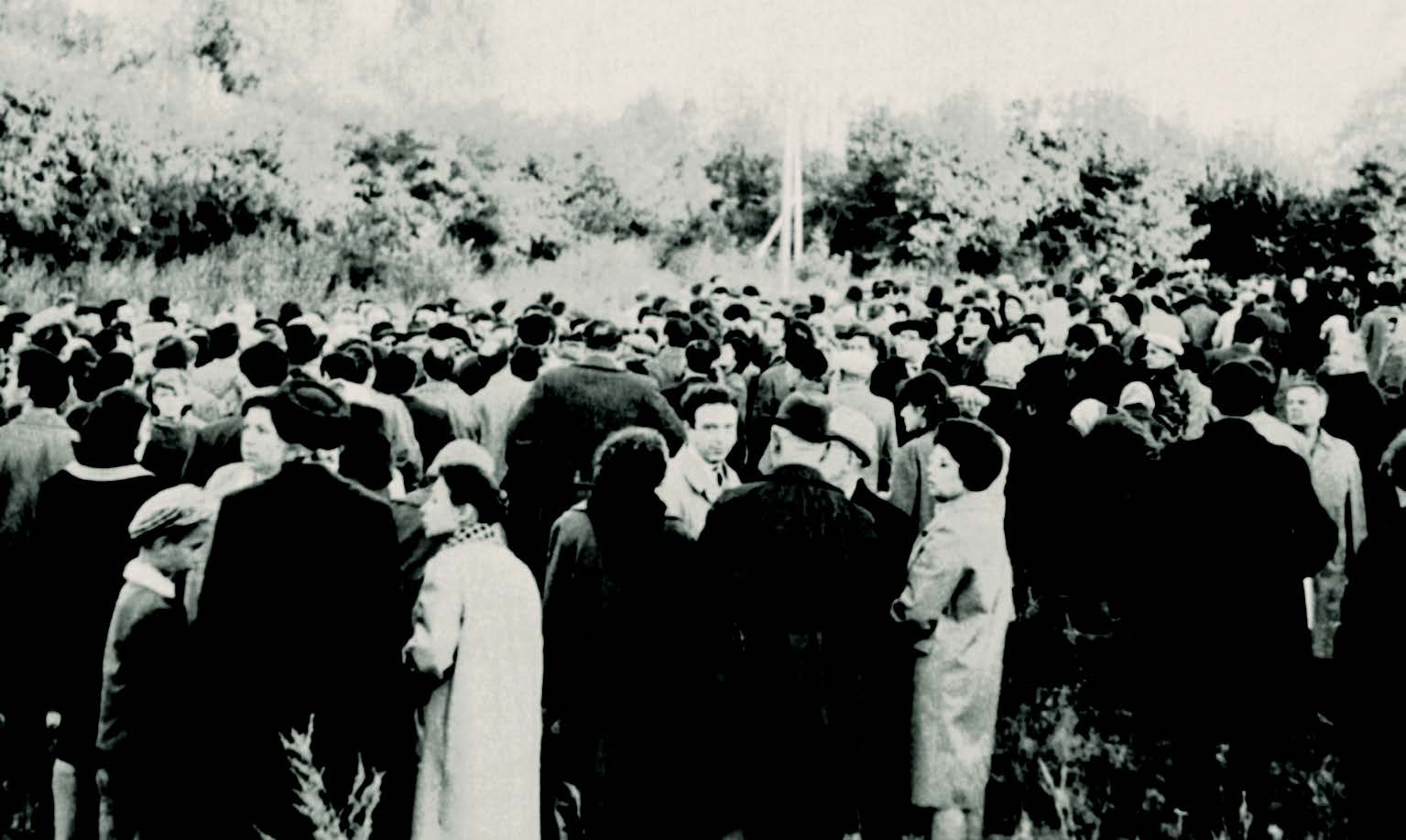
All the participants of the rally that took place at Babyn Yar in 1966 realized that it was a landmark political event; the authorities understood this as well. On 1 October 1966 Oleksandr Botvin, secretary of the Kyiv municipal party committee, submitted a report to Petro Shelest, first secretary of the CC CPU, entitled "About the Case of the Unorganized Rally Held at the Site of the Shootings of Soviet People by the German-Fascist Occupiers in Babyn Yar." At a meeting of the Kyiv municipal party committee held on 12 October 1966, the rally was characterized as an "unauthorized gathering." [79] Nevertheless, these events prodded the authorities into adopting more active measures aimed at "mastering" the process of memorializing the Babyn Yar tragedy. By 19 October 1966 the Kyiv municipal party committee and the municipal executive committee approved a joint decision entitled "About Erecting Commemorative Markers on the Territory of Babyn Yar and in the Square on Pryvokzalna Street in Darnytsia." The Kyivproekt Institute was ordered to prepare, within three days, a design for two commemorative markers, including one that would be installed at Babyn Yar. The order was duly carried out, and shortly afterwards a commemorative marker was installed between Dorohozhytska and Melnikova streets. It was inscribed with the following text: "In this place a monument will be erected to Soviet people, victims of the crimes of fascism during the temporary occupation of the city of Kyiv in 1941–1943." [80]
In order to hinder "unsanctioned gatherings" of Jews near the commemorative marker, the Soviet authorities decided to hold official meetings there. Thus, in subsequent years large gatherings attended by employees of enterprises and municipal institutions, who were obliged to attend them, were held at Babyn Yar in the last days of September. Secretaries of the municipal party and raion committees, war veterans, and front-rank workers, among whom there were always a few token Jews, spoke at these meetings at specially built podiums. The orators proclaimed the achievements of the Soviet government, denounced "international Zionism," and recalled the victims of fascism — innocent Soviet citizens; naturally, the Jewish component of the Babyn Yar tragedy was completely ignored. A brass band performed the "Internationale," after which the rally participants dispersed.
However, the police, KGB "people dressed in plainclothes," and specially dispatched government agitators remained at the site. As a rule, after these official meetings the latter would push their way into the throngs of people and try to convince Jews that Babyn Yar should not be viewed as a symbol of the sufferings only of the Jewish people and that the government was doing much to honor the memory of those who had perished and to ensure a happy future for the Soviet people. Meanwhile, the security officials carried out careful monitoring of "unorganized groups of Jews," making sure that no wreaths bearing "nationalistic" inscriptions and symbols were laid. Another manifestation of psychological pressure was the blatant photographing of Jewish activists (this meant that the government had "taken note" of an activist, who might experience serious unpleasantness at his or her place of work, school, etc.). Those who had the courage to make an overt demonstration of dissatisfaction were taken away to militia branches, where they were subjected, at best, to "preventive treatment" or arrested. [81]
That is precisely what happened to Borys Kochubiievskyi, a thirty-year-old radio engineer who graduated from the Kyiv Polytechnic. During the first official meeting held at Babyn Yar in 1968 he voiced his dissatisfaction with the speeches about "Israeli aggression" and the deaths of "Soviet citizens" at the hands of the Nazis, and the authorities' concealment of the fact that Jews were killed in Babyn Yar. The engineer's apartment was searched, and in early December he was arrested on charges of "disseminating in oral form patently false fabrications that tarnished the Soviet state and social order" (Article 187–1 of the Criminal Code of the Ukrainian SSR). Kochubiievskyi was tried in May 1969 and sentenced to three years in prison. He was released only in December 1971, and then immigrated to Israel. [82]
Despite government pressure and persecution, the number of people taking part in the "spontaneous rallies" at Babyn Yar increased steadily over the next few years. Whereas between 50 and 70 Jewish activists gathered at the marker in 1968, in 1969 this number rose to 300–400, and in 1970 — to 700–800. The KGB monitored these gatherings closely, invariably calling them "antisocial actions" and recording all these "provocative acts" tirelessly. For example, in September 1969 these acts included the laying of a "Zionist star, the lighting of candles, and distribution of leaflets" (according to the reminiscences of Alik Diamant, three young people brought pieces of cloth woven in white and blue colors, which they hung in such a way as to create a six-pointed Star of David; "people in plainclothes" tried to drive them back and destroy it, but were stopped by onlookers). [83] In late September of the following year the KGB recorded the next "Zionist provocation," during which several wreaths with Yiddish and Hebrew inscriptions were laid at the stone. [84]
The subsequent history of Jewish commemoration of Babyn Yar was connected to a significant degree with the specific features of the Jewish national movement that began to acquire certain organized forms in the early 1970s. According to the definition formulated by the Russian human rights activist Liudmila Alekseeva, the most influential trends in this movement were the "kulturniks" and the "immigrationists." Whereas the former focused their efforts on developing the Jewish language and culture, organizing Jewish higher education, creating a network of cultural institutions, and expanding Jewish religious communities in the Soviet Union, the latter staunchly championed the right of Jews to immigrate. [85]
In the summer of 1968, the Soviet government formally reinstated permission for Jews to immigrate to Israel (in the second half of the 1960s, applications to leave the Soviet Union were filed by 5,762 Jewish residents of the Ukrainian SSR, nearly half of the total number of applications submitted in the entire USSR). At the same time, quotas and important restrictions were introduced. For example, people with a higher and specialist education and employees of defense facilities were not allowed to immigrate. Individuals with no relatives in Israel were also not permitted to leave because, in the view of Soviet ideologists, this "compromised living conditions in the USSR." These restrictions led to the rise of the phenomenon of the "refuseniks," whose numbers increased proportionally to the number of rejected immigration applications. For example, in 1968 the Soviet government rejected the applications of 28 Jews; in 1969 — 1,079, and in 1970 — 1,439. By the late 1970s between 30 and 60 percent of all applications submitted by Jews in various oblasts of Soviet Ukraine were denied. At the same time in the late 1960s there were 5,762 applications submitted by Jews residing in Ukraine which amounted to almost a half of all such applications across the entire Soviet Union. [86]
This immigration policy spurred the refuseniks into uniting within individual cities, oblasts, and regions, and developing a joint tactic to counteract the Soviet government's efforts. Rallies, demonstrations, and other public events began turning into mass actions, and some of them were held at Babyn Yar.
On 1 August 1971 eleven Kyivan Jews, whose applications to immigrate to Israel were denied without explanation, tried to organize a protest demonstration and hunger strike at Babyn Yar. The KGB got wind of their plans, and several participants were summoned for "preventive conversations" to the Office of Visas and Registration (OVIR) of the Ministry of Internal Affairs of the Kyiv municipal council, but this did not stop the activists. Finally, the participants of the action were arrested "for causing a public disturbance." During the trial that took place the following day militiamen testified that the "arrestees broke flowers and trampled the grass at the monument to the victims of fascism." The ten defendants were sentenced to fifteen days in jail, and one of them was fined ten rubles. However, the matter did not end there. Shortly afterwards an issue of the Soviet opposition's information bulletin, Chronicle of Current Events, published a report stating that nine of the illegally imprisoned Jews had submitted a complaint to court institutions of the Ukrainian SSR in connection with "abuses in prison" (strip searches, name-calling, much harder work assigned to Jews than other prisoners, etc.). [87] The fact that these and similar actions organized by Jews at Babyn Yar were carefully monitored by the government "on the highest level" is attested by a report that the head of the KGB Yurii Andropov sent to the CC CPSU on 10 August 1971. In it Andropov informed the higher party leadership in detail about the events of 1 August and noted the following: "The Zionists' plan was foiled by measures that were adopted." [88]
In 1971 several more notable public actions took place at Babyn Yar. On the Day of Remembrance of the Holocaust and Heroism, which was celebrated that year in Israel on 22 April, Zionists in Kyiv planned to lay wreaths and flowers at the commemorative marker. The KGB instantly learned of this plan and summoned four activists to the oblast administration of the KGB for a "preventive conversation"; in fact, the goal of the meeting was to intimidate them.
The full-scale interrogation that ensued revealed not only the deep ideological divide between the Soviet government and the young Jewish activists but also the utter lack of fear of the regime on the part of the activists and their principled readiness to defend their rights. Anatolii (Alik) Feldman, one of the Jewish activists, recalled in his memoirs that he was questioned by a "man in plainclothes," who introduced himself as Major Ovcharenko, and then by the deputy head or head of the oblast directorate of the KGB:
I was asked: 'What action have you planned for tomorrow?'
'We have not planned any action. If you are interested in what I personally am planning to do tomorrow, I can say that I want to go to Babyn Yar and lay a wreath in memory of the Jews who perished there in 1941.'
'Why are you honoring the memory only of Jews? After all, Soviet people and other nationalities are buried there.'
'But only Jews died because they belonged to a certain people. This was genocide. To conceal this means to whitewash the fascist killers. In addition, when we come to a cemetery, we go up to the graves of our loved ones. Does this signify disrespect toward other graves? We grieve for all Nazi victims, but we do not conceal the fact that our hearts ache for the Jews who perished. Is this not natural?'
'For the mourning ceremony, why did you choose tomorrow, when all Soviet people are marking the birthday of V. I. Lenin? This might look like a provocation.'
'That's a coincidence. The Jewish calendar is a monthly one, and this year the Day of Remembrance of the Holocaust and Heroism falls on 22 April.
'And in future it will fall on 1 May?'
'No, on 11 April.'
'Why did you mark this day last year?'
'If you are right, I agree with you. This is truly an oversight on our part. I can promise you that this will not happen again.'
'We do not advise you to go to Babyn Yar tomorrow. Laying wreaths with inscriptions in a foreign language and, generally, your defiant behavior could spark a corresponding reaction on the part of the non-Jewish population. Aren't you afraid of this?'
'No, we're not afraid. I know that without your direct instruction, this will not happen. And right now excesses are not beneficial for you.'
'A militiaman, or a vigilante, or any Soviet person does not know what is written on the wreath. And what if it is an anti-Soviet slogan?'
'There are 150,000 Jews in Kyiv. You could have a staff member who knows the Jewish language.'
'Nevertheless, we are not advising you to go. Besides laws, there is Soviet rule of law. We will not allow anyone to violate it and hold religious orgies in a public place.'
'We do not need your advice. If you can, ban us from going to Babyn Yar.'
'We cannot forbid [you], but we are warning you: show prudence.'
'Thank you for the warning, and allow me to warn you. Since you are aware that we want to lay wreaths, then you will be responsible for all possible incidents.'
The conversation ended at this point. [89]
Despite brutal government pressure, the planned event took place. Standing at a distance, KGB men monitored the actions of the Jewish activists. However, clearly fearing the mechanisms of international publicity to which the Zionists resorted from time to time, the government did not dare to remove the wreaths that the activists laid at the commemorative marker, and they lay there until the following evening.
The atmosphere was also tense on 29 September 1971, during the ceremony marking the 30th anniversary of the Babyn Yar tragedy, an event for which both the Soviet authorities and Jewish activists prepared. As attested by declassified archival documents, government leaders drew up "a plan to prepare and hold the meeting and to ensure public order." At the appointed time "public representatives and delegations from the collectives of enterprises and institutions in Shevchenkivsky district," numbering between 3,000 and 3,500 people who had been "mobilized" to attend the official meeting gathered at the commemorative marker. According to established tradition, orators proclaimed ideological slogans from the podium and recalled the "victims of the fascist regime," without mentioning a single word about the Jewish victims of Babyn Yar. [90]
The "unsanctioned" meeting held at the commemorative marker that day drew, according to KGB data nearly 200 people of Jewish nationality and another 200 or so passersby. But the Chronicle of Current Events reported nearly a thousand participants, including many young people. From the Jewish inscriptions on the wreaths it was evident that Jewish activists from Moscow, Leningrad, Sverdlovsk, and Tbilisi were also in attendance at the mourning rally in Kyiv. This time the Soviet authorities did not stand on ceremony with the "gathering of citizens of Jewish nationality." Projectors and cameras were aimed at people, and militia units and "people in plainclothes" stationed at the approaches to the commemorative marker tore off anything that could be viewed as "Zionist symbols." "The KGB men, of whom there were very many that day, got down to work," recalled Yosif Begun, a resident of Moscow, former activist of the Jewish movement, and prisoner of the GULAG. "They tore the mourning ribbons from the wreaths. Kippahs were torn off our heads, mourning armbands from our arms…. When we were approaching our end goal, there were no longer any 'identifying' Jewish signs either on our persons or our wreaths. Everything had been torn off, thrown out, 'confiscated.'" [91]
The period of neo-Stalinism to the collapse of the Soviet Union
On 7 September 1972 a group of Kyivan Jews attempted to lay a wreath and bouquets of flowers at Babyn Yar in honor of the eleven Israeli athletes who were brutally murdered by terrorists two days earlier at the Munich Olympics. Militiamen and KGB agents stopped the mourning ceremony, and the twenty-seven activists were arrested. The militia used force in an effort to disperse their relatives and friends, who assembled at the building where the activists were being detained. Two of the arrestees, Yurii Soroko and Zinovii Melamed, recalled afterwards that a KGB officer named Davydenko spoke to them in a threatening tone at the KGB Directorate of Kyiv oblast, declaring frankly that the "circumstances had changed." The KGB's hands were now "untied," and if opposition activities continued, the activists would receive lengthy sentences. [92]
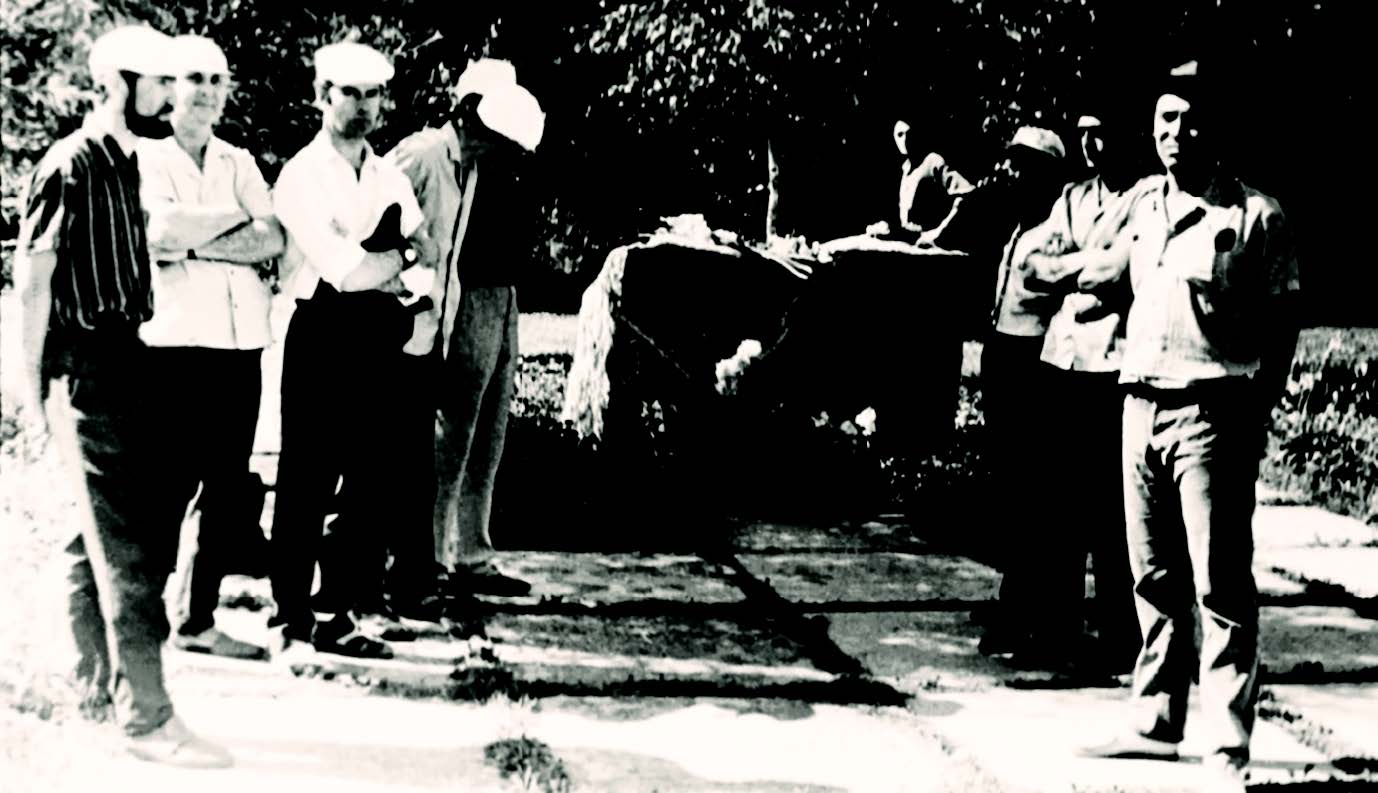
Even though this episode seemed to be true to form, in fact it was quite symptomatic in the context of the fundamental changes in the political climate in the Soviet Union in the late 1960s and early 1970s, with the rise to power of Leonid Brezhnev and his appointee in the Ukrainian SSR, Volodymyr Shcherbytsky. The "Thaw" years were followed by decades of "stagnation," or neo-Stalinism, marked by the restoration of the position of General Secretary of the CC CPSU, the curtailing of criticism of Stalinism, the intensification of repressions targeting oppositionists, who were now being imprisoned not only in the GULAG, but also subjected to forcible treatment in psychiatric hospitals. The government also intensified its ideological struggle against "manifestations of nationalism," especially in Ukraine, where it was waged with particular ferocity against "Ukrainian bourgeois nationalism" and "international Zionism." [see The Soviet authorities feared national movements that opposed the Soviet government both because of the rapid growth of their influence in the country and the international community's powerful support for these movements, especially in the sphere of information. It was clear that the national movements were undermining the legitimacy of communist rule and, in the long perspective, its very existence.
The indestructible ones: Ukrainian and Jewish dissidents
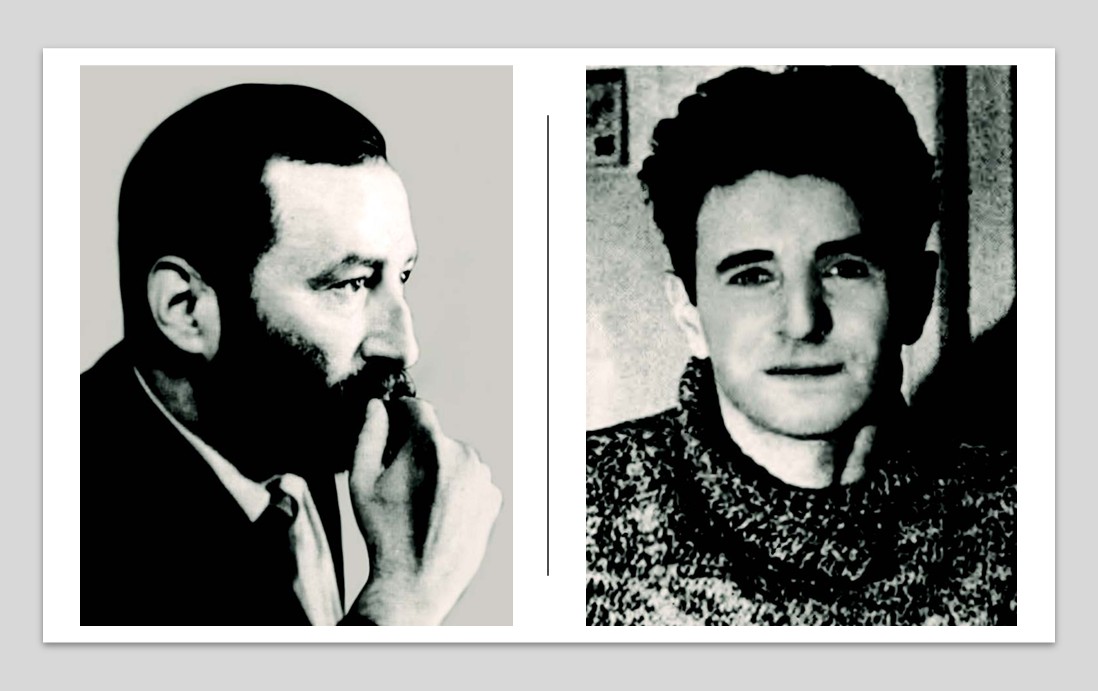
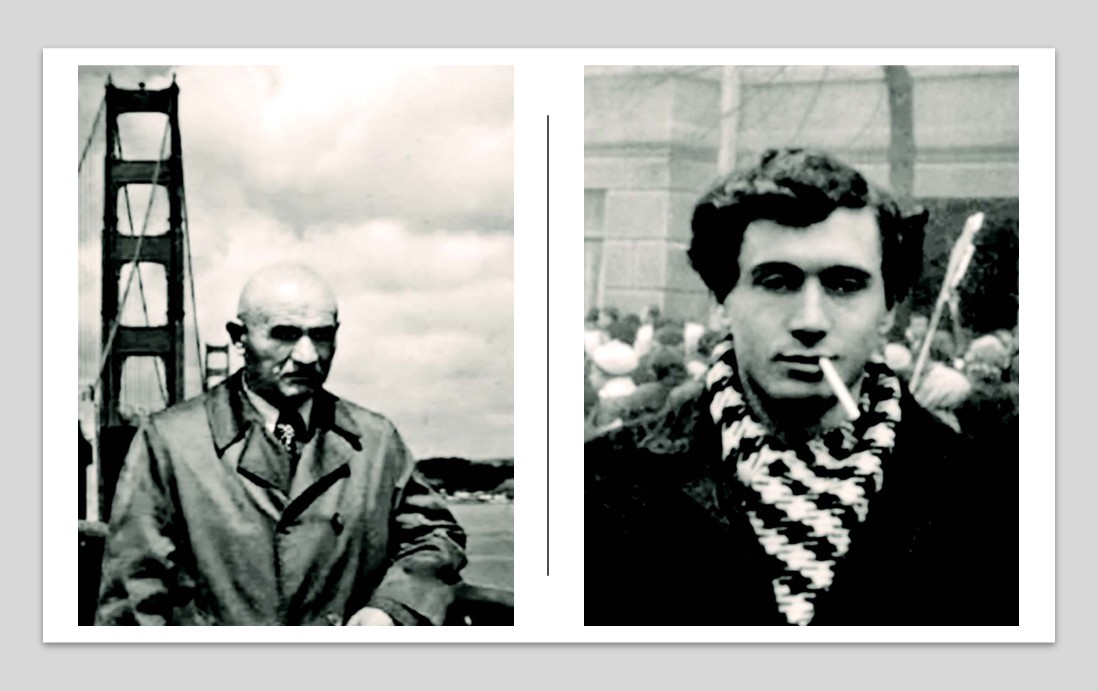
The government's offensive against the Jewish national movement was multi-pronged. In connection with and subsequent to the aircraft hijacking affair of 1970–1971 the Soviet authorities carried out repressions, arresting and imprisoning activists or resorting to expelling the most "odious" of them from the USSR. Numerous artificial obstacles were created for Jews attempting to immigrate to Israel, and prospective émigrés were intimidated by arrests, pogroms, expulsion from institutes, dismissal from work, etc. Finally, both inside the USSR and in the international arena the Soviet authorities conducted a widespread, mass-scale propaganda war against "international Zionism." [93]
On 17 February 1971 the CC CPSU approved a secret resolution entitled "About Measures for Intensifying the Struggle against the Anti-Soviet and Anti-Communist Activities of International Zionism." This document was supplemented by an almost identically titled resolution passed by the CC CPSU on 1 February 1972, "About Further Measures for the Struggle against the Anti-Soviet and Anti-Communist Activities of International Zionism." With the goal of implementing it, on 7 September 1972 the Secretariat of the CC CPSU, including Mikhail Suslov, Fedor Kulakov, Petr Demichev, Vasilii Kuznetsov, and other members, approved the "Plan of Basic Propaganda and Counterpropaganda Measures in Connection with the Latest Anti-Soviet Campaign of International Zionism." [94] A key role in carrying out this plan was assigned to the KGB, which was accountable to the Council of Ministers of the USSR, and its agents were instructed to adopt decisive measures in "exposing and halting the hostile actions of the enemy's security services, foreign Zionist organizations, and Jewish nationalists within the country." [95] Approval of these documents signaled a new round of confrontations between the Soviet government and the Jewish national movement in the USSR, in which circumstances Babyn Yar was objectively transformed into an arena of conflict.
On the eve of the commemoration of the next anniversary of the Babyn Yar tragedy, the Kyiv municipal party committee developed a pro-government action plan. On 29 September 1972 the official rally near the commemorative marker began much later than usual, at approximately 6:00 p.m., and it lasted only a short time. In keeping with established tradition, flowers and wreaths bearing "ideologically sustained" inscriptions were laid at the marker. Then an orator delivered a speech in which he emphasized the advantages of life in the "multinational Soviet state," denounced "Israeli aggression against the Arabs," and mentioned the tragedy of Babyn Yar, where during the war "many Soviet people of various nationalities" were killed. [96]
When the official part ended, several hundred Jews tried to pay tribute to their families and friends, but this unofficial part of the ceremony was suddenly taken in hand by the security forces. Numerous militia detachments, stationed earlier on the sidewalks flanking the road leading to the commemorative marker, let through only people bearing wreaths decorated with black and red ribbons, barring access to individuals carrying anything decorated with white and blue ribbons and inscriptions written in Hebrew, on the grounds that "it is not clear what is written on them." At 7:00 p.m. the militia began shoving people brutally away from Babyn Yar, and the electric light near the commemorative marker was switched off. By 8:00 p.m. the area was deserted. Arrests naturally took place. Eleven activists who had defied the Soviet government were detained by the militia and jailed for fifteen days on charges of "violating public order." [97]
On 27 December of that year the Soviet authorities issued a resolution entitled "On the Reimbursement of State Education Expenditures by Citizens of the USSR Leaving for Permanent Residence Abroad," which the Presidium of the Supreme Soviet of the USSR had approved on 3 August. Before leaving the USSR, all émigrés with a higher education were now obliged to repay the Soviet state 6,000 rubles (the average monthly salary at the time was 150 rubles); Candidates of Sciences — 15,400 rubles; and Doctors of Science — 17,200 rubles. (In 1972 Jews wishing to immigrate reimbursed the Soviet treasury nearly 4.5 million rubles, and more than 1.5 million rubles in the first two months of 1973). [98] In response to this essentially discriminatory decision, the American government signed into law the Jackson-Vanik amendment to the Trade Act of 1974, and in the USSR members of the refusenik movement held mass demonstrations and hunger strikes, and sent petitions and open letters to Soviet government agencies and the international community. [99] Some petitions singled out Babyn Yar as an example of how the Soviet authorities were ignoring the Jews' right to their own memory. In a letter addressed to the American people a Kyivan refusenik wrote:
We who have been denied this right are behind a curtain of numbers and words about free emigration. We are living in the Soviet Union against our will, the laws of this country no longer protect us. We are threatened with imprisonment for going to a synagogue, for commemorating those who were tortured and killed in Babyn Yar and the Warsaw Ghetto. Most of us have been dismissed from work; we do not know who is deciding our fate and what the future holds for us. The constant threats of arrest by state officials and intimidating articles in newspapers and radio broadcasts are creating an atmosphere of psychological terror around us. We have been stripped of the right to live, and we are not being given a chance to leave. We are turning to you, people of a great country, at this difficult time. Help us. [100]
Expecting that the American government would rescind its sanctions, the Soviet government canceled the education tax in March 1973. However, repressions against activists and intimidation of prospective immigrants continued as before. In keeping with the directives of the all-Union party leadership, on 15 August 1973 the CC CPU ordered Soviet Ukraine's Prosecutor's Office, its Ministry of Internal Affairs, and the KGB at the Council of Ministers "to intensify the work of exposing and prosecuting active propagandists of the 'movement' in support of Jewish emigration from the USSR [and] emissaries of foreign Zionist centers." [101] With the intention of implementing these directives, on 29 September 1973 the KGB and the militia were stationed at Babyn Yar, from where they dispersed approximately a thousand Jews who had come to Kyiv from various corners of the Soviet Union. [102]
As in previous years, the Jewish activists put up stubborn resistance to the ban on public manifestations of national identity during commemorations of the victims of the Babyn Yar massacre. Given their experience acquired over the years, the activists had pre-ordered wreaths to be laid at the commemorative marker and had prepared and hidden white ribbons with blue-colored inscriptions in Hebrew and Russian. Wreaths intended for the commemorative marker were carried by men and behind them came women bearing flowers. En route, people joined the procession making its way to the site of the ceremony. After they arrived at the commemorative marker, the activists quickly decorated the wreaths with the white-and-blue ribbons, and also managed to light twenty out of thirty-two candles that they had brought, before the KGB and militiamen pounced and began tearing off the ribbons and trampling the flowers. [103]
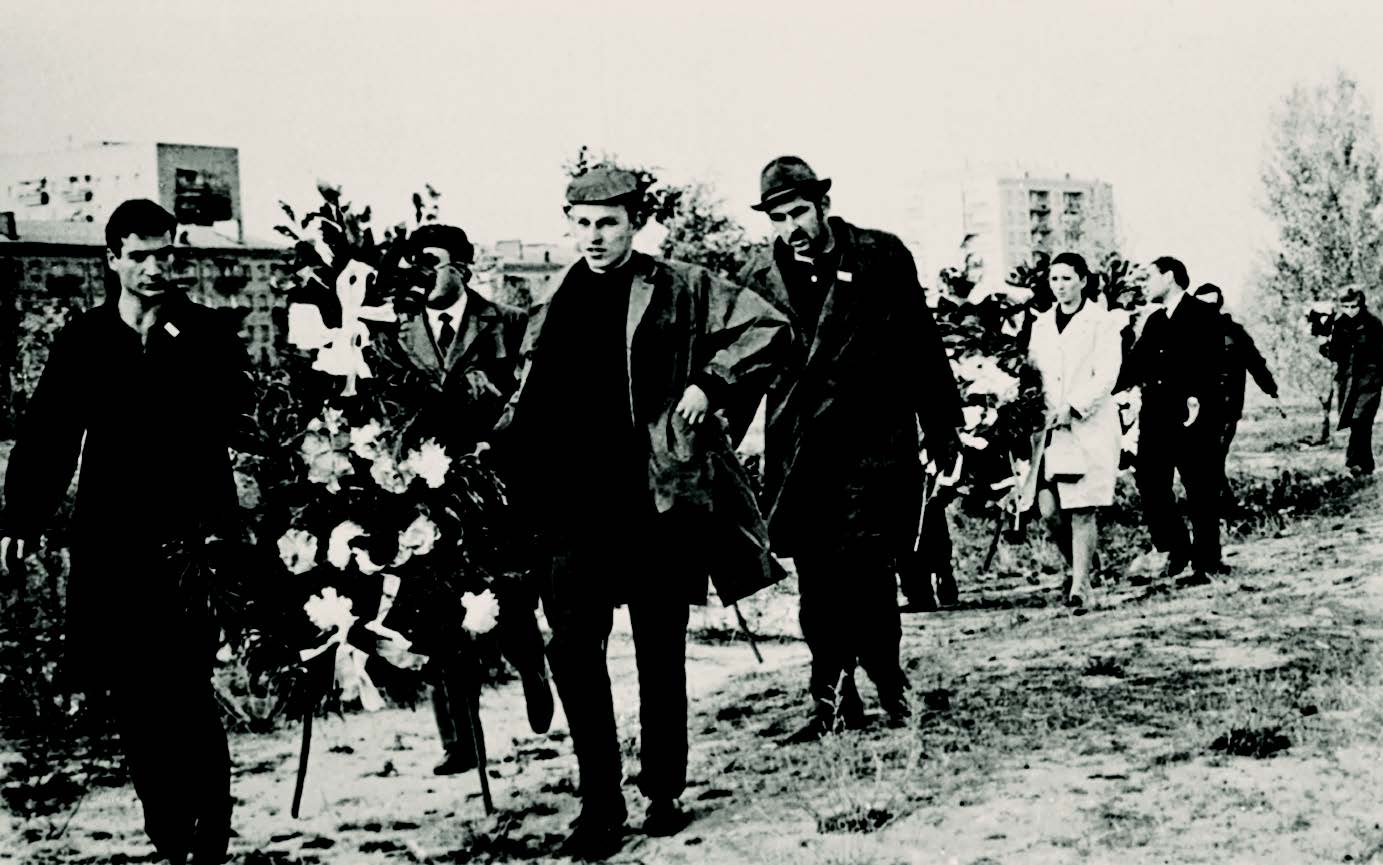
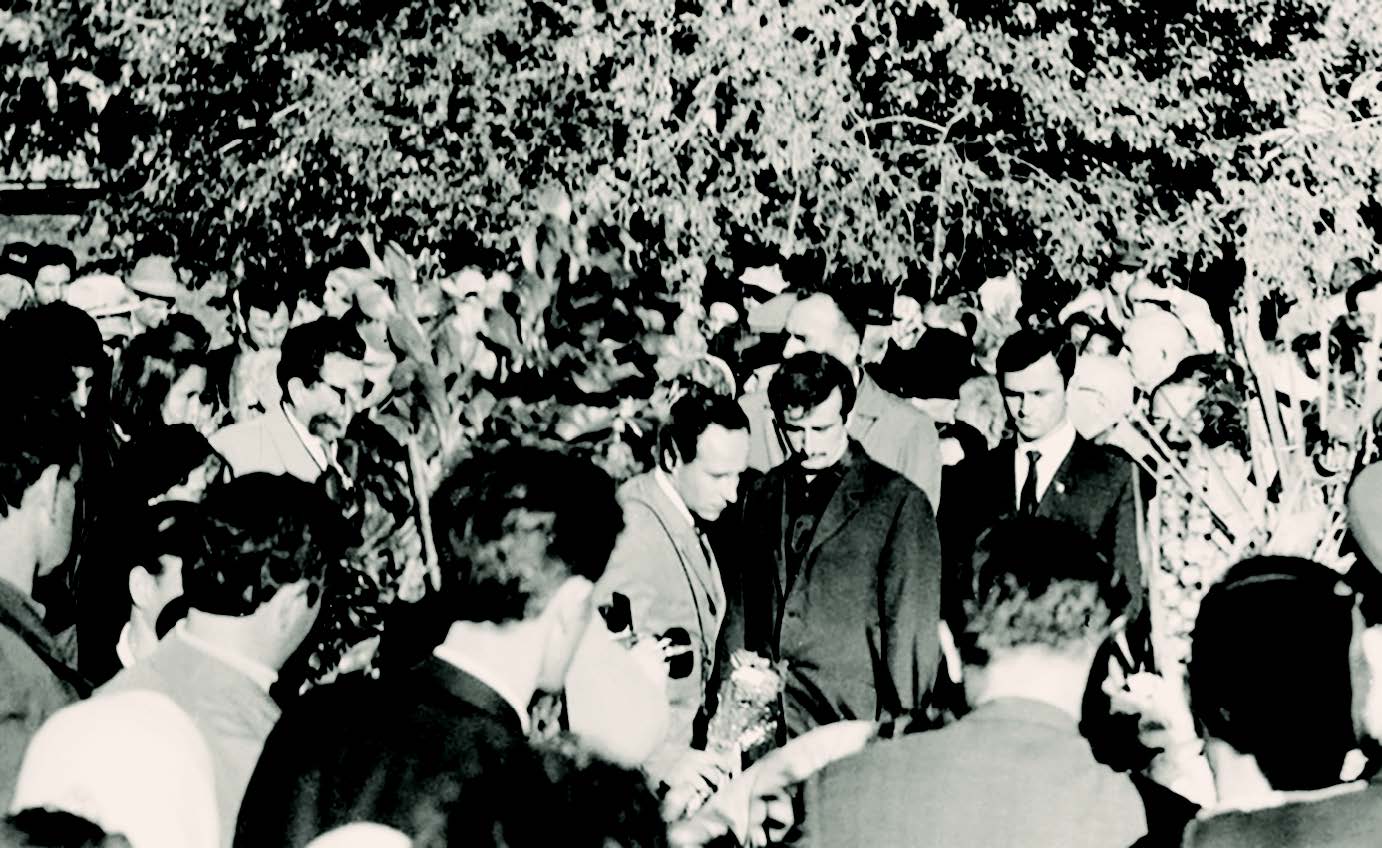
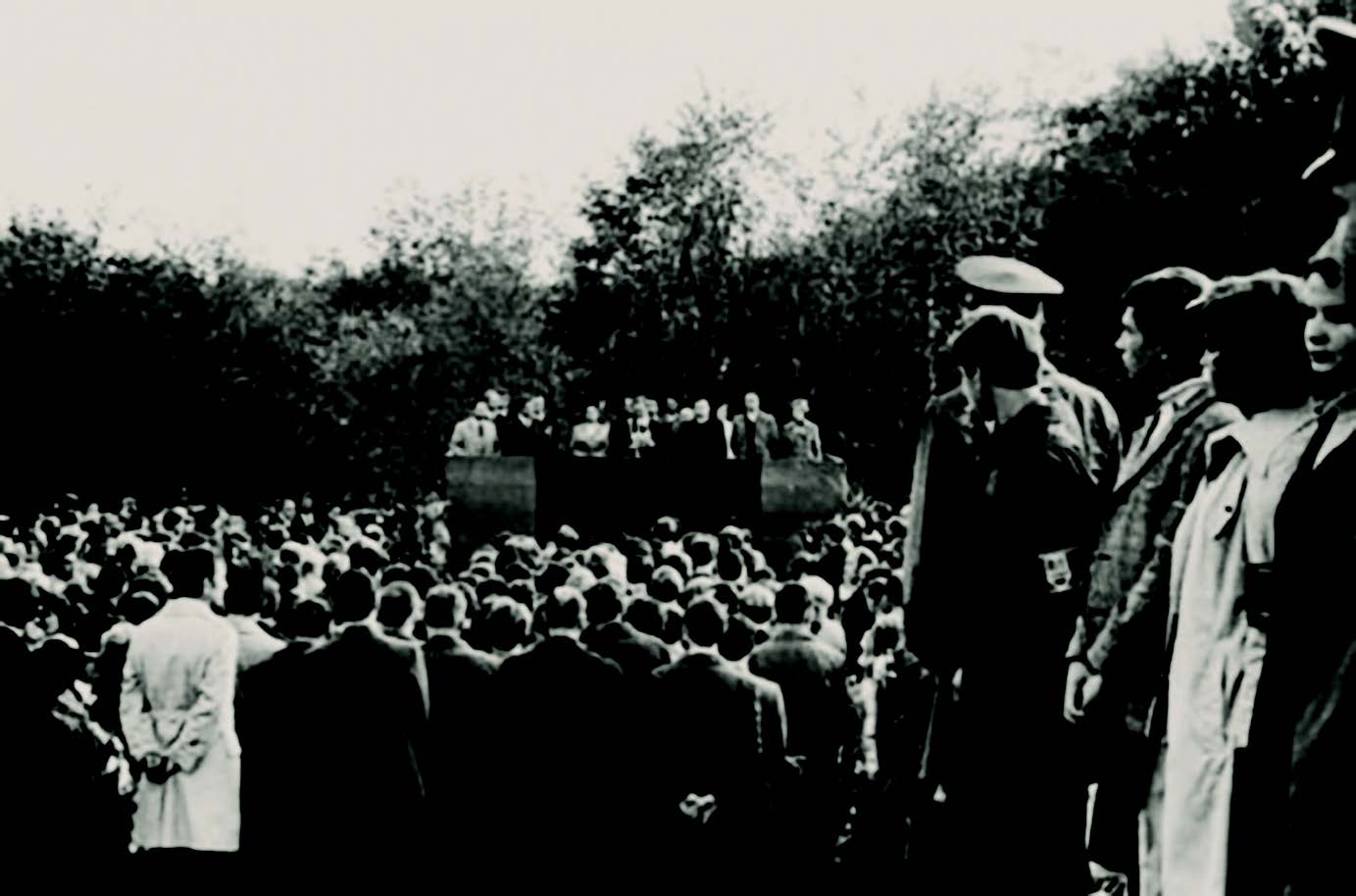
at Babyn Yar (late 1960s/1970s).
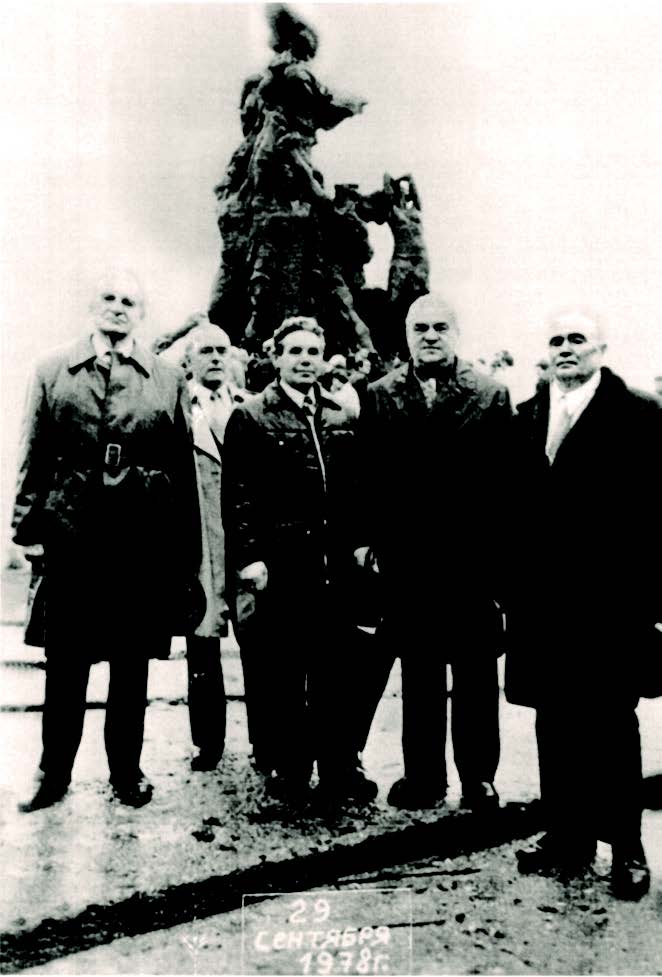
In 1974 the persecution of Jewish activists commenced several days before the commemorative days. On 29 September nearly 800 Jews who had gathered at Babyn were surrounded by KGB and militia detachments. The participants of the commemorative ceremony were forbidden to recite the Mourner's Kaddish and other prayers. After the mourning rally ended, several participants traveling home on public transport were subjected to acts of provocation intended to intimidate them. [104] On 28 September 1975 Jewish activists were prevented from holding a commemorative ceremony at Babyn Yar, and two days later several Jewish cemeteries in Kyiv were vandalized. [105]
Back in 1974, eighty-six Jews from Kyiv, Moscow, Tbilisi, and Minsk had sent letters to the CC CPSU protesting against harassment and the Soviet government's obvious procrastination in erecting the long-promised monument at Babyn Yar. They wrote:
The absence of a monument at Babyn Yar cannot be explained as forgetfulness on the part of the government of Ukraine. . . . Perhaps it . . . . does not have enough money. But a monument costs much less than one of the thousands of tanks that are supplied regularly . . . . to Arab countries. If there is still no possibility to economize the deliveries with at least one tank, then . . . the Jews of the USSR are ready to raise the necessary funds to erect a monument. [106]
Jewish activists then announced their readiness to found a public committee for raising funds for the construction of a monument at Babyn Yar.
Such actions on the part of "individuals of the Jewish nationality" were viewed as "provocative." The Soviet authorities banned the creation of this civic committee and, like in previous years, they decided to seize the initiative to construct a monument. On 2 July 1976, thirty-five years after the tragedy, a monument was finally erected at Babyn Yar. This was a multi-figured composition with a metal plaque inscribed with the following words: "Here in 1941–1945 more than a hundred thousand citizens of Kyiv and prisoners of war were shot by the German-fascist invaders." [107]
It was no accident that the date of the monument's unveiling was switched to summertime, the new date being far removed in time from the September days of commemoration. The secret police also took steps to adopt measures aimed at thwarting "provocations" by Jewish activists. The Soviet authorities used a variety of pretexts to prevent a significant number of activists from attending the unveiling ceremony (some people were removed from trains, others were warned about the possibility of arrest, etc.). One participant of this event, Yosif Begun, recalled that in Kyiv several dozen Jews from various cities who were getting ready to bring wreaths to Babyn Yar and take part in the official unveiling of the monument were surrounded, thrown into a bus, and brought to a militia station, where they were detained until late in the evening. These young people were released only at 9:00 p.m., when it was already dark on the streets and the area around the monument was deserted. (The activists brought the wreath that they had intended to lay at Babyn Yar to Moscow, where they showed it to foreign correspondents). [108]
Starting in 1977, official rallies were no longer held at Babyn Yar. The Soviet authorities clearly believed that the political potential of such events had been exhausted. Instead, the monument was often used for propaganda purposes, especially among foreign tourists, whose travel services were provided by the KGB-supervised state agencies Intourist and Sputnik. As noted in a 1978 report written by the head of Intourist, "many tourists express satisfaction as well as surprise at the possibility granted to them to visit Babyn Yar and lay flowers at the monument…, inasmuch as prior to their trip to the Soviet Union they had been warned that 'in Kyiv everything will be done so that tourists do not get to Babyn Yar.'" [109]
Such feelings of "satisfaction and surprise" were an exception to the rule as regards visits to the monument by tourists or official delegations that included members of the Jewish community. In early August 1979 a delegation from the United States visited Babyn Yar; one of its members was Elie Wiesel, chairman of the President's Commission on the Holocaust. In a speech delivered during the official part of the ceremony, Wiesel emphasized that the memory of the Jews killed in Babyn Yar was honored in the US. He also reminded his listeners that this place became sacred to the Jews long before a monument was installed there. Before his flight to Moscow, Wiesel expressed sharp indignation at the fact that the commemorative plaque next to the monument did not mention a single word about Jewish victims, and he promised to raise this question with the American government. [110]
In late 1979 the Soviet Union launched its military intervention in Afghanistan. Hopes for a reduction of tension between the Soviet and Western blocs, which were sparked by the signing of the Helsinki Accords, proved unfounded. A new round of the arms race and various conflicts erupted between the communist camp and the countries of the free world, the most powerful representatives of which were the USSR and the US. The newly elected US president Ronald Reagan announced a doctrine aimed at curbing communist expansionism the world over, and an arms race that proved to be beyond the capacity of the Soviet economy began.
At this new stage of the Cold War, the Soviet Union intensified its anti-American and anti-Israeli rhetoric in the international arena. In the USSR the Soviet authorities launched reprisals against dissidents who supported the Helsinki process, as well as other opposition forces. Once again, for a lengthy period of time Jews, with few exceptions, were denied the possibility to emigrate from the USSR. Any attempts to hold organized events were punished mercilessly. In order to preempt such events, in the early 1980s the KGB launched repressions against potential organizers of anti-government actions, and in addition to the arrests of Jewish refuseniks, "kulturniks" were persecuted as "agents of international Zionism." In March 1983 the secretariat of the CC CPSU approved the creation of the Anti-Zionist Committee of the Soviet Public (headed by General David Dragunsky), whose mission was to wage a struggle against "international Zionism"; in practice, the committee's efforts were aimed at discrediting the State of Israel. [111]
In the conditions of terror that existed behind the Iron Curtain, the activities of the Jewish national movement decreased significantly but did not disappear altogether. On the eve of the fortieth anniversary of the Babyn Yar tragedy, the KGB implemented a series of "preventive measures" in various cities in order to stop Jewish activists from traveling to Kyiv. On 24 September 1981 Oleg Popov was summoned to the militia in Moscow, where "people in plainclothes" had an unambiguous "talk" with him, warning him in no uncertain terms that if he traveled to Kyiv, both he and his family would end up in "cold lands" instead of gaining permission to immigrate to Israel. The "explanations" of the motivations underpinning the government's position were telling:
Popov: […] You do not want the anniversary of the shootings of Jews by the Nazis in Babyn Yar to be marked. By the way, why can't people lay a wreath at the monument in Babyn Yar? Is that against the law?
Unidentified individual: Honest Soviet citizens can. But we will not allow nationalists [to do this].
Popov: Aren't Jews Soviet citizens? How is it that some people can and other people can't?
Unidentified individual: But why do you talk only about Jews? The entire Soviet people suffered during the war, but you are commemorating only Jews. And the wreaths that will be brought are not ordinary ones but beribboned. And the ribbon is inscribed thus: 'We shall remember you in our historical fatherland.' Who gave nationalists the right to consider Israel the historical fatherland of Jews?. . . We will not allow nationalism to be promoted!. . . Times have changed. . . . Do you understand me?
Popov: No, I don't understand. What does different times mean?
Unidentified individual: It's too bad that you don't know. . . . You preach nationalism. And we will not allow this! . . . The propaganda of nationalism undermines internationalism. Clear? Is it not? Undermining internationalism is undermining our ideology. Still not clear? Undermining our ideology is undermining our order. . . .[112]
That same day, 24 September, Svitlana Yefanova, Volodymyr Tereshchenko, and Borys Kanevskyi were arrested in Kyiv, and were jailed for fifteen days on charges of "petty hooliganism." Several days later Mikhail Elman and Pavel Astrakhan of Leningrad were arrested and jailed for ten days; they had tried to lay a commemorative wreath with a ribbon inscribed with the following text: "Eternal memory to you. Leningrad, 1981." Two Moscow residents, the 70-year-old war veteran Moisei Ravich and Evgenii Nartov, were arrested right at the train station and turned back. But another Moscow resident, Aleksei Lorenstson, was jailed for fifteen days for allegedly "uttering obscenities." The Odesites Oleksandr Kushnir, Yana Mesha, Valerii Pevzher, and Yurii Shvarts were also detained near Babyn Yar and delivered to the airport. But the young people returned and managed to lay flowers at the monument and recite the Kaddish. Later the militia drove them to the train station and waited until the train pulled away. On 27 September at least a hundred militiamen and "people in plainclothes" were stationed near the monument to the victims of Babyn Yar. In addition, four buses were sent there to pick the arrested "hooligans," and the militia and KGB men controlled all the streets leading to Babyn Yar. [113]
Outraged by the government's actions, eighty Jewish activists wrote a letter to Leonid Brezhnev demanding that he stand up for the unjustly convicted activists and put an end to the "outrageous abuse of the sacred memory of the war victims." The letter stated in part:
For many years Babyn Yar has remained a wilderness. A monument was erected only five years ago; its inscription conceals the fact that this is a place of Jewish suffering. However, Jews from throughout the Soviet Union and from other countries always came here on 29 September to honor the memoir of the nameless victims. Any attempt to impede the desire to honor those who were killed would be profane. Nonetheless, such profanity did indeed take place. . . . What happened in Kyiv is terrible. This is an insult to the memory of war victims, an insult to Soviet Jews, an insult to everyone who fought and is fighting against fascism. [114]
A group of Soviet dissidents also reacted to the government's actions in Babyn Yar. Three members of the Moscow Helsinki Group — Elena Bonner, Sofia Kalistratova, and Naum Meiman — drafted a special declaration that read in part: "The events in Kyiv attest to the authorities' desire to erase the memory of Babyn Yar. At the same time the authorities used the fortieth anniversary of the mass killings of Jews near Kyiv as a pretext to launch the latest repressions against those Jews who want to emigrate from the Soviet Union." [115]
On 29 September Ukrainian television aired a propaganda film entitled Babyn Yar: Lessons of History. The author of the script, the Kyiv-based playwright Oleksander Shlaien, was dismissed from his job for refusing to obey party ideologists' orders that he introduce material aimed at "unmasking Zionists." As the film director Volodymyr Heorhiienko recalled later, all the "recommendations" were ultimately included in the final product. In addition to "exposing" Zionists, the film also included material on the "atrocities committed by the American military clique in Korea and China." An English version of the film, completed shortly afterwards, contained material on the "role of Ukrainian policemen."[116]
The latter was clearly connected with the Soviet government's desire to preclude the formation in the international area of any united "bloc" of Zionists and "Ukrainian bourgeois nationalists." The existence of such a strategy is attested by documents drafted by Soviet political and secret police agencies. A 1980 report prepared by the KGB of the Ukrainian SSR, in the section entitled "About Attempts to Create an OUNite and Zionist Bloc," describes joint Jewish-Ukrainian actions connected with the creation of Babi Yar Park in Denver, Colorado. According to KGB data, these actions were viewed as the "first practical step toward the realization of the Jewish-Ukrainian agreement on cooperation, which was supposedly adopted in Israel in 1979 by the members of the World Jewish Congress and the Ukrainian Congress Committee of America." The document noted that "the republican Committee of State Security is carrying out measures to counteract the formation of a bloc uniting the Ukrainian nationalists and the Zionists."
The history of the creation of Babi Yar Park in the United States merits separate attention. In general, little is known about how this park came to be. The idea to create a park emerged in the late 1960s–early 1970s. The initiative came from the local Jewish community, which included natives of Kyiv whose families were killed in Babyn Yar. The Jewish community raised $140,000 for the project, and the federal and municipal governments donated an additional $750,000. The city granted twenty-seven acres of land for the park. [117] At a certain stage, friction arose between the local Jewish and Ukrainian communities, sparked by different visions of the project, the traumatic experience of World War II, and — quite likely — targeted KGB provocations. For a certain period of time two parallel organizations existed: the Babi Yar Park Foundation and the Ukrainian Babyn Yar Committee. However, in August 1980 the two communities reached an understanding and formulated a joint plan to carry out the project. The Ukrainian community launched a fundraising campaign in order to make its own contribution to creating "the only memorial park in the world together with the Jews" and to pay homage to the "shadows of those whose lives were cut down prematurely by the brutal hurricane of war of German Nazism." One publication issued by the Ukrainian Babyn Yar Committee noted:
No matter from which point of view we approach in assessing the Ukrainian role in building the memorial park in Denver, we reach the conclusion that it has and will have a positive meaning for us and therefore it deserves our efforts and funds…. First, it is proof that we, like all cultured nations, honor the memory of the numerous victims among the Ukrainian people, and second, it is exemplary evidence that Ukrainians and Jews, with good will, can pave the way to better coexistence. [118]
While Jewish activists in Kyiv who tried consistently to honor the memory of the Jews killed in Babyn Yar continued to be terrorized and persecuted on the eve of and during the 40th anniversary of the tragedy, in the free world the Ukrainian Babyn Yar Committee published long lists of donors and reported on the funds that were raised in the United States, Canada, and Europe for the creation of the memorial park. The park was officially opened on 2 October 1983. A few days earlier, on 27 September, the Babi Yar Committee, along with Secretary Gallagher, organized a meeting between the Denver community and General Petro Hryhorenko (Petr Grigorenko), who had been expelled from the USSR.
The park was designed by Lawrence Halprin and Satoru Nishita, who devised the entrance to the path as a kind of purgatory taking the form of a narrow passage between two black granite monoliths flanked by trees, which by its configuration is reminiscent of the gates leading to the Garden of the Gods. The left stone is inscribed with the following words in Ukrainian: "In Memoriam to the Two Hundred Thousand Victims Who Died, Babi Yar, Kiev, Ukraine, USSR September 29,1941–November 6, 1943 / The Majority Jews with Ukranians [sic] and Others [Ukrainian] in Babi Yar / ETERNAL MEMORY to all the victims of terror." The right stone is inscribed with a poem written in English: "Decades Ago… / Still the Aching Sadness / Innocents . . . / People Who Loved / Forever Silenced by Nazi Terror / Sharing Eternally . . . / The Mystic Number . . . Six Million / A holocaust for the Jews of Europe / A tragedy for all humanity / Remember . . ." [119]
Mikhail Gorbachev's rise to power in the mid-1980s ushered in another wave of liberalization in the Soviet Union. The activities of oppositionist national movements were finally legalized, and formal obstacles to Jewish emigration from the USSR were abolished. A plaque inscribed in Yiddish appeared next to the monument at Babyn Yar. There was obvious progress in international relations, especially after Soviet troops were withdrawn from Afghanistan in February 1989 and the Berlin Wall was dismantled in November 1989.
Nevertheless, practically until the collapse of the USSR, there was a distrustful Soviet attitude to the State of Israel in the international arena and specific approaches to the "Jewish question," which were marked by considerations of "political expediency." Despite the détente, in 1989 the Soviet Union refused to acknowledge the erroneousness of the UN General Assembly's 1975 resolution defining Zionism as "a form of racism and racial discrimination." Furthermore, in actively exploiting for political purposes the theme that organizations of "Ukrainian nationalists" were involved in killing Jews during the Holocaust, the Soviet leadership refused to take responsibility for the decades of state antisemitism or publicly acknowledge the fact that the Nazis killed Jews in Babyn Yar only because they were Jews.
According to Gorbachev's personal assistant, the possibility of his visit to Kyiv was discussed on the eve of the 50th anniversary of the Babyn Yar tragedy. The main points of his speech were drafted quietly, and it referred "directly to Stalinist antisemitism and to the emigration of talented fellow citizens, and to the great nation, and to the lessons that we took from our own, not just Nazi, antisemitism." [120] In the end, Gorbachev decided not to attend the commemoration ceremonies in Kyiv. Instead, on 2 October 1991 he met with Shoshana Cardin, chairperson of the National Conference on Soviet Jewry. When he was asked the straightforward question of why the leadership of the Soviet Union, despite the conditions of democratization, still had not condemned antisemitism, the last leader of the Soviet Union not only dodged the question but commented, entirely in the spirit of all his predecessors, that "placing special attention on antisemitism" was not feasible. "We have 120 nationalities in the Union. Singling out one means to give preference to someone. And nationalistic manifestations exist not only in connection with the Jews." [121]
A month later the USSR ceased to exist. The question of whether to take on the burden of responsibilities for the policies and practices of Soviet state antisemitism and for the participation of a segment of "ordinary Soviet people" in the destruction of their Jewish neighbors during the Holocaust now emerged as a moral choice for the independent states that were created from the ruins of the USSR and for each of its citizens.
Babyn Yar in Ukraine's official politics of memory
On 24 August 1991 an extraordinary session of the Supreme Soviet of the Ukrainian SSR approved the Act of Declaration of Ukraine's Independence. The presidential elections were set for 1 December, as well as a referendum with which the Ukrainian people were supposed to confirm their decision to leave the Soviet Union and begin building a sovereign, democratic state. In these circumstances, the commemoration of the 50th anniversary of the Babyn Yar tragedy acquired special importance. Recognition of the Jewish component of the tragedy that took place in September 1941 was supposed to demonstrate that its disgraceful concealment was now a thing of the past and to attest to the new Ukrainian state's commitment to democratic and humanistic values that had been ignored for so long in the USSR.
On 10 September 1991 the cabinet of ministers of Ukraine handed down a resolution that spelled out a number of measures for the state commemoration of the upcoming anniversary of the massacre of Jews in Babyn Yar. The week-long commemorative events were slated to take place between 29 September and 6 October 1991. [122]
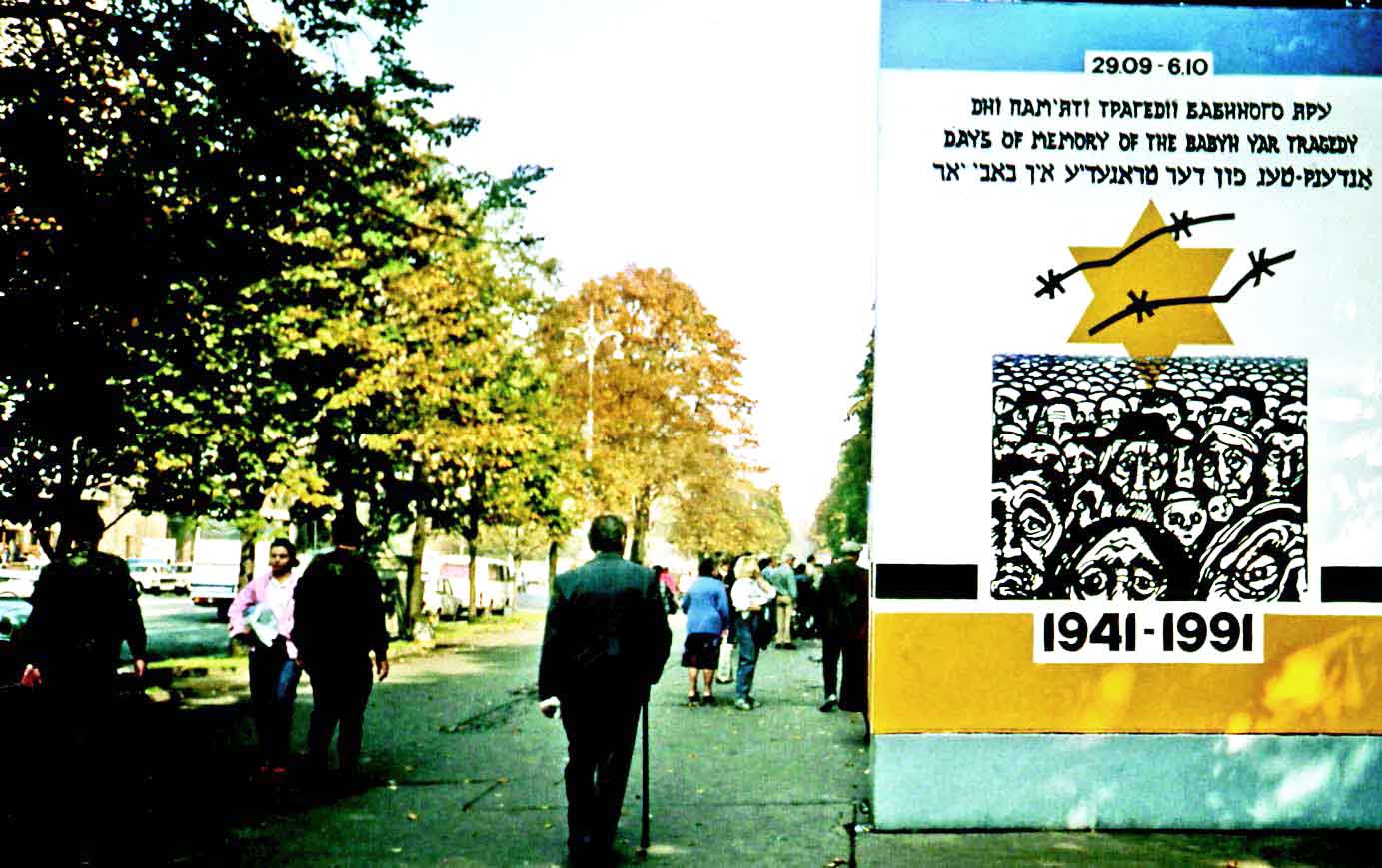
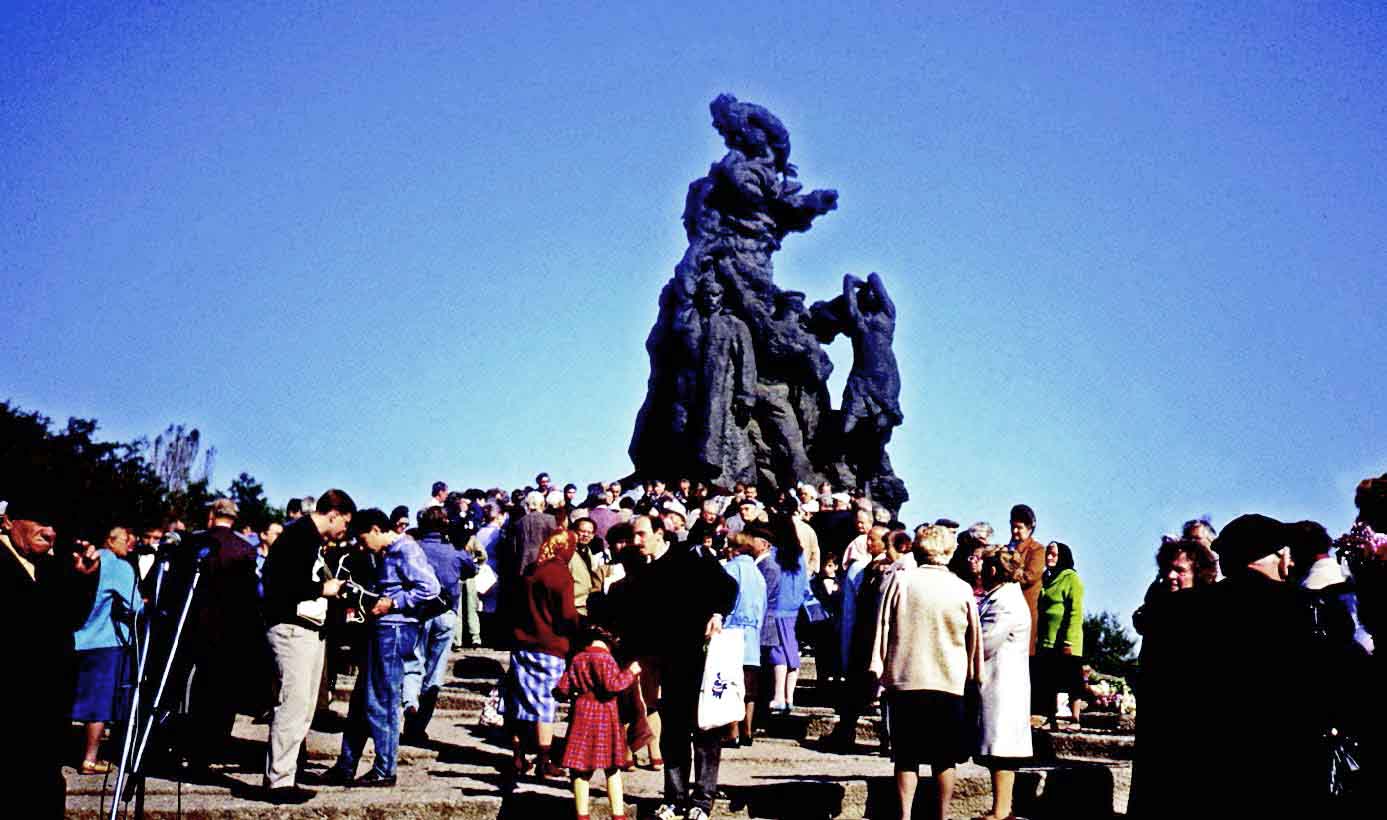
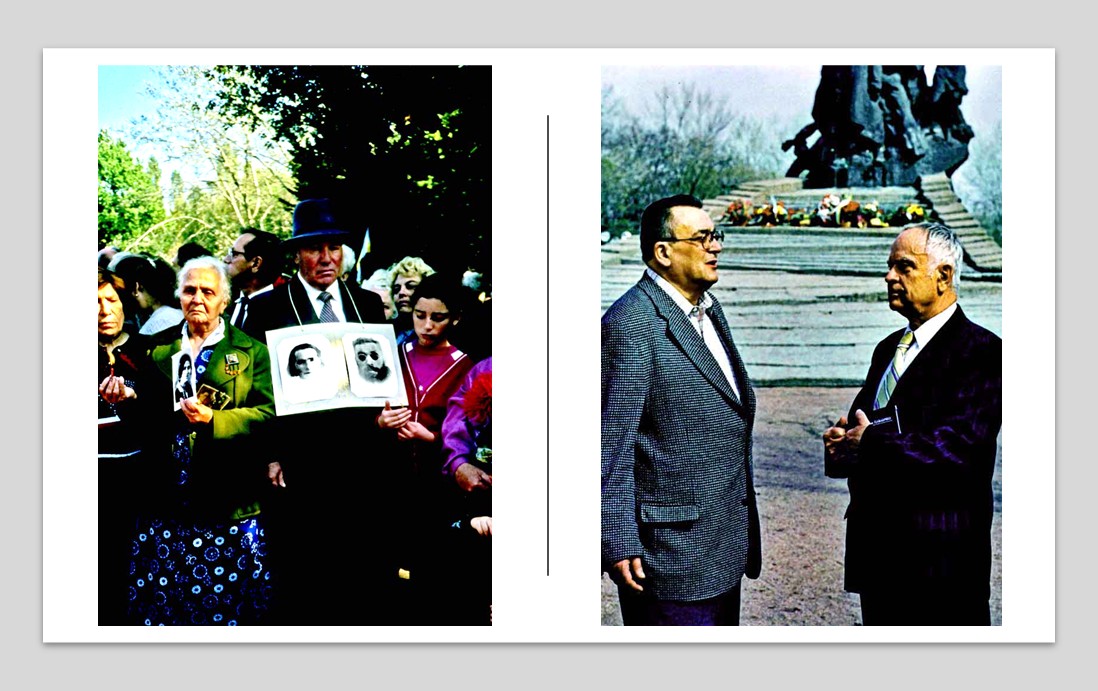
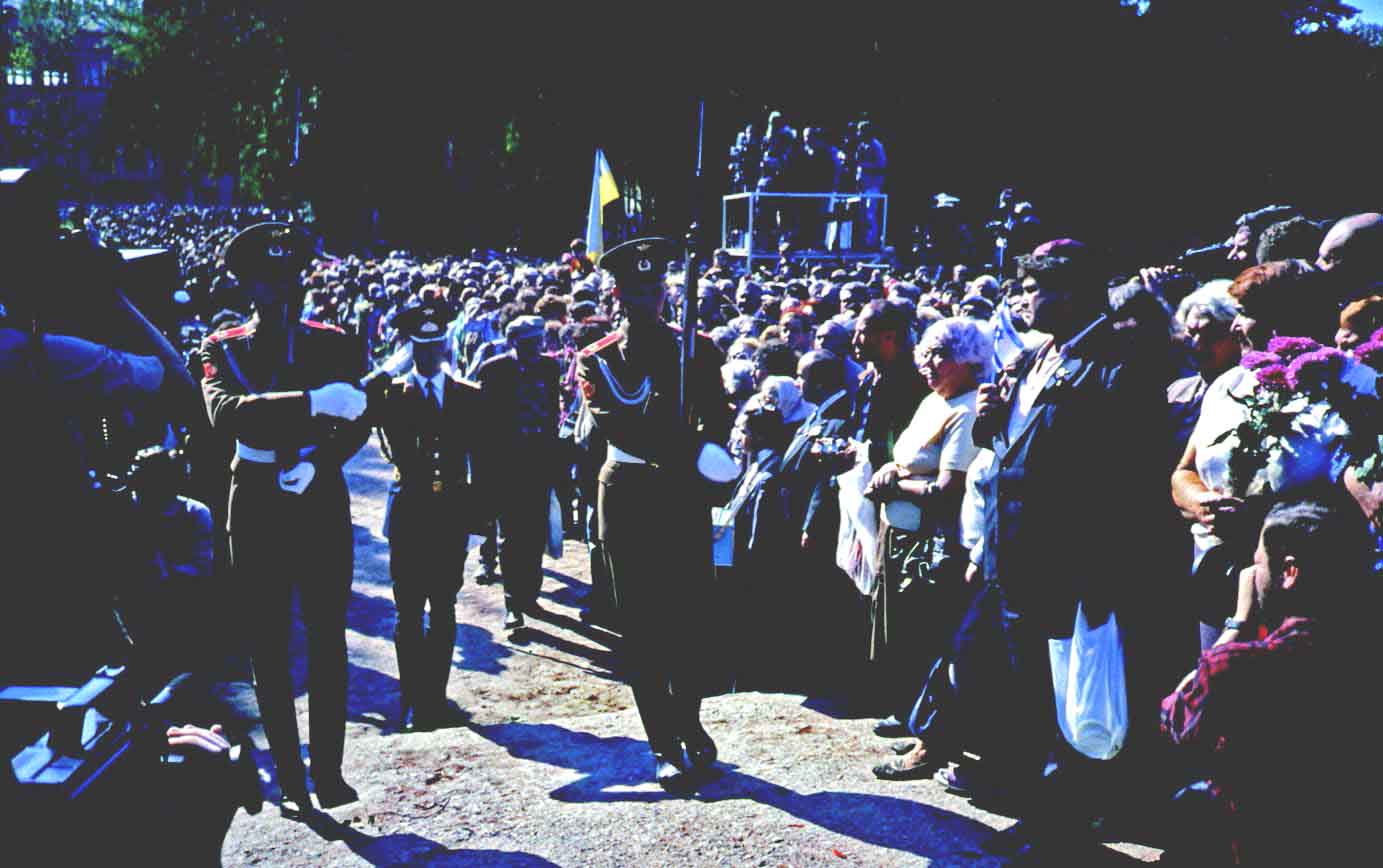
On the eve of the commemoration, posters were hung on Khreshchatyk, the main boulevard of the Ukrainian capital, bearing the following inscription in four languages: Ukrainian, Russian, Yiddish, and Hebrew: "Eternal memory. The Babyn Yar tragedy must never be repeated." That week the Menorah Monument (sculptor: Yurii Pasevych) was unveiled at the site of the shootings; various individuals were granted the title of Righteous Among the Nations, an international conference "Babyn Yar: History and Its Lessons" was held; and film screenings and documentary exhibitions took place. At the site of the tragedy the American actors Cliff Robertson and Tony Randall, the Israeli actor Chaim Topol, and the Ukrainian actor Bohdan Stupka gave a public reading of excerpts from the Black Book, published in Kyiv, and together with Yevgeny Yevtushenko, they recited his poem "Babi Yar." The performance of the Ukrainian composer Yevhen Stankovych's work Babyn Yar Requiem-Kaddish, set to the words of the poet Dmytro Pavlychko, was one of the highlights of the commemorative week. [123]
On 5 October 1991 several thousand people gathered at Babyn Yar for a mourning rally, having traversed the same "death road" along which the Jews of Kyiv had walked to their place of execution in the fall of 1941. Hundreds of foreign guests took part in the official ceremony, among them the Ambassador of Israel and representatives of the German and US governments. Aleksandr Yakovlev was sent to Kyiv as a delegate by the all-Union Soviet leadership. Among the participants of the mourning rally were numerous public figures, particularly activists of the Jewish and Ukrainian national movements, as well as many ordinary citizens. [124] The researcher Anatoly Podolsky noted that many of the Jews who came that day to Babyn Yar for the very first time were convinced that KGB agents would be in attendance, taking down their names; it was difficult for them to believe that it was now possible to honor the memory of the Jewish victims without fear of repressions. [125]
At the commemorative rally Leonid Kravchuk, head of the Verkhovna Rada of Ukraine, delivered a speech that raised a whole array of political and worldview perspectives. After decades marked by the suppression and denial of the Jewish tragedy, the following points were acknowledged on the official state level for the first time. Babyn Yar was the first act of the "final resolution of the Jewish question," and Jews were killed in Babyn Yar only because they were Jews. Kravchuk also mentioned the tens of thousands of Poles, Russians, Ukrainians, Lithuanians, Soviet partisans, underground members, and hostages who were murdered later by the Nazis. He emphasized: "Babyn Yar became an international mass grave. Babyn Yar was a testing site, where mass methods of destroying people were carried out…. It will forever be an eternal reproach to humankind, a testament to one of the most shameful of its evildoings." [126]
In recognizing that the Babyn Yar tragedy was the logical culmination of the monstrous theory and practice of antisemitism and emphasizing that Hitler frequently speculated on the slogans of waging a war against international Jewry, and that from the standpoint of a civilized person such slogans are the work of savagery, Kravchuk acknowledged the inadequate assessments of Zionism contained in the United Nations resolution of 1975 as a vestige of the past era of old quarrels, and announced his support for United States president George Bush's initiative to review it those decisions.
Leonid Kravchuk devoted part of his speech to the difficult and dramatic history of Ukrainian-Jewish relations. "In it there have been both bright and dark pages. None of us has the right to forget anything. But let us remember them not in order to reopen old wounds, but to prevent them in the future. Let that which unites rather than separates our peoples enter our recollections." [127]
The Ukrainian leader spoke at length about the fundamental principles of state building and policies of today's Ukraine, the main ones being the imperative to guarantee equal rights and respect regardless of national or social origin, race or skin color, political convictions or religious beliefs; equal opportunities for all national minorities to take part in building the Ukrainian state, and respect for their languages, traditions, culture, and spiritual characteristics.
Kravchuk went on to condemn the Soviet policies of ignoring human rights and concealing and suppressing the truth about the Babyn Yar tragedy. He then issued an apology to the Jewish community:
Before the entire world, today we declare the inadmissibility of the ideological considerations of the former regime in Ukraine, which trampled over the rights of the individual and the rights of nations, concealed from the people the historical truth about the Babyn Yar tragedy, about the fact that the majority of the victims of the mass shootings were Jews. This was genocide, and responsibility for it lies not only with the fascists but also with those who did not stop the murderers in a timely manner. We accept part of it on ourselves. Today's sad observances are also a fitting occasion to apologize to the Jewish people, against whom so many injustices were committed in our history. This is difficult. But it is necessary for people to acknowledge mistakes and to apologize. Without this, progress is impossible. It is better to do good than to sow hatred […].
Even today, the recollections of the mass killings of people, which the fascist executioners perpetrated in Babyn Yar, give us no peace. The ashes of the victims of genocide beat at our breasts. Can such a thing be forgotten? Never. The death of memory is the death of the soul. [128]
Kravchuk ended his speech with the following greeting in the Ukrainian and Yiddish languages: "Peace and happiness to you, the long-suffering Jewish people. Sholom eykh/could not verify this word/ tayere idn! [129]
On 1 December 1991, nearly 32 million citizens of Ukraine (84.2 percent of the electorate) took part in a nationwide referendum, in which an overwhelming majority of 90.3 percent of voters approved the declaration of Ukrainian independence. [130] That same day Leonid Kravchuk was elected president of Ukraine. A new era began in the life of the Ukrainian people. It was symbolic that by 26 December 1991 Ukraine and Israel established diplomatic relations. [131]
Historical memory in Europe and Ukraine
Sociopolitical events that took place in the last decade of the twentieth century — the velvet revolutions, decommunization, and the unification of Europe — had an essential impact on European countries' approaches to forming official politics of memory, which are marked by fundamental differences in western and central/eastern Europe.
Western Europe, which rests on the ideological heritage of enlightenment and humanism and the experience of World War II, set out to create a new culture of memory. The Nazi destruction of the Jews, who lived in practically every country of Europe and comprised a significant proportion of these countries' societies, was recognized as a tragedy of all the European people. At the same time, this perception also included a sense of blame, as part of the population of both aggressor-countries and victim-countries was implicated in this crime, having contributed one of the most shameful pages in European history. These ideas determined the centrality of the Holocaust as a symbol in the historical memory of Western Europe, an important element of whose culture became repentance.
Meanwhile, Central and Eastern European countries, following decades of communist rule, defined their priorities for restoring/forming their historical memory by emphasizing national and cultural renaissance. Post-communist countries, having suffered huge losses at the hands of both the Nazis and the Soviets, displayed a tendency toward victimization of their national histories, from which the Holocaust was excluded here and there.
Following the unification of Europe, the process of integrating the concept of the Holocaust into national memory models was launched in the new member countries of the European Union. As the British historian Tony Judt commented, awareness of the Holocaust became a kind of "train ticket" to European integration. [132] In the post-Soviet space, however, the re/formation of historical memory acquired its own clear-cut features. In Russia and Belarus, where authoritarian regimes emerged, emphasis was placed on the Great Victory in the war against Germany, heroism was accented, and a cult of leaders was glorified. Moreover, the Holocaust and Stalinist antisemitism did not occupy an important place in the official politics of memory. Where Ukraine is concerned, the formation of a contemporary historical memory model was unmistakably marked by the struggle between the post-Soviet, pro/Russian, and various versions of the Ukrainian national memory model, as well as by the features of various presidents' strategies for governing the state.
The first president of Ukraine, Leonid Kravchuk, sought to distance himself from the "extremes of communism and nationalism," and tried not to raise complex and painful historical issues that might "irritate" Russia, which stance was also adopted by the Ukrainian parliament, comprised mostly of former communists, and by the divided Ukrainian society. Admittedly, in the early years of independence the old, official Soviet memory model was removed from school textbooks, and the Ministry of Education became one of the key institutions for implementing desovietization and Ukrainization. The term "Great Patriotic War" was expunged from textbooks, the crimes of Stalinism and Nazism were condemned equally, and topics related to the Holodomor and the activities of the Organization of Ukrainian Nationalists and the Ukrainian Insurgent Army were introduced into curricula. Meanwhile, the Holocaust topic was not implanted in the education process, and it was inadequately covered in the media. After his memorable 1991 speech at Babyn Yar, Kravchuk practically never raised this topic during his presidency, believing that the question of rendering an apology to the Jews was now closed. Nevertheless, in the external political arena he expressed regret several times for crimes that were committed by Ukrainians against Jews, for example, in 1993, during his speech in the Knesset. [133]
The next president, Leonid Kuchma, a former "red director" from eastern Ukraine, won the elections, running on a campaign to grant Russian official-language status. During his presidency he too underscored the importance of restoring historical memory, a return to the origins of national identity, and the restoration of Ukrainian national traditions. The formation of a historical memory model throughout Kuchma's two terms in office took place mostly via the Ukrainization of old Soviet myths, particularly the myth of the "Great Patriotic War." Emphasis was placed on Ukrainians' heroism and self-sacrifice as soldiers of the Red Army during the war.
In 2000 the Verkhovna Rada of Ukraine, acting on a proposal submitted by the Veterans' Organization of Ukraine, approved a law entitled "About the Commemoration of Victory in the Great Patriotic War of 1941–1945," recognizing Victory Day as an official Ukrainian state holiday that was aimed at preserving the old, ritual symbolism. [134]
Against the background of this Sovietized historical memory, Babyn Yar was transformed de facto into a place visited once a year by government officials laying wreaths and uttering the customary phrases at a commemorative rally. This formality was violated in 2001, when, two weeks before the 60th anniversary of the Babyn Yar tragedy, terrorists attacked the World Trade Center in New York City. In his Address to the Ukrainian People, President Kuchma linked the mass killings in the US with the Nazi crimes of 1941, describing them as "genocide and [as] an extreme form of terrorism raised to the level of state policy." [135]
During his presidency public attention was abruptly focused on the tragedy that befell Ukraine's Romani people, who were among the Germans' first victims in Babyn Yar. Back in 1966, members of various civic organizations in Kyiv tried to organize the installation of a metal monument designed in the shape of a "gypsy caravan" to honor the memory of the Roma who perished in Babyn Yar. Encountering stiff opposition from the Kyiv authorities (who controlled the territory of Babyn Yar at the time), this idea never came to fruition. The caravan ended up in the city of Kamianets-Podilskyi, where it became the first monument dedicated to the genocide of the Romani people. [136] By the end of the Kuchma presidency, the Ukrainian state finally recognized this genocide. On 8 October 2004 the Ukrainian parliament passed a resolution entitled "On the Commemoration of International Roma Holocaust Remembrance Day," to be celebrated on 2 August (the date of the "Night of the Gypsies" in Auschwitz-Birkenau). [137]
Three weeks later, on 27 October 2004, during the celebrations of the sixtieth anniversary of Ukraine's liberation from the Nazis, President Kuchma offered his personal take on the history of World War II. Recalling the shootings in Babyn Yar of Jews, Ukrainians, and Russians, he also — unexpectedly — mentioned Ukrainian nationalists who also perished there. He went on to propose a qualitatively new historical memory model for the consolidation of society, the foundation of which would be the condemnation of all those who were involved in Nazi crimes and the rejection of the mechanistic exploitation of the thesis, imposed by Soviet propaganda, that all the members of the OUN and the UPA were criminals. According to Kuchma:
The 'new order' was revealed in Kyiv's Babyn Yar, where — in addition to tens of thousands of Jews — Ukrainian, Russians, and members of the Organization of Ukrainian Nationalists were shot. The history of World War II still contains many conflicting pages that are perceived ambivalently by our contemporaries. In particular, these are questions relating to prisoners of war and the activities of the OUN and the UPA. Without a doubt, all those with innocent blood on their hands deserve condemnation. However, it would be unjust to put forward such accusations against all the members of the insurgent movement. The search for compromises and possibilities for mutual reconciliation among various political forces, including the veterans' milieu, is the only path to the consolidation of Ukrainian society. [138]
The "memory wars" in Ukraine escalated significantly during the presidency of Viktor Yushchenko. He came to power in the country in the wake of the Orange Revolution and sought to make a radical change in Ukrainian politics of history by focusing on the crimes of the communist totalitarian system. Henceforward, the Stalinist USSR in the Yushchenko memory model was identified as an empire, and Ukraine — as a post-totalitarian, post-colonial, and post-genocidal state.
Babyn Yar and the Holocaust occupied a prominent place in Yushchenko's history policies. By his own admission, the Jews' tragedy was also part of his own family history. His father was a prisoner of Auschwitz, "and he was there with the Jews at a time when 25,000 people were exterminated in a single day, and during this period no one divided people into Ukrainians, Russians, or Jews; no one gave a thought to whom he was giving a piece of bread." [139] During the war President Yushchenko's grandmother and mother, who lived in his native village of Khoruzhivka, in the Sumy region, hid three little Jewish girls in the family home.
In 2005, the first year of his presidency, Yushchenko directed the Cabinet of Ministers to study "the question of creating in the established order the Babyn Yar Historical and Cultural Preserve." [140]Since Yushchenko viewed Ukraine's tragedy during the World War II period through the prism of the crimes committed by the two totalitarian regimes, Stalinist and Nazi, he drew a direct equivalence between Auschwitz and the GULAG and the Holocaust and the Holodomor. He also made consistent efforts to integrate into the Ukrainian memory model the idea of reconciliation between two groups of World War II combatants: veterans of the Soviet army and the Ukrainian Insurgent Army. At the same time, he began focusing attention on Ukrainian nationalists who were executed in Babyn Yar.
On 22 May 2006 President Yushchenko issued a decree entitled "On Commemorating the Centenary of Olena Teliha's Birth." Teliha was a Ukrainian poet and member of the Melnykite faction of the OUN, who was shot by the Germans in Babyn Yar on 22 February 1942. The decree mandated that official and cultural events take place from July to September 2006. Over the course of two-year period (2006–2008) a "monument to Olena Teliha and her companion in arms" was erected on the territory of the Babyn Yar Memorial Complex (the monument was supposed to replace the wooden cross that activists had erected in 1992). [141] At this point the monument installation project ground to a halt. Yet on 1 December 2009 a monument was erected at Babyn Yar in honor of Tania Markus, a member of the Soviet underground, on whom President Yushchenko conferred the title "Hero of Ukraine" on 21 September 2006. [142]
In the fall of 2006, the sixty-fifth anniversary of the Babyn Yar tragedy was marked on the state level. President Moshe Katsav of Israel flew to Kyiv to take part in the commemorative events, which included an official mourning ceremony, a litany served by the hierarchs of most of the traditional churches, and a themed exhibit held in Ukrainian House in downtown Kyiv. A highlight of the commemorative events was an international forum, "Let My People Live," organized by the government of Ukraine, the World Holocaust Forum, and Yad Vashem. The forum was attended by nearly a thousand foreign guests from over fifty countries. In his speech to the forum, President Yushchenko emphasized that "today Ukraine is speaking to mankind for the first time in the voice of the world catastrophe." He recalled the words of the Musaf Prayer for the Day of Judgment, "These things I remember, and pour out my soul within me," assuring his listeners that there would be no place in Ukraine for national or religious intolerance. [143]
The commemoration of the victims of Babyn Yar on the sixty-sixth anniversary of this tragedy was marked by special features. After a wreath was laid at the 1976 monument, President Yushchenko, together with the head of the Kyiv oblast administration Vira Ulianchenko, deputy premier Dmytro Tabachnyk, and the secretary of the National Security and Defense Council of Ukraine Ivan Pliushch, laid flowers at the memorial cross, the approximate spot where the Nazis shot a group of OUN members and the poet Olena Teliha (in subsequent years this ritual was repeated by prime minister Julia Tymoshenko and the head of the Ukrainian parliament, Arsenii Yatseniuk). In 2007 Yushchenko issued a decree granting the title of "Hero of Ukraine" to Roman Shukhevych, commander in chief of the UPA, and in January 2010 — to Stepan Bandera, the leader of the OUN(B). [144] Yet, in his official speeches he never once raised the difficult topic of the "idealistic" and "ordinary people" among those Ukrainians who helped the Nazis in their killing spree during World War II. This was a clear indication of his narrow view of the official memory model of a European Ukraine. At the same time this circumstance, taken against the background of President Yushchenko's decisions mentioned above, made him sensitive to the harsh criticism of his opponents both inside and outside Ukraine.
The expression "Forward to the past!" best characterizes the official politics of memory pursued by Viktor Yanukovych, the fourth president of Ukraine. Compared to all the previous presidents, who had proclaimed, clearly or not very plainly, their desire for the restoration and formation of Ukrainian identity, Yanukovych was the only one who showed absolute indifference and even hostility to this question.
During Yanukovych's presidency, President Yushchenko's flawed but consistent policy of dissociating the country from communism and condemning the crimes of the Stalinist empire began to be supplanted by the policy of reviving the old, heroized Soviet heritage; these efforts taking place against the background of unmistakable attempts to dilute Ukrainian identity with Russian. Holding a majority in the Ukrainian parliament, the president's Party of Regions and its communist allies approved laws and resolutions that recreated the old Soviet-Russian models of the historical memory of the war. At the same time it was obvious that this process was not simply a matter of copying Russian politics, but that it was being determined in no uncertain terms in Moscow. Such official acts as Yanukovych's public refusal to recognize the Holodomor as an act of genocide, the revival by the Ukrainian parliament of the practice of holding a grandiose Victory Parade (2010), and the passing of contradictory resolutions on the eve of the sixty-fifth anniversary of the Nuremberg trials and the "Law about the Red Flag" (2011) not only did not bring any peace to Ukrainian society but caused even more turmoil. [145]
The conflict between the new and old politics of memory was also reflected in the official practices of honoring the memory of the victims of Babyn Yar. For several years in a row, in late September, the area surrounding the 1976 Soviet monument was covered with red flags and banners, where communists and their ideological allies, like the members of the Anti-Fascist Committee of Ukraine founded in 2006, ruthlessly denounced "Ukrainian national fascists" and the "criminal organizations OUN-UPA," [146] exactly as they had once condemned "international Zionism" and the "Israeli military clique." Some speakers voiced programmatic slogans against Ukraine joining NATO and in favor of restoring the "everlasting fraternal relations with Russia, Belarus, and other countries of the Commonwealth of Independent States."
On 5 July 2011 the Verkhovna Rada of Ukraine approved a resolution entitled "About the 70th Anniversary of the Babyn Yar Tragedy," establishing 27 January as Holocaust Remembrance Day. Despite the fact that the Parliamentary Committee on Questions of Culture and Spirituality had proposed that Jews and Romani be singled out expressly, the promulgated resolution, similar to the Soviet-era practice, concealed these specific victims behind the euphemism "people of various nationalities." [147] However, in addition to civilians, prisoners of war, communists, and Soviet underground members and partisans, the list of people whom the Nazis murdered in Babyn Yar included Ukrainian nationalists, who could not be expunged from the list once the story about the Nazis murdering hundreds of OUN members became public knowledge. [148]
The tendency of repeating the Soviet-era practice of ignoring the Jewish victims of Babyn Yar was also revealed in no uncertain terms in Viktor Yanukovych's Address to the Ukrainian People on the occasion of the seventieth anniversary of the Babyn Yar tragedy, which mentioned, once again, only "the civilian population." [149] On 3 October 2011 the official ceremony organized to mark the anniversary of the tragedy attested to the deep divide between the Ukrainian government and society. The main feature of those commemorative events was the government's overt dissociation from the Ukrainian public and the "ceremonial indifference" to the tragic date that was supposed to become one of the main instruments for uniting Ukrainian society. [150] President Yanukovych's rejection and very real denial of democratic values, all the while declaring them, particularly in the sphere of the official politics of memory, was one of the causes behind the Revolution of Dignity (Maidan) in 2014, which put an end to attempts to preserve the traditions of the Soviet past and to halt Ukraine's move into Europe.
The current stage of forming the Ukrainian model of historical memory is proceeding in the extraordinarily complex conditions of Russia's annexation of the Crimean Peninsula and the hybrid war raging in Ukraine's Donbas region. The process of Ukraine's withdrawal from the influence of the Russian/Soviet empire is drawing to a close, and a new Ukrainian civic identity is forming. On 9 April 2015 a majority of Ukrainian parliamentarians adopted four laws, the so-called "decommunization packet": (1) "On the Condemnation of the Communist and Nazi Regimes," which bans the propaganda and symbols of these regimes; (2) "Regarding Access to the Archives of the Repressive Organs," which declassifies the archives of the All-Union ChEKA, NKVD, and KGB; (3) "Regarding the Commemoration of the Victory over Nazism," which supplements the 9 May date with 8 May, the Day of Memory and Reconciliation, and replaces the official use of the phrase "the Great Patriotic War" with "the Second World War; and (4) "About the Legal Status of Fighters for Ukraine's Independence," which recognizes as such not only those who fought in battles between 1941 and 1945 but also all members of anti-Soviet movements from the 1920s to 1991. [151] The decommunization legislation is based on the experience of Central and Eastern Europe, the Baltic countries, and Georgia. Despite some shortcomings, this packet of laws is of strategic importance for Ukraine's future.
Today the Holocaust, which was suppressed for so long in the USSR, occupies an important place in Ukraine's politics of history. In fact, the prospects for consolidating democracy in Ukraine, as well as the literal prospects for the country's integration into the family of European nations, depend on the degree to which this issue becomes a component of Ukrainian identity. President Petro Poroshenko's decree of 12 August 2015 entitled "Concerning Measures in Connection with the 75th Anniversary of the Babyn Yar tragedy" is the first time that this place of memory was linked directly with the Holocaust on the highest state level. The decree also refers to many other victims who are buried in this mass grave, including members of the Ukrainian liberation movement. [152]
President Poroshenko's speech in the Knesset on 23 December 2015 was a momentous event in terms of Ukraine's integration into the European culture of memory, the culture of grief and repentance. Emphasizing that Babyn Yar is a shared, open wound of Ukrainians and Jews and the place where tens of thousands of Jews were murdered only because they were Jews, and noting that 1.5 million Ukrainian Jews perished during the Holocaust, Poroshenko paid tribute to the Righteous Among the Nations who, risking their own lives, rescued Jews. He also spoke about negative episodes in history and about collaborationists, who "unfortunately, existed practically in all European countries that were occupied by the Nazis, and helped those monsters to implement the "final resolution of the Jewish question." [153] The president of Ukraine apologized for this to the children and grandchildren of Holocaust victims, and emphasized that future generations would be raised in the spirit of rejecting crimes, such as the Holocaust and Babyn Yar.
These words, reflecting the Ukrainian state's official politics of memory, hold great symbolic significance. They attest to Ukraine's decisive readiness to disengage itself from the Soviet past, adopt European values, and become an equal member of a united Europe.
NOTES
[1] See the report of the head of the security police and SD in Kyiv on the situation in Kyiv general district on 1 December 1942 in Liubov Lehasova et al. eds., Kyїv ochyma voroha: doslidzhennia, dokumenty, svidchennia (Kyiv: Aerostat, 2012), p. 334; Inessa Mirchevskaia, I on podaril mne mamu: vospominaniia (Kyiv: KMTs '"Poeziia,'" 2005), p. 31.
[2] Mykhailo Koval', '"Natsysts'kyi henotsyd shchodo ievreїv ta ukraїns'ke naselennia (1941–1944 rr.),'" Ukraїns'kyi istorychnyi zhurnal, XXXVI, 2 (Kyiv, 1992), p. 27.
[3] '"Zverstva nemtsev v Kieve,'" Pravda (Moscow), 19 November 1941, p. 4.
[4] Niels Bo Poulsen, '"The Soviet Extraordinary State Commission on War Crimes: An Analysis of the Commission`s Investigative Work in War and Post-War Stalinist Society'" (Ph.D. dissertation, Copenhagen University, 2004), р. 38.
[5] Amir Weiner, Making Sense of War: The Second World War and the Fate of the Bolshevik Revolution (Princeton: Princeton University Press, 2001), р. 209.
[6] '"Nota Narodnogo Komissara Inostrannykh Del tov. V.M. Molotova 'O povsemestnykh grabezhakh, razorenii naseleniia i chudovishchnykh zverstvakh germanskikh vlastei na zakhvachennykh imi sovetskikh territoriiakh' on 6 ianvaria 1942,'" Pravda (Moscow), 7 November 1942, pp. 1–2.
[7] '"Sovmestnaia deklaratsiia Pravitel'stva Bel'gii, Velikobritanii, Gollandii, Gretsii, Liuksemburga, Norvegii, Pol'shi, Soiedinennykh Shtatov Ameriki, Soiuza Sovetskikh Sotsialisticheskikh Respublik, Chekhoslovakii, Iugoslavii i Frantsuzskogo Natsional'nogo Komiteta o provodimom gitlerovskimi vlastiami istrebleniia evreiskogo naseleniia Evropy,'" Pravda (Moscow), 18 December 1942, p. 1.
[8] '"Osushchestvlenie gitlerovskimi vlastiami plana istrebleniia evreiskogo naseleniia Evropy,'" Pravda (Moscow), 19 December 1942, p. 1.
[9] Gennadii Kostyrchenko, Stalin protiv '"kosmopolitov'". Vlast' i evreiskaia intelligentsiia v SSSR (Moscow: ROSSPEN, 2009), p. 80.
[10] Oleh Bazhan, '"Represyvna diial'nist' orhaniv VUNK-DPU-NKVS-KDB na Kyїvshchyni u 1919–1980-ti rr.,'" Z arkhiviv VUCHK-HPU-NKVD-KDB, No. 1 (36) (Kyiv, 2011), p. 198.
[11] '"Soobshchenie Spetsial'noi Komissii po ustanovleniiu i rassledovaniiu obstoiatel'stv rasstrela nemetsko–fashistskimi zakhvatchikami v Katynskom lesu voennoplennykh pol'skikh ofitserov. 24.01.1944,'" in Sbornik soobshchenii Chrezvychainoi gosudarstvennoi komissii o zlodeianiiakh nemetsko-fashistskikh zakhvatchikov (Moscow: OGIZ, 1946), pp. 101–151.
[12] Soobshchenie Spetsial'noi Gosudarstvennoi Komissii po ustanovleniiu i rassledovaniiu zlodeianii nemetsko-fashistskikh zakhvatchikov i ikh soobshchnikov i pricheneniiu imi ushcherba grazhdanam, kolkhozam, obshchestvennym organizatsiiam, gosudarstvennym predpriiatiiam i uchrezhdeniiam SSSR o razrusheniiakh i zverstvakh, sovershennykh nemetsko-fashistskimi zakhvatchikami v gorode Kieve (Moscow: OGIZ, Gospolitizdat, 1944), p. 12.
[13] Tetiana Ievstaf'ieva, '"Trahediia Babynoho Iaru kriz' pryzmu arkhivnykh dokumentiv Sluzhby Bezpeky Ukraїny,'" Arkhivy Ukraїny, No. 5 (Kyiv, 2011), pp. 145–146.
[14] Cited in Kyїv: viina, vlada, suspil'stvo. 1939–1945 rr: za dokumentamy radians'kykh spetssluzhb ta natsysts'koї okupatsiinoї administratsiї (Kyiv: Tempora, 2014), pp. 630–631.
[15] See a special report of the head of the UNKDB in Kyiv oblast Bondarenko submitted to the people's commissar of state security of the Ukrainian RSR Serhii Savchenko on the execution of the active participants of mass atrocities over Kyivites, dated not later than 23 January 1944, in Kyïv u dni natsysts′koï navaly—za dokumentamy radians′kykh spetssluzhb: naukovo-dokumental′ne vydannia (Kyiv, Lviv, 2003), pp. 444–445.
[16] Ibid., p. 444.
[17] Ievstaf'ieva, '"Trahediia Babynoho Iaru,'" p. 147.
[18] Cited in Lev Bezymenskii, '"Informatsiia po-sovetski,'" Znamia, 5 (Moscow, 1998), p. 192.
[19] Ibid., pp. 191–199.
[20] '"Soobshchenie Chrezvychainoi gosudarstvennoi komissii po ustanovleniiu i rassledovanniu zlodeianii nemetsko-fashistskikh zakhvatchikov i ikh soobshchnikov o razrusheniiakh i zverstvakh sovershennykh nemetsko-fashistskimi zakhvatchikami v gorode Kieve,'" Izvestiia (Moscow), 29 February 1944, p. 2.
[21] Arkadii Liubchenko, Vertep (povist'): opovidannia—shchodennyk (Kharkiv: Osnova, 2005), p. 112.
[22] '"Soobshchenie Chrezvychainoi gosudarstvennoi komissii. . . ,'" Izvestiia (Moscow), 29 February 1944, p. 2
[23] Aleksandr Kruglov and Andrei Umanskii, Babii Iar: zhertvy, spasiteli, palachi (Dnipro: Ukrainskii institut izucheniia Kholokosta '"Tkuma'"; ChP '"Lira LTD,'" 2019), p. 4. Mordechai Altshuler, ed. Distribution of the Jewish Population of the USSR 1939 (Jerusalem: Hebrew University of Jerusalem, Centre for Research and Documentation of East European Jewry, 1993), 20.
[24] Cited Arkadii Zel'tser, '"Tema 'Evrei v Babiem Iaru' v Sovetskom Soiuze v 1941–1945 godakh,'" in Materialy mizhnarodnoї naukovoї konferentsiї '"Babyn Iar: masove ubyvstvo і pam'iat' pro nioho (Kyiv, October 24–25, 2011), p. 90.
[25] Ibid.
[26] Mordekhai M. Al′tshuler, '"Deiatel′nost′ evreev po uvekovechivaniiu pamiati o Kholokoste v Sovetskom Soiuze v epokhu Stalina,'" Yadvashem.org., https://www.yadvashem.org/yv/ru/pdf/yad_vashem_studies/altshuler.pdf
[27] Zel'tser, '"Tema 'Evrei v Bab'iem Iaru,'" p. 91.
[28] Itsik Kipnis, '"Babii Iar,'" Holokost i suchasnist'. Naukovo-pedahohichnyi biuleten', No. 10 (Kyiv, 2003), pp. 1–2..
[29] '"Spravka nachal'nika upravleniia militsii g. Kieva Komarova 'Ob antisemitskikh kontrrevoliutsionnnykh sluchaiakh, 8 veresnia 1944 r.'" Cited in Mikhail Mitsel′, Evrei Ukrainy v 1943–1953 gg.: ocherki dokumentirovannoi istorii (Kyiv: Dukh i litera, 2004), pp. 36–41.
[30] Special Report of the NKDB URSR to the secretary of the TsK KP(b)U Nikita Khrushchev '"on the anti-Semitic incidents in Ukraine,'" 13 October 1944, cited in Kyїv: viina, vlada, suspil'stvo, pp. 769–778.
[31] Ibid., 775.
[32] Proposals of the TsK KP(b)U following the inspection of activities of the NKDB URSR concerning '"the uncovering of the Zionist elements,'" 28 October 1944, cited in ibid., pp. 778–779.
[33] Special Report of the NKDB URSR to the secretary of the TsK KP(b)U Nikita Khrushchev '"On the anti-Semitic incidents in Ukraine,'" 13 October 1944, cited in ibid., p. 776.
[34] Cited in Feliks Kandel′, Kniga vremen i sobytii: istoriia rossiiskikh evreev, Vol. 6: Istoriia evreev Sovetskogo Soiuza (1945–1970) (Jerusalem: Gesharim/Mosty kul′tury, 2007), p. 20.
[35] '"Soobshchenie Narodnogo komissara vnutrennikh del USSR V. Riasnogo sekretariu TsK KP(b)U D. Korotchenko o sobytiiakh v Kieve 7 sentiabria 1945 g. 8 sentiabria 1945 g.,'" in Mitsel′, Evrei Ukrainy v 1943–1953 gg., pp. 65–66.
[36] Ibid., p. 34.
[37] Ibid., p. 27.
[38] '"Iz protokola doprosa na Kievskom protsesse v kachestve svidetelia spassheisia ot rasstrelov D. Pronichevoi. 12 ianvaria 1946 g.,'" cited in Tatiana Evstaf′eva and Vitalii Nakhmanovich, comps., Babii Iar—chelovek, vlast′, istoriia: dokumenty i materialy, Vol. 1: Istoricheskaia topografiia: khronologiia sobytiia (Kyiv: Vneshtorgizdat Ukrainy, 2004), pp. 277–280.
[39] '"Promova prokurora,'" in Kyїvs'kyi protses: dokumenty ta materialy, compiled by Leonid Abramenko (Kyiv: Lybid', 1995), p. 145.
[40] '"Vystuplenie pomoshchnika Glavnogo obvinitelia ot SSSR L.N. Smirnova,'" in Niurnbergskii protsess: sbornik materialov, Vol. 5 (Moscow: Iuridicheskaia literature, 1991), pp. 80–187.
[41] Tana Penter, '"Collaboration on Trial: New Source Materials on Soviet Postwar Trials Against Collaborators,'" Slavic Review, LXIV, 4 (Cambridge, Mass., 2005), p. 784.
[42] Mikhail Mitsel', '"Zapret na uvekovechivanie pamiati kak sposob zamalchivaniia Kholokosta: praktika KPU v otnoshenii Bab'iego Iara,'" Holokost i suchasnist', 1 (Kyiv, 2007), p. 10.
[43] Ibid.
[44] '"Postanova Rady narodnykh komisariv URSR i Tsentral'noho komitetu KP(b)U No. 378 vid 13 bereznia 1945 r.,'" in Il'ia Levitas, comp., Babii Iar: kniga pamiati. (Kyiv: Stal', 2005), p. 489.
[45] Тat'iana Evstaf'ieva, '"Babii Iar: poslevoennaia istoriia mestnosti,'" in Materialy mizhnarodnoї naukovoї konferentsiї '"Babyn Iar,'" p. 22.
[46] Mitsel', '"Zapret na uvekovechivanie pamiati,'" p. 10.
[47] Timothy Snyder, Bloodlands: Europe between Hitler and Stalin (New York: Basic Books, 2010), pp. 350–351.
[48] Volodymyr Prystaiko, Oleksandr Pshennikov, and Iurii Shapoval, '"Sprava Ievreis'koho antyfashysts'koho komitetu,'" in Z arkhiviv VUCHK-HPU-NKVD-KDB, No. 3/4 (Kyiv, 1998), p. 13.
[49] Il'ia Al'tman, comp., Evreiskii antifashistskii komitet v SSSR, 1941–1948: dokumentirovannaia istoriia (Moscow: Mezhdunarodnye otnosheniia, 1996), pp. 74–345.
[50] Idem, '"Belye piatna 'Chernoi knigi,'" Lekhaim, August 2002.
[51] '"Dokladnaia zapiska agitpropa TsK A.A. Zhdanovu po voprosu izdaniia 'Chernoi knigi' ot 3 fevralia 1947 g.,'" in Aleksandr Iakovlev, ed., Stalin i kosmopolitizm. 1945–1953: Dokumenty Agitpropa TsK (Moscow: MFD: Materik, 2005), pp. 103–105.
[52] '"Zakliuchenie upravleniia propagandy i agitatsii TsK VKP(b) o nevozmozhnosti izdaniia 'Chernoi knigi' ot 7.10.1947 g.,'" Fond Aleksandra N. Iakovleva. https://www.alexanderyakovlev.org/fond/issues-doc/68431
[53] '"Postanovlenie Politbiuro TsK VKP(b) 'O rospuske Evreiskogo antifashistskogo komiteta' ot 20 noiabria 1948 g.,'" in Iakovlev, Stalin i kosmopolitizm, pp. 193–195.
[54] Shimon Redlikh, ed., Evreiskii antifashistskii komitet v SSSR. 1941–1948: dokumental'naia istoriia (Moscow: Mezhdunarodnye otnosheniia, 1996), pp. 346–348.
[55] '"Postanovlenie Politbiuro TsK VKP(b) 'O rospuske obiedineniia evreiskikh pisatelei i o zakrytii al'manakhov na evreiskom iazyke' ot 8 fevralia 1949 g.,'" in Iakovlev, Stalin i kosmopolitizm, pp. 263–265.
[56] Vasyl' Iurchuk et al, eds., Komunistychna partiia Ukraїny v rezoliutsiiakh i rishenniakh z'їzdiv, konferentsii і plenumiv TsK, Vol. 2: 1941–1976 (Kyiv: Vyd. Politychnoї literatury Ukraїny, 1977), pp. 135–136.
[57] Oleh Berenshtein, '"Elie Spivak: zhyttia, tvorchist', dolia,'" in Z arkhiviv VUCHK-HPU-NKVD-KHB, No. 3/4 (1998), pp. 21–30.
[58] I. Pogrebinskaia, '"Kabinet evreiskoi kul'tury pri VUAN,'" in Ievreї v Ukraїni—istoriia, kul'tura, tradytsii: zbirnyk naukovo-publitsystychnykh statei (Kyiv, 1997), p. 39.
[59] Cited in ibid., p. 42.
[60] Redlikh, Evreiskii antifashistskii komitet, p. 383; Vasilii Malinovskii, '"Poslednii Stalinskii rasstrel,'" Vestnik (Cockeysville, MD), No. 2 (209), 19 January 1999.
[61] Volodymyr Prystaiko, Oleksandr Pshennikov, and Iurii Shapoval, '"Sprava Ievreis'koho antyfashysts'koho komitetu,'" p. 13.
[62] Mykhailo Hutor, Zberezhennia pam'iati pro trahediiu v Babynomu Iaru v chasy radians'koї vlady (Kyiv: Natsional'nyi istoryko-memorial'nyi zapovidnyk '"Babyn Iar,'" 2019), pp. 12–22.
[63] '"Podlye shpiony i ubiitsy pod maskoi professorov-vrachei,'" Pravda (Moscow), 13 January 1953.
[64] Il'ia Erenburg, Ottepel' (Moscow: Sovetskii pisatel', 1954).
[65] Viktor Nekrasov, '"Babii Iar, 45 let,'" Novoe russkoe slovo (New York), 28 September 1986.
[66] The original poem was written from a male's perspective, but the composer and the singer adapted it for a female voice. The Yiddish original, '"Liulenky-liuliu,'" appeared in Shike Driz's third collections of poetry, Di ferte strune (Moscow, 1969); an English version was cited in Dov Noy, '"The Model of the Yiddish Lullaby,'" Studies in Yiddish Literature and Folklore, No. 7 (1986), p. 223.
[67] '"Rasskaz artistki Nekhamy Livshits o pesne Shiki Driza 'Kolybel'naia Bab'iemu Iaru,''" in Efrem Baukh, ed., Babii Iar (Tel-Aviv: '"Moriia,'" 1993), pp. 95–98.
[68] Viktor Nekrasov, '"Pochemu eto ne sdelano?,'" Literaturnaia gazeta (Moscow), 10 October 1959.
[69] Evstaf'ieva, '"Babii Iar: poslevoennaia istoriia mestnosti,'" p. 23.
[70] Аleksandr Anisimov, Kurenevskii potop: Kurenevskaia tragediia, 13 marta 1961 goda (Kyiv: Kurch, 2003), p. 13.
[71] Cited in Tatiana Evstaf'ieva, '"Kurenevskaia tragediia v svete novykh dokumentov,'" in Materialy shchorichnoї naukovo-praktychnoї konferentsiї '"Kyїv i kyiany'" (Kyiv, 22 December 2011); Tatiana Evstafieva, '"K 50-letiiu Kurenevskoi tragedii.'" https://photohistory.kiev.ua/articles.php?a=1
[72] Cited in Mikhail Buzukashvili, '"Evgenii Evtushenko o 'Bab'iem Iare.' Intervew,'" Chaika, (No. 2 (2011). https://www.chayka.org/node/3104
[73] '"Istorychna dovidka. Natsional'nyi istoryko-memorial'nyi zapovidnyk 'Babyn Iar,'" Babynyar.gov.ua. 17 March 2011. http://babynyar.gov.ua/%D1%96storichna-dov%D1%96dka
[74] Evstaf'eva and Nakmanovich, Babii Iar, p. 386.
[75] Cited in Emmanuil (Amik) Diamant, '"Babii Iar, ili pamiat' o tom, kak v narod prevrashchalos' stroptivoe plemia,'" My zdes' (New York and Jerusalem), 15–21 September 2011.
[76] Ibid.
[77] Ivan Dziuba, '"U 25-ti rokovyny rozstriliv u Babynomu Iaru,'" in his Ukraїna u poshukakh identychnosti: statti, vystupy, interview, pamflety (Kyiv: '"Ukraїna,'" 2006), pp. 789–795.
[78] Vladimir Voinovich, Avtoportret: roman moei zhizni (Moscow: Eksmo, 2010), p. 579.
[79] Diamant, '"Babii Iar, ili pamiat' o tom.'"
[80] Ibid.
[81] Izraїl' Kleiner, Anekdotychna trahediia (Munich: Suchasnist', 1974), pp. 53–60.
[82] '"Delo Borisa Kochubievskogo,'" Khronika tekushchikh sobytii, Nos. 6,7,9 (Moscow, 1969). Kandel', Kniga vremeni i sobytii, p. 516.
[83] Diamant, '"Babii Iar, ili pamiat' o tom.'"
[84] Kandel', Kniga vremeni i sobytii, p. 109.
[85] Liudmila Alekseeva, Istoriia inakomysliia v SSSR: noveishii period (Moscow: Moskovskaia Khel'singskaia Gruppa, 2012), p. 134.
[86] Diamant, '"Babii Iar, ili pamiat' o tom.'"
[87] '"Dvizhenie evreev za vyezd v Izrail','" Khronika tekushchikh sobytii, No. 21 (Moscow, 1971).
[88] '"Spetsial'noe soobshchenie KGB USSR o namerenii evreev provesti golodovku v znak protesta protiv otkaza im v vyezde v Izrail' ot 02.08.1971 goda,'" Haluzevyi Derzhavnyi Arkhiv Sluzhby bezpeky Ukrainy, Kyiv (hereafter: HDA SBU), Fond 16, Sprava 994.
[89] Cited in Mykhailo Hutor, '"Bortsi za zberezhennia pam'iati pro Babyn Iar,'" Evreiskii obozrevatel', No. 3 (339) (Kyïv, 2021).
[90] Alekseeva, Istoriia inakomysliia v SSSR, p. 128.
[91] Cited in Diamant, '"Babii Iar, ili pamiat' o tom.'"
[92] Ibid.
[93] In 1970–1971 alone, fifty-nine books with a print run of two million copies in Russian, Ukrainian, Lithuanian, French, Spanish, and Arabic were published in the USSR on the topic of the '"reactionary essence'" of Zionism. Kandel', Kniga vremeni i sobytii, p. 512.
[94] Олег Bazhan, '"Represyvni zakhody radians'koї vlady shchodo hromadian ievreis'koї natsional'nosti v URSR (1960-ti-1980-ti rr.),'" Z arkhiviv VUCHK-HPU-NKVD-KDB, No. 1/2 (22/23) (Kyiv, 2004), p. 115.
[95] Ibid.
[96] Diamant, '"Babii Iar, ili pamiat' o tom.'"
[97] '"Repressii na Ukraine,'" Khronika tekushchikh sobytii, No. 27 (Moscow, 1972).
[98] Evgenii Zhirnov, '"A kogo my ne khotim vypuskat', my ne dolzhny vypuskat','" Kommersant (Moscow), 9 March 2018.
[99] Alekseeva, Istoriia inakomysliia v SSSR, p. 135.
[100] Cited in Fred A. Lazin, '"Jewish Influence in American Foreign Policy: American Jewry, Israel and the Issue of Soviet Jewry, 1968–1989.'" The Lawyer Quarterly, No. 3 (1) (Prague, 2011), 159–160.
[101] Bazhan, '"Represyvni zakhody radians'koї vlady,'" p. 116.
[102] '"Repressii na Ukraine,'" Khronika tekushchikh sobytii, No. 27 (Moscow, 1972).
[103] Ibid.
[104] '"Spetsial'noe soobshchenie V. Shcherbitskomu v dele provedeniia aktsii v Babiem Iaru ot 30.09.1974 g.,'" HDA SBU, Fond 16, Sprava 1037.
[105] Alekseeva, Istoriia inakomysliia v SSSR, pp. 68–69.
[106] Cited in Oleh Bazhan and Iurii Danyliuk, Opozytsiia v Ukraïni (druha polovyna 50-kh–80-ti rr. XX st.) (Kyiv: Ridnyi krai, 2000), pp. 121–122.
[107] Cited in Evstafieva, '"Babii Iar: poslevoennaia istoriia mestnosti,'" p. 28.
[108] Bazhan and Danyliuk, Opozytsiia v Ukraïni, pp. 121–122.
[109] Cited in Mitsel', '"Zapret na uvekovechivanie pamiati kak sposob zamalchivaniia Kholokosta,'" pp. 19–20.
[110] Ibid., pp. 23–24.
[111] Matvei Geizer, '"Istoriia zhizni generala Dragunskogo,'" Lekhaim, No. 6 (98) (Moscow, 2000). https://lechaim.ru/ARHIV/98/geyzer.htm
[112] Cited in '"40 let Babiemu Iaru,'" Khronika tekushchikh sobytii, No. 63 (Moscow, 1981).
[113] Bazhan and Danyliuk, Opozytsiia v Ukraïni, pp. 125–126.
[114] Cited in ibid., pp. 125–126.
[115] Cited in ibid., p. 127.
[116] '"Aleksandru Shlaenu – 70 let!,'" in Khar'kovskii muzei Kholokosta: Daidzhest E, No. 6 (23) (Kharkiv, June 2001).
[117] Nataliia Shchur, '"K 72-i godovshchine rasstrela evreev v Babiem Iaru: vechnaia pamiat','" Zemliaki (Chicago), September 2013.
[118] Cited in ibid.
[119] Cited in ibid.
[120] Cited in Anatolii Cherniaev, 1991 god: Dnevnik pomoshchnika prezidenta SSSR (Moscow: TERRA; Respublika, 1997), p. 71.
[121] Cited in ibid., p. 115.
[122] '"Postanova Kabinetu Ministriv Ukraїny № 192 'Pro zakhody u zv'iazku z 50-richchiam trahediї Babynoho iaru','" Verkhovna Rada Ukraїny, 10 September 1991. https://zakon.rada.gov.ua/laws/show/192-91-%D0%BF#Text
[123] Alexander Burakovskiy, '"Holocaust Remembrance in Ukraine: Memorialization of the Jewish Tragedy at Babi Yar,'" Nationalities Papers, XXXIX, 3 (Basingstoke, England, 2011), pp. 371–389.
[124] Ibid., p. 379.
[125] From the author's personal archive.
[126] '"Vystup holovy Verkhovnoї Rady Ukraїny L. Kravchuka na memorial'nii tseremoniї u Babynomu Iari,'" Holos Ukraїny (Kyiv), 8 October 1991, pp. 1–2.
[127] Ibid.
[128] Ibid., pp. 1–2.
[129] Ibid., p. 2.
[130] Petro Kahui, '"Arkhivni foto. Referendum za nezalezhnist' Ukraїny 1 hrudnia 1991 roku,'" Radio Svoboda. 29 May 2021. https://www.radiosvoboda.org/a/referendum-pershoho-hrudnia-1991-roku-pro-nezalezhnist-ukrayiny-arkhivni-foto/30287132.html
[131] '"Politychni vidnosyny mizh Ukraїnoiu ta Izraїlem,'" statement issued by the embassy of Ukraine in the State of Israel, 1 May 2020. https://israel.mfa.gov.ua/spivrobitnictvo/429-politichni-vidnosini-mizh-ukrajinoju-ta-izrajilem
[132] Tony Judt, '"The Past Is Another Country: Myth and Memory in Postwar Europe,'" in István Deák, Jan Gross, and Tony Judt, eds., The Politics of Retribution in Europe: World War II and Its Aftermath (Princeton, N.J.: Princeton University Press, 2000), pp. 293–325.
[133] '"Address of Ukrainian President Mr. Leonid Kravchuk to the Knesset Plenum Jerusalem,'" 12 January 1993 (unofficial translation of the speech delivered in Ukrainian). https://www.knesset.gov.il/description/eng/doc/speech_kravchuk_1993_eng.pdf
[134] '"Zakon Ukraїny 'Pro uvichnennia Peremohy u Velykii Vitchyznianii viini 1941–1945 rokiv','" Verkhovna Rada Ukraїny, 20 April 2020. https://zakon.rada.gov.ua/laws/show/1684-14#Text
[135] Leonid Kuchma, '"Tol'ko sovmestnoe protivodeistvie terrorizmu pozvolit izbezhat' povtoreniia novykh Bab'ikh Iarov – takikh zhe zhestokh i stokrat bolee strashnykh po svoim masshtabam,'" Fakty (Kyiv), 2 October 2001.
[136] Andrei Kotliarchuk, '"Natsistskii genotsid tsygan na territorii okkupirovannoi Ukrainy: rol' sovetskogo proshlogo v sovremennoi politike pamiati,'" Holokost i suchasnist', No. 1 (12) (Kyiv, 2014), p. 45.
[137] '"Postanova Verkhovnoї Rady Ukraїny 'Pro vidznachennia Mizhnarodnoho dnia holokostu romiv','" Verkhovna Rada Ukraїny, 8 October 2004. https://zakon.rada.gov.ua/laws/show/2085-IV#Text
[138] Leonid Kuchma, '"Vyzvolennia Ukraїny – odna z naivydatnishykh storinok svitovoї voiennoї istoriї: vystup Prezydenta Ukraїny na urochystomu zibranni z nahody vidznachennia 60-ї richnytsi vyzvolennia Ukraїny vid fashysts'kykh zaharbnykiv,'" Uriadovyi kur'ier (Kyiv), 29 October 2004.
[139] '"Syn v'iaznia №11367 їde v Osventsim,'" Ukraїns'ka pravda (Kyiv), 19 January 2005.
[140] The Cultural Preserve was founded in 2007 under the Ministry of Culture and Tourism and transferred in 2008 to the jurisdiction of the Ukrainian Institute of National Remembrance; on 24 February 2010 President Yushchenko issued a decree granting Babyn Yar the status of a national historical and memorial preserve. '"Istoriko-memorial'nyi zapovednik 'Babii Iar' poluchil status natsional'nogo,'" Khreshchatyk (Kyiv), 25 February 2010.
[141] '"U Babynomu Iari vstanovliat' pam'iatnyk Oleni Telizi,'" Istorychna pravda (Kyiv), 10 November 2013.
[142] '"Pidpil'nytsi Tetiani Markus postavyly pam'iatnyk,'" Khreshchatyk (Kyïv), 4 November 2009.
[143] Cited in Iuliia Kundeleva, '"Prezidenty Ukrainy i Izrailia prizyvaiut pomnit' o zhertvakh tragedii v Babiem Iaru,'" MediaPort (Kharkiv), 27 September 2006.
[144] '"Ukaz Prezydenta Ukraїny 'Pro prysvoiennia S. Bandery zvannia Heroi Ukraїny.'" Verkhovna Rada Ukraїny, 20 January 2010. https://zakon.rada.gov.ua/laws/show/46/2010#Text
[145] '"Ianukovych: Holodomor nespravedlyvo vyznavaty henotsydom ukraїntsiv,'" Radio Svoboda, 27 April 2010. https://www.radiosvoboda.org/a/2025786.html; '"Zaiava Verkhovnoї Rady Ukraїny 'Do 65-ої richnytsi Niurnberz'koho protsesu nad fashysts'kymy zlochyntsiamy', 19 April 2011,'" Holos Ukraїny (Kyiv), 7 May 2011; '"Ianukovych pidpysav Zakon pro Chervonyi Prapor,'" Tyzhden.ua, 21 May 2011. https://tyzhden.ua/News/23070
[146] '"Antyfashysts'kyi komitet Ukrainy zavtra v Kyievi provede aktsiiu 'Den' borot'by z natsional-fashyzmom','" UNIAN (Kyiv), 13 October 2010.
[147] '"Postanova Verkhovnoї Rady Ukraїny 'Pro 70-richchia trahediї Babynoho Iaru','" Verkhovna Rada Ukraїny, 5 July 2011. https://zakon.rada.gov.ua/laws/show/3560-VI#Text
[148] The memorial cross erected in honor of Ukrainian nationalists at Babyn Yar was vandalized from time to time, as was the Menorah Monument.
[149] '"Ianukovich: v Ukraine net mesta rasizmu i nasiliiu,'" Obozrevatel' (Kyiv), 29 September 2011.
[150] '"Tseremoniia pokladannia kvitiv do 'Pam'iatnyka radians'kym hromadianam ta viis'kovopolonenym soldatam i ofitseram Radians'koї armiї, rozstrilianym nimets'kymy fashystamy u Babynomu Iaru.'" Natsional'nyi istoryko-memorial'nyi zapovidnyk 'Babyn Iar','" 4 October 2011. http://babynyar.gov.ua/tseremon%D1%96ya-pokladanya-kv%D1%96t%D1%96v-do-pamyatnika-radyanskim-gromadyanam-ta-v%D1%96iskovopolonenim-soldatam-%D1%96-o
[151] '"Zakon Ukraїny 'Pro zasudzhennia komunistychnoho ta natsional-sotsialistychnoho (natsysts'koho) totalitarnoho rezhymiv v Ukraїni ta zaboronu propahandy їkhnioї symvoliky','" Verkhovna Rada Ukraїny, 9 April 2015; '"Zakon Ukraїny 'Pro dostup do arkhiviv represyvnykh orhaniv komunistychnoho totalitarnoho rezhymu 1917–1991 rokiv','" Verkhovna Rada Ukrainy, 9 April 2015; '"Zakon Ukraїny 'Pro uvichnennia peremohy nad natsyzmom u Druhii svitovii viini 1939–1945 rokiv','" Verkhovna Rada Ukraїny, 9 April 2015; '"Zakon Ukraїny 'Pro pravovyi status ta vshanuvannia pam'iati bortsiv za nezalezhnist' Ukraїny u XX stolitti','" Verkhovna Rada Ukraїny, 9 April 2015. https://zakon.rada.gov.ua/laws/show/314-19#Text
[152] '"Ukaz Prezydenta Ukraїny 'Pro zakhody u zv'iazku z 75-my rokovynamy trahediї Babynoho Iaru','" Verkhovna Rada Ukraїny, 12 August 2015. https://zakon.rada.gov.ua/laws/show/471/2015#Text
[153] '"Vystyp Prezydenta Ukraїny u Knesseti Derzhavy Izraїl','" Galinfo (Lviv), 23 December 2015.