




"Babyn Yar: History and Memory" — Chapter 9
The Ukrainian Jewish Encounter was founded in 2008 with the goal of building stronger relations between Ukrainians and Jews, two peoples who, for centuries, lived side by side on the territory of what is modern-day Ukraine. Since then, in keeping with its motto, "Our stories are incomplete without each other," UJE has sponsored conferences, round-table discussions and research, as well as translations and publication of works the organization anticipates will promote a deeper understanding between the two peoples and an appreciation of their respective cultures.
We offer for the first time the book Babyn Yar: History and Memory in eBook format.
A ravine on the outskirts of Kyiv on September 29-30, 1941, was witness to one of the great atrocities of the Holocaust. There, over a two-day period, nearly 34,000 Kyiv Jews were shot to death in one of the first major events that has become known as the “Holocaust by Bullets”.
With deep compassion and understanding, a group of internationally-renowned scholars discuss the treatment of Babyn Yar in culture, music, and the arts from Stalinist times to our own. Beyond the detailed and harrowing accounts of what took place in Kyiv in late September 1941, the essays in this volume realize the importance of preserving Babyn Yar as a symbol of the Holocaust and other tragedies of the twentieth century.
Babyn Yar: History and Memory was edited by Paul Robert Magocsi, Professor Emeritus of history and political science at the University of Toronto, where from 1980 to 2025 he held the professorial Chair of Ukrainian Studies and Vladislav Hrynevych, Leading Scholar at the Kuras Institute for Political and Ethnic Studies, Ukraine.
The book (Ukrainian version) was published in conjunction with a series of events sponsored by UJE to commemorate the 75th anniversary of Babyn Yar. Published in 2016 by Dukh i Litra.
Publication of the English version (2023) was made possible by the generous support of the Ukrainian Jewish Encounter, Toronto, Canada. Distributed by the University of Toronto Press for the Chair of Ukrainian Studies, University of Toronto,
(The editors appreciate the support of the sponsor and acknowledge that the views expressed herein are not necessarily those of the Ukrainian Jewish Encounter.)
Chapter 9
Click here for a pdf of the entire book.
Babyn Yar in Belles Lettres
Iryna Zakharchuk
Coming to grips with the tragedy of Babyn Yar in literature involves various dimensions both in its chronological and cultural-generational aspects. Above all, this is connected with the change in reception models of World War II and the dynamics of the moral, psychological, and intellectual climate within society. In the sphere of artistic creativity, the war brought to the fore numerous challenges that demanded different approaches. A key problem was the need to overcome the pressure exerted by established ideological schemes and to find new resources for reproducing the collective trauma.
The essence of the challenges facing artists was described by Alexander Dovzhenko at a meeting of filmmakers that took place in 1942: "Today and tomorrow we will have to push the limits of what is permissible in art. Today unprecedented baseness and crimes are crying out to be depicted on screen, as are sadism and abuse, hatred of the individual, and hatred of humanism. Today the mass, fascist child-killer, hangman…killer of wounded people, old people, and children…the killer of entire nations should come to the screen." [1] In bringing to light the tragic dimensions of the war, the Babyn Yar theme shifted the emphases to the category of victims, resistance to violence, and responsibility for perpetrated crimes.
Earliest writings
Already during the war, information about Babyn Yar appeared in the Soviet press, in official statements issued by the Ministry of Foreign Affairs, and in eyewitness testimonies. The first news about the mass killings appeared in the pages of Pravda in November 1941, when the perception of the tragedy was still especially acute. Particularly important in this regard was the Yiddish-language newspaper Einikait (Unity), the official mouthpiece of the Jewish Anti-Fascist Committee, which began to appear in June 1942. Among the contributors to this newspaper were Itsik Fefer, Dovid Bergelson, Ilya Ehrenburg, Vasilii Grossman, and other writers.
Several strategic directions predominated in Einikait's coverage of the war. Its editors collected and systematized materials on the mass killings of the Jewish people, which were perpetrated by the Nazi occupiers. The newspaper also devoted much attention to the selfless struggle of Jewish fighters in the ranks of the Red Army, emphasizing their readiness to fight, active resistance, and desire to revenge their people's collective suffering. These strategies were bound together by moral and ethical reflections on the scale of the national catastrophe and by considerations of the spiritual breakdown in national awareness.
A veritable symbolic chronicle of Babyn Yar was recorded systematically and comprehensively in the pages of Einikait. First and foremost, the newspaper published testimonies of people who had managed not only to survive but also escape from occupied Kyiv. The atmosphere of moral devaluation and cynicism was reflected in the diary of a Nazi corporal named Herbert Becher, who carried out the shootings in Babyn Yar. In October 1942 the Soviet writer Ilya Ehrenburg published fragments from the killer's diary for the purpose of eliciting the reader's condemnation. In this way, the voices of both executioners and victims created a mirror image of the crime, which gave an impetus to understanding the scope of moral degradation.
The truth about the Nazis' efforts to conceal the traces of their crimes in Babyn Yar was recounted in the pages of Einikait by participants in an uprising that took place in the early morning hours of 29 September 1943. Relying on their testimonies as well as on materials gathered by the Office of Jewish Culture in Kyiv, Ikhil Falikman and Moishe Myzhyritsky published articles recounting the preparations for and the evolution of the uprising. In a speech delivered at the third anti-fascist meeting of "representatives of the Jewish people" held in Moscow in April 1944, Itsik Fefer (whose relatives were killed in Babyn Yar), noted that the "ashes of Babyn Yar are scorching our hearts." [2] Over the next several decades this image would become a major theme in belles lettres.
In October 1943 Vasilii Grossman's essay "Ukraine," which discussed the Babyn Yar tragedy, was published in the Yiddish-language Soviet newspaper Einikait. The following month, the newspaper published another of his articles, "Ukraine Without Jews." The writer perceived this tragedy of the Jewish people as a personal drama whose reverberations he projected onto Ukraine's history, culture, and family memory. He used the "tree of life" metaphor, noting that the mass killing of the Jews is the "death of roots, not just branches and leaves." For this literary artist, this is tantamount to the "murder of a people, of homes, entire families, books, faith… This is the murder of a people's morals… memories, folk poetry, of cheerful and simultaneous bitter life." [3] Grossman thus clearly codified the category of victims as a key topos in the construction of the narrative about the experience of war. His system of moral priorities obviously clashed with the official Soviet interpretation of the war, which was dominated by emotional and entreating intonations that emphasized the feats of the Soviet armed forces at the same time that it concealed the tragic and multifaceted experience of life under the German occupation. It is not surprising, therefore, that the Soviet authorities sought to limit Grossman's readership and curb access to his frank and courageous statements. This explains why Grossman's Russian-language article, "Ukraine Without Jews," was never published in the original language.
The de-occupation of Soviet Ukraine led to an increase in the number of articles about the crimes committed in Babyn Yar. They were published in Izvestiia, Krasnaia zvezda (Red Star), Radians′ka Ukraїna (Soviet Ukraine), among other newspapers by such writers as Aleksandr Avdeenko (Oleksandr Avdiienko), Kostiantyn Bukovsky, Vadim Skomorovsky, and others. In other words, there was ample information in the press about Babyn Yar to provide a deeper understanding of the tragedy in the sphere of belles lettres.
The ways of narrating the Babyn Yar massacre, however, depended to a significant degree on the government's position in the sphere of nationality policy and the integration of culture into the official models of remembering World War II. In fact, it was the war itself that introduced a palpable imbalance into Soviet nationality policy. During the first phase of the war, when the Soviet-Nazi conflict was at its most complex stage, there was a marked tendency to revive certain national components in the rhetoric of propaganda and to restore national symbols and key figures of national history to the system of military awards, theater repertoires, agitational brigades, and literary texts. Eventually, an imperialistic and chauvinistic attitude came to dominate the Soviet government's cultural strategy, as part of its general concern with the exceptional achievements and selfless struggle of the Russian people. In this context, the treatment of the Babyn Yar theme in official publications was characterized by a lack of consistency and double standards, which ranged from the use and exploitation of symbols of national awareness as an active instrument and powerful mobilizational resource to the gradual neutralization and repression of individual national cultures.
It is generally assumed that literature is particularly sensitive to problems of national identity, suffering, and death, as well as to new meanings of life that war brings to the experience of the individual and society. Writers believed it was their moral obligation to express the tragedy of Babyn Yar in belles lettres. This attitude was also determined by the creative atmosphere in the literary milieu during the war, which was marked by the easing of censorship and control on the part of Soviet institutions. This breath of freedom gave grounds to hope for an expansion of creative horizons and the possibility that writers might be able to speak with their own voices and not be at the mercy of instructions dictated from above. But the introduction of Babyn Yar into the literary space also demanded civic courage because, one way or another, this theme was embedded in the national memory, philosophical dimensions of life and death, religious tradition, and prayer practices; that is, the breadth of experiences that had been proscribed in Soviet literature before the war. No one could predict the government's reaction to such "free-thinking," so that the threat to life and death hung like the sword of Damocles over every creative person.
Another problem concerned the artistic factor itself. The Babyn Yar narrative required a fundamental renewal of stylistic manner and content-based emphases: the existing technique of writing, which was activated by the recreation of battle scenes and descriptions of armed resistance at the front or selfless labor in the rear, turned out to be ineffective where the mass killing of civilians was concerned. The scale of the Babyn Yar massacre and its transcendental dimension, along with the intonations of pain, sympathy, shared suffering, and calls for revenge, which are understandable in such situations, also required psychological distance from the language of agitation leaflets, propagandistic slogans, and aggressive patriotism — and, above all, civic courage to embark on an open dialogue with the reader.
Babyn Yar in Soviet literature during World War II
The first literary texts to record an emotional and psychological reaction to the tragedy of Babyn Yar were works of poetry. The reason for this is that poetry is always fluid in reproducing lived experience, and dynamic in its reaction to painful shocks. The first writers to respond to the massacre in Babyn Yar were two female poets, Olga Anstei and Liudmyla Titova, who lived in Kyiv during the Nazi occupation, and for whom the mass murder became part of their personal experience of the war. Their texts were written between 1941 and 1943.
Olga Anstei (née Steinberg) was born in 1912 in Kyiv. Jewish and German branches interwove in her family tree: her mother was Jewish; her father, a russified German. Kyiv played a special role in her writings as a source of inspiration that awakened her artistic self-awareness. It is no coincidence that Anstei referred to the initial stage of her writing career as the Kyiv period. Her first poems date back to the 1930s, but she neither published them in the press nor produced a separate volume of collected poems in the interwar period. Her creative growth was supported by Maksym Rylskyi, who spoke favorably of her poetry, while being fully aware that her works did not fit into the ideological imperatives of totalitarian literature and could not appear in print.
Anstei managed to survive during the Nazi occupation thanks to her good command of German and self-identification as an ethnic German (Volksdeutsche). In 1943, she left Ukraine together with her husband, the poet Ivan Elagin, and they soon found themselves in DP camps. This was the beginning of her emigré period. There she published "Kirillovskie iary" (The Kirillov Ravines), a series of poems about the tragedy of Babyn Yar. They first appeared in a literary magazine (1948) and the following year were included in a book of poems Dver' v stene (The Door in the Wall). [4]
In the series, Anstei employs the name for Babyn Yar which was used by the locals, Kirillov Ravines, thus emphasizing the continuity of historical memory and pointing to the irreversible losses in Kyiv's national and cultural landscape. The poem involves the images of the valley of tears, a giant cemetery, and places of funeral prayer. There is also a highly distinct appeal to the religious tradition, which, according to the author, is a powerful spiritual resource for re-living the tragedy.
The last cup. That place
Where nature sleepily whirled,
To this strange, endangered people
Became the Calvary, the place of the cross.
Listen! They were lined up,
Their belongings stacked in piles on slabs.
Half-dead, half-gone,
They were half-slain by foreign soldiers…
Can you see the old ladies in handkerchiefs,
Elders, stately like Abraham,
And, as in Bethlehem, curly babies
Held by their mothers? [5]
Anstei clearly points to the ethnicity of the victims through the use of phrases like "a holey tallis", "scraps of the Talmud", and "tattered, rain-soaked passports." It is crucial for the author that the national and universal dimensions of the tragedy coexisted organically in the experience of collective memory. The pathos expressed in her verses is aimed at being heard and making a compelling case with her poetic testimony.
The poem was originally written in Russian but was later translated into Ukrainian by the author. This suggests that Anstei felt the need to redefine the image of her homeland by injecting the Ukrainian factor as an integral component of her cultural consciousness. It can also be argued that the translation reflected the poet's desire to expand her readership by integrating the tragedy of Babyn Yar into the Ukrainian literary experience.
Another author, Liudmila Titova, grew up in an environment similar to that of Anstei. A survivor of the Nazi occupation in Kyiv, Titova was one of the first to depict the tragedy of Babyn Yar in writing. She compared the crimes committed in Babyn Yar with the devolution of humankind to animal instincts and arbitrary aggression: "no longer do I believe that there was once the Appassionata [the colloquial name for Beethoven's Piano Sonata No. 23 in F minor, Op. 57 — translator]." [6] Titova conveys the anomaly of the terrible events through the image of bloody snow: as it falls over Kyiv, everything around turns crimson. Thus, the tragedy of Babyn Yar was first interpreted by women, and their poetic voices are close to weeping and lamentations over the dead. Both Titova and Anstei try to relate the traumatic, spiritual, and commemorative dimensions of the crime. In their artistic versions, they pay special attention to the moral humiliation of the victims and the physical torture they endured.
The postwar experience of the two authors was different. While Titova was not active in the literary scene and was basically unknown, Anstei published her works in Russian literary magazines in exile. It is no wonder that their works took a long time to reach readers in Ukraine, which effectively happened only after the country became independent.
The poems of both Titova and Anstei were included in the anthology Vidlunnia Babynoho Iaru (The Echoes of Babyn Yar), first published in 1991 and reprinted multiple times. [7] The anthology was dedicated to the fiftieth anniversary of the tragedy in Babyn Yar. It can be argued that Ukraine's independence enabled its literary memorialization at the public level and had a significant impact on restructuring Babyn Yar's genealogy by highlighting in collective memory Kyiv's status as the primary locus of attempts at comprehending the tragedy through literature. In this way, the poems by Titova and Anstei prove that artists whose life was linked to Ukraine were best able to understand the tragedy. Anstei penned her texts on the Nazi atrocities in Babyn Yar in December 1942, while research suggests Titova's poems date from 1941–1942. Their works are still in the process of being integrated into Ukrainian literature and literary consciousness.
After Kyiv was liberated from the Nazi occupation, Ukrainian writers were among the first to address the tragedy of Babyn Yar. Among them was the poet and front-line soldier Vasyl Shvets, who fought throughout the entire war and was wounded. War poetry and the actualization of Shvets's wartime experience characterize his work. In the poet's archive the poem "Babyn Yar" is dated 3 March 1944, that is, the artistic embodiment of the Kyivan tragedy took place relatively long after the massacre. It is highly likely that this fact defined to a significant degree the text's palette of intonations, in which moods of grief and sadness are predominant, and represented by the image of a mother crying over unborn children. The poem expresses agonizing reflections on the sundering of generational continuity and the loss of the tree of life and the spiritual code.
From beneath the earth rise our children,
Tortured to death, suffocated, killed,
Loved incompletely by us and the world
Unschooled in how to walk firmly. [8]
The poem "Babyn Yar" was not included in any collection published during the author's lifetime. The policy of distinct antisemitism at the state level, which prevailed in the first postwar years, evidently prompted him to leave the text in the "archives of memory."
The experience of Jewish Yiddish-speaking writers is crucial for understanding the evolution of receptive models of the Babyn Yar tragedy. In 1946, the eminent Jewish poet Peretz Markish completed his epic poem "Milkhome" (War), which includes a section on Babyn Yar. Because it was written in Yiddish, it remained inaccessible to Ukrainian and Russian readers for a long time. Some excerpts, including the part about Babyn Yar, were translated into Ukrainian by Valeriia Bohuslavska and included in another collection of Markish's poems. [9] Another outstanding Jewish poet, Shike (Ovsei) Driz, wrote a poem, "A Lullaby to Babi Yar," with the haunting verses:
I do not know where to look for the little bones now,
The dear little bones of both my children.
Help me, mothers, help me,
To wail to the end my melody.
Help me, mothers, help me.
To lull Babi Yar to sleep. [10]
For many writers, the experience of living in German-occupied Kyiv became part of their family history and personal drama, onto which were overlaid intensified feelings of national identity and a paradigm shift in understanding cultural and religious traditions. In discussions of the most famous texts that became landmarks of Soviet Russian literature, critics traditionally focus their attention on two poems written in 1944–1945 by Ilya Ehrenburg and Lev Ozerov, each of which is entitled "Babi Yar."
The eminent Soviet writer and wartime journalist Ilya Ehrenburg devoted to the Holocaust several poems: "Screbet sebia na peple Iov" (Job Scrapes Himself on the Ashes, 1943), "V eto getto lyudi ne pridut" (People Won't Come to This Ghetto, 1944), and "Za to, chto znoy poludennoy Esfiri…" (For Keeping the Heat of the Southern Esther, 1944). He also expressed his moral solidarity with the victims in his poem "Babii Iar," first published in 1946. Actually, the poem was given no title and there was not a single mention of Jews or any sign of a Jewish narrative. This posed for the authors an unprecedented challenge: How to recreate in writing a tragedy that defied description; and how to recount a trauma, in comparison with which all words seemed trite. The author admitted frankly that this was by no means an easy task, which is why his poetic language is extraordinarily restrained, even frugal, and the pathos that is typical of Soviet war poetry is muffled.
What use are words and what use is the pen,
When this stone on the heart,
When, like a convict with a ball and chain,
I drag someone else's memory? [11]
Intonations of grief predominate in Ehrenburg's text, which includes an appeal to observe a personal moment of prayerful silence that is essential for symbolically uniting the living and the dead ("Blow out the light. Lower the flag."). The author explained that his duty was to become a voice of collective memory, its cultural emissary to a wide readership. It is worth noting that Ehrenburg penned his poetic text about Babyn Yar at a time when he was also publishing journalistic pieces exhibiting a clear anti-German stance as well as ideological messages of the Soviet authorities. The topic of Babyn Yar restructured Ehrenburg's political and artistic identity, and it enabled him to focus, if only indirectly, on the ethnic experience. The best example of this new focus appeared in the novel The Storm, for which Ehrenburg was awarded the Stalin Prize in 1948. [12]
The Storm is organized in a largely cinematic manner: the lives of many heroes are interwoven in the text; the events of World War II are re-interpreted; and the issues caused by the crisis of humanism are highlighted. The eighth chapter focuses on the occupation of Kyiv and the shooting of Jews in Babyn Yar. The writer recreates the fate of Jewish families left to fend for themselves in a duel with death. In terms of mood, Kyiv is portrayed most palpably, as it turns from a space of life into a territory of death and despair. The infamous road to Babyn Yar is depicted in detail. It is fixed in the mind of an old Jewish woman who is being driven to the place of death together with her granddaughter: "No, this road is not to life! Everyone is crying; women are tearing their hair out; old people are praying as if before death." [13] Ehrenburg then describes various reactions of the victims — from fear and despair to curses and threats against their murderers. At the last moment before the shooting, girls sing lines from "The Internationale" with a smile on their faces: "Arise, ye prisoners of starvation! Arise, ye wretched of the earth!". Grandmother Khana exclaims: "The Red Army shall come! You shall pay for everything, beasts!" [14]
Undoubtedly, Ehrenburg deliberately added ideological coloring to the victims' reactions. Such an approach was one of the components in his version of the war. Hence, in order to voice this version more deeply and philosophically, the author resorted to well-established propagandistic schemes. It is important to note that the publication of the novel chronologically coincided with the launch of the antisemitic campaign and the persecution of Jewish artists in the Soviet Union. Ehrenburg, however, was one of the few who managed to avoid repression and continue writing. In official government presentations, his name actually served as a major counterargument to accusations of antisemitism. In other words, Ehrenburg functioned as a kind of alibi for the authorities: a Jewish writer who is respected, not persecuted, and is allowed to realize his full creative potential.
Naturally, the question arises as to how, amidst of the struggle against the "rootless cosmopolitans", a novel like The Storm could be officially published and receive a literary award to boot. There are several possible answers, all of which suggest that behind the novel's external ideological framework there lies hidden complex existential and social issues. Thus, there is a need to re-read the novel as a text that laid the foundation for the interpretation of the Holocaust in world literature.
It seems that the contemporary Russian literary scholar Dmitry Bykov has offered one of the most meaningful and intellectually profound interpretations, pointing out for the first time that the deep semantic structures of the novel needed to be revealed. [15] As Bykov points out that The Storm is an attempt to create a full-scale military epos, but that such an artistic canvas is impossible to create for a writer like Ehrenburg, who was integrated into the system of totalitarian literature. Any author who sets out to write a war epic must, according to Bykov, be imbued with a holistic, ontologically complete worldview. Since Soviet literature removed transcendental components and historiosophy as a worldview tool from its artistic foundations, it was impossible to create a true war epic within the Soviet value system. Instead, the Soviet cultural doctrine encouraged mimicry as an integral part of the writer's identity. As a result, Ehrenburg was not completely sincere in The Storm. He often resorted to "Aesopian language," not for fear of Soviet censorship but because he did not dare speak out with certainty. Bykov put it, "mimicry is in his blood," something that is noticeable in the entire Jewish discourse of Ehrenburg's writings. [16]
It is, in fact, the Jewish discourse of Ehrenburg's novel to which Bykov draws the reader's attention. He interprets the very title as a philosophical phenomenon, noting that the "storm" is actually the internal state of Ehrenburg's mind, that is, it is reflective of his worldview and his unrest about everything. This is a Jewish rather than artistic trait, the inner hell of an eternal stranger who is alien to all people in Europe. In Bykov's version, it is precisely because Ehrenburg "showed" (or really was) the type of Jew with his eternal inner chaos, skepticism, insecurity, and "internal storm" that he survived amidst repressions. Bykov notes further that in the Stalinist era, only an artist who embodied a certain pre-established character and demonstrated certain completeness stood any chance of survival. It was this integrity that gave him a chance to live because Stalin simply did not like complexity. The Soviet leader formed an opinion of a person, and if that person did not correspond to his understanding, he perceived this as a betrayal. Ehrenburg most consistently "stayed within the image." His "inner hell" seemed most convincing and found an axiological interpretation in The Storm.
At the same time, Ehrenburg's novel gave rise to the iconic models of Holocaust interpretation. For example, the worldview of The Storm became the philosophical foundation for Zhizn' i sud'ba (Life and Fate) by Vasilii Grossman. Bykov also believes that The Storm served as a matrix for Jonathan Littell's novel Les Bienveillantes (The Kindly Ones, 2006), in which Ehrenburg's anthropologist becomes a German esthete. According to Bykov, in terms of passionate hatred towards the dehumanization of society and exposition of the destructive power of bigotry, Ehrenburg's The Storm is more fascinating than Grossman's Life and Destiny and much deeper than Littell's novel. Thus, we are still faced with the problem of re-reading The Storm in order to put it into the right artistic niche and gauge its role in shaping interpretive models of the topos of Babyn Yar.
Lev Ozerov's interpretation supplements and expands Ehrenburg's poetic vision. In 1943 the poet visited Kyiv after its liberation and then wrote an essay about the victims of Babyn Yar. Shortly afterwards Ozerov wrote the poem "Babi Yar." As the writer later recalled: Kyiv was part of his youth and family history:
Born in 1914, I experienced all the wars of the century and three famines, especially the famine in Ukraine of 1930–1933, which the Ukrainians refer to by the much more profound word holodomor [murder by starvation]. We were hanging on by a thread; how we survived is difficult to comprehend. I had already then…begun to write; I received positive responses, but because of the famine I had to drop everything and hire myself out as an unskilled laborer at the Arsenal Plant in Kyiv. . . . They were happy at home because I would bring a small handful of groats and a fishtail. [17]
Ozerov's "Babi Yar" generalizes the accumulation of several traumas caused by both the Soviet and Nazi totalitarian regimes. The poem recreates the lyrical hero's symbolic road to Babyn Yar. Along the way he bids farewell to people who are dear to him, and honors their memory; there is no doubt whatsoever that this path leads from the depths of his conscience. According to the German dramatist, poet, writer, essayist, and theater director Heiner Müller, trauma is an explosion of a memory set off after a long, latent period. For Ozerov, the detonator of memory is the symbolic return to the tragedy that took place in September 1941, and the recreation of the moods and psychological state of the people who went to their death.
And the autumn day is transparent, slow, eternal.
The crowds flow, dark in the light.
The last candles on poplars tremble quietly,
And in the air:
— Where are we? Where are they taking us?
— Where are they taking us? Where are they taking us today?
— Where? — eyes question in final supplication.
And the long and endless procession
Walks to its funeral.
Everything is understood now. And the pit is open, like a pool.
And the distance is lit up with the light of final moments.
Death too has an anteroom.
The fascists, business-like, remove
Clothing from the newcomers and lay it in a pile. [18]
The author uses the language of cinema, recording sequences that reveal the fine line between life and death: a little girl being buried alive, who begs her tormentor not to throw sand in her eyes; a small boy with trusting eyes asks a policeman stripping the condemned of their clothing if he should take off his stockings. At the same time, the lyrical hero is wracked with guilt because he could not save his loved ones from death. Interspersed throughout his internal monologue are notes of self-reproach and the question of whether it would have been better to perish together with the people he loved most: "We would have embraced each other in the final dream/ And fallen together to the bottom/ For I will be tormented as long as I shall live/ That we did not die all together." [19] The private component humanizes the text of the poem and intensifies the intonations of confession and repentance. The poet's artistic attitude may be summarized with the words of the Jewish-American scholar Yohanan Petrovsky-Shtern: "to help victims of violence find their voice." [20] Self-identification with victims is precisely the position that will define the creative quests of many writers who, during the war and immediately after its conclusion, were the first to explore the tragedy of Babyn Yar in their works.
Babyn Yar and Ukrainian writers
Ukrainian writers also posed questions about the moral consequences of the German occupation and the reverberations of the Babyn Yar massacre in the lives of Kyivites and the life of their city. The encounter with the Ukrainian capital and especially its surviving inhabitants after the expulsion of the Nazi occupiers had an oppressive effect on many writers. This is corroborated by entries in Alexander Dovzhenko's journal:
What affected me most, what plunged me into unforgettable sorrow and despair and anguish, was the people. The people of Kyiv. There were none. The city was empty. I saw a total of approximately a hundred people either individually or in small groups. For the most part these were elderly people and invalids, cripples. But all of them had that harrowing look that no one in the world can ever forget. They were half-mad, thin, in rags, yellow, with unnatural, hysterical gestures and wide-open, unhealthy eyes. . . . This was the state of people after an unprecedented earthquake or some other kind of geological catastrophe. These were people in the aftermath of extraordinary misfortune, abuses, and that lawless, daily and hourly danger that brings a person to the semi-mad state of a tormented human being. It is difficult to describe, difficult to recall. [21]
Poetic reflections on Babyn Yar also appear in the work of the Ukrainian writers Mykola Bazhan, Volodymyr Sosiura, and Oleksa Yushchenko. Both chronologically and atmospherically, their works are consonant with the texts of Ehrenburg and Ozerov. Mykola Bazhan's poem "Yar" appeared in 1943, that is, in the first months after Kyiv was liberated of the Nazi forces. Like the works of other Ukrainian writers, this text is an important argument in building the significance of the Ukrainian-centric Holocaust reception. Bazhan's poetry is distinctive for the particularly emotional intransigence that he expresses in the poetic slogan, "We shall not forget, we will not forgive!" Like his fellow poets, Bazhan conveys his impressions of a visit to Babyn Yar, over which a "wind from the grave" blows and the "fumes of fatal fires, the bodies of smoking cinders" are sensed. In the poet's perception, the silence around Babyn Yar is deceptive; it is rent by the voices of the murdered innocents. "No, this is not silence! This is the inextinguishable cry of a hundred thousand hearts, a despairing cry before death." The poet is affected by the visible traces of that horrific crime.
The curly and delicate gold of hair
Has not been hidden in the soil, has not decayed.
Shining in the wet mud of the steep ravines
Is the shattered glass of an old person's glasses,
And a bloody children's shoe tossed aside
Is rotting. [22]
Bazhan uses the truncated version Yar rather than the full toponym Babyn Yar. The critic Yuri Barabash rightly notes that Bazhan's poem does not contain a clear reference to the Jews. In other words, there is no distinct ethnic connotation. Instead, the poet points to the Jewish background of the victims indirectly through semantic allusions and associations, such as "no rot, no hiding for the golden curls." [23] Later in the text, Babyn Yar does appear as the name of the crime scene and a symbol of revenge.
The indirect manner in which the ethnic identity of the victims is revealed invites a deeper analysis of the author's approach. The poet clearly strives to speak in line with the official formulations of the authorities which unequivocally characterized the tragedy of Babyn Yar as the murder of "peaceful Soviet citizens," the formula used to replace the term "Jews." As the editor of the newspaper For Soviet Ukraine and a person close to government circles, Bazhan certainly knew about these political attitudes and was, in consequence, torn between the need for an adequate formula to express his artistic vision and a desire not to deviate from the official rhetoric. As Barabash notes, "this was not a 'surrender' or a capitulation — merely a forced compromise — but it was probably enough for a dramatic emotional conflict." [24]
Bazhan's artistic reception of the Holocaust found expression in some of his other works, including the poem "Deborah." The stimulus for this poem came in 1967, when Bazhan visited a place called Sukha Balka in the Cherkasy region where the Nazis killed Jews during the war. First published in the magazine Vitchyzna (Fatherland) in 1968, the poem "Deborah" does not speak directly about the events of the Holocaust. There are, however, clear psychological parallels between the tragic history of the Ukrainian and Jewish peoples in an era of social upheaval and trial. The publication drew the ire of censors. An official letter from the Soviet Writer's Publishing House claimed that "the parallels drawn in the poem between the events in Uman during the Civil War [1919] and the Nazi invasion of 1941 are somewhat biased and obviously not entirely legitimate." [25] Despite numerous changes that Bazhan was forced to make, "Deborah" was not included in his 1972 collection Umanski spohady (Uman Memories).
The trial of the individuals involved in the mass shootings during the Nazi occupation took place in Kyiv between 17 and 28 February 1946. Present in the courtroom were the Ukrainian writers Volodymyr Sosiura and Yurii Smolych. Based on his courtroom experiences, Sosiura wrote the following lines.
The hour of judgment for Babyn Yar has come!
For our blood, for the arbitrary oppression of darkness,
These are the evils of monsters, and folly, and filth.
The hand of vengeance.
Try them, try them in the name of the people,
In the name of the dead and the living,
In the name of life and happiness and freedom
О, righteous judges, try them, the accursed ones. [26]
The poet give emphasis to the concept of "righteous judgment," which is simultaneously the "hand of vengeance." The motif of the inevitability of retribution becomes a dominant one in many poetic texts during the first stage of the literary interpretation of the Babyn Yar tragedy.
The first stage of the literary response to Babyn Yar may be dated tentatively to 1943–1946. In terms of genre, it was mostly poetic texts that emerged in Soviet literature. A ground-breaking prose work that would become a fact of cultural awareness during the war and the first postwar decade had not been created yet. This lacuna may be explained by artistic and political factors, the most pivotal of which was the intensification of governmental control over the interpretation of the war.
In the Soviet cultural space of the first postwar decade a celebratory, victorious version of the war became the order of the day. It was distinguished by a bombastic code featuring feats of heroism. Victory in the war became a powerful propagandistic device for promoting the superiority of the Soviet regime. The replication of symbolic military myths took place in cultural awareness; for example, the leading role of the Communist party, the friendship of peoples, the liberation mission of the Soviet army, and others. Official literature was enlisted to promote actively these myths, with the result that the entire multifaceted experience of the war was standardized and pushed into identical, explanatory schemas marked by several negating oppositions: ours and outsiders, enemies and heroes, heroic deed and treason. The non-celebratory version of World War II, which exposed psychological and spiritual traumas, national problems, the Holocaust tragedy, and the Soviet government's responsibility for the price of victory, was relegated to the archives of memory, where it remained for a long time.
During this first period of the literary interpretation of Babyn Yar, writers faced several fundamental problems, above all, the redefinition of identity. For many writers there began a move away from the Soviet matrix to the realization of a dual codification of sameness: Soviet-Jewish, Russian-Jewish, Ukrainian-Jewish, Soviet-Ukrainian, etc. Positioning within the framework of a dual identity expanded the range of possibilities for creative realization, and laid the foundations of intercultural dialogue and new forms of cultural memory (first and foremost, Ukrainian-Jewish and Russian-Jewish). But the creative development of writers in the force field of dual identity was brutally halted by the government-inspired political campaign of 1945–1948, which went down in history as the "struggle against cosmopolitanism" concurrently with the "struggle against Ukrainian bourgeois nationalism." Writers thus often found themselves in the crossfire of accusations. Overt antisemitic rhetoric as well as the psychological harassment and physical liquidation of well-known Jewish artists led to the prohibition, concealment, and marginalization of the Babyn Yar theme.
Ukrainian émigré literature
There was an alternative to the Soviet techniques of obliteration and consignment to oblivion. That occurred, however, outside the borders of the totalitarian Soviet state, on the pages of Ukrainian émigré literature where a frank discussion of the Ukraine's experience of World War II was possible. One of the first efforts to portray the Babyn Yar tragedy in Ukrainian literature is Dokiia Humenna's epic novel, Khreshchatyi yar: Kyiv 1941–1943 (The Cruciform Ravine: Kyiv 1941–1943), which was written immediately after the end of the war. This novel is called a chronicle, reflecting of Humenna's desire to describe her experiences from the perspective of an eyewitness and artistic analyst. During the Nazi occupation the writer lived in Kyiv, where she witnessed various incidents revealing how humans behave in extreme situations.
During the Nazi occupation, Dokiia Humenna was in Kyiv where she experienced first-hand a variety of forms of human conduct in extreme situations. As Myroslav Shkandrij notes, "Humenna's writings appear to be some of the first by a Ukrainian eyewitness to describe the Holocaust in Kyiv. They predate by more than a decade Anatolii Kuznetsov's Babii Yar, which first appeared in heavily censored form in Russian in the Soviet Union and then caused a sensation when it was published in English translation in 1970, shortly after the author escaped to Britain. "She deserves credit for portraying a range of public attitudes toward the Holocaust, for problematizing the issue of violence and the question of who forms part of the nation." [27]
Given that the Ukrainian literary space of the first postwar years was dominated by heroic and victim narratives, it can be argued that Hummena's novel emerged as an artistic alternative to such models. At the same time, the author painted a collective portrait of Ukrainian artists in whose lives the traumas of the Holodomor, Stalin's repressions, and the Holocaust tragedy were interwoven. Humenna builds a dialogue with European literature by describing how violence was an integral part of the colonization of Ukrainian space and culture by the Soviet and Nazi regimes. Fundamental to the novel was the reproduction of multiple experiences of war in the ethnocultural, axiological, and gender dimensions and a desire to integrate them into the private and public narrative. For Humenna, the interwar period was marked by a thorny dilemma: a desire to find her place in the writing milieu and a realization that creative fulfillment was impossible to attain living in a totalitarian state.
Humenna's formative years as a writer coincided with the 1920s, a period marking the dynamic and creative burgeoning of Ukrainian literature. This was followed by the decade of the 1930s, which came to be known as Ukraine's "executed renaissance." This was a time when the majority of Ukrainian artists were liquidated by the Soviet totalitarian regime. Those able to survive endured severe moral tribulations, which for many provided a genuine experience in their psychological and artistic mastery of trauma.
For Humenna, the perception of collective trauma is connected with the destruction of the Ukrainian countryside. In 1928 she worked as a special correspondent of the journal Pluh (The Plow), and spent time in the southern regions of Ukraine (the Dnipropetrovsk region and Zaporozhia) and the Kuban. This experience resulted in a cycle of travel essays entitled Lysty iz stepovoi Ukrainy (Letters from Steppe Ukraine) and Ekh, Kuban, Kuban ( Eh, Kuban, Kuban), published in the journals Pluh and Chervonyi shliakh (Red Pathway). Published in 1928–1929, these provide a frank and truthful account of the situation in Ukraine's rural regions: the suffering, the curses directed at the Soviet government, and the evil specter of famine against a background of the destruction of established moral principles that traditionally governed relationships in rural communities. Humenna thus exposed the very problems that the Soviet authorities (and officially sanctioned literature) were ignoring and silencing.
The reaction of the Communist party leadership to Humenna's publications was harsh. At various official meetings the general secretary of the Central Committee of the CP(b)U Stanislav Kosior delivered speeches that were highly critical of her writings. The editors of the All-Union Communist party's official organ Pravda also harassed Humenna, publishing a denunciatory exposé entitled "Prokazy teti Khivri" (The Pranks of Aunty Khivria). [28] Subsequently, Humenna was forbidden to publish, banned from Ukrainian literature, and in a real sense trapped between life and death, between despair and mobilization of her spiritual resources to counteract falsehood and humiliation.
All these experiences were transformed into the creative dimensions of the novel, Khreshchatyi yar (The Cruciform Ravine), in which the occupation of Kyiv is presented as a story about moral challenges, tests, and personal choice. Rather than building a dialogue with the reader through the condemnation of some and the glorification of others, Humenna reveals the variability of people's roles and statuses in life-threatening conditions. Her focus is on the life stories of various characters: those who sympathized with the Soviet regime; those who pinned their hopes on the Nazi invaders; those who felt for the Jews; and those who participated in their persecution. The city of Kyiv itself is a symbolic character in the novel rendered in different incarnations — Ukrainian, Soviet, German, and Jewish — which are represented through the life events of the protagonist, Mariana Veresoch, for whom the war becomes a chance to restructure identity. We learn that Mariana's youth coincided with Ukraine's short-lived statehood in 1917–1920. During the subsequent Stalinist period her relatives perished in exile or in forced labor camps, while the heroine herself was branded as a "relative of an enemy of the people" and forced to conceal her thoughts and convictions.
At this time a Jewish family becomes her spiritual refuge. In this family headed by a rabbi, Mariana hears about the outbreak of World War II. In the early months of the war, Kyiv, itself a symbolic character, emerges as a city of diverse and frequently contradictory moods and expectations of the war. The inhabitants grow increasingly distrustful of the government's official announcements about the situation at the front, and the city is filled with conflicting rumors. The double standards and morals nourished by totalitarianism are portrayed against this background. At official, obligatory meetings intellectuals make pompous declarations about the "beloved leader" and "our military and political might." At the same time, we read about the panic-stricken flight of high-ranking officials and their families, who manage, nevertheless, to cart away a considerable number of assets. Then there is the forced evacuation of all suspect citizens; robberies; and looting incidents. Giving way to feelings of alarm and uncertainty, the rabbi's family is also evacuated hurriedly. "I don't know anything," the Rebbe replies perplexedly. "All I know is that wherever Hitler comes, our lives are in danger." [29] During the German occupation Mariana goes back to the home of her good friend. It has been looted and plundered, and the heroine grabs the owner's books and papers and takes them to a safe place. The ruined house of the rebbe and occupied Kyiv symbolize the loss of home as a spiritual homeland.
Humenna recounts the tragic fate of the Jews in occupied Kyiv and the challenges that the Holocaust presented to Ukrainian society. With particular warmth the author recreates the life story of Mariana's friend, a Jewish woman named Roza, who, because of her family circumstances, is detained in Kyiv. She fails in her attempt to leave the city at the last minute, before the Germans arrive. Roza's home is occupied by the Germans, and she seeks shelter with Mariana. After a fire breaks out in downtown Kyiv, both women become homeless and end up in a building packed with other people who have lost their homes. One of them is the wife of a caretaker named Tykhohlasykha, whose main job under Soviet rule was to spy on people and denounce the residents of her building to the authorities. "Tykhohlasykha exchanged knowing looks with her female neighbors. It must be said…that there are Jews among us. They began whispering and dashing out somewhere. Snippets of conversation: 'We're not going to shelter them.'" [30] A German officer arrives eventually. He brutalizes the Jews (among whom are many elderly and sick people), beats them, and evicts them from the premises. Mariana is in despair over not being able to help Roza and protect her from death. Roza hides in bushes and parks, finds refuge in the odd building, and is finally denounced. As for Mariana, the German administration constantly evicts her from her lodgings, and she has to move several times. In her fourth temporary lodgings she discovers a photo album belonging to the previous owners. From the very first page of the album Roza gazes at Mariana. She is young, surrounded by a nimbus of happiness. Mariana recalls that Roza's husband was killed at the front and their young son was left in the countryside. She reflects that Roza accepted all the burdens of this terrible time.
The motif of homelessness, lack of protection, and impending death of all those who are trapped in the occupied city is repeated throughout the novel. Singled out is the dramatic story of Semen Kucheriavyi, who is married to a Jewish woman. He makes a conscious decision not to abandon Kyiv and convinces his wife that the rumors about the Nazis' savagery are all lies. He clings to an old illusion that the advancing Germans are those whom he remembers from his youth. In his dreams he imagines that prosperity, order, and "our own Ukrainian state" will arrive along with the Germans. Kucheriavyi's anticipations complement the palette of other moods prevalent among the residents of Kyiv. "Some want the return of Ukraine, others want 'a [Russia] one and indivisible', while others do not care, as long as 'they bring in goods'." [31] Everyone is seeking a return to the past, but reality turns out to be terrible and cruel. For a while Kucheriavyi hides his Jewish wife, but some neighbors denounce her to the Germans, and she dies at the hands of the Nazis. Left alone with his three children, homeless, and with no means of survival, he has paid dearly for his naivety, and he sinks into disillusionment and depression.
Humenna does not conceal the population's collaboration with the German authorities or the fact that, for various reasons, some local residents revealed the hiding places of Jews. At the same time, But at the same time she convincingly proves that the reaction of most Kyivites to the killings in Babyn Yar was almost universally negative. At first, they are in a state of shock and unable to comprehend the unthinkable. Shock is then replaced by feelings of sympathy for the victims and condemnation of the Germans' actions. The author describes the atmosphere in the city, filled with rumors that made one's "hair stand on end." The inhabitants of Kyiv are stunned by accounts of:
how a machine gun . . . clattered away above the ravine and swept [people] into the ravine, how the Germans threw one or two grenades, and the earth covered thousands of perhaps fatally wounded people, possibly still alive, how they killed with an electric current. . . . There is no one in Kyiv who was not repulsed and did not shudder inwardly from the Hitlerites' savage reprisals against the Jews. . . . No, the Hitlerite bloodbath is not to the Kyivites' taste, there are no voices of the malicious joy that Hitler was probably expecting. Hitler perpetrated a loathsome act against the Jews! It would have been better if they had all left than for this to have happened in Kyiv. [32]
As Myroslav Shkandrij noted, this novel "is perhaps the most thoughtful attempt to grapple with the Holocaust and with Jewish-Ukrainian relations in Ukrainian fiction of the postwar years, and raises issues that only entered wider public discourse in later decades: political conformism, guilt felt by silent witnesses, responses to limit experiences, and the need to construct a narrative for even the most traumatic events." [33] Humenna broaches the psychological changes that occur in the consciousness of Kyiv residents as a result of the Babyn Yar massacre. Their feelings of marginality and defenselessness in the face of violence and fear of the future are exacerbated, and their daily life is filled with worries about their physical survival and how to avoid being deported as slave laborers to the German Reich. In a certain way, the obsession of Kyiv's residents with their own troubles reduces their openness to others' sufferings; each person becomes a hostage to his or her own tragic history.
Humenna's artistic depiction reveals the dramatic experience that was later systematically summarized by Karel Berkhoff in his study Harvest of Despair. Describing the moral and psychological climate in Reichskommissariat Ukraine (which included Kyiv), the researcher compares it to the regime of Nazi concentration camps: "the pervasive terror; the obligation to witness public beatings or executions; the happy music during sad occasions; and the frequency with which captors observed their subjects with disgust or pretended not to see them at all." [34] Accordingly, the symbol of Babyn Yar in Humenna's novel is integrated into the coordinates of values-based priorities. For Mariana Veresoch, the German occupation creates the problem of existential choice. The heroine overcomes her fears and seeks support through spiritual resistance to both the Soviet and Nazi totalitarian regimes. The experience of living under the occupation teaches her not to curry favor with any powers that be, not submit to the temptations of all-out hatred and moral deafness, and not lose the capacity to empathize with another's pain. At the same time Mariana realizes that the Ukrainians failed to gain a political state or spiritual fatherland under both Soviet and Nazi rule. Whereas at the beginning of the novel Kyiv is "on the alert" prior to the arrival of the German army, by the epilogue the city is "bewitched by fear."
Hummena ends the novel with the main heroine setting out on a journey. Contextually, this is not simply flight from the approaching Soviet army but, above all, an attempt to find new spiritual reference points; a longing for genuine — not simulated — liberation from violence. It is not accidental that encoded in the title Khreshchatyi yar/The Cruciform Ravine are direct parallels to the toponym "Babyn Yar": A common, unifying point in the novel is the memory of suffering, victims, and the assertion of the value of human life.
Thus, Humenna's novel revealed the need to address painful and complex issues related to the experience of occupation and the Holocaust. Her work became a reliable basis for reinterpreting Ukrainian-Jewish relations during World War II and for exposing the complex problems that people faced in situations where they had to make a moral choice and assume responsibility. Noteworthily, the author integrates into Ukrainian cultural memory the narrative of Jewish suffering and links it to the history of Ukrainian suffering. The combination of these narratives changes the notion of national identity into one that is open to the integration of multiple ethnic experiences and their cultural memorialization. Shkandrij rightly notes that by addressing the sufferings of both Ukrainians and Jews during World War II, Humenna re-creates the idea of the nation as a spiritual family. The spiritual family of Mariana, the protagonist of Khreshchatyi Yar, includes "Ukrainians and Jews, and the loss of Jewish friends is mourned as a loss of family members." [35] Remarkably, her version is not a "competition of victims". Rather, she emphasized that, by being open to the sufferings of another person, you can better understand who you really are and discover yourself in another human being. Thus, Khreshchatyi Yar became the first significant attempt at outlining the Holocaust trauma in Ukrainian emigration prose and set Ukrainian literature on the course of decolonization.
The Sixties Generation
In the late 1950s–early 1960s, under the influence of social changes that sparked a wave of spiritual emancipation in art, a fundamental reconsideration of the war and its overloaded memory took place. A new generation of writers appeared in literature. Known as the Shistdesiatnyky ("The Sixtiers"), its members distanced themselves from the political and cultural legacy of Stalinism. One of the representatives of this generation, the Ukrainian writer and journalist Yevhen Sverstiuk, noted that the "sixties were a period of great upheavals throughout the world. Young radicals were entering the arena. They rejected the world that their parents had created for them." [36]
It was the Sixtiers who established a new moral and critical response to the war. At its heart lay attention to the fate of concrete individuals and the glaring incongruity between the optimistic and victorious representation of the war, as cultivated in the Soviet Union, and the private, mostly traumatic and tragic, experience of the war. In Soviet Russian literature, a wave of "lieutenant's prose" appeared, its authors portraying the war as a set of moral tests, extreme psychological states, and the dilemma between choice and personal responsibility. Among the texts revealing this new moral and analytical dimension of the war are Boris Balter's novel Do svidaniia, malchiki (Goodbye, Lads), Viktor Astafev's novel Zvezdopad (Starfall), Vasilii Rosliakov's novel Odin iz nas (One of Us), Konstantin Vorobev's Ubity pod Moskvoi (Killed at Moscow) and other works.
Other Ukrainian prose works of the sixties, such as Hryhir Tiutiunnyk's short stories "Smert kavalera" (Death of a Hero), "Obloha" (The Siege), and "Klymko"; Yevhen Hutsalo's short story "Mertva zona" (Dead Zone); and Volodymyr Drozd's novel Zemlia pid kopytamy (The Land under the Hooves), stand out in marked contrast to the bombastic pathos and grandiloquence that frequently defined the war theme in literature. Instead, this new generation of Ukrainian writers focused their attention on the trauma of a war childhood, incomplete families, and survival strategies to cope with life under German occupation.
Against the background of social changes and the revival of literature, the Babyn Yar theme acquired new topicality. The unique poetic detonator that awakened the artistic milieu from its spiritual sleep and garnered a broad response among readers was Yevgeny Yevtushenko's poem "Babi Yar," whose opening line reads: "No monument stands over Babi Yar" (in the English translation by Benjamin Okopnik). Yevtushenko wrote the poem following his trip to Kyiv in August 1961, during which he visited Babyn Yar together with the writer Anatoly Kuznetsov. Stunned to see that the site of the mass executions was utterly neglected and resembled a huge, appalling garbage dump, Yevtushenko was moved to write his poem, first read publicly in September 1961 at a literary evening held at the Polytechnical Museum in Moscow. The members of the audience listened with baited breath, then burst into a frenzy of applause and demanded an encore; they listened to the second reading of "Babi Yar" standing at attention.
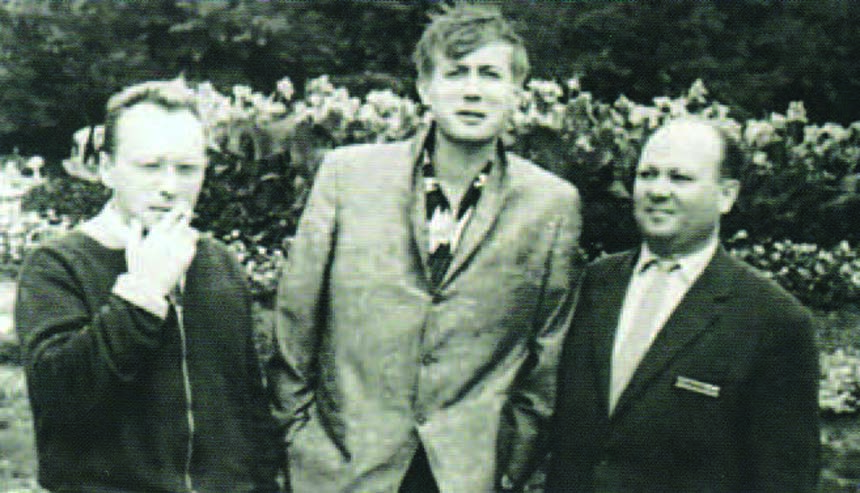
For a long period of time Yevtushenko was not able to publish the poem, although it finally appeared in Literaturnaia gazeta (Literary Gazette). No reader could remain indifferent to the poem, which soon became the subject of energetic discussions and impassioned arguments. Some writers accused Yevtushenko of a lack of patriotism, cosmopolitanism, and 'forgetting about his own Russian people." The majority of reputable literary figures, however, including Samuil Marshak and Konstantin Simonov, publicly supported the poet in their writings. [37]
The opening lines of Yevtushenko's poem sounded like a symbolic indictment of the Soviet government and the double standard in its attitude to the memory of the victims of Babyn Yar: "No monument stands over Babi Yar./ A steep cliff only, like the rudest headstone." Then the poet diagnoses the spiritual abyss in the Soviet Union, from which an exit was possible only through liberation from the burden of the stereotypes imposed by the authorities. The burden in question is the imperialistic legacy of antisemitism, the language of suspicion, innuendo, and mutual recrimination. The poet's persona rebels against this state of affairs, so that the feelings of blame and responsibility acquire a particular resonance.
Wild grasses rustle over Babi Yar,
The trees look sternly, as if passing judgement.
Here, silently, all screams, and, hat in hand,
I feel my hair changing shade to gray. [38]
Like his predecessors Ehrenburg and Ozerov, Yevtushenko identifies himself with the victims of violence. Yet at the same time he is well aware of his obligation to awaken deadened memory.
And I myself, like one long soundless scream
Above the thousands of thousands interred,
I'm every old man executed here,
As I am every child murdered here. [39]
In discussions about the tragic past, the supreme authority for the poet is truth. The perception of the other as hostile and potentially dangerous is a disgraceful page that must be turned over forever. This statement became the poem's symbolic slogan and artistic platform of the generation of Sixtiers.
May [the] "Internationale" thunder and ring
When, for all time, is buried and forgotten
The last antisemites on this earth. [40]
Literary scholars noted that Yevtushenko's poem became a phenomenon not only in cultural but also in sociopolitical life. In December 1962 the poet read a fragment of his poem at a meeting attended by Nikita Khrushchev. The Soviet leader's reaction was categorically negative. Khrushchev called such texts irrelevant and politically harmful, and accused he Yevtushenko of "singing in a foreign voice." The Soviet government thus continued to think in oppositional terms and wielded the language of political accusations. [41]
Yevtushenko's poem was a turning-point on literature's path to finding its own voice and the courage to oppose the authorities. Spiritual continuity with the main principles of Yevtushenko's civic stance was manifested with particular clarity in mass rallies that took place on 29 September 1966 to mark the twenty-fifth anniversary of Babyn Yar. A public meeting held in Kyiv was attended by the Russian writer and journalist Viktor Nekrasov, and his Ukrainian colleagues, the literary critic Ivan Dziuba, the writer and translator Borys Antonenko-Davydovych, the writer and director Helii Sniehiriov, and others.
In his address, Dziuba noted that various norms of social behavior regarding attitudes to Babyn Yar were now current in Kyiv. Drawing a clearly demarcated line between unofficial memory and the government's official position, Dziuba declared:
Some Kyivites went out on this day with bouquets of flowers and black mourning ribbons, heading for the outlying district of the city whose name has become sadly notorious throughout the world: Babyn Yar. Meanwhile, other Kyivites wracked their brains, trying to prevent a large gathering of the former at this site. Still other residents of Kyiv, on orders from the second group of Kyivites, monitored the members of the first group, and, in case of need, 'adopted measures' against those of us who were most enthusiastic. [42]
The impact of the first commemorations
The symbolic space of Babyn Yar thus came to embody various values-based priorities. For some it was viewed as a place of grief and remembrance; for others it became a political instrument of control, blackmail, and intimidation. The latter factor undoubtedly played a decisive role in the fact that in the postwar decades no prominent cultural figure ever took part in the annual mourning processions of Kyivites to Babyn Yar, or delivered any eulogies at the victims' graves.
In September 1966 an especially large crowd of people came to the ravine in Kyiv. The presence of well-known artists created a special psychological and emotional atmosphere. As Dziuba recalled:
People's faces were frozen with suffering, and their eyes were otherworldly: they gazed into the depths of time and saw a dreadful picture of what was not and would never become the past for them. The shadow of the bygone horror and a kind of human bewilderment reigned over Babyn Yar, and thousands of people, mute in petrified trepidation, seemed to be permeated with the mute cry of an entire people. The crowd remained silent. But this was a pressing, questioning kind of silence. People wanted to listen, they rushed toward us, they grabbed us in various directions. . . . Each one of us was surrounded by a dense crowd demanding: 'Tell us something!' [43]
The words of Ivan Dziuba, one of the intellectual leaders of the Ukrainian Sixtiers, rang out powerfully that day. First and foremost, he emphasized the "conspiracy of silence" that had risen around the semantic field of Babyn Yar. In his considered opinion, this long-lasting silence "was becoming an accomplice of untruth and unfreedom." [44] Second, Dziuba integrated the Babyn Yar tragedy into the coordinates of the Ukrainian experience, collective memory, and cultural awareness. A concerted effort to gain an understanding of the tragedy, one that transcended the limits of national identification and opened up new horizons for a different set of philosophical and psychological optics, was the very approach that failed to be reflected in a full-fledged manner in the space of Soviet (and Soviet Ukrainian) literature during the postwar decades. In a certain sense, Dziuba's speech played a compensatory role with regard to the moral dilemmas that had fallen out of the analytical field of Ukrainian literature but which had to be expressed in order to overcome the colonial way of thinking.
Dziuba's stirring speech not only issued an appeal to the past, it also outlined prospects for the future, linking them with the development of new communications practices, in which culture would be called upon to carry out a leading role. Accordingly, the lessons of Babyn Yar envisioned a dialogue among cultures and nations.
Viktor Nekrasov, one of the organizers of the 1966 commemorative event, later recalled Dziuba's speech warmly. He commented that the Soviet state security service duly noted the writer's participation in the ceremony to honor the victims of Babyn Yar, adding it to the list of political accusations against Dziuba, who was later imprisoned on charges of "Ukrainian bourgeois nationalism." But the public meeting, as well as its scale and the questions that were posed that day, spurred the party leadership into co-opting the initiative and imbuing future commemorations of the Babyn Yar massacre with ideological and ritual content.
For the purpose of comparison, it is worthwhile recalling the words of Nekrasov, who noted the "governmentalization" of the commemorative tradition. His reflections exposed the Soviet government's efforts to strip Babyn Yar of its intellectual voice and to supplant the commemoration of its victims with exclusively Soviet ideological content.
And now, every year on 29 September (the day set aside to honor the victims of the temporary German-fascist occupation), not far from the rock a podium is being constructed, from which the secretary of the Shevchenko raion party committee is delivering a speech devoted mostly to the achievements in fulfilling the plan in various branches. Later, speeches are made by a few factory workers recognized for their initiative or exemplary work, among whom there is one token worker of the Jewish nationality (today it is not acceptable to say simply a Jew), and he talks about the Zionists' savagery in Israel. After the speeches the hymn is performed and the meeting is declared closed. At this very moment people with flowers and wreaths appear. But it turns out that it is no simple matter to lay them. Members of the militia and their doubles, dressed in civilian clothing, carefully inspect the inscriptions on the wreaths, and if they find something suspect ('And what language is this written in? Translate it.'), the people holding the wreaths end up in 'Black Marias' [security service vehicles] that are idling nearby. Elderly people with small bouquets are let through without hindrance. Well, maybe, someone is photographed. [45]
Nekrasov incorporated his reminiscences and impressions of the 1966 Babyn Yar commemoration into his novel, Zapiski zevaki (Notes of a Bystander). This work, written during his forced emigration (1976), may be regarded as the confessions of a Kyivite, which gushed out in the form of a frank conversation about values and about an individual who seeks the profound meaning of life. In addition to other urban centers (Paris, New York, Warsaw), Nekrasov reconstructs the image of his native Kyiv, a city that is immeasurably dear to him and which vanished without a trace or was obliterated from the map of memory by the winds of history and the actions of politicians.
Babyn Yar occupies a singular place in Nekrasov's text, and acquires universal, symbolic meaning. The writer inserts it into the cultural space of Kyiv and his own life story. The supreme importance to him of this part of the Kyiv landscape is attested by the fact that before emigrating, Nekrasov visited the site of Babyn Yar. This farewell pilgrimage turns into an analysis of past experience and a quest for spiritual support in the future. The author's look at Babyn Yar is multifaceted. Above all, his novel Zapiski zevaki is a reconstruction of the mass killings that took place there during World War II. He also describes the postwar life of Babyn Yar as a place of special commemorative unanimity. "A small hill of flowers. Wreaths. Large, small; simply bouquets of flowers. On the wreaths are ribbons with inscriptions saying 'To father, to mother, to grandfather — from your sons, daughters, and grandchildren'; 'To the children who were not destined to reach adulthood'." [46]
Nekrasov does not overlook the Kurenivka mudslide of 1961. He traces the tragedy's roots to acts of vandalism that mock death itself in the form of the planned destruction of a Jewish cemetery located near Babyn Yar. During the 1941 occupation of Kyiv, the main cemetery alleyway was destroyed by the Germans. The destruction of Jewish gravestones was continued later by Kyiv's city authorities. Nekrasov compares his impressions of this destruction from various perspectives of time: the late 1950s, when he first discovered traces of the ruins, and the mid-1970s, on the eve of his departure from Kyiv: "I was there at the time; in fact, before my departure. After fifteen years. . . . Everything was overgrown with bushes and grass. The ruined gravestones had been carted off somewhere. But not all of them. Here and there half-broken pedestals, stairs, bits of marble, and labradorite gleam whitely. And bulldozers. They are rumbling, and through the metal screeching they are laying a road on the site of the main alleyway. . . . There are no people. It is empty. Dead . . . and terrifying." [47]
Nekrasov treats the Babyn Yar massacre during World War II, the destruction of the Jewish cemetery by both totalitarian regimes, the dam collapse in Kurenivka, and, finally, the spatial disappearance of Babyn Yar as manifestations of the "captive mind" (to quote Czesław Miłosz), submission to evil, and descent into a state of moral nihilism. Nekrasov's unwillingness to reconcile himself to this situation was a decisive factor in his participation in the dissident movement and lengthy spiritual duel with the Soviet government.
For Nekrasov, the culmination of his chosen path was the 29 September 1966 commemoration, which the writer recorded with painstaking precision. Describing his feelings, he accentuated the spiritual freedom that filled his being. He had every reason to feel this way because he had not coordinated his speech in advance with anyone, and it had not been vetted by any oversight institution. In other words, no censorship of any kind had influenced his thought processes. For this former front-line soldier and author of the masterpiece V okopakh Stalingrada (Front-Line Stalingrad), the war found its continuation and gained new meaning precisely at the site of Babyn Yar, and it became a struggle for human dignity and memory. In a certain sense, the struggle for memory is one of the most important subjects raised in Nekrasov's Zapiski zevaki, in which the author recalls his impressions of the various entries that were submitted to a design competition for a monument intended to commemorate the victims of Babyn Yar. The submission terms and conditions included clear-cut ideological criteria: "The monuments should reflect in artistic form the heroism, invincible will, courage, and fearlessness of our people in the face of death at the hands of the German executioners; they should depict the beastly faces of the Hitlerite invaders, and they should also convey the nationwide grieving for the thousands of nameless heroes." [48]
It is no wonder that Nekrasov rebelled inwardly against the majority of the submitted designs. For this writer, who had direct experience of the war (and not in the way Soviet propaganda portrayed it), it was important to liberate memory from the patriotism of hatred. His top priority in the process of comprehending the tragedy was to apprehend the philosophy of death. In his view, the attitude to death is a marker of a society's spiritual maturity. He realizes with bitterness that a profanation of death is taking place within Soviet totalitarian society, especially through the negation of its sacred, religious dimension and denial of the transcendental sense. What is obvious to the writer in this context is the culpability of ideologically subordinated art that generates simple, standardized answers to complex and debatable questions.
On the whole, there is a very personal dimension to Babyn Yar in Zapiski zevaki. In a certain sense, it became part of the author's treasured memories of his childhood, youth, and civic maturation. At the same time, Nekrasov's version of Babyn Yar signifies the problem of choice: between freedom of self-realization and conformism; between truth and the "conspiracy of silence." In those social confrontations that the writer was destined to experience, Babyn Yar became the source of spiritual strength, impregnability, and the capacity to remain his own person.
The Babyn Yar tragedy found its fullest possible artistic expression in Anatoly Kuznetsov's novel Babi Yar: A Document in the Form of a Novel, a work that played a special role in the author's life and became a unique literary phenomenon in the era of the Sixtiers. Kuznetsov recalled that the publication of his novel was dictated by the government's attempts to dampen the public's response to Yevtushenko's poem. Literary ideologists sought to prove that Kuznetsov's novel utterly contradicted the main ideas of Yevtushenko's tribute to Babyn Yar. Kuznetsov rejected these claims, emphasizing that his novel was not a polemic against Yevtushenko's poem but a continuation and substantial expansion of a set of problems pertaining to Babyn Yar.
From the pen of the writer whose childhood and youth were linked indissolubly with Kyiv (Kuznetsov and his family lived in Kurenivka, the district adjacent to Babyn Yar) came the artistic and documentary embodiment of multiple dimensions of meaning layered over the symbol of Babyn Yar. The occupation of Kyiv had a decisive, formative influence on the writer. Kuznetsov, who began taking notes in his adolescence, returned constantly to his wartime experiences and eventually created a document in the form of a novel.
Kuznetsov's work encountered numerous obstacles. His novel first appeared in abridged form in three issues (nos. 8–10) of the journal Yunost (Youth) in 1966; a year later, the Molodaia gvardiia publishing house released it as a separate book. From both versions the censors mercilessly excised excerpts containing what they considered "anti-Soviet content." The author later recalled: "Writers in the Soviet Union are always confronted with a dilemma: whether they should be published at all, or whether they should publish only what is permitted by censorship. Many believe that it is better to offer the reader something rather than nothing. I too thought that." [49] When, in 1969, Kuznetsov was sent on an assignment to London, he requested political asylum and announced his refusal to return to the Soviet Union. His decision sparked a wave of indignation and political accusations in Soviet governmental circles. Placed on a list of "traitors and enemies," Kuznetsov's novel was banned for several decades. Its complete text, along with additions that the writer made in 1967–1969, was published abroad in 1970.
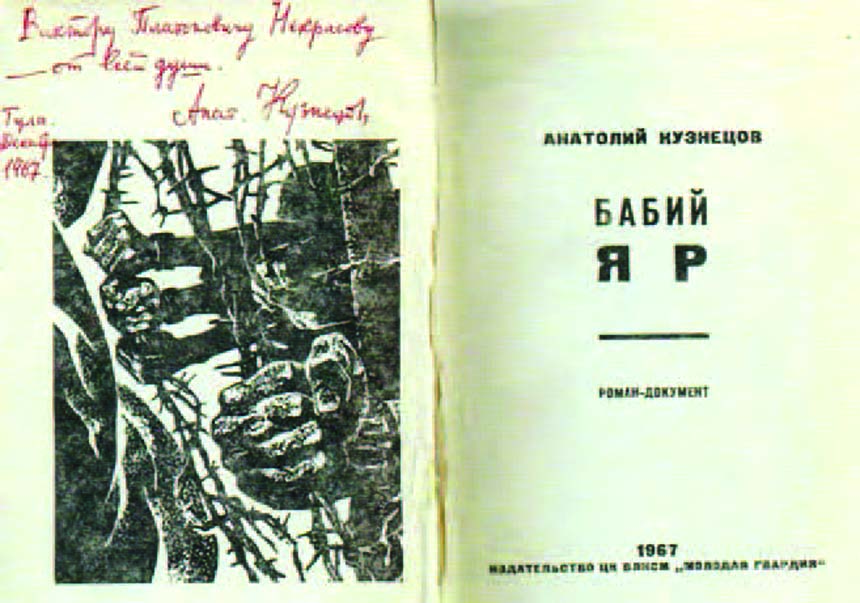
The book's complicated trajectory was determined not only by Kuznetsov's political choice (he was branded as a defector) but, above all, by those questions that he brought into the public space of literature. They struck a discordant note within the totalitarian system of political directives, above all through his call to resist the attack on the space of freedom and human dignity. The final lines of his novel proclaim: "No social crime will remain unknown. Something can be burned, dispersed by the wind, covered up with earth, and trampled down, but human memory remains." [50] In fact, memory is one of the main heroes in the novel, and the author's interlocutor.
Kuznetsov begins his symbolic journey into the depths of memory with episodes that had a decisive impact on the writing of his novel. First and foremost, the author revisits his impressions of Kyiv during the German occupation, when for two years he heard machine-gun fire coming from Babyn Yar, and noticed thick, black smoke rising from the ravine for several weeks. When he went to the ravine later, he spotted many white stones at the bottom of a little stream. Picking one up, he realized that it was a charred fragment of a human bone. Reaching the end of the stream, he noticed that the sand was gray, and realized that he was walking on human ashes. The writer reinterprets this symbol and declares that the "ashes of Klaas knock at my heart" [51] (a reference to Till Eulenspiegel, an impudent trickster figure originating in German folklore, who carries his father's ashes in a bag around his neck — translator). Kuznetsov's work thus became a symbolic step to ensure that human memory will not be transformed into the ashes of oblivion. At the same time, this is a story about the ways one individual survived in a totalitarian society, as well as about the tragedy of an artist stripped of the freedom to create.
Kuznetsov insisted that his novel was based entirely on documentary materials. His main goal was to convey as much truthful information as possible and thus distance himself from Socialist Realist texts. He opted for confessional writing, a style that allowed him to present the historical, social, and psychological characteristics of a particular era. The novel begins in the mid-1920s and ends in the late 1960s. Such a broad chronological sweep allowed the novelist to recreate major historical events and to recount the history of numerous heroes, as well as his own family history.
One of his first conscious memories of childhood was overhearing adults' conversations about the famine that ravaged Ukraine in 1933 (marked by incidents of cannibalism), the New Year tree, and a song about "this wonder tree that Postyshev has brought us." In one scene little Tolia is shocked to see his mother burning "dangerous" books on the stove; in another, he and his friends are watching their favorite movies: Chapaev, Shchors, Bohdan Khmelnytsky, and Esli zavtra voina (If War Comes Tomorrow). This kaleidoscope of childhood experiences is layered over the life stories of the people who are dearest to him: his grandparents, his mother, and the parents of his childhood friends. In Kuznetsov's view, the multitude of problems that were exacerbated by World War II are rooted in the situation that existed before the war, with its repressions, lies, and atmosphere of fear and mutual suspicion.
The arrival of German troops becomes engraved in the memory of the teenaged Kuznetsov as a result of the following incident. A female neighbor, who had rushed over to his parents' house, was "excited, not herself; she was shouting in joyful astonishment and exultation: 'Why are you just sitting here? The Germans have come! Soviet rule has ended'." [52] The writer supplements his account with other examples demonstrating the priorities in the expectations of Kyiv residents, for whom the end of Soviet rule is a more important event than the arrival of a foreign army. He writes convincingly and truthfully about the rapid onset of disillusionment and despair, and the tragedy of life under the German occupation. At the same time he introduces psychological parallels, showing how hope gave way to the disillusionment and fear that were everyday features of people's lives during Soviet and German rule.
Kuznetsov reproduces the varied topography of the crimes committed in occupied Kyiv: the explosions detonated on Khreshchatyk Boulevard and in the Kyivan Cave Monastery; and the death camp for Soviet prisoners of war in the Darnytsia district of Kyiv. Into this space of violence and death he inscribes Babyn Yar. The author confesses that this place had a lethal effect on him because forever after he was plagued by dreams in which he heard the voices of people being shot, and imagined scenes in which he himself was being led away to be shot. However, Kuznetsov's novel cannot be reduced to a psychological release from childhood trauma. There is no question that unexpressed pain and the process of pushing into the subconscious information begging to be recorded on paper were part and parcel of a situation that was typical of all Soviet literature in the first postwar decade. But, in addition to Post-Traumatic Stress Disorder, the writer outlined the war's new dimensions of meaning: state violence against the individual and the loss of preventive ethics with regard to evil.
The writer portrays the beginning of the occupation of Kyiv also through the deformation of the information space, which, in his estimation, became a component of physical violence. Kuznetsov cites announcements, orders, and directives issued by the German administration that communicates with the civilian population in the language of threats, intimidation, and a list of punishments to be meted out in the event of noncompliance. One such announcement that the twelve-year-old Tolia Kuznetsov happened to read proved fatal for many thousands of Jews living in the Ukrainian capital.
Kuznetsov recreates the tragic death route that wound its way through the streets of Kyiv on 29 September 1941 by conveying moods of anxiety, uncertainty, fear, and impending doom among the Jewish population (he was struck by the large numbers of sick, elderly, and weak people), as well as sympathy, indifference, and malicious joy expressed by the local citizenry. Despite the varied reactions of Kyivites, the writer underscores the fact that the residents of the Ukrainian capital were shocked to their core by the shootings in Babyn Yar.
While Kuznetsov was working on his novel, he met many people, who not only recalled the dreadful years of the German occupation, but also their personal stories to him. In his novel the storytellers are not just eyewitnesses but active figures in a grand history that was often excessively brutal toward them. The multiplicity of voices allows the reader to comprehend how Ukraine lived through the largest war of the twentieth century, to become aware of the dramas and tragedies that played out on its territory, with its heroes and antiheroes, and to understand how the writer resisted the temptations of falseness and untruth.
Kuznetsov recapitulates the life stories of several individuals who managed to save themselves from the deadly hell (Dina Pronicheva, Volodymyr Davydov) and talks about the Kyivites who helped some to survive. He significantly expands the martyrology of victims and recalls the Ukrainian poet Olena Teliha, the editor of the newspaper Ukrainske slovo Ivan Rohach, the Roma people, and the extermination of patients at the Pavlov Psychiatric Hospital, Soviet prisoners of war, and underground members who were shot in Babyn Yar.
The writer describes in detail how the German occupation authorities manipulated the vanquished by provoking them into engaging in mutual suspicion and spying on each other. "Woe to you if you had an enemy or someone envied you. In the past, someone might write a denunciation stating that you are against Soviet power, therefore an enemy of the people, and you disappeared without a trace. Now that person might write that you are against German power, therefore an enemy of the people, and Babyn Yar awaited you. Even the German terminology was the same: 'enemy of the people'!" [53] For Kuznetsov, Babyn Yar becomes a symbol of the totalitarian ghetto; it is the road traversed by the writer in order to cast off his political and spiritual chains.
Kuznetsov's novel achieved several strategic goals. One of the main ones was breaching the information blockade by literary means. By combining the formats of reminiscences and journal entries, the writer created an emotionally arresting account of violence, terror, and people's capacity to counteract them by marshaling their spiritual reserves. One of the book's main commandments is that truth is the most potent weapon in the struggle against violence. The standard of openness and moral responsibility that was put into practice by Kuznetsov was definitive in the formation of the world perceptions and principles of many writers.
The capacity to be oneself and not betray one's chosen principles is especially prominent in the works of the talented and original Ukrainian writer Leonid Pervomaiskyi. The theme of the Holocaust and Babyn Yar is foremost in his creative explorations.
Leonid Pervomaiskyi was born in 1908 into a Jewish family in the Ukrainian region of Poltava. He began his literary career in the late 1920s as a poet and prose writer. His choice to link his destiny with Ukrainian literature was unusual in his milieu, as the majority of his peers aspired to realize themselves creatively within the dominant culture of the Soviet state — Russian. But Pervomaiskyi deliberated chose integration into the Ukrainian cultural space. This choice became a values-based priority which was to define the philosophical principles of his creativity. In the perceptive words of Yohanan Petrovsky-Shtern: "Pervomaiskyi identified with the deprived shtetl Jews and the silenced victims of the Ukrainian famine, the anonymous Red Army soldiers perishing on the front during World War II and the voiceless Holocaust martyrs, the persecuted literati of various epochs and nations, and the executed Soviet Yiddish writers. At the end of his career, he came to identify with the martyrdom of creative writing, with persecuted poets such as himself, and with the suppressed voice of Ukrainian poetry." [54]
In 1949, during the "struggle against rootless cosmopolitans," Pervomaiskyi was powerless to escape the accusations and humiliating jibes that were aimed at him. The direct response to his spiritual conflict with the Soviet government was the poem, "Na ukrainskii zolotii zemli" (On the Ukrainian Golden Land). The writer had fought at the front, and when the war ended, he worked as a military correspondent for the newspaper Pravda. The Babyn Yar tragedy could not fail to affect him, whether as a writer whose life before the war and creative formation were inextricably tied to Kyiv, or as a Jew who had survived and felt a spiritual kinship with the victims of the Holocaust.
At the same time, what makes Pervomaiskyi stand out is his sense of guilt before the victims, which is why the topic of the Holocaust has a special place in his oeuvre and runs through his postwar poetry ("Melnikova Street", "Wild Honey", "In Babyn Yar"). Pervomaiskyi is also of interest with regard to the limits of the permissible in Ukrainian literature as defined by the imperial cultural policy. To quote again Petrovsky-Shtern: "The area of the 'legally allowed' was much narrower for a Ukrainian writer than for a Russian one. National endeavors within Russian national perceptions were censored, whereas such endeavors within Ukrainian national feelings were expurgated. The regime would frown on certain Jewish motifs in Russian-Jewish literature but would immediately stifle recognizable Jewish hints in the texts of Ukrainian-Jewish writers." [55] For Pervomaiskyi to address Holocaust issues was in itself an act of civic courage, and, at the same time, a testament to new approaches of describing the tragedy. The poet localized the spatial dimensions of the Holocaust, outlining them in the parameters of family history, emphasizing not so much the acts of violence and cruelty as those of kindness, compassion, and rescue. In the words of Yohanan Petrovsky-Shtern, he "found voiceless victims . . . and helped them speak." [56]
Pervomaiskyi's reinterpretation of the Kyivan dimension of the Nazi German occupation was reflected in both his prose and poetry. In his short story "Vulytsia Melnykova" (Melnykov Street), Pervomaiskyi reveals the moral and psychological challenges that the Holocaust introduced into the lives of ordinary Kyiv residents. [57] The Ukrainian–Jewish couple, Klava and Mosia, get married before the war. When the war breaks out, Mosia is sent to the front, and his pregnant wife remains in occupied Kyiv. Klava is about to give birth, and while waiting for labor to begin, she reads some announcements that have been plastered all over the city, ordering all Jews to assemble at the corner of Melnikova and Dehtiarivska streets. The young woman rents an apartment from Aunty Nastia and tells her landlady who the father of her child is. Aunty Nastia becomes preoccupied with her thoughts and with various evil presentiments. She is afraid for her life and does not know what to do. The birth of Klava's child coincides with the first days of the executions in Babyn Yar, and at this very time some policemen come to the flat to check passports. Aunty Nastia convinces them that Klava is her niece, and thus saves the mother and her newborn. This ordinary woman achieves the greatest possible victory, triumphing over her own terror and hopelessness.
It is precisely through the exploration of such extreme situations that Pervomaiskyi exposed new psychological dimensions of Babyn Yar. In other words, even while being defenseless against the government, a person is nonetheless able to resist. In the author's interpretation, the day of death becomes the birthday of a new life, and this life is stronger than fear and despair. Hence the semantics of death is not dominant in this version. Instead, the author reveals sources of spiritual strength and solidarity. For example, ordinary women experience a powerful transformation and turn into warriors in spiritual confrontation. Such spiritual power cannot be overcome by physical means. As Petrovsky-Shtern reminds us: "whatever the real number of righteous gentiles in Kyiv in 1941, the most important lesson one may draw from [the short story] "Melnikova Street" is that marginalized individuals can and should actively oppose violence." [58]
Not unexpectedly, echoes of Babyn Yar also appear throughout Pervomaiskyi's poetry. One poem, symbolically entitled "Popil" (Ashes), conveys his fear and bitterness at the state of spiritual amnesia that reigns in society.
It lay on guard over conscience,
But we, living and existing passersby,
Shake that dread dust off our boots,
Is it because the crime has not ended,
That we fear future bloodshed
That we have no strength to stop? [59]
Another poem "V Babynim Yaru" (In Babyn Yar) reproduces a heart-wrenching and extraordinarily caring conversation between an elderly Jew and his son a minute before their execution.
Stand next to me, stand, my son,
I will cover your eyes with my palm,
So that you will not see your death,
Just my blood in my fingers in the sun,
That blood which also became your blood
And is about to pour onto the ground . . .[60]
The absence of traditional curses and accusations directed at the murderers is striking. Instead, the main emphasis is shifted to the father's love for his son, which is stronger than death.
Pervomaiskyi was one of the first writers to explicate clearly the main mission of artists when dealing with the Holocaust — memorialization. Writers must become the voices of those "who are being killed" and recreate their life stories for posterity. This explains the reappearance of the image of the elderly Jew, who addresses the poet as the mouthpiece of the nameless victims.
And when I was falling dead into the ravine
Into the terrible clay of bloody bodies,
I stubbornly believed that you would inevitably
Come to resurrect me! [61]
Pervomaiskyi turned to the Babyn Yar theme in moments when he himself was experiencing crisis situations linked to questions of creative solitude, a reassessment of values, and states of "inner emigration." Creative insight into the tragedy also became a kind of psychological bulwark and a new understanding of the mission of art. It is no accident that the poem "V Babynim Yaru" was included in a collection entitled Uroki poeziï (The Lessons of Poetry). [62] At the same time, Babyn Yar became a projection of Pervomaiskyi's philosophical reflections, according to which supreme wisdom and truth are on the side of martyrs and sufferers.
Recent Ukrainian-language belletrists
This particular attitude is also common to the artistic construction and new interpretation in the works of several late twentieth-century Ukrainian poets. It is worth mentioning poems by Moisei Fishbein ("Yar"), Leonid Vysheslavsky ("Olena Teliha's Cross"), Yuri Kaplan ("Babyn Yar," "Self-Portrait"), Dmytro Pavlychko ("Requiem", "Walking near Babyn Yar"), Abram Katsnelson ("Grandson's Monologue"), and Dmytro Palamarchuk ("A Vision of Babyn Yar").
In his interpretation of the Babyn Yar tragedy, Fishbein, a Ukrainian-Jewish poet, adopts a metaphorical model blending biblical associations (Rachel weeping for her murdered children), folkloric symbols (the image of cranes flying over the ravine is more eloquent than words), and the perception of the tragedy as a component of his own spiritual landscape. The poet raises his voice in defense of women and children, the most vulnerable and defenseless victims of Babyn Yar.
They are walking
on the cold, hard pavement,
Thousands of people
are walking between the hard, implacable walls,
they carry
Rachel without a hole in her temple,
Here it is, the temple,
a child's temple without a hole,
they are carrying her there, to the machine guns.
Shuffling. Tramping. Creaking. Noise.
From the sky,
birds gaze at the earth. [63]
In Iurii Kaplan's poem "Babyn Yar," he spoke about "the 100,000 [people] sleeping" in it, with "their names forgotten forever." [64]
Each of these writers relived the tragedy through an imaginary reconstruction of events which restored the victims' personal stories and integrated memory into the moral climate of contemporary life. A prominent feature of this poetic polyphony is the perception of Babyn Yar as a space for the reconciliation of memories.
At the turn of the twentieth century the poetic counterpoint of Babyn Yar remained the most productive in literature, which was poignantly revealed in several anthologies. For example, the anthology Vidlunnia Babynoho Yaru (Echoes of Babyn Yar) compiled by Yurii Kaplan was reissued a third time to mark the sixty-fifth anniversary of the tragedy. The book featured the poems of writers who were not published in the Soviet Union: Liudmila Titova, Olga Anstei, and Naum Korzhavin ("Poema sushchestvovaniia" [A Poem of Existence]). The third edition also included Paul Celan's "Fugue of Death," translated by the Ukrainian poet Vasyl Stus, and the poems of Yurii Kaplan, Dmytro Palamarchuk, and others.
Several trends have been observed in the prose writings devoted to the theme of Babyn Yar in the first decades of the twenty-first century. The first and main one is linked to values-based approaches to the experience of World War II on the whole. The new generation of Ukrainian writers focuses attention, first and foremost, on Ukrainian projections of the war in the anti-totalitarian, anti-imperialist, religious, national, and psycho-emotional dimensions. In recent years, evocative works of Ukrainian prose, such as Oksana Zabuzhko's Muzei pokynutykh sekretiv (The Museum of Abandoned Secrets), Volodymyr Lys's Stolittia Yakova (Jacob's Century), Yurii Vynnychuk's Tango smerti (Tango of Death), Andrii Kokotiukha's Chervonyi (Red), Tetiana Belimova's Vilnyi svit (Free World), Lesia Stepovychka's Nimtsi v horodi (Germans in the City), Vasyl Shkliar's Troshcha (The Reed), and Sofia Andrukhovych's Amadoka, depict many traumatic experiences that intersected during the war. The private stories on which these writers focus their attention help to reveal various strategies of behavior and to delineate the changeability of roles. Depending on circumstances and moral priorities, during the war one and the same person was capable of demonstrating immense courage and heroism, and after a short period of time — becoming a coward and betrayer.
Within the dimension of private stories, the image of the enemy has undergone fundamental restructuring. Above all, it has been stripped of demonizing, irrational patterns that were cultivated in the space of Soviet literature, which for the longest time portrayed the enemy only as a base individual deserving of hatred, contempt, and liquidation. Contemporary literature, which is restoring full-fledged, vital space to the enemy, exposes his various faces (often contradictory) and studies the transformations that the war brought into his life.
An alternate view of victims and criminals, whose life stories emerge not within a system of oppositions, but as self-sufficient and equivalent, is presented in Mykola Mashchenko's novel Dytia ievreiske (The Jewish Baby, 2008). The author, a well-known Ukrainian film director, constructed his work in the form of a melodrama, blending elements of a detective novel with a love story. The novel centers on the fate of a Jewish woman named Ida Fridman and the Nazi officer Wilhelm Hauptmann. On 29 September 1941, on the way to Babyn Yar, Ida seizes an opportunity to hide her daughter in some bushes. The child is later found and hidden by a Ukrainian family, and Major Hauptmann saves the mother from being shot.
Wilhelm's encounter with Ida on the very day of the Babyn Yar shootings marks the start of a new war — with himself and the system. He refuses to carry out his superiors' order and does not take part in the executions. "Even Hitler himself cannot save all of you, although it is he who handed down the death sentence to your entire nation. I am fatally guilty in that I am not shooting the Jews right now in Babyn Yar. All of Germany is shooting hundreds of thousands of you. But I am saving a single Jewish baby and its mother …in order to prolong the Jewish line. My entire soldier's crime and great human deed lie only in this," says Wilhelm to Ida. [65] The love-based motivation in the Nazi officer's change of life strategy is very important, but no less significant for the author is an individual's capacity to issue a challenge to the entire machinery of government and collective will, and to resist evil by realizing his/her own responsibility. It is precisely this choice that sets in motion the hero's spiritual healing and regeneration.
Mashchenko, who died in 2013, was the creator of such Soviet cult films as Komisary (The Commissars, 1969) and Yak hartuvalasia stal (How the Steel Was Tempered, 1973). The artist's path from cinema, in which life is sacrificed for ideology, to the novel Dytia ievreiske that confirms life as the highest value, reveals a profound internal evolution in understanding the nature of violence and, ultimately, changing one's life priorities. In the foreword to his novel Mashchenko noted: "Today the world of goodness, love, human civilization are in the same kind of jeopardy as all the most tragic epochs in the history of the planet. . . . Dytia ievreiske is a warning about the threat that new Babyn Yars may take place! I pray that nothing like that will ever happen again in the world. This is a painful plea to treasure God's supreme grace: human life." [66]
In recent years, independent Ukraine's changes in literary space have become a powerful impetus to the reception of the Holocaust experience. An important confirmation of these processes is the collective monograph Holokost: khudozhni vymiry ukraïns'koï prozy (The Holocaust: Artistic Dimensions of Ukrainian Prose). [67] Its authors draw attention to an impressive array of works, previously published in independent Ukraine, that provide a powerful stimulus to comprehend the Holocaust from a new analytical perspective. Examples of such works include: V yaru zhasaiuchykh zirok (In the Ravine of Fading Stars, 2007) by Raisa Plotnikova; Cherevychky Bozhoi Materi (The Shoes of Our Lady, 2013) by Maria Matios; Vohnenni stovpy (Pillars of Fire, 1999–2012) and Torhovytsia (The Merchant, 2012) by Roman Ivanychuk; Vidlunnia: vid zahybloho dida do pomerloho (Echoes: From the Fallen Grandfather to the Deceased, 2012) by Larysa Denysenko; Sonia (2013) by Kateryna Babkina; Ya, ty i nash maliovanyi i nemaliovanyi Boh (I, You, and Our Painted and Unpainted God, 2016) by Tetiana Pakhomova; Istoriia varta tsiloho yablunevoho sadu (A Story Worth an Entire Apple Orchard, 2017) by Maksym Dupeshka, and Vynova hora (Wine Mountain, 2017) by Nadiia Morykvas, and Amadoka (2020) by Sofia Andrukhovych.
All these works incorporate the Holocaust into their narrative and actualize memorialization practices that have arisen through family memory and moral challenges caused by a combination of an internal existential crisis and the crisis of social order. As far as the analysis of the Holocaust is concerned, researchers emphasize its relation to the history of previous genocides in Ukraine. Attention is given to reformatting cultural memory, to narrating the Holocaust in terms of the ontological designations Ours and Theirs, and to establishing the genre and style attributes of texts depicting the tragedy. This recent emergence of a significant number of works on the Holocaust in modern Ukrainian literature has provided a solid foundation for the eventual appearance of new texts of artistic quality with a focus on Babyn Yar.
A landmark in this new cultural development is a collection of poems Babyn Yar: holosamy (Babyn Yar: In Voices, 2017) by Marianna Kiyanovska. The book became a momentous event in Ukraine's literary life because it introduced a new artistic metalanguage to speak about trauma. Kiyanovska said that she constructed her book on the principle of a choir, that is, choosing poems so that they would sound in tune. Since her poems tell multiple stories of Babyn Yar victims, Kiyanovska provides an individual voice for each victim. In the words of one critic, readers can "see the world through someone's eyes and listen to the world on their behalf." [68]
Kiyanovska does not limit the space of death to Babyn Yar only. Rather, she traces its origins to Stalin's prewar crimes and extends the coordinates of violence to all of Kyiv, to its basements, attics, and the hideouts of the Jews. Hence, her poems present the psychology of a person that lives in constant apprehension of mortal danger coming from either the bullets of Nazi invaders or civilian denunciations.
Featured are the voices of men and women of all ages and social status: Jews, Roma, and victims of the Holodomor and other Stalinist repressions of the 1930s. All are united by the figure of the Eyewitness who seeks to inscribe individual traumatic experiences in the collective memory — to survive in order to testify. Kiyanovka's poems provide a powerful transcendent foundation that genealogically goes back to the sacred biblical story and that reveals the strategy of confronting evil in the existential dimension. Kiyanovska's texts are also a reflection on the murder of the Human Being, which is the essence of all totalitarian regimes:
nothing or nothing save maybe tears saves me anymore
tears that break the background surface and the remainders of the body
to survive I must have it in my vessels at the bottom and at the bottom of the suitcases
the heavy mechanisms of inventing displacement wings wings. [69]
The story of how Kiyanovska's texts emerged is symbolic in many ways. Most were written in 2016, the third year of the Russian-Ukrainian war. According to the author herself, the current war prompted the need for a powerful reset of historical memory in Ukrainian literature. In the case of the Holocaust, it was now possible to develop plots and intellectual reflections that either had been voiced sporadically or not at all, or displaced into the subconscious. In Kiyanovska's poetic version, the narratives of Babyn Yar and the Russian-Ukrainian war create an organic unity and complement each other. Moreover, the poet notes that she originally intended to recreate her impressions specifically of the war in eastern Ukraine, but that this revision of the modern military confrontation in terms of values led her to the topic of the Holocaust: "when I write some of my poems about what happened in Babyn Yar, for me it is an experience of both what was then and what is now happening in the Donbas. It's a special experience of trauma." [70] In the search for a new metalanguage to describe modern warfare, Kiyanovska turned to the experience of World War II, in which the topic of Babyn Yar was decisive. As Iya Kiva points out, "the book Babyn Yar: In Voices is an attempt to understand (literally: to hear) the future through the past and to understand today's war through the past war and thereby overcome the language of hate by creating a supranational language of the victim." [71]
Kiyanovska cites distance in time as one of the factors that enabled her collection of poems. She counts herself as a member of the first generation educated and formed spiritually in independent Ukraine, that is, a generation free from the fear that an artistic interpretation of the Holocaust may have negative consequences for the author or cause repression by the authorities. It was this generational change and distance from the experience of Soviet totalitarianism that prompted contemporary authors to seek an artistic language freed from imperial myths and stereotypes. Thanks to Kiyanovska, Ukrainian literature has been enriched with a new quality of writing and new interpretive practices consistent with the experience of present-day European intellectuals.
Most appropriately, Kiyanovska's book won Ukraine's highest literary award, the Taras Shevchenko Prize, in 2020. This extraordinary event in Ukraine's cultural life proved that the tragedy of Babyn Yar became an integral component of Ukrainian cultural identity and Ukrainian culture of memory.
The literary interpretation of Babyn Yar has motivated artists of different generations and eras. Each of them destroyed the "zone of silence" and constructed the analytical and cognitive space necessary for spiritual growth. At the same time, the topic of Babyn Yar has taken on multiple characteristics that have yet to be made sense of by each new literary generation. With regard to the present Ukrainian cultural consciousness, the emergence of new artistic strategies is associated with the final liberation from the cultural domination of imperial rule and from the language of hatred and aggression.
Thus, the third millennium has brought new challenges that inevitably will spur writers to seek answers to problems of contemporary life in the experiences of the past. In these quests literature may become an advisor, a wise interlocutor, and a valuable reference point as well as — perhaps — a ray of hope.
Notes
[1] Cited in Valerii Fomin, comp., Kino na voine (Moscow, 2005), p. 5.
[2] Cited in Arkadii Zel′tser, "Tema 'Evrei v Bab′em Iaru v Sovetskom Soiuze v 1941–1945 godakh." In Babyn Iar: masove ubyvstvo i pam'iat' pro n'oho: materialy mizhnarodnoï naukovoï konferentsiï 24–25 zhovtnia (Kyïv, 2017), pp. 83–101.
[3] Vasilii Grossman, "Ukraina bez evreev", Eynikayt (Moscow), 25 November 1943.
[4] Ol'ga Anstei, Dver' v stene (Munich, 1949), https://www.liveinternet.ru/users/4652778/post208473970
[5] Ol'ga Anstei, "Stikhotvoreniia," in Dver' v stene (Munich, 1949), http://laidinen.ru/women.php?part=528&letter=%C0&code=3352
[6] Cited in https://en.wikipedia.org/wiki/Liudmila_Titova
[7] Iurii Kaplan, comp. Vidlunnia Babynoho Iaru (Kyiv, 2001).
[8] Vasyl' Shvets', "Babyn Iar," manuscript copy in the Tsentral'nyi derzhavnyi arkhiv, Muzei literatury i mystetstv Ukraїny, Fond 949, Opys 2, Zbirka 2, Arkush 25–25 zvorot.
[9] Peretz Markish, Narechenyi zaviriukhy: virshi i poemy (Kyiv, 2000), pp. 125–128.
[10] Shike Driz, Di ferte strune (Moscow, 1969). An English version, cited here, comes from Dov Noy, "The Model of the Yiddish Lullaby," Studies in Yiddish Literature and Folklore, No.7 (Jerusalem, 1986), p. 223.
[11] Il'ia Erenburg, Sobranie sochinenii, Vol. 3 (Moscow, 1964), p. 455.
[12] Il'ia Ehrenburg, Buria (Moscow, 1960).
[13] Ibid.
[14] Ibid.
[15] Dmitrii Bykov, Il'ia Erenburg: kurs sovetskoi literatury, in https://www.youtube.com/watch?v=XDnU46rnjc0
[16] Ibid.
[17] Lev Ozerov, recollections in http://ju.org.ua/ru/literature/241.html
[18] Lev Ozerov, "Babii Iar," in his Izbrannye stikhotvoreniia (Moscow: Khudozhestvennaia literatura, 1974), p. 451.
[19] Ibid., p. 453.
[20] Yohanan Petrovsky-Shtern, The Anti-Imperial Choice: The Making of the Ukrainian Jew (New Haven and London: Yale University Press, 2009), p. 227.
[21] O.P. Dovzhenko, Shchodennykovi zapysy, 1939–1956, edited by A. A. Artizov et al. (Kharkiv: Folio, 2013), p. 301.
[22] Mykola Bazhan, Polit kriz′ buriu: vybrani tvory (Kyiv: Krynytsia, 2002), p. 197.
[23] Iurii Barabash, Chuzhe-Inakshe-Svoie (Kyiv, 2020), p. 143.
[24] Ibid., p. 144.
[25] Volodymyr Panchenko, "Po zharyshchu pidem udvokh . . . Pro poemu Bazhana 'Debora,'" Slovo Prosvity (Kyiv), 23 July 2015, in http://ju.org.ua/ru/publicism/695.html
[26] Volodymyr Sosiura cited in "Voennye prestupniki: vozmezdie," in https://babiy-yar.livejournal.com/3601.html
[27] Myroslav Shkandrij, Jews in Ukrainian Literature: Representation and Identity (New Haven, CT: Yale University Press, 2009), p. 204.
[28] Cited in Liudmyla Hrynevych, Khronika kolektyvizatsiï ta holodomoru v Ukraïni, 1927–1933, Vol. 1, pt. 2 (Kyiv: Krytyka, 2012), p. 107.
[29] Dokiia Humenna, Khreshchatyi iar (Kyїv 1941–1943): roman-khronika (Kyiv: Vydavnytstvo im. Oleny Telihy), 2001, p. 5.
[30] Ibid., pp. 155–156.
[31] Ibid., pp. 104–105.
[32] Ibid., p. 169.
[33] Shkandrij, Jews in Ukrainian Literature, p. 202.
[34] Karel Berkhoff, Harvest of Despair: Life and Death in Ukraine under Nazi Rule (Cambridge, Mass. and London: The Belknap Press of Harvard University Press, 2004), p. 309.
[35] Shkandrij, Jews in Ukrainian Literature, p. 202–203.
[36] Ievhen Sverstiuk, Bludni syny Ukraїny (Kyiv, 1993), p. 23.
[37] "My reshili byt' uvolennymi", in https://babiy-yar.livejournal.com/6149.html
[38] Evgenii Evtushenko, Stikhotvoreniia (Moscow, 1988), p. 72.
[39] Ibid., p. 74.
[40] Ibid.
[41] "My reshili byt' uvolennym," in https://babiy-yar.livejournal.com/6149.html
[42] Ivan Dziuba, "U 25 rokovyny rozstriliv u Babynomu Iaru: promova, 29 September 1966," Iehupets', No. 1 (Kyiv, 1995), pp. 4–8.
[43] Ibid.
[44] Ibid.
[45] Viktor Nekrasov, Zapiski zevaki (Moscow: Vagrius, 2003), p. 40.
[46] Ibid., p. 38.
[47] Ibid., p. 45.
[48] Ibid., p. 42.
[49] Anatolii Kuznetsov, Babii Iar: roman-dokument (Kyiv: MIP "Oberih," 1991), p. 7.
[50] Ibid., p. 349.
[51] Ibid., 17.
[52] Ibid., p. 21.
[53] Ibid., p. 15.
[54] Petrovskyi-Shtern, Anti-Imperial Choice, p. 166.
[55] Ibid., p. 277.
[56] Ibid., p. 227.
[57] Leonid Pervomais'kyi, "Vulytsia Melnykova" in his Tvory, Vol. 3 (Kyiv: Dnipro, 1985), pp. 416–429.
[58] Petrovsky-Shtern, Anti-Imperial Choice, p. 203.
[59] Leonid Pervomais′kyi, Vybrani tvory u dvokh tomakh, Vol. 1 (Kyiv: Dnipro, 1978), p. 230.
[60] Ibid., p. 180.
[61] Ibid.
[62] Leonid Pervomais'kyi "Babynim Iaru," in Uroky poeziï (Kyiv: Radians'kyi pysmennyk, 1968), p. 29.
[63] Moisei Fishbein, "Vechir bez kolyskovoї," Suchasnist′, No. 5 (Munich, 1983), p. 3.
[64] Iurii Kaplan, Iurkovitsa (Kyiv, 2010), pp. 238–248.
[65] Mykola Mashchenko, Dytia ievreiske (Kyiv: Dukh i litera, 2008), pp. 78–79.
[66] Ibid., p. 8.
[67] Natalia Horbach et al, Holokost: khudozhni vymiry ukraїn'skoї prozy (Dnipro, 2019), p. 41.
[68] Olga Tokarczuk, "Te, shcho ne rozkazane, perestaie isnuvaty, vmyraie," in https://culture.pl/ru/article/olga-tokarchuk-te-scho-ne-rozkazane-perestae-isnuvati-vmirae
[69] Marianna Kiianovs'ka, Babyn Iar: holosamy (Kyiv, 2017), p. 7.
[70] Marianna Kiianovs'ka, "Holokost stav chastynoiu istoriї Ukraїny," interview in https://hromadske.radio/podcasts/zustrichi/golokost-stav-chastynoyu-istoriyi-ukrayiny-marianna-kiyanovska-pro-babyn-yar-golosamy
[71] Iia Kiva, "Plach Rakhyli, Zbruch, 25 July 2017, in https://zbruc.eu/node/68821