




History that has failed us
One of the most famous researchers I would have liked to talk to during the war is the French historian Marc Bloch, a founding member of the Annales School and someone who knew about war not only from books. He fought in World War I and was tortured by the Nazis in World War II as a member of the French Resistance. During World War II, he managed to write two of his works: Apologie pour l'histoire (published in English as The Historian's Craft), one of the most famous theoretical and methodological explorations (which he did not complete), and L'Etrange defaite (Strange Defeat), in which he reflected on why France fell so rapidly in the war. Both are informed by his experience of the war as a historian. He was moved to write Apologie by a phrase he heard from a French soldier during a German attack, "Has history really failed us?" Many researchers, particularly students of the 20th-century criminal wars, can relate to this, feeling as if everything learned has lost its meaning. Moments of violence and danger heighten anxiety about the interpretation of the past and raise the question of whether it matters at all. If all the research on genocide has failed to protect us from the next one, what is it good for?
Bloch went further. The war itself prompted him to write chapters about how the past helps us understand the present and vice versa. Bloch's experience of World War I as a soldier helped him feel the joy of victory, which he had previously read and written about as a scholar. The war forced him to reflect on his Jewishness and think about choice and patriotism.
The experiences of Ukrainian historians — explosions, missile and drone threats, the deaths of acquaintances on the frontline, constant necessity to make life-and-death choices (go into a bomb shelter, hide between two walls, or wait it out?) — separate and distance us from our colleagues in other countries. Without these experiences, they have a hard time grasping how war has become firmly entrenched in our reality, turning into a topic of everyday small talk, terrifying and at the same time trivialized by everyday routine.
When communicating with colleagues from other countries, we often draw their attention to the numerous structural changes taking place in Ukrainian science. Some Ukrainian historians are fighting at the front, risking their lives and health. Others are refugees or internally displaced, working on temporary contracts or outside the field. It is difficult for male colleagues to leave the country for conferences or internships, and many female colleagues carry the burden when their close ones go to the front. All universities are seeing a decline in teenage applicants, especially boys. Even the very sense of gender difference, which now defines so much in Ukraine, is alien to those outside the context. Many colleagues from abroad are wary of coming to Ukraine due to the security situation, and international events are often held in western Ukraine or abroad. All these factors, common to different scientific fields, will undoubtedly affect our science for a long time to come. The war has sparked renewed interest in the humanities, and distance-learning programs for scholars allow them to engage more closely with scientific communities across different countries. Some universities, including German ones, are launching programs in Ukrainian studies and demonstrating a better understanding of this discipline's uniqueness. Many Ukrainian historians, like ordinary citizens, feel a duty to engage in cultural diplomacy through lectures, discussions, and presence.
At the same time, the experiences of the war are germinating into deeper worldview changes common to those who either live in Ukraine or have loved ones here. They are manifested in the way historians look at sources, interpret them, and see themselves in history. These changes are not so noticeable and may remain under the radar, as it takes time to gain the necessary distance from oneself and perceive shifts in your own mindset. More obvious are changes in the meanings of words. For example, when I use the word prewar, my students may ask, "Before which war?" Reflections on this topic come from scholars serving in the army. For example, historian Maksym Hon from Rivne, who has been defending Ukraine since the first days of the full-scale invasion, has described his journey from a teacher who did not like military topics in the classroom to a serviceman. His concepts and reflections on compassion, heroism, and the roles of the masses and elites are being transformed by his very real combat experience and anxiety about relatives in the rear. The Ukrainian Center for Holocaust Studies has published a handbook for Ukrainian history teachers that explains how to discuss genocide ethically, why you can't compare events, and how to decolonize your narrative.
In 2025, I had to focus more on the interwar history of Galicia. The protagonists of my texts — collector Maksymilian Goldstein, craft school director Cecilia Klaften, poet Debora Vogel, and numerous artists and historians — did not survive the Holocaust. The number of Lviv residents who died in 1942–1943 (for many, the year of death is written as 194?) is staggering. You feel uncomfortable reading their texts from the late 1930s, as you are well aware that all their plans for collecting, creating, and preserving were doomed. When these people were being killed, they saw their world collapsing and probably could not imagine that someone would remember them and appreciate their work in the future. Goldstein collected Jewish material heritage. During the German occupation, friends and colleagues tried to save him. Ilarion Svientsitsky made efforts to secure for Goldstein the position of a collection curator. However, the noose tightened, and Goldstein and his entire family were eventually murdered. In 1935, he published a guidebook to accompany his collection. Everyone involved in its publication died in the Holocaust and World War II — his co-author Dresdner, historian Majer Balaban, who wrote the foreword, and Jacob Schall and Stanislav Makhnievich, the authors of the afterwords. In their texts, they wrote a lot about how to save the historical heritage and keep the past from oblivion, but one by one, they themselves became the past that others would later try to save from oblivion.
Reading this book, which joyfully expounds on the wealth of the collection, is almost physically painful. One reason is that we can observe the fate of artists and stolen collections. History becomes very literal and very alive; it is much more difficult to talk about it as a narrative or a construct. The distance between us and the prewar era is decreasing, because war is no longer a watershed between the safe present and the disturbing past. It exists here and now, constantly repeating itself. Terror and persecution of historians, destruction of historical monuments, and looting take place very close by. At the same time, we also understand that this may be only the beginning, rather than the end, of large-scale destruction.
The experience of war sharpens a historian's focus, helping them notice other things in sources. This is despite the fact that every war is different, even those that continue alongside ours. The moment when our safe world is falling to pieces, while the safe world of other people continues to exist, forces us to evaluate security in general differently, as well as the teleology of the idea that barbaric violence is left in the past. It imposes the understanding that distancing ourselves from the object of research will not save us from possibly becoming this object at some point. But even in such moments, Bloch found comfort and meaning in writing a theoretical text about the meaning of history, which also gives us additional stability.
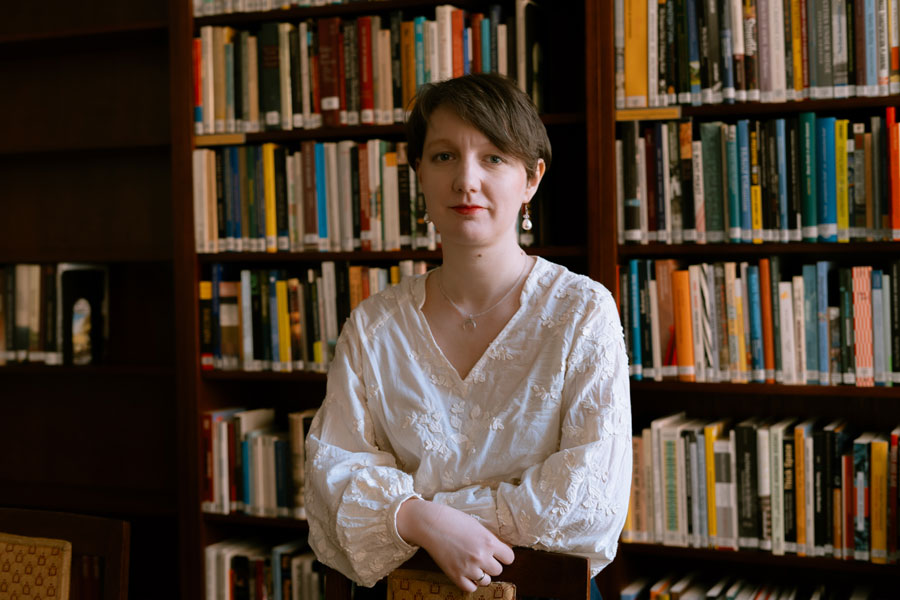
Vladyslava Moskalets is a researcher at the Lviv Center for Urban History, a lecturer at the Department of History of the Ukrainian Catholic University, and coordinator of the Jewish Studies program there. She studies the social history of Galician Jews and the history of urban spaces. She is a guest lecturer at the University of Illinois Chicago.
Originally appeared in Ukrainian @Ukraina Moderna
This article was published as part of a project supported by the Canadian non-profit charitable organization Ukrainian Jewish Encounter.
Translated from the Ukrainian by Vasyl Starko