




Janet Sobel (1893-1968)
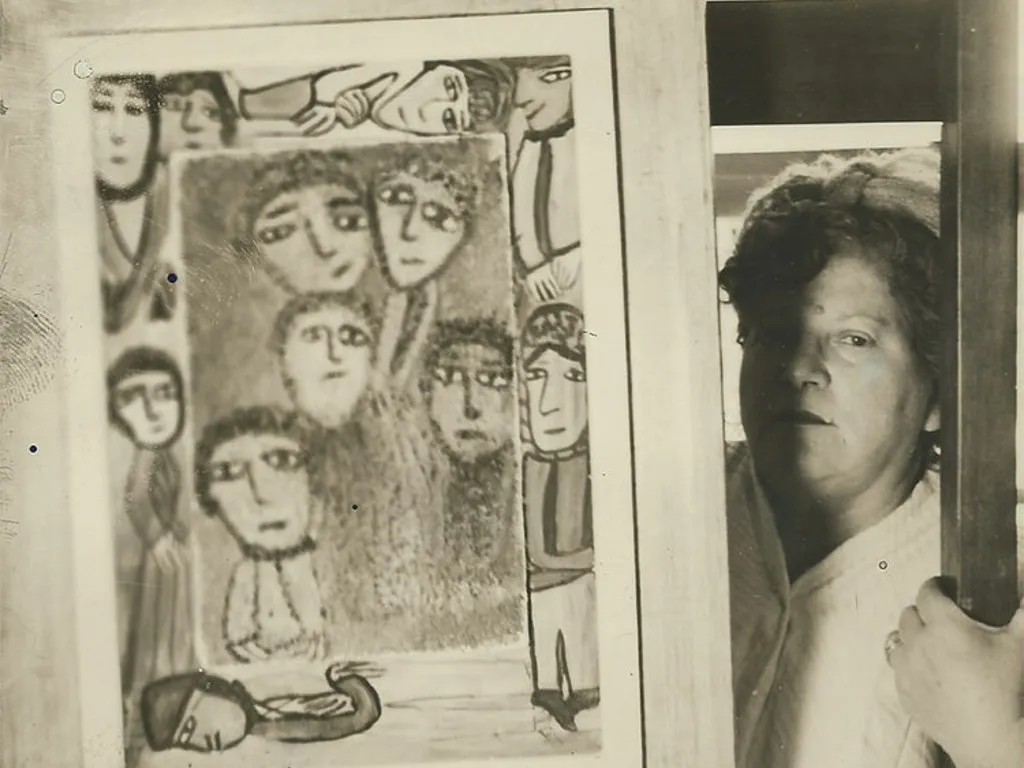
Janet Sobel, née Jennie Olechovsky, was one of the most prominent American artists of the 20th century, who pioneered the dripping technique. She is also considered the "grandmother of American abstract expressionism." She was born in 1893 into a Jewish family near the city of Dnipro. Her father, Baruch, died during an anti-Jewish pogrom. This prompted her mother, Fannie Kinchuk, to leave her homeland in 1908 and flee to the USA with her children, away from potential persecution. The family lived in Brooklyn at that time.
Janet married when she was 16. Her husband was a Ukrainian Jew, Max Sobel (Tsybulsky), who was engaged in the jewelry business. Five children were born in the marriage, so Janet had to shoulder the everyday chores and family affairs. Her talent for painting manifested itself in adulthood. She began painting in 1937 at the age of 44. Before that, she did not attend art school or receive any other art training. Because of this, her style was free from any formalities regarding techniques or materials. Her first attempts are vivid examples of naive art or primitivism, typical of artists without an appropriate art education.
Janet Sobel's works show traces of her childhood experiences, particularly her time in Ukraine: they often feature floral motifs, elements of folk art, and pointers to Jewish life and traditions.
Janet introduced the dripping technique, which was later adopted and actively developed by the famous American artist Jackson Pollock. Janet Sobel used glass pipettes, pouring paints into them and spraying them on the canvas to create thin lines. Her painting Milky Way (1945) is one of the most famous and a vivid example of her experiments with various painting techniques.
In 1944, Janet Sobel's first solo exhibition took place at the Puma Gallery on 57th Street. She was becoming more visible and recognizable in the New York art world. This is when Janet was noticed by Peggy Guggenheim, one of the most famous collectors of the time. Thanks to this acquaintance, her works were included in the 1945 exhibition "Women" at The Art of This Century Gallery. The following year, Janet had a solo exhibition at the same gallery.
Janet's son, Saul, was the promoter of his mother's talent: he studied art, which at one point inspired Janet to try her hand at painting. In her early works, she often depicted floral motifs rooted in Ukrainian folk art.
Janet Sobel's creative development and rise were to some extent interrupted in 1946 when her husband moved the family to New Jersey for his work. This cut Janet off from the active artistic community. For the next twenty years, she lived in oblivion and died in 1968.
In Ukraine, Janet Sobel became known in 2023 when Rodovid published the book Janet Sobel: Wartime in Ukrainian translation. Leading Ukrainian curator and art critic Alisa Lozhkina writes about Janet Sobel in her essay: "In a study of Pollock toward the end of the 1960s, William Rubin, the authoritative art historian and curator who was just beginning a long tenure at the Museum of Modern Art (MoMA), called Janet Sobel's works a source of inspiration for Jackson Pollock's experiments in drip painting. Two of Sobel's works ended up in MoMA's collection, but unfortunately, this is where the unique artist's recognition by the art world ends. In recent decades, experts have gradually been rediscovering Sobel, yet it is only today, more than fifty years after her death, that the time has come for a full-scale reconsideration of her legacy in the context of examining the patriarchal version of the history of American modernism and twentieth-century art in general."