





'Mariupol Drama' in Israel: What comes from the heart, goes to the heart
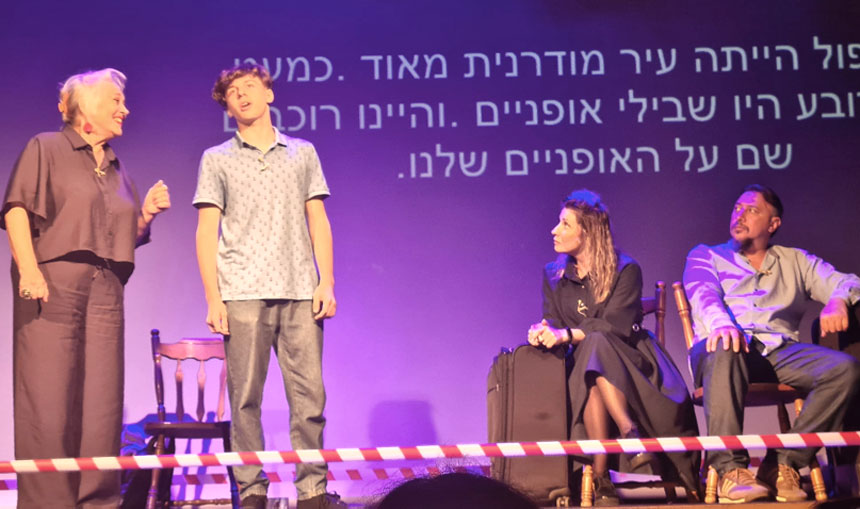
The Israeli tour of the Mariupol Drama Theater actors demonstrates how wartime tragedies unite Ukraine and Israel, fostering mutual empathy for each other's suffering.
The Donetsk Regional Academic Drama Theater left the city of Mariupol, which was captured and destroyed by Russian aggressors, in March 2022. Currently, the troupe continues to perform at the Theater Without a Roof in Uzhhorod.
From 6 to 10 July 2026, Mariupol actors performed Mariupol Drama in five Israeli cities — Rishon le-Zion, Haifa, Ashdod, Ashkelon, and Petah Tikva. The performance was in Ukrainian with Hebrew subtitles.
The play is built on lively dialogues and personal memories of the actors about the first weeks of the full-scale invasion of the Russian Federation. The Mariupol Theater building then turned into an "island of salvation" from shelling for hundreds and thousands of city residents until the tragic end on 16 March 2022, when it was hit by devastating Russian airstrikes.
Even the "CHILDREN" signs, written in huge letters on both sides of the building, did not stop the enemy from carrying out the bloody, barbaric bombing, which is considered one of the most terrible war crimes committed by the Putin regime. According to an Associated Press investigation, the strike could have killed 600 people in the Mariupol Theater.
The play begins with a video address by Ukrainian President Volodymyr Zelensky about hundreds of people dying in the Mariupol theater hit by Russian bombs.

Mariupol Drama is a theater project created by the surviving actors of the bombed Mariupol Theater. It is a powerful testimony to the tragic events that occurred in Ukraine in February-March 2022.
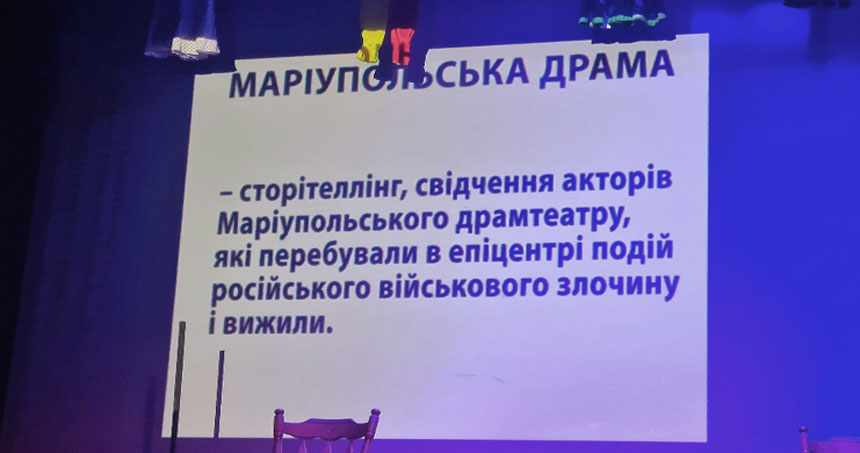
Eyewitnesses to the events appear on stage — Mariupol actors who play not fictional characters, but themselves. They were in the theater building during the blockade and, together with the audience, experienced all the horrors of the besieged city.
The production uses the actors' personal belongings, which they managed to retrieve from their shelter, as well as videos and photos taken during the blockade of Mariupol.
The play was written by Ukrainian writer and playwright Oleksandr Havrosh based on a collection of testimonies. It has been staged in the Mariupol Theater by director Yevhen Tyshchuk, who, through the prism of theatrical art, tells the world the truth about Russia's war crimes and preserves the memory of the Ukrainian victims in Mariupol. The artistic director of the Mariupol theater is Hennadii Dybovsky.
The theatrical performance looks like a living historical document in the style of a docudrama and has been successfully shown in Poland, Germany, and the UK. In Israel, the play sold out every time, demonstrating that a high-quality Ukrainian-language artistic product can be not only an emotional but also a commercial success, even at a fairly steep ticket price of 60–80 dollars.
On tour in Israel, actors Vira Lebedinska, Olena Bila, Ihor Kytrysh, and Matvii Kytrysh looked very natural on stage. Their stories about the tragedies experienced in Mariupol were absolutely sincere, coming from the depths of their hearts and deeply touching the Israeli audience.
When sirens and explosions sounded on stage, people remembered the air raid sirens and blasts in the spring of 2026, when Iran fired missiles at Israeli cities. The Mariupol war drama resonated with everyone in the audience.
When the actors talked about the first days of the ruscist invasion — "the decision to leave had to be made quickly without any regrets about the furniture pieces we were leaving behind," — I remembered the story of my family's older generation about how they fled from the city when Nazi troops approached. At that time, my grandmother was wondering whether to stay or leave. How could she leave a new leather sofa behind? She eventually decided to throw away all her belongings and put her family on the last train, thanks to which my ancestors did not die in the Holocaust. Thus, my Jewish family's memory of the Holocaust helped me better relate to similar moments in the Ukrainian tragedy of Mariupol.
The audience actively sympathized: when the actors announced from the stage that the Mariupol Theater had gone dark after the electricity was cut off, hundreds of Israelis lit the flashlights on their phones.

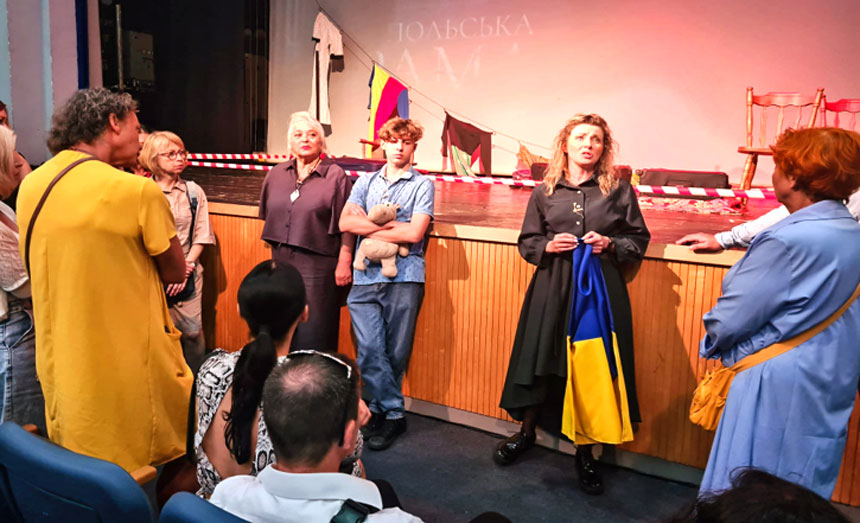
The performance ended with a standing ovation from the audience, accompanied by shouts of "Glory to Ukraine!" The Ukrainian actors then came down from the stage to interact with the Israeli audience face-to-face.
I would like to note that the success of the tour of the Ukrainian play Mariupol Drama in Israel was so great that the Russian embassy made another false statement. Wanting to cover up the crimes of the Putin regime, Russian diplomats wrote that “on 16 March 2022, the building of the Mariupol Drama Theater was almost completely destroyed as a result of an explosion carried out by Ukrainian terrorists from the ‘Azov’ formation.”
The hysterical and false reaction of the Russian embassy showed that Mariupol Drama has become not only an artistic event in Israel. The theatrical performance has turned into a pro-Ukrainian act of solidarity of Israelis with Ukraine
The final scene of the play (video):
Text, photos, and video: Shimon Briman (Israel).
Translated from the Ukrainian by Vasyl Starko.