




Study: Ukrainians are more willing to accept Jews than Poles, Americans, or Canadians
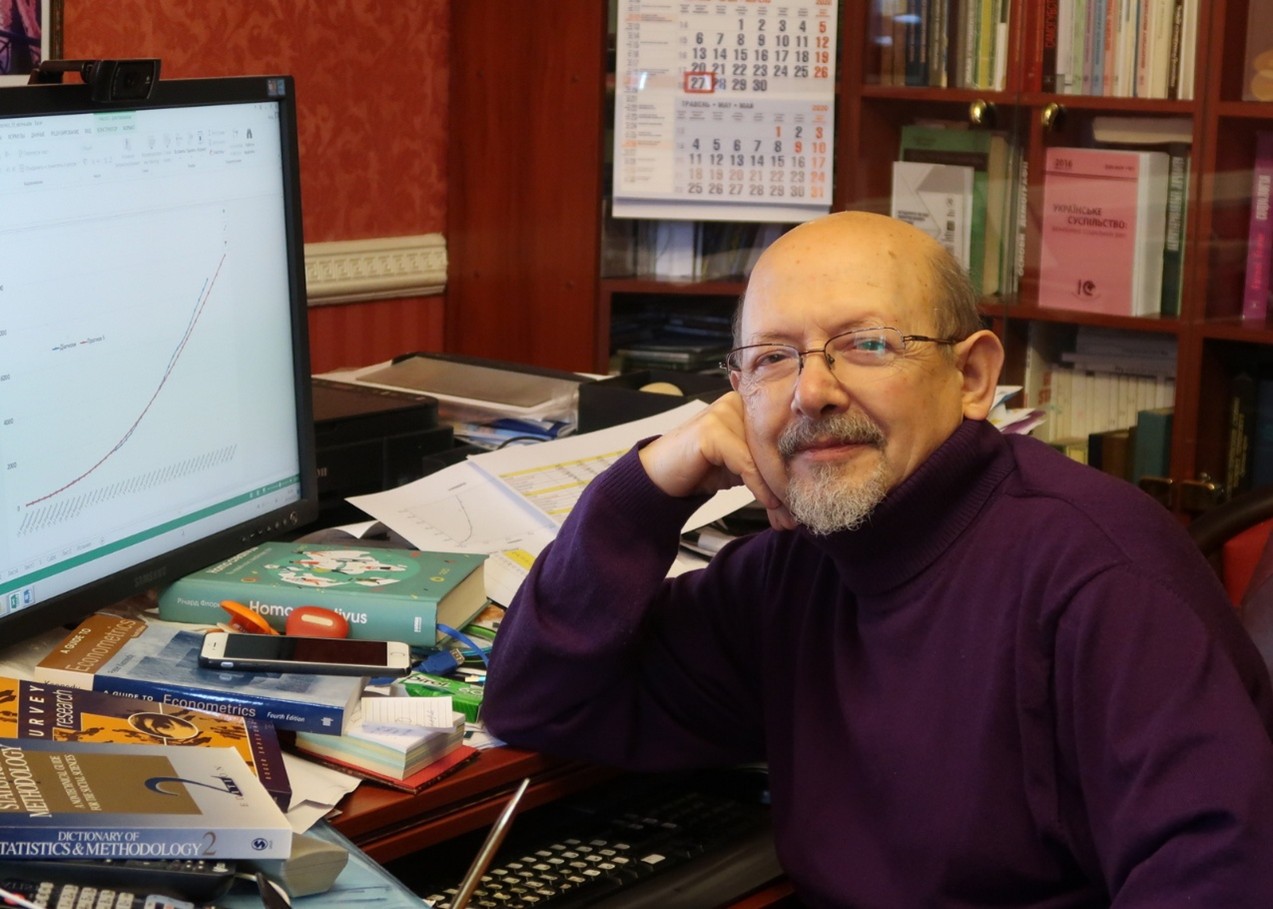
In April 2026, Dr. Volodymyr Paniotto published the results of an interesting opinion survey conducted by the Kyiv International Institute of Sociology (KIIS), which he heads. At the end of 2025, KIIS explored attitudes toward ethnic groups using the Bogardus social distance scale via telephone interviews with a random sample of 1,008 respondents across all regions of Ukraine (government-controlled territory).
The questions were structured according to the following scheme: "Say whether you agree to admit representatives of this ethnic group:
- As members of your family — 1
- As close friends — 2
- As neighbors — 3
- As work colleagues — 4
- As residents of Ukraine — 5
- As guests of Ukraine — 6
- You would not let them into Ukraine — 7."
Thus, the closer to the number 7, the greater the distance and rejection of a particular ethnic group. The lower the number, the better the attitude toward this ethnic group, and the greater the willingness to accept its members in one's close circle.
The survey results showed that the lowest social distance in Ukraine and, thus, the greatest degree of "acceptance and sympathy" exists, of course, toward Ukrainian-speaking Ukrainians and toward Russian-speaking Ukrainians.
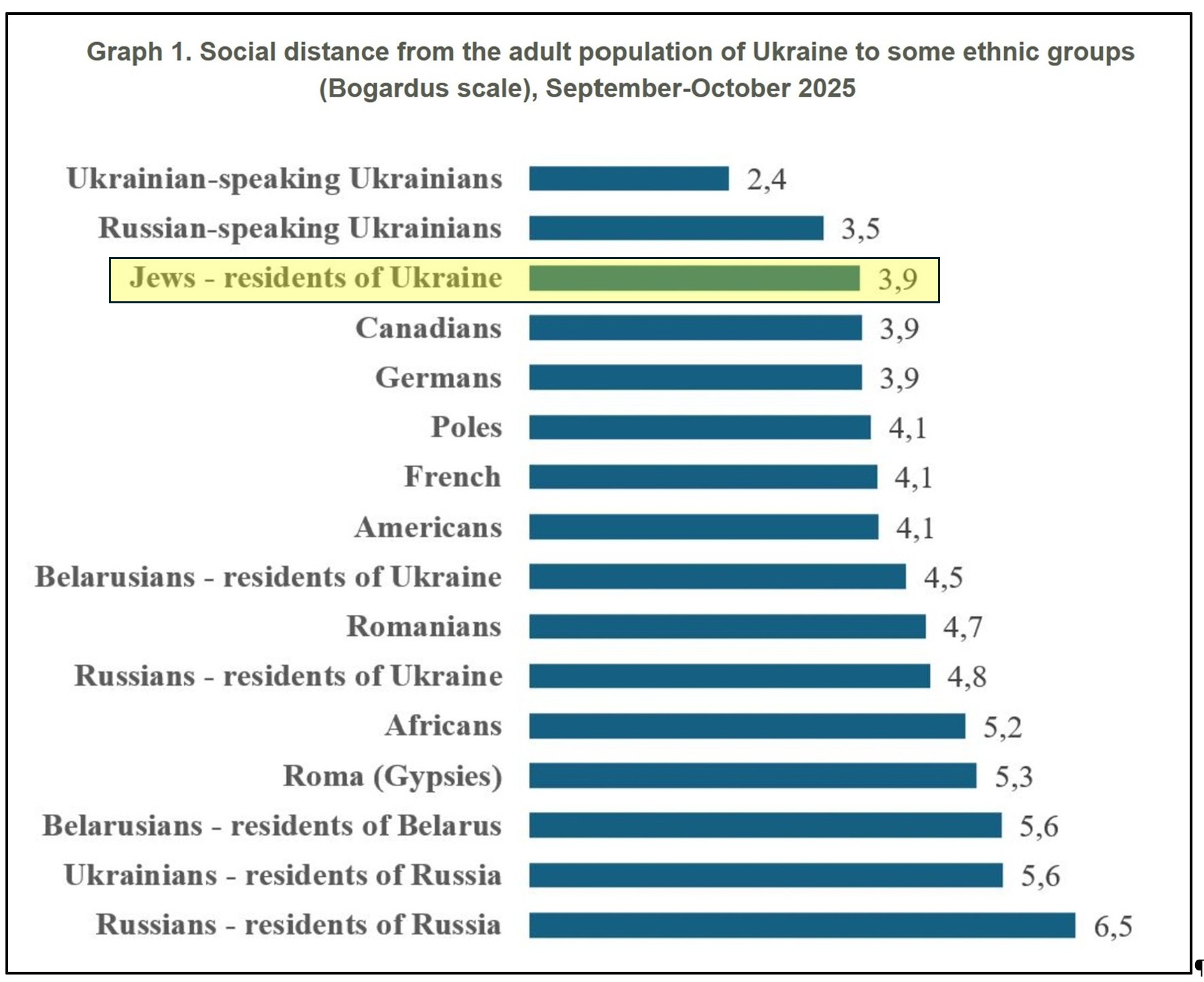
Remarkably, Jews resident in Ukraine came in third! Moreover, this happened for the first time in the more than 30-year history of opinion surveys in Ukraine. The distance to Jews (i.e., the degree of their acceptance as one's own and the willingness to include them in one's closest "family-friends-work" environment) was even smaller than the distance to Americans. Next on the scale are Canadians and Germans.
The greatest social distance, which speaks of repulsion and rejection, persists after four years of war in relation to Russians resident in Russia, as well as Belarusians living in Belarus, and Ukrainians residing in Russia.
Here are some exact figures:
- Jews resident in Ukraine: 3.9 in 2025 (up by 0.1 compared to 2022)
- Poles: 4.1 (a strong and noticeable increase by 1.1 compared to 2022)
- Americans: 4.1 (up by 0.4 compared to 2022).
The Kyiv International Institute of Sociology also provides data on social distance indices toward Jews for previous decades. These figures point to two trends:
- According to the 1994 and 2013 surveys, attitudes toward Jews have always had "good" indices, indicating a high degree of their acceptance in Ukrainian society.
- This positive attitude improved even more from 2013 to 2025, with the social distance index dropping from 4.24 in 2013 to 3.92 in 2025.
Thus, the Jews of Ukraine moved from sixth to third place among other ethnic groups in terms of their acceptance in Ukrainian society.
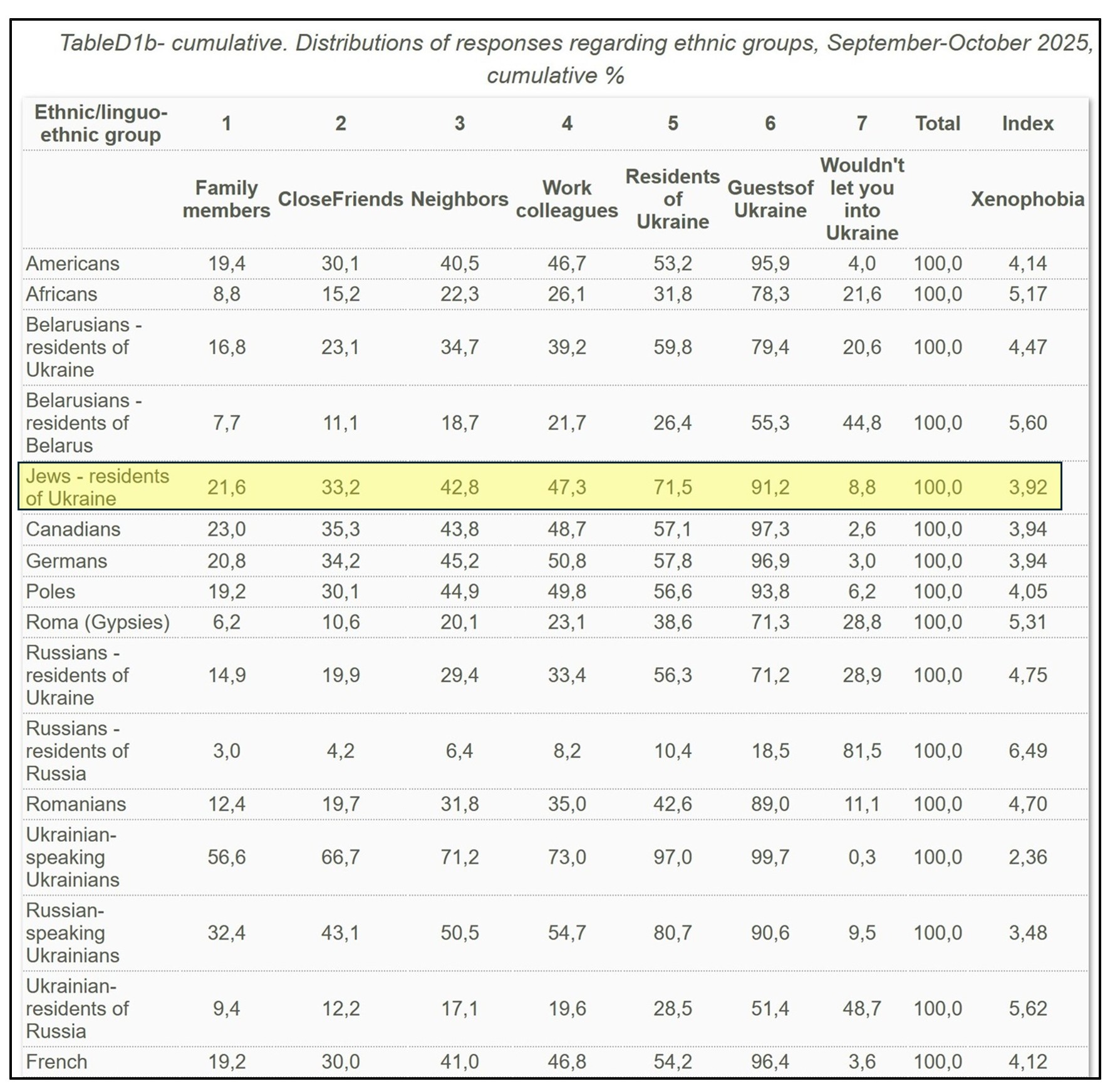
Commenting on the survey's outcomes, Dr. Paniotto noted that "the level of xenophobia in Ukraine is not high, but not very low either" and placed it mid-way between openness and national isolation. According to the latest survey, the xenophobia index in Ukraine (average social distance on the Bogardus scale) is 4.29, while the "Jewish indicator" of 3.92 is noticeably lower than that. This once again indicates that the attitude toward Jews in Ukraine and the degree of their "acceptance" by Ukrainian society at the individual level is palpably better than toward other ethnic groups.
The full results of the KIIS study are available at:
https://kiis.com.ua/?lang=eng&cat=reports&id=1603&page=1
Following up on this report, I invited Dr. Paniotto, who is also a professor at Kyiv-Mohyla Academy, to answer some questions.
Shimon Briman: According to the survey data and based on your previous surveys in 1994–2025, within Ukrainian society, Jews living in Ukraine rose to third place among ethnic groups in terms of their acceptance. Can it be said that the Ukrainian society has experienced a positive shift in its acceptance of Jews over the past 30+ years?
Volodymyr Paniotto: Yes, a positive long-term shift has occurred. Actually, in the early 1990s, the social distance toward Jews was also low, but then it increased due to growing poverty coupled with increasing xenophobia toward other ethnic groups.
Moreover, the externally funded Interregional Academy of Personnel Management (MAUP) operated from 2000 to 2006, producing and distributing a large volume of antisemitic materials. After its operation ended, the situation improved.
On the Bogardus social distance scale, lower values indicate a shorter distance and a better attitude. In particular, a decrease from 4.24 in 2013 to 3.92 in 2025 indicates greater proximity. Furthermore, by moving from the 5th to the 3rd place, Jews improved their relative standing among other groups. In general, values below 4 points usually mean a fairly favorable perception of the group as "one's own."
Shimon Briman: Do these figures indicate that antisemitism as a rejection of Jews and a negative attitude toward Jews does not have "mass success" within Ukrainian society?
Volodymyr Paniotto: Yes, these data suggest that antisemitism is not a mass phenomenon. An index value of about 3.9 and a top-three placement mean that Jews are among the most acceptable groups.
Groups experiencing a pronounced negative attitude usually have significantly higher distance values (4.5–6 and higher). So, there is no mass rejection of Jews. This is further corroborated by the results of systematic monitoring carried out by Jewish organizations for many years: the level of antisemitic incidents in Ukraine is relatively low. We are talking about dozens of cases per year, while physical violence occurs extremely rarely or is absent altogether. To compare, more than 1,500 such incidents are recorded annually in France, a significant part of which include attacks on people, while in Germany, their number reaches several thousand per year, with a sharp increase in recent times.
Crucially, even if there are certain prejudices in Ukraine, they rarely turn into violent actions, while a higher level of aggressive manifestations is observed in many Western European countries.
Shimon Briman: Can we assume that such a high level of acceptance of Jews "as one's own and close ones" played a role, among other things, in Ukrainians' support for a Jewish presidential candidate in 2019, with Zelensky's Jewish background not being a repulsive factor for the mass of voters?
Volodymyr Paniotto: Yes, this connection seems reasonable. Volodymyr Zelensky's victory in 2019, with about 73 percent of the vote in the second round, shows that his ethnic background was not a barrier.
However, the situation seems more complicated, with the so-called "LaPiere paradox" manifesting itself. This is where real behavior does not correspond to stereotypical statements. In 2018, we conducted an opinion poll in Ukraine, asking a question similar to the one used in long-standing Gallup surveys: "If a party you trust nominated a definitely well-qualified female/Jewish/Black politician for president, would you vote for this candidate?" In Ukraine, only 36 percent said that they would vote for a Jew, while 73 percent supported Zelensky in the real elections. Ukrainians may continue to rely on some stereotypes when answering direct questions about Jews without always realizing that Jews are now one of the closest groups to them in reality. It tallies with the data on social distance: at about 3.9, the group is perceived as "one's own," and ethnic background has practically no effect on electoral choice.
Shimon Briman: In 2022–2023, at the initial stage of the war, Russian propaganda tried to use the incitement of antisemitism to destabilize Ukraine from within. At the time, Moscow emphasized the Jewish background of the Ukrainian president and broadcast the message "Ukrainian Cossacks will not obey a Jew." This propaganda campaign failed. Was this failure partly or mainly caused by the fact that emphasizing a Jewish background does not discredit a person in Ukrainian society?
Volodymyr Paniotto: Yes, in many ways it was. At a social distance level of about 3.9, a Jewish background is not perceived as a negative characteristic. Therefore, such messages fail to evoke the intended response. Moreover, in conditions of war, society consolidates around civic identity rather than ethnic differences, further reducing the effectiveness of such attempts.
Shimon Briman: Does this positive standing of Ukraine's Jewish residents depend on sympathy or the Ukrainians' positive attitude toward Israel? I remember the results of a KIIS survey in December 2023, according to which 69 percent of Ukrainians supported Israel in its war against Hamas in Gaza. So, is the good attitude of Ukrainians toward Israel, as it fights against the axis of evil, a factor in their perception of Jews within Ukraine?
Volodymyr Paniotto: There is no doubt about that. After Russia seized the Crimea and unleashed the war in the Donbas in 2014, Israel was increasingly mentioned in the media as an example to follow as a state that, while outnumbered, successfully resisted an adversary. After 2022, Israel became a country fighting against Iran, Russia's loyal ally. Every night, the Russians attack Ukraine using Shahed drones made in Iran or produced using Iranian technology. However, this factor probably plays an additional role, since the low social distance existed even before the war against Russia. The key factors are still internal, such as a long-term decrease in social distance, increasing tolerance, and stronger civic identity.
Text: Shimon Briman (Israel).
Photo: Private archive of Dr. Paniotto.
Translated from the Ukrainian by Vasyl Starko.