




"The Ukrainian-Jewish Encounter: Cultural Dimensions": Part 2.3
The Ukrainian Jewish Encounter was founded in 2008 with the goal of building stronger relations between Ukrainians and Jews, two peoples who, for centuries, lived side by side on the territory of what is modern-day Ukraine. Since then, in keeping with its motto, "Our stories are incomplete without each other," UJE has sponsored conferences, round-table discussions and research, as well as translations and publication of works the organization anticipates will promote a deeper understanding between the two peoples and an appreciation of their respective cultures.
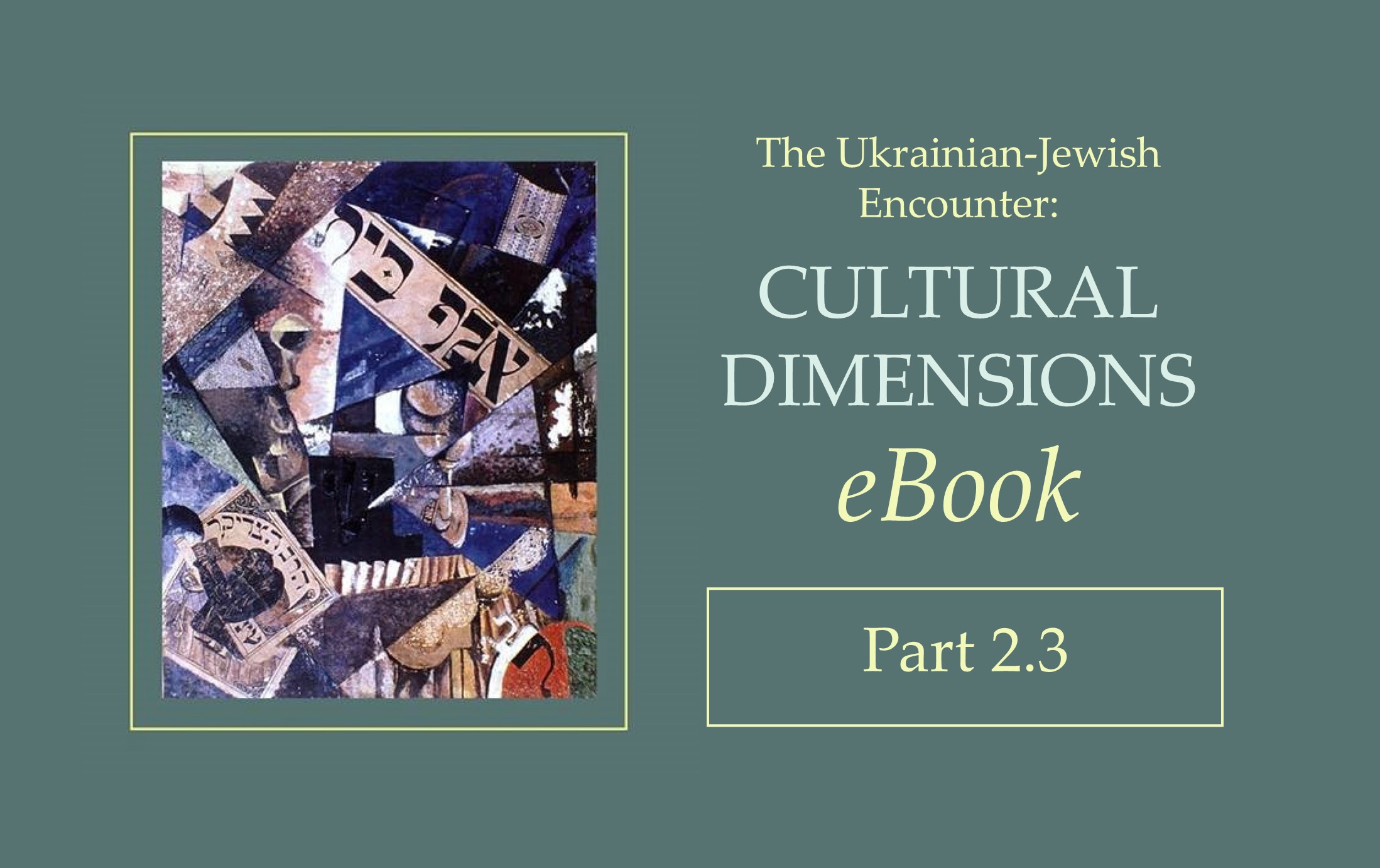
We offer for the first time the book The Ukrainian-Jewish Encounter: Cultural Dimensions in an eBook format.
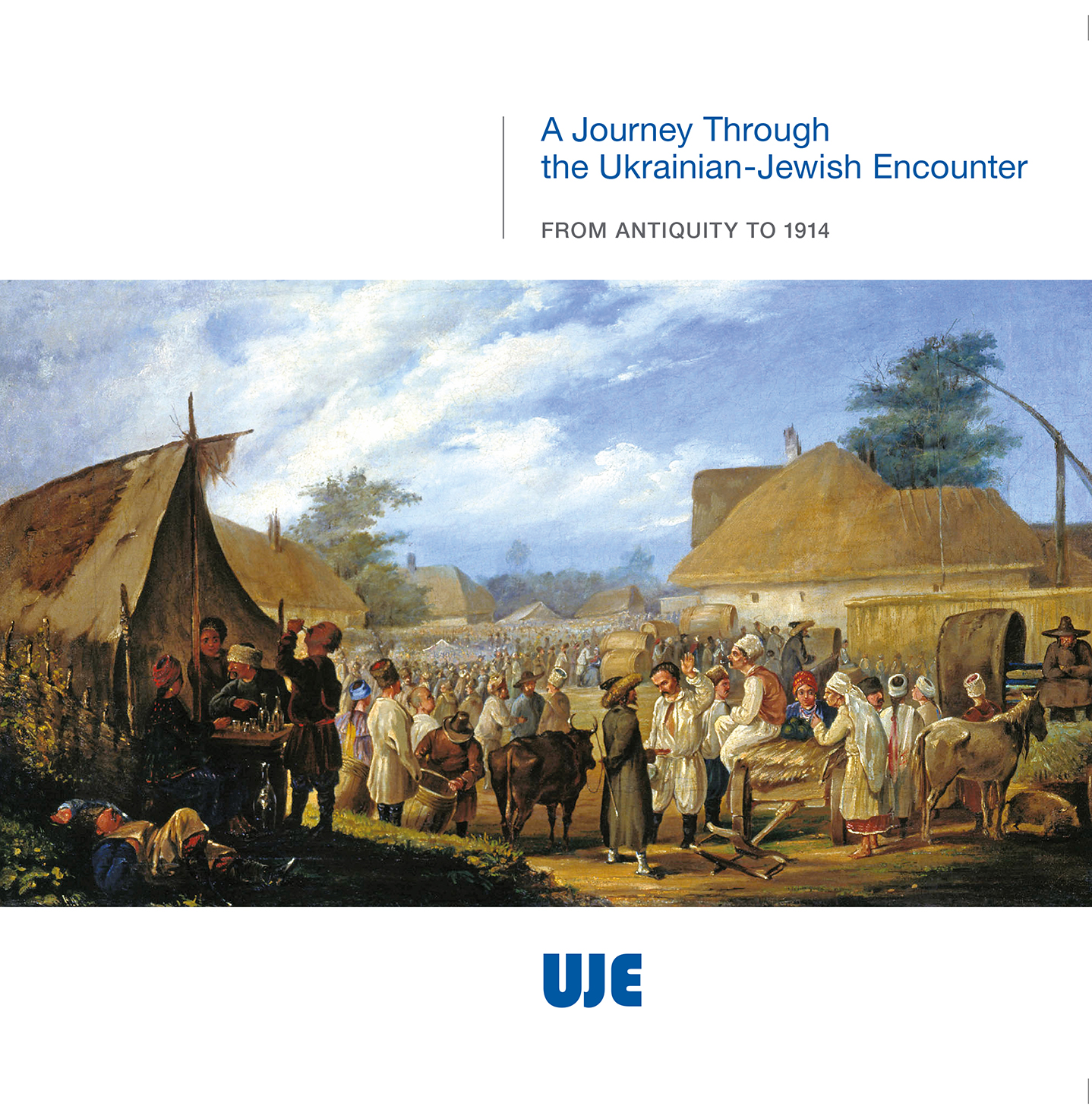
The book is a collection of essays that examine the interaction between the Ukrainian and Jewish cultures from the seventeenth century onwards. Written by leading experts from Ukraine, Israel, and other countries, the book presents a broad perspective on parallels and cross-cultural influences in various domains — including the visual arts, folklore, music, literature, and language. Several essays also focus on mutual representation — for example, perceptions of the "Other" as expressed in literary works or art history.
The richly illustrated volume contains a wealth of new information on these little-explored topics. The book appears as volume 25 in the series Jews and Slavs, published by the Hebrew University of Jerusalem since 1993. In several previous volumes, considerable attention is given to the defining role of the Old Testament in Ukrainian literature and art and to the depiction of Jewish life in Ukraine in the works of Nikolai Gogol, Taras Shevchenko, Ivan Franko, Lesia Ukrainka, Vladimir Korolenko, and other writers.
This collection of essays was co-edited by Wolf Moskovich, Professor Emeritus, Hebrew University of Jerusalem, and Alti Rodal, Co-Director of the Ukrainian Jewish Encounter, who also wrote the introduction to the volume. It was published in 2016 by Hebrew University of Jerusalem.
Part 2.3
Click here for a pdf of the entire book.
Oleksandr Dovzhenko and Jewish Mythology
Serhii Trymbach (President, Filmmakers' Union of Ukraine, Kyiv)
In the films and texts of Oleksandr (Alexander) Dovzhenko one can find numerous fragments that relate to Jewish mythology. In this regard, he continued a particular trend in Ukrainian tradition — that of Taras Shevchenko, Ivan Franko, Lesia Ukrainka, and many other authors. According to some memoir writers, Dovzhenko was also planning to make a film on a specifically Jewish theme.
Dovzhenko's interest in Jewish themes is manifest first of all in the clear allusions made to ancient Jewish history as presented within the mythology of the Jewish religious tradition. The myth, in this context, is seen as a means of comprehending the beginning, the sources of ethnic history. A striking example among Ukrainian authors is the association of the non-state status of Ukrainians and their submission to the Russian Empire with the story of the Jewish exodus from Egypt as described in the Second Book of Moses. These Ukrainian authors perceived Moses as an ideal guide to freedom and a role model to be followed. Another myth — the giving of the land by Jehovah to the Jewish people — also resonated with how Ukrainians viewed their own history. As the mythology of the Land is of great significance for Ukrainians, it is no wonder that the most celebrated film made in Ukraine — Dovzhenko's Zemlia (Earth) — was based on this theme. The land is granted by God and at the same time occupied by foreigners (according to Taras Shevchenko, by the Russians, Germans, or Jews). We live "not in our own land" and need to fight to reclaim it. Also regarded as relevant, though less popular, was the idea of Ukrainians being a people chosen by God. Themes relating to the Temple in Jerusalem, however, are to be found in many Ukrainian texts, including those by Dovzhenko.
In general, one must remember that in his early works Dovzhenko belonged to the artistic avant-garde, which had its own peculiar relations with mythology, including from the Jewish tradition. As the Ukrainian master worked in the context of the contemporary ideological and political life of Europe, it is no wonder that his works bear similarities with the cultural phenomena of other countries with respect to the use of ancient Jewish themes. Moreover, Dovzhenko personally had a good grasp of biblical stories and ideas, and often used them in communicating with other people even in his private life. For example, he would draw from eschatological mythologies, as seen in the following instance. After the Second World War was over, Dovzhenko had, for various reasons, a sense of impending death — his own and that of the entire nation, even of civilization as a whole. In his diary, he mentions a conversation he had back in 1930 with the then people's commissar for education Mykola Skrypnyk:
While looking into my eyes with his heavy man-hating eyes, he said: 'As far as your working plans are concerned, I will tell you right from the Holy Scripture: Lord, I have tasted a little bit of honey and here, I'm dying.' Why am I remembering these words today? I have no idea. I spent the whole day thinking of the nuclear bomb. It seemed to me today that our whole world will die and with it all of the evil. [1]
There are many similar examples in Dovzhenko's texts. The speed and the burning pressure for radical changes in the social order, which he perceived as changes in the very foundations of civilisation, caused great personal anxiety for the author, despite the ideological support that came from the sense of solidarity in difficult times and that everybody was striving forward together. The angst was especially strong during the war and found expression in many diary entries and in the 1943 documentary war film Ukraina v ohni (Ukraine in Flames), which contained numerous eschatological ideas and allusions. A foremost theme was the tragedy of the Ukrainian people just before the war in the Great Famine, and then during the war, as they found themselves "between the rock and the hard place" of two totalitarian systems prepared to ruin them both physically and spiritually.
One should also take into consideration the role and use of the mythologies of messianism in the aspirations of the avant-garde. [2] Dovzhenko frequently considered himself a national messiah, a national prophet (even asking that he be buried as a prophet — in Kyiv, by the high bank of Ukraine's main river). A number of his central characters are also messiahs. This cultural-ideological code was inherited by the avant-garde cinema of a later period as well. For example, the 1970 film Komisary (Commissars), directed by Mykola Mashchenko, was based on references to the world of the early Christians whose faith was mightily tested. Their tests are so catastrophic that they can be saved only by a fanatical and deadly faith, as paradoxical as this may sound. Another example is recapturing the "historical zero" — the mythological moment that sparked the beginning of the revolutionary
events — in Mashchenko's film. This relates to one of the first incidents of the 1905 October Revolution, which took place on the cruiser Aurora.
The idea of going back to one's sources, to the beginning of time, to purifying the foundations of civilisation, is in line with a pattern followed by many avant-garde artists. A resource commonly used in such purification was Christian-Jewish mythology, supplemented by more recent mythologies. An example is Dovzhenko's film Zvenyhora (1928), which was based on polemics about the idea that Ukraine would be reborn only when the treasured primordial code of Ukrainianness is unearthed. As reflected in Dovzhenko's film Arsenal (1929), this idea invites opposition from the new Bolshevik messiah, who pursues the idea of a dynamic country of tomorrow.
In the film Earth (1930), propaganda about the advantages of the collective economy turns into a screen myth of fighting for the land, allegedly granted by the Bolshevik "god" to the poor. A saving sacrificial gesture is needed to win in this fight. The main character Vasyl goes to the city and returns on a tractor. The entire village comes out to greet him. One can see a certain parallel with the entry of Jesus Christ into Jerusalem on a donkey. Jesus found a donkey, sat on it, and made a festive entry into the city. Delighted people went out to meet him with palm branches and leaves, put their clothes on the road before him, and shouted with joy, glorifying him, and crying for salvation.
While it is unlikely that there is any conscious thought in such parallelism, it is noteworthy that this Gospel story continues an ancient cultural tradition described by a number of researchers. [3] Christ's entry into a city recreates an element of the ancient Jewish festival of Tabernacles — the festival of fertility and harvest, involving an ancient female god or mother-earth: "First, this god of the land was seen as a god of a locality since the land where the farming community resided was also considered to be god." [4] The image of the land or the earth corresponds to a woman giving birth. This goddess of fertility, mother-earth, has a husband, god of heaven, who impregnates her with light and moisture.
Concerning the festive entry per se, one should remember that both the city and the land were generally perceived as feminine. The entry of the god to the city or village, in this particular way of thinking, therefore may be identified with a sexual act. By entering a city the god was conquering it, impregnating it/her. Thus, the gates must have been considered akin to a woman's fertility organ.
The images of a charming village landscape are thus violated by the severe historical reality in the form of a tractor and its driver, Vasyl Trubenko (Semen Svashenko). Vasyl belongs to a respected farming dynasty, used to living in harmony with nature and its laws. The farming, earth myth is dominant here. Everything is subject to the movement of the sun and the changes of the seasons: sowing of seeds, growing of seeds, harvesting when the seeds bring forth fruit, processing the produce so that there are provisions for the winter, and the beginning of a new work cycle with the spring sun. The charmed cycle is continually repeated and nobody seems to be able to break free from it. However, the new man, Vasyl, and his allies in the community "cell" are presented as heroes as they dare to break free from that cycle — to free themselves from slavery to nature and thus bring paradise to earth. It would be paradise because men would be empowered to establish their own laws of being in it. And rivers of milk would flow, and the deepest dreams of humankind would come true.
In many respects, the Slavic pagan cosmogony is not only replenished but also contradicted by elements of the Christian-Jewish mythology and new features coming from the Bolshevik ideology. Despite the dissonance created by bringing them together, they paint a grand mythological picture of a national revival.
Let us remind ourselves once more that in the 1920s the idea of a renaissance looked very real, so much so that it was fixed in a very specific imaginary construct. One of the most read books of that decade — The Decline of the West by the German author Oswald Spengler (published in Moscow in 1922) — spoke about the "decline" to be followed by the "sunrise." It spoke of natural cycles: the sun rises and sets, and in the morning it rises again. It goes down in the west, it comes up in the east — that is how it should be. Therefore, it is from the East that one should expect renewal. Spengler expected the renewal of culture from the East as well. According to him, western European culture had declined and lost its energy. In the East however, especially in the territory of the former Russian Empire, the energy was still strong. The writer Mykola Khvylovy, a leader of the Ukrainian intellectuals of the 1920s and early 1930s, considered this thesis to be the final truth and presented it as a historic mission for Ukraine. Khvylovy proclaimed in a number of his manifestos that the "Asian Renaissance" meant that Ukrainians must begin to recognize that they are creating not just their personal future but also the future of the entire continent.
Zvenyhora, Arsenal, and Earth include an episode on the entry of a saviour who was called upon to bring happiness to that particular land. In the language of a farming myth (which is frequently used by Dovzhenko), the saviour refers to the giver of life, of new births. The hero's entry in Earth symbolizes the wedding with the virgin land, which requires a saving copulation. As expressed in the imagery of a plough cutting into the land, the mission is accomplished! And then the entire farming cycle is portrayed, up to the harvest and bread baking. Lovers' games also come into play: for example, in the famous episode when the loving couples stand still in the moonlight, and the men's hands get lost in the girls' bosoms — a secretive gesture that brings closer the solemn moment when the still virgin gates will open up.
Another indicative scene is Vasyl's dance, full of the anticipation of happiness, in the dawn. The sun would rise soon. The episode breathes the metaphorical themes of birth and renewal. For a scene of such significance to take place (again, in terms of the farming myth), a redeeming sacrifice of the saviour is required before the rebirth. This is played out in the evil act of the shooting by the kulak Khoma from behind the wall, and the synchronization of the death and the funeral with the delivery of new life, as Vasyl's mother gives birth to another son — referring clearly to the hero's resurrection. The mother's womb opens and he goes through the heavenly gates into eternity, into the new circle of life. At the end, Vasyl's bride recognizes his immortal essence in the smile of another young man. Heaven and earth rejoice in the wedding, and the mother's womb embraces the life-giving moisture that washes the beautiful fruit of universal love. And the sun, which for the first time appears in the film, is reflected in every drop of rain, shining with the suggestions of heavenly joys of a life given. The land is saved, humankind is revived — and there is no end to this eternal magic.
Dovzhenko was a true avant-garde artist. He believed that actual historical time belonged to the "zero point" from which new time/space comes, giving birth to new social relations and a new man who will not bear the birthmarks of previous civilizations. Meanwhile, his cultural and ideological surroundings pushed his creative intuition towards an apocalyptic worldview. This came about as a result of the experience of the nation to which he belonged and the fact that the mythological tools he used were mostly Christian-Jewish in origin. The events of the 1930s, then the war, the creation of nuclear arms, and his personal tragedy (when he was prevented from participating in the civil and political life of the country after working on the film Ukraine in Flames), all contributed to the mythological elements that shaped the worldview of this outstanding personality.
A later example of Dovzhenko's preoccupation with mythological themes may be seen in his drafts for the script for Zahybel bohiv (The Death of Gods). The first draft was written in 1947, the last one on 1 October 1954, after the death of Stalin. Unfortunately, these remained just sketches. A few decades later, the young director Andrii Donchyk would film these sketches, enabling viewers to see Dovzhenko's heroes on the screen. The storyline consists of an icon painter (Yaroslav Havryliuk) who comes to the village to paint the church. In painting the saints, he uses as models the figures of ordinary peasants. The village chief (Hennadii Harbuk) regards this as blasphemy. Dovzhenko put all his contempt for bureaucrats into this character, who is presented as controlling and extremely deficient in human qualities — "most thorough and careful, nothing could stop him, and unable to survive a day without being in control."
An interesting episode in these sketches illustrates Dovzhenko's outlook and approach regarding the impact that mythologies can have. The men whose portraits were painted on the church walls refused to pray to one another's images. This led the church hierarch to order that all the saints be painted over: "and when all the saints became strangers, looking like nobody else, everything calmed down." One old man, however, who was painted as the God of Sabaoth, disagreed with this order because he recognized himself in God's likeness. In a related section, the script reads: "They were not believers. But what they created made them kneel and for the first time in their lives they thought deeply because they saw the human and the national in such unity with the Gospel landscape, the sun, gold, and the blue sky….'No, I'm not God', one of them says, 'I'm only God's nature'. The impact of the experience, according to the script, is that people who saw themselves on the church walls began to change their inner and outer appearances. This is the ideal of an artist's work — that the art produced has the power of religious influence, that it can replace religion, raising humankind to the peaks of the spirit and holiness. [5] But in life it is seldom possible to have such an impact and attain such results. And then the very life of the artist seems destroyed, as evil prevails.
[1] Dovzhenko, Oleksandr. Diary, 16 October 1945, cited in the journal Iskusstvo kino, no. 9 (1989): 53. Oleksandr Dovzhenko, Diary, 16 October 1945, cited in the journal Iskusstvo kino, no. 9 (1989): 53.
[2] See for example Anna Bila's discussion in The Ukrainian Literary Avant-garde: Search and Styles (in Ukrainian) (Kyiv: Smoloskyp, 2006).
[3] See: Freidenberg, O. "Entry into Jerusalem on a Donkey," in Evangelical Mythology, and O. Freidenberg's book Myth and Literature of Ancient Times (in Russian) (Moscow: Nauka, 1978).
[4] Ibid., 494–95.
[5] Dovzhenko, Oleksandr. Works, 5 vols. (in Ukrainian) (Kyiv: Dnipro, 1967), 5: 498.