




"Babyn Yar: History and Memory" — Chapter 2
The Ukrainian Jewish Encounter was founded in 2008 with the goal of building stronger relations between Ukrainians and Jews, two peoples who, for centuries, lived side by side on the territory of what is modern-day Ukraine. Since then, in keeping with its motto, "Our stories are incomplete without each other," UJE has sponsored conferences, round-table discussions and research, as well as translations and publication of works the organization anticipates will promote a deeper understanding between the two peoples and an appreciation of their respective cultures.
We offer for the first time the book Babyn Yar: History and Memory in eBook format.
A ravine on the outskirts of Kyiv on September 29-30, 1941, was witness to one of the great atrocities of the Holocaust. There, over a two-day period, nearly 34,000 Kyiv Jews were shot to death in one of the first major events that has become known as the “Holocaust by Bullets”.
With deep compassion and understanding, a group of internationally-renowned scholars discuss the treatment of Babyn Yar in culture, music, and the arts from Stalinist times to our own. Beyond the detailed and harrowing accounts of what took place in Kyiv in late September 1941, the essays in this volume realize the importance of preserving Babyn Yar as a symbol of the Holocaust and other tragedies of the twentieth century.
Babyn Yar: History and Memory was edited by Paul Robert Magocsi, Professor Emeritus of history and political science at the University of Toronto, where from 1980 to 2025 he held the professorial Chair of Ukrainian Studies and Vladislav Hrynevych, Leading Scholar at the Kuras Institute for Political and Ethnic Studies, Ukraine.
The book (Ukrainian version) was published in conjunction with a series of events sponsored by UJE to commemorate the 75th anniversary of Babyn Yar. Published in 2016 by Dukh i Litra.
Publication of the English version (2023) was made possible by the generous support of the Ukrainian Jewish Encounter, Toronto, Canada. Distributed by the University of Toronto Press for the Chair of Ukrainian Studies, University of Toronto,
(The editors appreciate the support of the sponsor and acknowledge that the views expressed herein are not necessarily those of the Ukrainian Jewish Encounter.)
Chapter 2
Click here for a pdf of the entire book.
On the eve of Babyn Yar
Igor Shchupak
The roots of World War II and the tragedy of Babyn Yar lay in the preceding decades. Some historians call the period from the beginning of World War I to the end of World War II — 1914 to 1945 — the twentieth century's Thirty Years' War. [1] Ukraine was at the very center of these events, a part of what Timothy Snyder has termed the "bloodlands." On an expanse of territory stretching from central Poland to western Russia, the Nazi and Soviet regimes destroyed millions of people between 1933 and 1945. [2] The majority of Europe's Jews lived in these very "bloodlands"; it was here that both Hitler's and Stalin's imperialistic plans intersected and where the Soviet NKVD and the German SS concentrated their forces. [3]
The roots of Nazi ideology
Nazi Germany, the aggressor country that was responsible for starting World War II, differed little from the other aggressor, the Soviet Union. However, the specific feature of Nazi ideology, concocted on a foundation of radical antisemitism, led to the emergence of one of the greatest crimes in the history of mankind, the Holocaust.
The historical precondition of the birth of Nazism was Germany's defeat in World War I. This defeat was regarded as the failure of the "German idea." The acknowledgement of Germany as the country responsible for starting the war, together with the payment of immense reparations, as required by the Treaty of Versailles, led to changes in the German public's attitude toward its postwar "Weimar" republic and its experiment with democracy. Moreover, antisemitism, which was prevalent among certain strata of the German population, held "international Jewish financiers" [4] and Jewry in general responsible for the war and Germany's defeat.
Revanchism, antisemitism, and xenophobia constituted the ideological foundation of National Socialism. In the formation of the Nazi doctrine, [5] a varied and contradictory spectrum of philosophical, historical, and sociological concepts were utilized, especially the racial theories of Paul de Lagarde, Arthur de Gobineau, Houston Stewart Chamberlain, and Social Darwinism. In 1919, the National Socialist German Workers' party (Nazi party) was founded in Munich, and two years later was headed by Adolf Hitler. The party program, known as the Twenty-Five Points, was adopted in 1920. It called for the unification of all ethnic Germans into a Greater Germany, the abolition of the conditions set by the Versailles peace treaty, the creation of a strong and centralized state, the expansion of German "living space" (Lebensraum), the restriction of the activities of trusts and monopolies, and the creation of a "robust middle class." It also included a whole array of antisemitic clauses and demands. [6]
The two key texts that outlined the ideology of National Socialism were Adolf Hitler's Mein Kampf (1925) and Alfred Rosenberg's The Myth of the Twentieth Century (1929). These works featured pseudohistorical concepts on the special historical mission of the Aryan race mixed with antisemitic slogans, a critique of liberal democracy and communism, and propaganda calling for revenge and external expansion. [7] The ideological currents that existed within the Nazi party until 1934 differed from each other only in regard to the vision of future social reforms and attitudes to great capital.
The components of Nazi ideology were a racial credo and the theory of an expanding Lebensraum. At the heart of Nazi teachings about the biological and spiritual differences among various nationalities lay the "basic principle of the blood," according to which only the Aryan-Nordic race could be the bearer of the finest human qualities. The Nazis put forward the postulate that the purer the blood the greater the qualities it has; hence, the Aryan-Nordic race should not mix with others. [8] Thus, the entire history of humanity was proclaimed as a struggle for the purity of the "master" race, the segregation from it of "other racial" elements, and the consolidation of the Aryans' ruling position in the world. [9]
According to Nazi racial theories, humankind was divided into "superior" and "inferior" races. The Aryan-Nordic race was proclaimed the "master" race; a rung lower was the Mediterranean race; below that was the Slavic race. Jews were not even included in this hierarchy.
A radical and militant antisemitism occupied a distinctive place in Nazi ideology. The dehumanization of Jews turned them into non-persons, literally parasites. The Nazis emphasized that Jews were the direct opposite of Aryans. [10] According to a leading Holocaust scholar Yehuda Bauer, the Nazis viewed Jews not only as a different race but also as an anti-race, the personification of Satan, the defilers of culture, and the mortal enemies of the Aryan peoples. [11] This ideology subsequently became the main justification for Nazi genocidal practices and the Holocaust, one symbol of which was Babyn Yar.
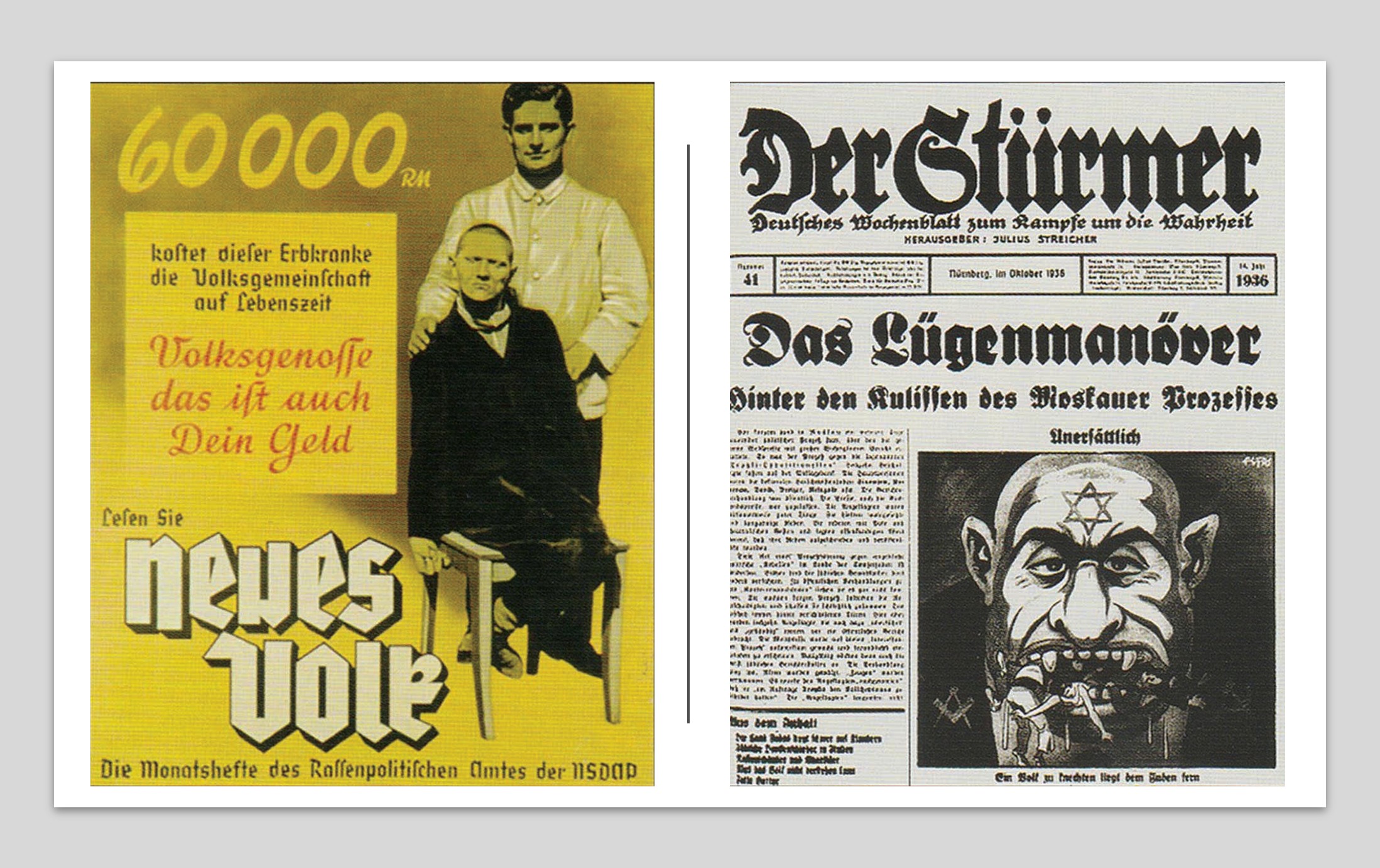
and dehumanization of Jews in the newspaper Der Sturmer (Germany, 1936)
Nazi racial ideology, which emphasized the special characteristics of the German race and the inferiority of other races and peoples, became the justification for Germany's right to Lebensraum. Hitler declared that after World War I the world's territory was divided unfairly and that there was a disproportion among various states with regard to the size of their populations and the amount of land that was capable of feeding them. [12] In the words of Hitler, Germany had been "unjustly deprived," and therefore it had to struggle for the restoration of justice: "The foreign policy of the folkish state must safeguard the existence on this planet of the race embodied in the state, by creating a healthy, viable natural relation between the nation's population and growth on the one hand and the quantity and quality of its soil on the other." [13]
The struggle against the enemies of Germany's Third Reich, who allegedly were united around the "Jew, Our Archenemy," was one of the motives behind the Nazi decision to start World War II. According to Yehuda Bauer: "The anti-Jewish campaign was a decisive component of Nazi eschatology, the cornerstone of their universe, not just one of the parts of their program. The future of mankind depended on their victory over Jewry." [14]
Unlike the Bolsheviks, the Nazis held Jewish conspirators responsible for the world order, not capitalists and imperialists. Nazi views focused in particular on Jewish control of both capitalism and communism; hence, control over the United States, Great Britain, and the Soviet Union. For Hitler and his fellow thinkers, Communism was a Jewish "fairy tale" about unachievable equality, which was invented in order to place naive Europeans in the Jewish yoke. Thus, the response to "ruthless Jewish capitalism and communism" could only be National Socialism, signifying the "restoration of justice for the German at others' cost." [15]
In addition to its historical and racial foundations, radical antisemitism was based on a religious and popular antisemitism that was reinforced by ideas about "Jewish Masons and revolutionaries" as enemies of the German people and the "culprits" responsible for Germany's defeat in World War I. All this was further nourished by myths about the Zhydokomuna, the alleged Communist-Jewish conspiracy in the Soviet Union.
The Nazi rise to power
Nazism became the state ideology in Germany when the Nazis came to power in 1933. This was facilitated by the revanchist mood in the country after its defeat in World War I and the humiliating conditions imposed on it by the Treaty of Versailles. The social vulnerability of the majority of the population living under conditions of a profound socioeconomic crisis and the government's inability to overcome these problems only increased tensions among German populace. The effective use of propaganda as well as the acute struggle between the Nazis' opponents, the communists and social democrats, played an important role in the Nazi rise to power.
On 30 January 1933, Germany's President Paul von Hindenburg issued a decree appointing Adolf Hitler as chancellor and head of the government. This move foreshadowed Germany's transformation into a totalitarian state. Events unfolded quickly during the first three weeks of February: The German parliament Reichstag was dissolved and new elections were called; the president issued the "Ordinance for the Protection of the German People," banning any publications that might pose a threat to public order; police gained the right to use firearms against the political opposition; and the Auxiliary Police (Hilfspolizei, or Hipo) was created. The culmination came on 27 February, when the Reichstag building burned down, providing the government with a convenient pretext for arresting communists and banning the communist press.
Elections took place under conditions of terror on 5 March, in which the Nazi party won a plurality of the vote (43.9 percent). Having failed to win an absolute majority, the Nazis decided to drop any semblance of democracy and respect for the constitution. On 23 March Hitler introduced a law granting the government extraordinary powers. It passed easily in parliament, with only the social democrats voting against it. Three months later the Social Democratic party was outlawed, and on 14 July all political parties were declared illegal except for the Nazi party, which merged with the state. Starting in 1933, concentration camps for "enemies of the Reich" were established throughout the country. Basic political rights, including freedom of expression, freedom of assembly, the inviolability of the home, and the right to conduct private correspondence, were abolished.
In effect, the consolidation of Nazi rule in Germany took place with the tacit approval of German citizens. At the close of the war in 1945, the Lutheran pastor Martin Niemöller, an opponent of Nazism, recalled:
They came first for the Communists,
and I did not speak up because I wasn't a Communist.
Then they came for the Jews,
and I did not speak up because I wasn't a Jew.
Then they came for the trade unionists,
and I did not speak up because I wasn't a trade unionist.
Then they came for the Catholics,
and I did not speak up because I was a Protestant.
Then they came for me,
and by that time no one was left to speak up. [16]
Another aspect of strengthening Hitler's rule was the liquidation of political opponents within the Nazi party itself. In the early morning hours of 30 June 1934 (known as the Night of the Long Knives) the SS, acting on Hitler's orders, murdered Ernst Röhm and other leaders of the Sturmabteilung (SA), the paramilitary Brownshirts. These events were closely followed by another dictator, Joseph Stalin. According to the memoirs of the prominent Soviet statesman Anastas Mikoian, Stalin was thrilled by Hitler's audacity and perseverance on the path to consolidating his power. "Attaboy," Stalin said. "[Hitler] knows how to do it [treat his political opponents]!" [17] Further transformations within Germany involved the unification of the economy and other spheres of life, preparations for war, and mass violence and repressions against real and suspected opponents of Nazi rule.
Nazi repressions and state antisemitism
A signal of future violence was the burning of books whose authors were liberals, socialists, pacifists, and Jews. On 10 May 1933 book-burning campaigns took place in numerous German cities to the accompaniment of "patriotic" music and "fire incantations" (Feuersprüche). Among the many authors, German and foreign, whose books were singled out for burning included: Isaac Babel, Bertolt Brecht, Jaroslav Hašek, Mikhail Zoshchenko, Erich Kästner, Heinrich Mann, Karl Marx, Lion Feuchtwanger, and Sigmund Freud. [18]
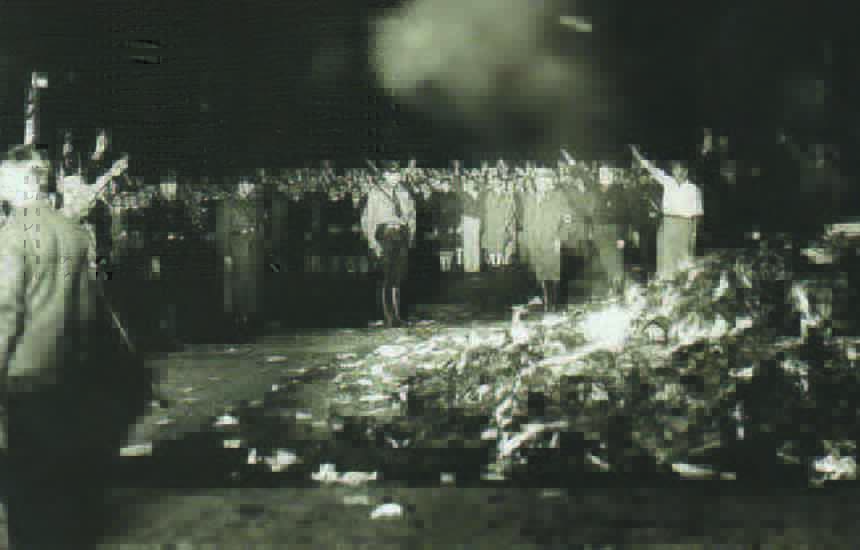
Books were not the only victims of the Nazi regime. During the course of repressions that took place before the beginning of 1935 alone, more than 4,200 "enemies of the Reich" were liquidated and 515,000 people were arrested. By 1939, more than 300,000 people had been imprisoned, while hundreds of thousands of Germans emigrated abroad.
Jews were the main target of repressions. As of 1933, there were nearly 500,000 Jews living in Germany (accounting for less than one percent of the total population). Most were highly assimilated, spoke German, and had an excellent knowledge of German history and culture. They were proud of their country. At times it seemed as though they were more German than Jewish. Nevertheless, official state antisemitism continued to intensify. The spring of 1933 marked the start of a government boycott of all Jewish-owned institutions, businesses, and shops, even though at this time the majority of the German population did not support the boycott. The Nuremberg Race Laws, adopted in 1935, stripped Jews of German citizenship and banned them from holding government offices, owning businesses, marrying German women, and studying at state educational institutions. Their property and businesses were registered and subject to confiscation. [19]
In the early morning hours of 10 November 1938, the Nazi authorities carried out an anti-Jewish pogrom known as Kristallnacht (the "Night of Broken Glass"), during which Jewish-owned shops, pharmacies, and other businesses were smashed and looted. The pogrom claimed tens of thousands of victims. Jews were forbidden to appear in public places and engage in various types of activities, and they were obliged to wear a yellow, six-pointed star sewn on their clothing.
The practice of mass killings was first used not against Jews, but against "incorrect" or "mentally defective" Germans. Nazi racial theories about "superior" and "inferior" races echoed other ideas, such as the social philosophy of eugenics. A considerable number of German physicians who were in favor of eugenics collaborated with the Nazis on a program of forced sterilization. In order for "racial hygiene" to take its proper place in medical practice, this policy was turned into an academic discipline, and in 1936 it was introduced as an exam subject. Those Germans found to suffer from genetic diseases were subject to surgical sterilization or irradiation. [20]
Also at risk of forced sterilization were people designated as "asocial psychopaths," that is, "mentally retarded" people as well as individuals without regular employment or people with a criminal record. The Roma and Sinti peoples were also victims of this policy because a pathological "commitment to crime" was ascribed to them. Up to two percent of all women died as a result of surgical interventions. According to some estimates, as of 1939, the number of victims of forced sterilization in Germany and Austria reached half a million people.
After Germany's attack on Poland on 1 September 1939 and the beginning of World War II, Hitler launched a secret war against his own German people. In October 1939 he wrote the following on a sheet of his private correspondence (backdated to 1 September 1939): "Reichsleiter Bouhler and Dr. Brandt are charged with the responsibility of expanding the authority of certain officially appointed doctors, so that after a critical diagnosis incurable persons may be granted a mercy death." [21] Hitler thus launched the transition from the prevention of so-called "defective life" to its destruction, and to a policy of killings masked by the euphemisms "death with pity" (mercy killing) and euthanasia.
A special meeting attended by twenty physicians and directors of psychiatric hospitals convened in Berlin in July 1939. Little is known about this "euthanasia conference," which took place two and a half years before the Wannsee Conference addressed the "final solution of the Jewish question." Some data does exist, however, on the "practical results" of the criminal program of mercy killing, which claimed the lives of thousands of patients housed in psychiatric wards in Poland after Germany invaded that country. Already in the fall of 1939 SS units shot and gassed thousands of mentally ill Pomeranian Germans.
The murders of "mentally defective" Germans on the territory of the Third Reich were organized by a subdivision of Hitler's Reich Chancellery, which in 1940 was located on Tiergartenstrasse 4 in Berlin. The "death with pity" program was therefore called Aktion T4. Once all medical and care facilities as well as shelters for invalids that housed mentally ill people were registered, systematic killings began. Six psychiatric clinics in Germany were refitted as execution sites, which were equipped with gas chambers that operated without interruption. Concurrently with Aktion T4, German children with intellectual and physical handicaps were killed in thirty "children's wards" specially equipped for this purpose.
Despite the secrecy behind these killings, news trickled out as early as 1940. In August 1941, Bishop Von Galen of Münster made the following courageous declaration during one of his sermons: "If one is allowed forcibly to remove one's unproductive fellow human beings, then woe betide loyal soldiers who return to the homeland seriously disabled, as cripples, as invalids." [22] In order to prevent public disturbances, Aktion T4 was suspended in August 1941. Nevertheless, people continued to lose their lives. German doctors simply carried on as before, starving patients to death and depriving them of medication in hospitals, clinics, and shelters. These murders were known as "wild euthanasia."
According to current scholarly research, as a result of the implementation of the euthanasia program, between 250,00 and 300,000 Germans suffering from psychological, intellectual, and physical handicaps were killed on the territory of the Third Reich alone. Later, a substantial number of sick people were killed by the Nazis on occupied Soviet territory: in Mahilioŭ (Belarus), in Zaporizhzhia and Dnipropetrovsk (Ukraine), and in Kursk and Stavropol (Russia). If the Germans were killing "defective Germans," citizens of their own state, then it is clear what fate awaited the residents of the countries that were occupied by the Nazis over the course of their continuing aggressions. Lands that had belonged to the Soviet Union before the start of the German-Soviet war were subjected to the totalitarian Stalinist regime whose characteristics to a large degree defined the events of World War II.
The nationality question in an internationalist state
On the one hand, the communists who ruled the Soviet Union and the Nazis who ruled Germany always emphasized the "fundamental difference" between each other. The chief distinction between the two lay in the fact that the Communists championed the idea of a "class struggle," while the Nazis proclaimed the need to preserve "racial purity." In the socioeconomic sphere, the Nazis supported the inviolability of private property, whereas the communists abolished it, nationalized industry, collectivized agriculture, and introduced central command planning. According to Norman Davies, these very measures give grounds for regarding communism as the supreme form of totalitarianism. [23] In principle, the totalitarian essence of both communism and fascism was similar. Those people who had experienced both manifestations of totalitarianism called the communists "red fascists" and called the fascists "brown communists." [24]
The main features of Bolshevik nationality policy are worth recalling. [25] In the words of the historian Vladyslav Hrynevych:
After destroying, with the help of the Red Army (comprised predominantly of ethnic Russians), the national governments that in 1918–1920 emerged in the "national borderlands" of the former Russian Empire, the Bolsheviks continued their practice in the sphere of state building in the national republics. By granting the formerly oppressed nations some rights in the realm of language, culture, education, and in the training of national cadres, the Bolshevik government sought to extinguish all manifestations of nationalism that had emerged during the period of the Revolution and the Civil War, thereby strengthening the internal integrity of the Soviet Union. At the same time, Soviet political figures tried to combine nationalistic demands concerning national territory, culture, language, and elites with the socialist need for the economic and political unity of the Soviet state. [26]
In the early 1920s the Soviet government announced the policy of indigenization, which in Ukraine took the form of Ukrainianization. "Hence, when Ukrainianization was implemented," writes Paul Robert Magocsi, "policies with similar goals were introduced among some of the national minorities – Moldovanization, Yiddishization, Polonization, Tatarization, Hellenization." [27] Nationality districts and village and town councils, including Jewish ones, were formed throughout Ukraine. [28] The print runs of books, newspapers, and magazines in the languages of national minorities continued to increase, and technical institutes, scientific institutions, and theaters in minority languages were established. The main goal of indigenization was not, however, the development of the national life of Ukrainians, Jews, and other nationalities, but rather their Sovietization. The introduction in the late 1920s of Stalin's "revolution from above" marked the beginning of the destruction of Ukrainian and Jewish cultural achievements. [29]
The process of Jewish nationality and cultural building went on until the mid-1930s. Then, with the consolidation of the Soviet totalitarian system, nationality institutions of education and culture were declared to be centers of "bourgeois-nationalist" influence whose activity was deemed "harmful" and a "national perversion." The suicide on 7 July 1933 of Mykola Skrypnyk, perhaps one of the most outstanding proponents of the policy of Ukrainianization as well as of the national and cultural development of minorities in Ukraine, signaled what might be called a "great breakthrough" in the nationality policy of Stalinism. [30]
Consequently, what in the words of the historian Roman Szporluk was the real revolution, [31] took place in the 1930s, during which the national republics of the Soviet Union were stripped of what little autonomy they had, and their inhabitants reduced to communities that were subordinated to the Russians. The Soviet authorities sought to reinforce their legitimacy and, simultaneously, to strengthen the loyalty of the population through the accelerated formation of a new Soviet identity. This required:
essential correctives and changes to Soviet ideology and propaganda — above all a rejection of the utopian Marxist principle of proletarian internationalism that had begun to inhibit the mobilization of Soviet society with regard to modernization and war preparations. The result of this quest for a more pragmatic and unifying concept was the partial return to the model of Russocentric statism, which was supposed to foster state building and guarantee the population's loyalty to the existing Soviet regime. [32]
In essence, the Soviet regime recreated the imperialistic nature of its predecessor, the tsarist Russian Empire, even if the imperialism was presented in new ideological packaging. At its heart lay the Stalinist theory of the Russian people as the "elder brother" of the other Soviet peoples. [33] The Russian people were assigned a state-building and consolidation role similar to the great-power principle from tsarist times that viewed the Russians as the ultimate pillar of the state.
Soviet society was informed in no uncertain terms of the new imperialism when, in the winter of 1936, the main ideological mouthpiece of the Bolshevik regime, Pravda, introduced the formula known as "the first among equals." That formula thereby emphasized the special place accorded to the Russians among the other peoples of the Soviet Union. The Pravda article noted the "exceptional role" of the Russian people in the struggle for the proletarian state and the importance of Russian culture to the development of all the other nationalities in the Soviet Union. Thereafter began the practice of identifying everything Russian as Soviet from the standpoint of its significant influence. [34] At this time a definite hierarchy of Soviet peoples was formed, at the top of which was the Great Russian people.
Henceforth, the rights of the non-Russian republics were reduced to a nominal status, while the declared principle of proletarian internationalism was a mask for russification. The special role of the Russian people within the so-called brotherly union of peoples became increasingly tangible. Russian patriotism was revived against the background of the struggle against "nationalistic perversions" of national minorities, and the process of rehabilitating traditional Russian historical, military, and political values got underway. In official historical scholarship some tsars were now treated as progressive historical figures, while the various peoples of Russia, which in the past had been presented as victims of colonial conquests, were transformed into recipients of fraternal assistance, whom the Russians had rescued from their own and Western enslavers. [35]
Particularly harsh criticism of Russophobia was directed at the so-called "Pokrovskii School" of historians, and even more brutal attacks were aimed at the conceptual views of the distinguished Ukrainian historian Mykhailo Hrushevskyi, whose writings allegedly created a rift between the Russian and Ukrainian peoples. [36] The Soviet population was now categorized according to the level of its loyalty to the Bolshevik regime. The categorization had both a social class and a national dimension, and in this context the Ukrainian peasantry was deemed especially unreliable.
Famine as government policy
The building of a powerful military-industrial complex with a state-run economy and dictatorial system of government determined the radical transformation of Soviet agriculture. Industrious and self-sufficient Ukrainian peasants, who frequently championed a democratic approach in the functioning of their society's economic and political order, were unable to fit into the Soviet system. Consequently, they were viewed as a grave threat to the ever-growing might of the totalitarian Bolshevik system. [37] This was the main premise behind the implementation of collectivization, which gained momentum after 1928.
Collectivization and the destruction of agricultural farms, the forcible confiscation of grain from the peasants, and the accompanying repressions led to a horrific catastrophe, the genocidal Great Famine/Holodomor of 1932–1933. It should be noted that the Ukraine's peasantry suffered from famine both before and after Holodomor. Liudmyla Hrynevych actually speaks of a two-decade-long history of semi-starvation imposed upon Ukraine's population, which included the famines of 1921–1922, 1924–1925, 1928–1929, 1932–1933, and 1935–1936, and 1946–1947. [38] The famine of 1928–1929, which preceded the Holodomor, is unknown to many historians let alone Ukrainian society in general. It, too, was caused by the criminal policy of the country's Bolshevik leadership. According to Hrynevych, the famine of 1928–1929 was caused "not by a bad harvest but by the confiscation policy of the Soviet authorities, above all the introduction of a system of extraordinary measures as a result of which peasants were deprived of reserve food stocks." [39] This famine had a particularly horrible impact on Ukraine's Jewish agricultural colonies. [40]
Undoubtedly, the biggest losses were those suffered by ethnic Ukrainian peasants during the Great Famine/Holodomor. Its apogee occurred in the spring-summer of 1933. Among Ukraine's regions which sustained the biggest losses (52 percent of all who perished) were the former Kharkiv and Kyiv oblasts (today's Poltava, Sumy, Kharkiv, Cherkasy, Kyiv, and Zhytomyr oblasts). The death rate in those regions was 8 to 9 times more than the average for the rest of the country. In the Vinnytsia, Odesa, and Dnipropetrovsk oblasts the death rate was 5–6 times above the average, while in the Donbas it was 3 times.
Researchers offer varying mortality rates that resulted from the Holodomor, ranging from 3 to 10 million people. What is clear, however, is that millions perished regardless of their ethnic background.
Practically every recollection by Jews of life in small towns mentions the various horrors connected with the Holodomor. [41] The worst famine among Jews of southern Ukraine occurred in the northern districts of Mykolaiv oblast [42] and in the Stalindorf Jewish nationality district in the Dnipropetrovsk oblast. [43] The situation was particularly grave in those towns that had been struck off the list of centralized state food deliveries. Consequently, in the winter and spring of 1933 Jews and ethnic Ukrainians starved to death in Berdychiv, Zhytomyr, Uman, Bila Tserkva, Fastiv, and Proskuriv.
Desperate to avoid starvation, people fled to large cities, but, even there, implacable fate caught up with them. In January and February 1933 alone, the bodies of 918 Jews who had starved to death were retrieved from the streets of Kyiv, followed by another 249 bodies collected during the first ten days of March. [44] Jewish workers employed in one enterprise in Berdychiv sadly noted: "more than 100 dead bodies that perished from hunger are buried in the Russian [Orthodox] cemetery and another 40 in the Jewish cemetery." [45] International organizations — among them the Jewish Aid Committee created in [Polish-ruled] Lviv to help the starving Jews and non-Jews of [Soviet] Ukraine — were unable to do anything substantial due to the opposition on the part of Soviet authorities. Representatives of the Jewish Agro-Joint were also prevented from visiting Ukrainian villages.
The Great Famine was only one aspect of Soviet repression. In his discussion of the criminal nature of the Soviet and Nazi regimes, Timothy Snyder has noted that under Stalin in 1933 millions of Ukrainians died of starvation in the largest artificially engineered famine in the history of mankind, while less than a decade later, in 1941:
Hitler took Ukraine from Stalin and tried to carry out his own colonial project, starting off by killing Jews and establishing camps for Soviet prisoners of war. The Stalinists colonized their own country, while the Nazis colonized a German-occupied Soviet Ukraine. During the years that both Stalin and Hitler were in power, more people were killed in Ukraine than anywhere else in the bloodlands, or in Europe, or in the world. [46]
Nationality repressions
The mass repressions in the Soviet Union had their own specific features compared to the terror that was subsequently organized by the Nazis. As Robert Conquest's research has shown, the Stalinist purges reached an unprecedented scale, victimizing millions of people and forcing all of society to live in a state of perpetual fear. [47] Another feature pertains to the methods by which the repressions were carried out, including the extraordinary public show trials, during which the main opponents of Stalin were forced to accuse themselves publicly of state treason. Yet another feature was the impenetrable curtain of secrecy that surrounded the crimes of the Soviet government. [48]
Among the key targets were the country's national minorities. [49] Repression against them occurred in the wake of the further consolidation of the totalitarian regime, the crushing of all opposition, and the strengthening of Soviet Russian great-power chauvinism, which continued to be camouflaged by slogans of internationalism. The intensification of repressive policies was also influenced by external political factors and the difficulties affecting the Soviet Union's position in the international arena, particularly the Nazis' rise to power. On the one hand, Stalin was so impressed by the radicalism and decisiveness of the Brownshirts that he advised his colleagues in the Politburo to learn how Hitler dealt with his political opponents and how he managed to unite the German nation around himself. An important tool in the Nazi propaganda arsenal was to promote the image of the "blood-sucking Jew" as the ultimate enemy. [50] On the other hand, in the early 1930s a German-Polish rapprochement based on anti-Sovietism emerged, and this influenced the escalation of repressions against the Polish and German minorities in Ukraine.
For example, in 1932–33 the NKVD fabricated the case of the so-called Polish Military Organization. [51] Repressions reached their peak during the "Polish Operation," and by mid-1938 nearly 135,000 Poles were arrested (roughly half of whom were from Ukraine and Belarus). About 67,000 were executed, the rest imprisoned in the Gulag or deported to Kazakhstan. [52] The mid-1930s also marked the intensification of repression against Ukraine's ethnic German population. The Soviet secret police exposed conspiratorial nests of German fascist spies, who were liquidated with all the severity of proletarian law. From the mid-1930s, there were further repressions against ethnic Germans. Soviet security police discovered "fascist German spy rings," which were liquidated with the full severity of proletarian law (that at the time also involved the execution of children from the age of 12). [53]
Other victims included 264,000 Jews who were imprisoned on various changes, 87,000 Jews accused of criminal offenses, and tens of thousands of family members of the above "enemies of the people" (including children) who were deported from Ukraine to other parts of the Soviet Union.
The Bolsheviks' nationality policy was not limited to repressions and deportations. The policy of militant atheism was intended to destroy the national and religious traditions of all minorities in the Soviet Union. The Jews and their religion were a special challenge. Judaism by its very existence was a barrier that impeded the assimilation of Jews and therefore it needed to be destroyed. Soviet efforts to transform Jewish traditional life did provoke resistance which took the form of attempts to emigrate abroad. No longer able to function legally, Zionist political parties and youth organizations in Ukraine could only operate clandestinely.
It should also be noted that a considerable number of revolutionaries and political and civic activists of Jewish background played an active role in the state's anti-people and anti-national experiments. For these Jews internationalism and world revolution were of paramount importance. Of the many who were drawn into the new Soviet political elite, several were natives of Ukraine, including Lev Trotsky (Bronshtein) from the Mykolaiv area, Grigorii Zinovev (Appelbaum-Radomyslsky) from the northern Kyiv region, and Moisei Uritsky from Cherkasy. [54] Jewish Communists changed their names and adopted Russian pseudonyms according to the pendulum principle ("we were persecuted, now we will take revenge on others"), and they joined in large numbers units of the Cheka punishments brigades fighting peasants.
Many scholars have attempted to determine the percentage of Jews as well as Latvians, Poles, Georgians, and other minorities in the leadership of the Communist party, in the all-Russian and Ukrainian state organs, and in the repressive organs such as Cheka-OGPU-NKVD. In making such calculations one must take into account not only the social but also national character of the 1917 Bolshevik coup and the subsequent Civil War throughout the vast territory of the former multiethnic Russian Empire. Furthermore, the origins of people born into ethnically mixed marriages are hard to define. Also, in order to determine changes in the nationality composition of the institutions mentioned above, one must differentiate and between the Ukrainian republic and all-Soviet structures and between members of the leadership class and the rank-and-file operatives on the peripheries. More importantly still, it is imperative to understand that many Jews who decided to serve the new Soviet state and become an integral part of the system rejected their national identity and transformed themselves into the bearers of a homo sovieticus mentality. In this context, the connection to the Jewish people of someone like Lazar Kaganovich was as meaningless as the alleged Polish "patriotism" of Felix Dzerzhinsky or the pro-Georgian "sentiments" of Sergo Ordzhonikidze.
Another important factor was the pace of change among the political elite. Immediately after the 1917 Bolshevik coup and continuing into the following two decades several non-Russian individuals adapted fully to the new system and were part of the overall policy of Russification that affected Soviet personnel policy. In Soviet Ukraine, the political elites, whether the pre-revolutionary intelligentsia, Communist opponents of Stalin, and even Stalinist cadres were replaced by Russian or Russified elements. For instance, of the 102 members and candidates for membership in the Central Committee of the Communist party (Bolshevik) of Ukraine, only three persons survived the purges of 1937.
As a consequence, the composition of Soviet Ukraine's government changed completely, as did the heads (secretaries) of oblast party committees. [55] By the summer of 1938 the Communist party Central Committee apparatus stopped appointing functionaries of Jewish origin, and the following year, at the beginning of the Soviet-German rapprochement, Jews who had survived the Great Terror began to be dismissed from government posts. [56]
If one seeks to clarify the question of the Bolshevik attitude to Jews, it becomes clear that Stalin's antisemitism stemmed not from ethnic sympathies or antipathies, but rather was determined by his political objectives. Having rejected in the mid-1930s the "principle of proletarian internationalism as the basis of revolutionary patriotism, Stalin henceforth consistently implemented national patriotism as the underlying principle of his ideology and propaganda in ethnic matters. Thus, Jews, who from the very beginning had been actively recruited for the dissemination of the propaganda of internationalism, turned out to be superfluous in the new Russian imperial project.
Vinnytsia, Bykivnia, and Katyn: Soviet crimes on the eve of Babyn Yar
Terror, the disregard for human life, and mass killings for the sake of realizing a certain idea were traits shared by Communism and Nazism. "The bureaucracies of Nazi Germany and the Soviet Union turned individual lives into mass death," to quote Timothy Snyder. "The Soviets hid their mass shootings in dark woods and falsified the records of regions in which they had starved people to death; the Germans had slave laborers dig up the bodies of their Jewish victims and burn them on giant grates." [57] The wave of large-scale Soviet mass repressions encompassed specifically Ukraine, where in the early 1930s the Ukrainian peasantry resisted collectivization. [58] It is perhaps not surprising that by 1938 the percentage of death sentences was especially high in Ukraine in comparison with other types of punishment. Regular mass shootings ended with bodies dumped in mass graves, the precursors of Babyn Yar during the Nazi occupation. Present–day historians have captured some of the horrors of those days.
In Vinnytsia, people sentenced to death were tied, gagged, and driven to a car wash. There a truck awaited, its engine running to cover the sound of the gunshots. The bodies were then placed in the truck and driven to a site in the city: an orchard, perhaps, or a park, or a cemetery. Before their work was done, the NKVD men had dug no fewer than eighty-seven mass graves in and around Vinnytsia. [59]
Another example was Bykivnia, where the remains of Soviet citizens were found. They were victims shot by the NKVD between 1937 and 1941. [60] Local residents recall intense activity taking place at a special site located in the Bykivnia woods, where the NKVD arranged for pits to be prepared in advance.
Every night closed trucks delivered something from Kyiv and would return before morning. There were two or three vehicles, and sometimes an entire column of five or six trucks, and always accompanied by a car carrying soldiers. After the war broke out in June 1941, the traffic heading to this zone increased. A few days before the Germans arrived, Soviet NKVD officers herded a large column of arrested people from prisons in Kyiv across Bykivnia into the "green fence" zone. The column was an entire day's walk long. Shots rang out the whole night in the zone behind the 'green fence'; you could hear the awful cries of people. Soldiers, so-called deserters, were also brought to the woods. They dug a pit for themselves; they were ordered to lie face down, and they got a bullet in the back of the head. [61]
The total number of victims found in Bykivnia has not been established, with the figures ranging from 6,323 to tens of thousands. [62]
Perhaps the most notorious site of crimes perpetrated by the Soviet totalitarian regime was Katyn, where Polish soldiers and officers were shot en masse. In the wake of the Soviet Union's participation with Nazi Germany in the destruction of Poland, tens of thousands of Polish military officers were taken as prisoners of war by the Soviet forces. Most of them were ethnic Poles, although considering the multinational character of the Polish armed forces, there were also Ukrainians, Belarusians, and Jews among them. [63]
On the territory "liberated" by the Red Army, the new Soviet authorities of Western Belarus and Western Ukraine also organized massive arrests of so-called class enemies, including political and civic activists of different nationalities and former soldiers. In early March 1940, over 18,000 prisoners, of whom more than 10,000 were Poles, were apprehended and held in NKVD prisons, mostly in oblast-based NKVD solitary confinement cells in Lviv, Rivne, Lutsk, Ternopil, Drohobych, Stanyslaviv, Berestia, Pinsk, and Baranovychi. [64] On 5 March 1940, Lavrentii Beria, the Soviet Union's Commissar of Internal Affairs, sent Stalin the draft of a decree to liquidate Polish citizens. It projected the shooting of 14,700 captives held in Kozelsk, Starobilsk, and Ostashkiv, as well as 11,000 people who were imprisoned in western Belarus and western Ukraine. As a result of the decision handed down by the Bolshevik leadership, nearly 26,000 Polish citizens were condemned to death. [65]
On 2 April 1940, the head of the NKVD's Department for POWs instructed the commandant of a camp in Kozelsk to prepare the first "death transport" which left the following day. At the station of Gnezdovo, located just west of Smolensk, POWs were transferred to buses and transported to the site of execution, just a few kilometers away. This hilly terrain, the Katyn forest, was a recreational zone of the NKVD and, therefore, inaccessible to the local civilian population. NKVD operatives killed the Polish officers with a shot at the temple from a short range. According to one version, the executions took place inside a zone fenced off with barbed wire directly over open pits. According to another version, the mass executions took place in the NKVD mansion in Smolensk after which the bodies were transported to the Katyn forest. The "operation" ended on 21 May 1940. [66] The term "Katyn executions" subsequently referred to all mass executions of Polish citizens (largely officers) carried out in the Soviet Union in April–May 1940.
It was the invading Nazi German forces who first discovered the mass graves at Katyn. A special international commission was created whose investigation concluded that the executions were carried out by NKVD operatives. [67] The Soviet leadership categorically rejected any involvement. Later, when the Soviets retook Smolensk from the Nazis, a special commission declared that the executions were carried out by the Nazi German occupying forces in 1941. Not until 1990 did the Soviet leadership admit the guilt of the NKVD. [68]
Among the other crimes of Soviet totalitarianism were the mass shootings in the summer of 1941 of prisoners held in NKVD prisons as German armies were pushing ever farther eastward into the Soviet Union. Many people remained in prisons in western Ukraine, having been imprisoned after the Soviet annexation of formerly Polish-ruled Galicia and western Volhynia (1939) and of formerly Romanian-ruled northern Bukovina (1940). In July 1941, within the first week of the Nazi German invasion of the Soviet Union, prisons in western Ukraine were filled to 1.5–2 times their capacity. The Soviet security organs planned to transport the captives deeper eastward into Soviet territory. But the rapid advance of the German forces, problems with transport, and the increased attacks by the Ukrainian nationalist underground intent on freeing the prisoners thwarted their plans. After repeated requests from Soviet Ukraine's NKVD to Moscow for guidelines, a telegram arrived which stated: "according to the decision of Lavrentii Beria and based on the list approved by the [state] prosecutor, all persons under investigation sentenced for counterrevolutionary crimes by the article 170 of Criminal code are to be executed. Persons who committed embezzlement and who are not indicted on those charges are to be freed." [69]
In practice, not only those sentenced to capital punishment were executed but also those sentenced to various prison terms and even those who were only under investigation. [70] From the very outset of World War II political prisoners were eliminated in Przemyśl/Peremyshl and Dobromyl prisons just beyond the German front. The inmates were executed without trials, following the orders from the local prison authorities. The Soviet murder techniques varied depending on the concrete circumstances. In the last days before the Soviet troops retreated, prisoners were executed without death lists, sometimes right inside the cells, with machine guns and grenades. In order to prevent the screams of the dying prisoners from reaching the city residents, car or tractor engines were run during the executions. Prisoners tried to mount resistance, but their efforts usually failed. [71] During the first weeks of the war approximately twenty thousand people were executed in the prisons of western Ukraine. Most of them were Ukrainians, a certain percentage was comprised of Poles, and nearly ten percent were Jewish Zionists. [72]
Hence, Vinnytsia, Bykivnia, Katyn, and other places of mass executions became symbols of the crimes of the Soviet regime, just like Babyn Yar and numerous other "babyn yars," where subsequently Jews and other "enemies of the Reich" were executed en masse became symbols of crimes of the Nazi German regime.
Nazi Germany and the Soviet Union on the eve of the Holocaust
In 1939–1941 Nazi Germany continued along a course marked by the conquest of much of Europe and the consistent intensification of its anti-Jewish policies, especially after the occupation of Poland with its several million strong Jewish population. During this period Stalin tried not so much to preserve peace in Europe as to whip up the military conflict. As the situation in Europe escalated, he got the chance to realize imperialistic ambitions that he identified with his country's security. Stalin expected that Germany's conflict with the Anglo-French bloc would allow him to intervene at an opportune moment, after having already ensured the expansion of the socialist front into Poland. [73]
During negotiations with Great Britain and France in the summer of 1939, the Soviets demanded conditions that were unacceptable to their potential Western partners, and the talks were suspended. Meanwhile, both Stalin and Hitler were interested in a Soviet-German rapprochement. Stalin hoped to obtain spheres of influence in Europe, while Hitler sought to open up better opportunities for launching an attack on Poland.
After the requisite diplomatic preparations were completed, the Soviet-German Non-Aggression Pact (the Molotov-Ribbentrop Pact) was signed in the early morning hours of 24 August 1939. An additional — secret — protocol was also signed between the two states that divided eastern Europe into Soviet and German "spheres of influence." The Pact not only allowed Germany and the Soviet Union to destroy Poland and to capture a number of other small European states located between the two aggressor states, it also provided Hitler with an opportunity to attack the West, now that he had Stalin's support and encouragement.
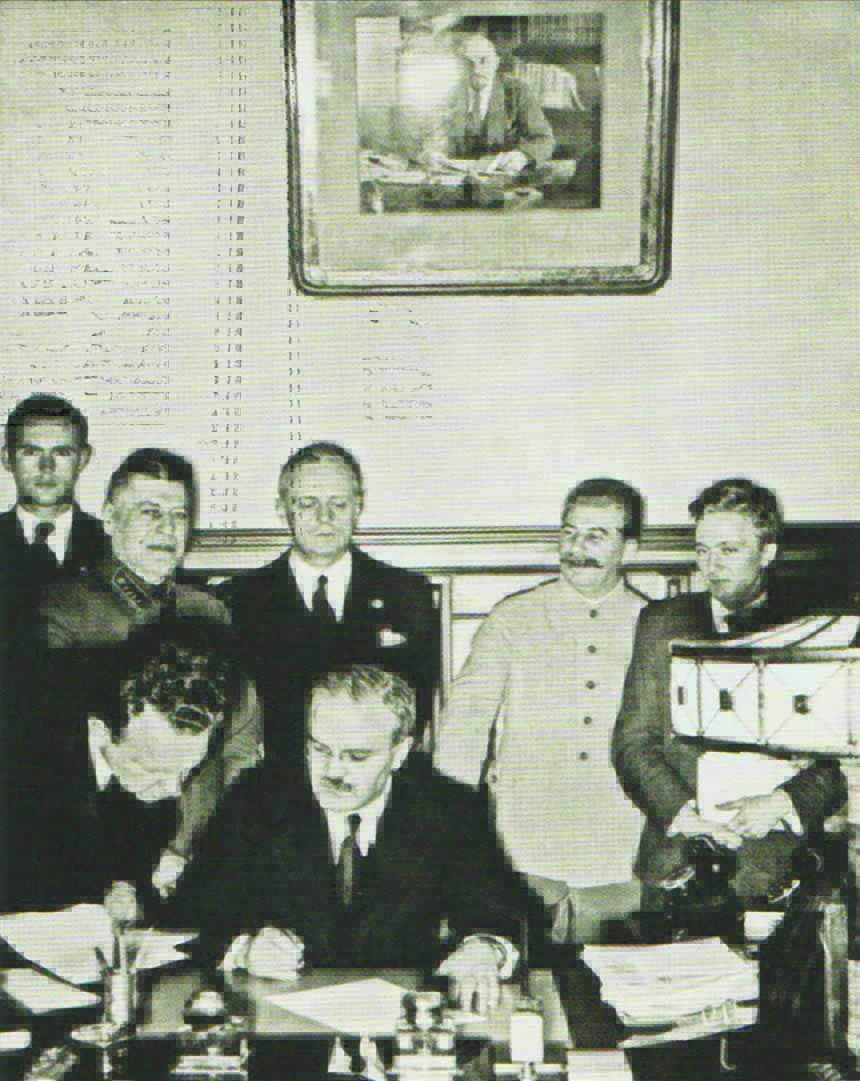
Such an abrupt reorientation of the Soviet politics from confrontation to friendship with Germany could not but disrupt and disorient the Soviet public. Nevertheless, Stalin and his ideologists moved forward and actively promoted the thesis about "friendship with Germany." The Soviet government's leading organ, Pravda, ran an editorial the day after the pact's signing which noted that a difference in the ideology and political system of both countries should not be a hindrance to the establishment of good neighborly relations. [74] Speaking at the extraordinary session of the Supreme Soviet of the USSR, Molotov alluded to the need to curtail "anti-fascist" and anti-German propaganda so common until then in the Soviet media. He also emphasized that "in our country there used to be some shortsighted people so carried away by simplified anti-fascist agitation" that they forgot about the "provocative work of our enemies." The head of the Soviet government stressed:
The Soviet-German non-aggression agreement means a turnabout in the development of Europe… This agreement gives us not only the elimination of a threat of war with Germany… and thus serves the cause of universal peace, — it should [also] guarantee us new opportunities to grow forces, strengthen our positions, and further increase an influence of the Soviet Union on international development. [75]
This turnabout in "the development of Europe" gave rise to what the Ukrainian historian Vladyslav Hrynevych has called "unbridled dissonance" in Soviet society. [76] Such social discord attested to the reaction to the changes in the Bolshevik ideological orientation and in political life both in the "land of the soviets" and outside its borders. The discord was also revealed in the population's reaction to the start of the German-Soviet war and the founding of the "new order" by the Nazis, Nazi antisemitic propaganda, and the beginning of the Holocaust in the Ukrainian lands.
The biggest confusion in the social consciousness of the late 1930s was caused by the change of Soviet goals from the "opposition to fascism" toward an alliance with Hitler's Germany. In one of his numerous reports, Soviet Ukraine's Commissar of Internal Affairs, Ivan Serov, touched upon the opinions of Soviet citizens regarding the conclusion of the Soviet-German pact. "What's going on?," referring to the words of Soviet scientist P. Pustokhod, "Fascists have become friends, while the so-called democratic countries have found themselves almost among the enemies." [77] Pustokhod's colleague, A. Iaroshevych, also expressed concerns about ideological and moral aspects of a Soviet-German conspiracy: "It is a bit shameful in the eyes of the world democracy. It looks like we handed it over to fascists for plunder … One hears talk of 'Red fascism' and the Hitlerite one. And it appears to be true." [78]
It is important to note that the August 1939 Soviet-German pact generated antisemitic moods in society and a variety of myths about the "Jewish" character of the Bolshevik regime. In the words of one Ukrainian nationalist named Streletskyi: "Hitler concluded this pact as a distraction; meanwhile, he will conspire with the capitalist countries; together they will attack the USSR and destroy the Jews' power." [79] On the other hand, the Soviet secret police, especially in the days immediately following the signing of the Molotov-Ribbentrop Pact, recorded people's positive reactions to the Soviet-German pact, along the lines of "Germany is forced to recognize the USSR's might" and the pact "will decrease the threat of war." [80]
Subsequent events proved fateful for both Europe and Soviet-ruled Ukraine. On 1 September 1939 Germany attacked Poland, and almost immediately Wehrmacht troops began executing both Polish prisoners of war and civilians, including Jews. [81] On 17 September 1939 Soviet troops crossed the Polish border and, in keeping with the terms of the Molotov-Ribbentrop Pact, occupied the territories that were reserved for the Soviet Union. In the words of Timothy Snyder:
By opening half of Poland to the Soviet Union, Hitler would allow Stalin's Terror, so murderous in the Polish operation, to recommence within Poland itself. Thanks to Stalin, Hitler was able, in occupied Poland, to undertake his first policies of mass killing. In the twenty-one months that followed the joint German-Soviet invasion of Poland, the Germans and the Soviets would kill Polish civilians in comparable numbers . . .[82]
Thus, another step towards Babyn Yar was made.
The Soviet-Polish war was no less a shock for the Soviet people than the non-Aggression Pact with Nazi Germany. After all, the war contradicted all slogans connected with Stalin's "politics of peace." The gradual realization that the Soviet Union had suddenly turned from a "peace-loving country" into an actual aggressor proved to be a very unpleasant "surprise" for Soviet citizens. [83]
In 1939–1941 Soviet propagandists and news reporters applied considerable efforts to present every military campaign in the context of the "further development of Stalin's policy of peace." The first victim of the Soviets' "peace policy" was Finland, followed by Romania. [84]
What were the results of this expansionist policy? The Soviet Union's aggression toward other countries and peoples, the scale of its annexations, and the ease with which they took place gave rise to the phenomenon of "Red imperialism." This brand of imperialism was a bizarre blend of imperialistic, chauvinistic, communist, great-power, and revanchist ideas that coexisted in the public mind. [85] Advocates of "Red imperialism" comprised, however, a rather insignificant proportion of Soviet society. Far more widespread were anti-Soviet attitudes of citizens who expected the collapse of Stalin's rule in the context of the approaching war. [86]
The next shock to society was the German-Soviet Treaty of Friendship, Cooperation, and Demarcation that was signed in Moscow on 28 September 1939. The Soviet Union had until recently proclaimed itself the sole fighter against fascism. Now all anti-fascist rhetoric transmitted via the mass media was suspended. Instead, Soviet newspapers began printing the speeches of Nazi leaders, which were discussed widely and even studied in Red Army political indoctrination classes. Somewhat parallel to anti-Soviet attitudes were antisemitic attitudes. As relations improved between the Soviet Union and Nazi Germany, there was no longer any criticism of the Reich's official policy of antisemitism. In fact, a number of Soviet military officers expressed a positive attitude toward Germany's antisemitic policies. [87] These policies were well known through a wide range of Soviet Union official sources (newspapers, the cinema), private letters written by Jews living outside the Soviet Union, and the internal documentation known to the Soviet state security organs. [88]
Military operations and repressions led to a huge wave of refugees moving from the west to the east and in the reverse direction. Those who fled sought to escape either the Nazi and Soviet totalitarian regimes. Among such people were very many Jews seeking to escape either Bolshevik or Nazi rule. The Israeli scholar Aaron Weiss, who was living at the time in Boryslav, recalled how Jewish refugees, encountering each other on the border in a kind of "collision course," argued about and were astonished by the incorrect direction of flight taken by their coreligionists, who were heading either "into the paws" of the NKVD or the Nazis. A considerable number of Jews choose the "lesser evil": Stalin's "land of the soviets" over openly antisemitic Nazi Germany.
The situation in the world and the one that existed in Soviet society changed fundamentally after Germany's attack on the Soviet Union. Soviet territory, where the second-largest (after Poland) community of European Jews lived, ended up under Nazi control. Thus, Hitler's dream of eliminating European Jews could now be possibly realized. [89]
The fate of the Jews depended not only on the Nazi invaders but also on the attitude of the local inhabitants to the occupiers and their policies. The first days of the German-Soviet war in late June and early July 1941 saw a rise in patriotic fervor among a certain proportion of Soviet citizens, as well as anti-Soviet and antisemitic moods. Interestingly enough, a substantial number of Jews breathed a sigh of relief when the war broke out because this meant the end of the "strange friendship" between the Soviet government and the antisemitic Nazi regime. A report of Soviet Ukraine's Commissar of Internal Affairs, Pavlo Meshyk, cites a comment expressed by a citizen named Kammershtein: "I am certain that from now on Jews in all countries will feel good; they know that we will destroy Hitler." [90] Similar thoughts were expressed by the writer Lurie in the first days of the war: "Of course, in any war there can be victims, but ultimately Hitler will be destroyed. I say this not just because I am a Jew." [91]
The remarks of Professor Belov serve as an illustration of similar views that were held by the non-Jewish population: "I am relieved, finally. Never before have had I felt so devoted to the Soviet government as I do now. For two whole years I was depressed by our friendship with Hitler, with the bearer of obscurantism and fascist fanaticism and antisemitism." [92] Meanwhile, others anticipated a normal life under German occupation: "The Germans are not at all the barbarians they are made out to be in the press." [93]
As the Red Army continued to suffer defeat after defeat and the Wehrmacht forces approached Kyiv, the interconnected anti-Soviet and antisemitic moods among the Soviet population intensified. A report written in late July 1941 cites the remarks of one Klepfer-Chumak, a female resident of Kyiv: "Hitler will come soon and . . . . he will kill all the Jews. Then all of us will be better off." [94] A lecturer named P. M. Korbut expressed similar thoughts on 6 August 1941: "No one wants to fight . . . The Soviet regime is coming to an end. Devastation, panic, and the collapse on the home front are everywhere evident. The Jews have derailed the war. They were the first to sow panic and devastation. They brought the country to a catastrophe." [95]
A few days before the tragic events that took place at Babyn Yar in September 1941, part of Ukraine's population was ready to defend its homeland from the German invaders. At the same time, there were also a considerable number of Ukraine's inhabitants who were waiting for the German troops to arrive, thinking that the new rulers would pose a threat only to Communists and Jews. Reflective of such attitudes is a special report written in August–September 1941 by the head of the NKVD for the Kyiv oblast, which cites the remarks of several individuals, including a woman named S. F. Zelinska: "The Germans are a cultured people, and only Jews and Communists must fear them; others must await calmly" [96]; an unnamed citizen who "is waiting impatiently for the Germans' arrival . . . [and who] will then go and carry out a pogrom; I will kill Jews" [97]; and a female citizen named S: "It is necessary to beat everyone: communists, and Jews, and everyone who ingratiated themselves with them." [98]
Hence, the internal division within Ukrainian society — the "unbridled dissonance" — influenced the conditions in which the Soviet and Nazi totalitarian regimes perpetrated their crimes in Ukraine on the eve of the Babyn Yar tragedy.
[1] Iaroslav Hrytsak, "Nezrozumila viina," Ukraïna Moderna, No. 23 (Kyiv, 2016), p. 209.
[2] Timothy Snyder, Bloodlands: Europe between Hitler and Stalin (New York: Basic Books, 2010), p. 4.
[3] Ibid., pp. 9–10.
[4] Myroslav Popovych, Krovavyi vek (Kharkiv: Folio, 2015), p. 362.
[5] See K. Iu. Halushko, "Natsyzm," in Entsyklopediia istoriї Ukraïny, Vol. VII (Kyïv: Naukova dumka/Instytut istoriї Ukraїny NANU, 2010), pp. 234–235.
[6] Ibid.
[7] Ibid.
[8] Valentyna Shaikan, Ideolohichna borot'ba v Ukraїni period Druhoї svitovoї viiny 1939–1945 rr. (Kryvyi Rih, 2010), p. 51.
[9] Vol'fram Vette, "Obraz vraga: rasistskie elementy v nemetskoi propaganda protiv Sovetskogo Soiuza," in Vtoraia mirovaia voina—Vzgliad iz Germanii: sbornik statei (Moscow: Iauza-EKSMO, 2005), p. 94.
[10] Sergei Artamoshin, "Obraz vraga v natsistskoi ideologii Veimarskogo perioda," Vestnik Tambovskogo universiteta; Seriia: Gumanitarnye nauki, No. 8 (Tambov, 2008), pp. 225–231.
[11] Iehuda Bauer, "Mistse Holokostu v suchasnii istoriї," in Poza mezhamy rozuminnia: bohoslovy ta filosofy pro Holokost (Kyiv: Dukh i Litera, 2005), p. 68.
[12] See the discussion in Iurii Levchenko, "Evoliutsiia ideolohii national-sotsializmu shchodo Ukraїny protiahom 1933–1942 rr.," Naukovi zapysky Natsional'noho universytetu "Kyievo-Mohylians'ka akademiia": istorychni nauky, Vol. 156 (Kyïv, 2014), pp. 42–47.
[13] Adolf Hitler, Mein Kampf (Boston: Houghton Mifflin, 1943), pp. 642–643.
[14] Bauer, "Mistse Holokostu v suchasnii istoriї," p. 57.
[15] Cited in Snyder, Bloodlands, p. 17.
[16] Niemöller's text is cited in Clinton Bennett, In Search of Jesus (London and New York: Continuum, 2001), p. 256.
[17] See Evgenii Gusliarov, Stalin v zhizni: sistematizirovannyi svod vospominanii sovremennikov, dokumentov epokhi, versii istorikov (Moscow: OLMA-PRESS Zvezdnyi mir, 2003), p. 542.
[18] Hagen Shul'tse [Hagen Schulze], Istoriia Nimechchyny (Kyiv: Nauka, 2010), p. 180.
[19] Iryna Vyrtosu, "Uroky natsysts'koї Nimechchyny," Dzerkalo tyzhnia (Kyiv), 9 October 2015.
[20] Lecture by Uta Gerlant, "Evtanaziia – prestuplenie natsional-sotsialistov," cited in Vestnik Assotsiatsii psikhiatrov Ukrainy, No. 2 (2013), in http://www.mif-ua.com/archive/article/36252
[21] Cited in ibid.
[22] Cited in ibid.
[23] Norman Davies, Europe: A History (Oxford and New York: Oxford University Press, 1996), p. 948
[24] Ibid., p. 945.
[25] Roman Szporluk, Imperiia ta natsiї: z istorychnoho dosvidu Ukraїny, Rosiї, Pol'shchi ta Bilorusi (Kyiv: Dukh i Litera, 2000), p. 10.
[26] Vladyslav Hrynevych, Nepryborkane riznoholossia: Druha Svitova viina i suspil'no-politychni nastroї v Ukraїni, 1939-cherven' 1941 rr. (Kyiv and Dnipropetrovsk: Lira, 2012), p. 355.
[27] Paul Robert Magocsi, A History of Ukraine: The Land and Its Peoples, 2nd ed. (Toronto, Buffalo, London: University of Toronto Press, 2010), p. 613.
[28] Iurii Korohods'kyi, "Holod u ievreis'kykh zemlerobs'kykh koloniiakh Ukraїny (1932–1933 rr.): istoriohrafiia problemy," Storinky istoriiї: zbirnyk naukovykh prats' Natsional'noho tekhnichnoho universytet "Ukraїny Kyїvs'kyi politekhnichnyi instytut," No. 36 (Kyїv, 2013), p. 118.
[29] Magocsi, History of Ukraine, p. 615.
[30] The phrases cited in the paragraph are taken from Oleksandr Rubliov, "Represiї proty poliakiv v Ukraїni u 1930-ti roky," Z arkhiviv VUChK-HPU-NKVD-KHB, No. 1/2 [2/3] (Kyiv, 1995), p. 117.
[31] Szporluk, Imperiia ta natsiї, p. 10.
[32] Hrynevych, Nepryborkane riznoholossia, p. 353.
[33] Serhii Kal'ian, "Realizatsiia bil'shovyts'koї natsional'noї polityky v URSR (1920–1939)," Naukovi zapysky Instytutu politychnykh i etnonatsional'nykh doslidzhen' im. I.F. Kurasa NAN Ukraїny (Kyiv, 2011), No. 6 (56), pp. 456–457.
[34] See the discussion in Iuliia Kysla, "Ukraїns'ka istorychna pam'iat': konstruiuvannia zahal'noradians'koї identychnosti v URSR u stalins'kyi period," Naukovi zapysky Natsional'noho univ. 'Kyievo-Mohylians'ka Akademiia', Vol. 78 (Kyiv, 2008), pp. 34–39.
[35] Szporluk, Imperiia ta natsiї, p. 10.
[36] See the discussion in Dmitrii Churakov, "Stalinskaia natsional'naia politika i reshenie 'russkogo voprosa' v SSSR v 1920–1930-e gg.," Dialog, No. 10 (Moscow 1999), accessed in https://portal-slovo.ru/history/39063.php
[37] L. Frei, "Sotsial'no-ekonomichni protsesy v ukrains'komu seli v konteksti polityky radians'koi derzhavy shchodo zamozhnoho selianstva (20-ti-seredyna 30-kh rokiv XX st.)," in Istorychnyi arkhiv: naukovi studiї—Zbirnyk naukovykh prats' Chornomors'koho Derzhavnoho universtytetu im. Petra Mohyly, No. 5 (Mykolaїv, 2010), pp. 67–70.
[38] Lecture by Liudmyla Hrynevych, "Nevidomyi holod v Ukraїni 1928–1929 rr.," accessed at http://tkuma.dp.ua/index.php/ua/prosvescheniye/istoricheskiy-klub/123-nevidomij-golod-v-ukrajini-1928–1929-rr
[39] Liudmyla Hrynevych, Holod 1928–1929 rr. u radians'kii Ukraїni (Kyiv: Instytut istoriї Ukraїny NAN Ukraїny, 2013), p. 330.
[40] Liliia Menashevna Grinbaum-Sadovskaia, "Vospominaniia detstva," in Vidrodzhennia pam'iati: spohady svidkiv ta zhertv Holokostu, Vol. 2 (Dnipropetrovsk: Tsentr "Tkuma," 2009), pp. 49–53.
[41] See the discussion in Viktoriia Vengerskaia, "Shtetl v istorii i politike imperii XIX-XX vv. (na primere mestechek Ukrainy i Moldovy)," in Mezhdunarodnaia nauchno-prakticheskaia konferentsiia . . . Komratskogo gosudarstvennogo universitata, No. 2 (Komrat, 2015), p. 134.
[42] Korohods'kyi, "Holod u ievreis'kykh zemlerobs'kykh koloniiakh Ukraїny," p. 119.
[43] Iurii Kotliar, "Trahediia ievreis'koho etnosu pid chas holodomoru-henotsydu," in Holodomory 1921–1923 rr. ta 1932–1933 rr. na Pivdni Ukraїny: etnichnyi ta mizhnarodnyi aspekty, Vol. 2 (Kyiv and Mykolaiv: Vyd. MDHU im. Petra Mohyly, 2008), pp. 90–98.
[44] Iakiv Khonihsman, "Kolektyvizatsiia, holodomor i zanepad ievreis'koho zemlerobstva v Ukraïni," Ukraïns'kyi istorychnyi zhurnal, XXXVII, No. 2 (Kyiv, 1994), p. 73.
[45] Cited in Vladyslav Hrynevych and Liudmyla Hrynevych, "Ievreї URSR u mizhvoiennyi period," in Narysy z istoriї ta kul'tury ievreїv Ukraїny (Kyiv: Dukh i Litera, 2005), p. 160.
[46] Snyder, Bloodlands, p. 20.
[47] Robert Conquest, The Great Terror: Stalin's Purge of the Thirties (London: Macmillan, 1968), p. xi.
[48] Aside from the discussion in Conquest, ibid., see also Nicholas P. Vakar, Belorussia: The Making of a Nation (Cambridge, MA.: Harvard University Press, 1956); and Hryhory Kostiuk, Stalinist Rule in the Ukraine: A Study of the Decade of Mass Terror, 1929–1939 (New York: Praeger, 1960). For the Soviet version of the same period see Mykola Bazhan, ed., Radians'ka Ukraїna (Kyiv: Akademiia nauk URSR, 1970).
[49] Lecture by Valerii V. Engel', "Natsional'naia politika SSSR v 1930-e gg.—novye tendentsii," in his Kurs lektsii po istorii evreev v Rossii (Moscow, 2000–2001), accessed at http://jhist.org/russ/russ001-15.htm
[50] Rubliov and Reprintsev, "Represiï proty poliakiv vv Ukraïni," p. 117.
[51] Ibid, p. 119.
[52] Magocsi, A History of Ukraine, p. 620.
[53] Ibid., p. 621.
[54] Ihor Hyrych, "Stavka na syl'nishoho: chomu ukraїntsiam ta ievreiam ne vdalosia dosiahnuty konstruktyvnoho dialohu v XIX – na pochatku XX stolittia," Ukraïns'kyi tyzhden', No. 14 [231], 15 April 2012.
[55] Conquest, The Great Terror, pp. 255–258; Vakar, Belorussia, pp. 145–154; Kostiuk, Stalinist Rule in the Ukraine, pp. 76–78.
[56] S. Ie. Kal'ian, "Realizatsiia bil'shovyts'koї natsional'noї polityky v URSR (1920–1939), in Naukovi zapysky Instytut politychnykh i etnonatsional'nykh doslidzhen' im. I.F. Kurasa NAN Ukraïny, No. 6 (Kyiv, 2011), p. 458.
[57] Timothy Snyder, "Holocaust: The Ignored Reality," The New York Review of Books, LVI, 12 (New York, 2009).
[58] Snyder, Bloodlands, p. 84.
[59] Ibid.
[60] Tamara Vrons'ka, "Bykivnia," in Entsyklopediia istoriї Ukraїny, Vol. 1 (Kyiv: Naukova dumka, 2003), pp. 251–252.
[61] Cited in Dmytro Kravchenko, "Rol' usnoї istoriї u rozkrytti istorychnoї pravdy pro Bykivniu," in Storinky istoriiї: zbirnyk naukovykh prats', Natsional'nyi tekhnichnyi universytet Ukraїny "Kyїvs'kyi politekhnichnyi instytut," No. 40 (Kyïv, 2015), p. 93.
[62] Vrons'ka, "Bykivnia," p. 252.
[63] Snyder, Bloodlands, p. 151.
[64] Zagłada polskich elit: Akcja AB – Katyń, 2nd revised ed. (Warsaw: IPN, Komisja Ścigania Zbrodni przeciwko Narodowi Polskiemu, 2009), p. 25.
[65] Ibid., p. 33.
[66] Ibid, p. 36.
[67] Snyder, Bloodlands, p. 375.
[68] "Stalinskie deportatsii 1928–1953: Deportatsii byvshikh pol'skikh grazhdan iz anneksirovannykh raionov Vostochnoi Pol'shi (fevral'-iiun' 1940)," cited in Fond Arkhiv Aleksandra N. Iakovleva, accessed at http://www.alexanderyakovlev.org/fond/issues-dok/102128
[69] Cited in Oleksandr Pahiria, "Masovi roztrily v'iazniv u tiurmakh NKVS URSR vlitku 1941 roku," accessed in http://territoryterror.org.ua/uk/publications/details/?newsid=248
[70] Lesia Bondaruk, "Znyshchennia v'iazniv u Luts'kii tiurmi. 70 rokiv biini NKVD," Istorychna pravda (Kyiv, 20 July 2011), accessed at http://www.istpravda.com.ua/articles/2011/07/20/46167/
[71] Ibid.
[72] Pahiria, "Masovi roztrily."
[73] Hrynevych, Nepryborkane riznoholossia, p. 67.
[74] "O ratifikatsii sovetsko-germanskogo dogovora o nenapadenii: soobshchenie tov. Molotova na zasedanii Verkhovnogo Soveta Soiuza SSR 31-go avgusta 1939 goda," Pravda, 1 September 1939.
[75] Ibid.
[76] Hrynevych, Nepryborkane riznoholossia, pp. 71–79.
[77] "Special report of the people's commissar of the internal affairs of the Ukrainian RSR I. Serov to the secretary of the Central Committee of RKP(b)U N. Khrushchev regarding the population's reaction to the conclusion of the Soviet-German Non-Aggression Pact. 5 September 1939," cited in Kyїv: viina, vlada, suspil'stvo. 1939–1945 rr. za dokumentamy radians'kykh spetssluzhb ta natsysts'koї okupatsiinoї administratsiї (Kyiv: Tempora, 2014), p. 220.
[78] Ibid.
[79] Ibid., p. 222.
[80] Report from Soviet Ukraine's Commissar for Internal Affairs, I. Serov, to the Central Committee Secretary of the All-Russian Communist party Nikita Khrushchev, 5 September 1939, cited in ibid, pp. 220–222.
[81] Snyder, Bloodlands, pp. 115–117.
[82] Ibid., pp. 117–118.
[83] Hrynevych, Nepryborkane riznoholossia, pp. 84–86.
[84] Ibid., p. 89.
[85] Ibid., p. 103.
[86] Ibid., p. 108.
[87] Ibid., p. 204.
[88] Ibid., p. 290.
[89] Snyder, Bloodlands, pp. 9–10.
[90] "Special report of the people's commissar of internal affairs of the Ukrainian RSR P. Meshyk to the secretary of Central Committee of RKP(b)U Nikita Khrushchev about the reaction of population of Kyiv to the start of the hostilities between Germany and the USSR, 23 June 1941," cited in Kyїv: viina, vlada, suspil'stvo, p. 244.
[91] Cited in ibid., p. 246.
[92] Cited in ibid., p. 250.
[93] Cited in ibid., p. 251.
[94] "Report of the people's commissar of internal affairs of the Ukrainian RSR V. Serhiienko to the secretary of Central Committee of RKP(b)U Nikita Khrushchev on the actions regarding the "elimination of anti-Soviet expressions" in Kyiv and other districts and cities of the republic, 30 July 1941," cited in ibid., p. 301.
[95] "Special report of the head of the UNKVS in Kyiv oblast O. Chermnykh to the people's commissar of internal affairs of the Ukrainian RSR V. Serhiienko about the attitudes of the population of Kyiv, 6 August 1941," cited in ibid., p. 308.
[96] "Special report of the head of the UNKVS in Kyiv oblast O. Chermnykh to the people's commissar of internal affairs of the Ukrainian RSR V. Serhiienko about the attitudes of the population of Kyiv, 13 August 1941," cited in ibid., p. 326.
[97] "Special report of the acting head of the UNKVS in Kyiv oblast M. Cherevatenko to the people's commissar of internal affairs of the Ukrainian RSR V. Serhiienko about the reaction of the population of Kyiv to the war, 6 September 1941," cited in ibid., p. 348.
[98] Cited in ibid.