




"Babyn Yar: History and Memory" — Preface and Introduction

The Ukrainian Jewish Encounter was founded in 2008 with the goal of building stronger relations between Ukrainians and Jews, two peoples who, for centuries, lived side by side on the territory of what is modern-day Ukraine. Since then, in keeping with its motto, "Our stories are incomplete without each other," UJE has sponsored conferences, round-table discussions and research, as well as translations and publication of works the organization anticipates will promote a deeper understanding between the two peoples and an appreciation of their respective cultures.
We offer for the first time the book Babyn Yar: History and Memory in eBook format.
A ravine on the outskirts of Kyiv on September 29-30, 1941, was witness to one of the great atrocities of the Holocaust. There, over a two-day period, nearly 34,000 Kyiv Jews were shot to death in one of the first major events that has become known as the “Holocaust by Bullets”.
With deep compassion and understanding, a group of internationally-renowned scholars discuss the treatment of Babyn Yar in culture, music, and the arts from Stalinist times to our own. Beyond the detailed and harrowing accounts of what took place in Kyiv in late September 1941, the essays in this volume realize the importance of preserving Babyn Yar as a symbol of the Holocaust and other tragedies of the twentieth century.
Babyn Yar: History and Memory was edited by Paul Robert Magocsi, Professor Emeritus of history and political science at the University of Toronto, where from 1980 to 2025 he held the professorial Chair of Ukrainian Studies and Vladislav Hrynevych, Leading Scholar at the Kuras Institute for Political and Ethnic Studies, Ukraine.
The book (Ukrainian version) was published in conjunction with a series of events sponsored by UJE to commemorate the 75th anniversary of Babyn Yar. Published in 2016 by Dukh i Litra.
Publication of the English version (2023) was made possible by the generous support of the Ukrainian Jewish Encounter, Toronto, Canada. Distributed by the University of Toronto Press for the Chair of Ukrainian Studies, University of Toronto,
(The editors appreciate the support of the sponsor and acknowledge that the views expressed herein are not necessarily those of the Ukrainian Jewish Encounter.)
Preface
Click here for a pdf of the entire book.
Norman M. Naimark
Genocide has been part of human history from its very beginnings. Ancient empires subjected their own and conquered peoples to elimination, just as modern states destroyed minority peoples through programs of mass murder. Communist governments engaged in genocide, as have ostensibly democratic ones. Settler genocide — sometimes known as colonial genocide — condemned entire groups of indigenous peoples to death as a way to seize territory and resources. Recent history seems no more immune to genocide than the past. Rwanda, Bosnia, Darfur, Congo, and the Islamic State's attack against the Yazidi Kurds remind us that political leaders and their followers, motivated by ideology and immediate gains, are ready to isolate and murder alleged enemies both within their own states and in conquered territories.
Within this dark tableau of the history of genocide, the Holocaust stands out as a particularly beastly example of human evil. Hitler and the Nazis, along with their helpmates throughout Europe, designated the Jews for elimination and did everything they could to pursue their lethal aims. As World War II progressed and German victory became increasingly unlikely, the Third Reich only intensified its efforts to eliminate every man, woman, and child of Jewish origin, sometimes sacrificing its own military needs to implement the "Final Solution." Close to six million Jews fell to the voracious Moloch known as Nazi Germany. Genocide has a way of spreading to envelop other groups of victims, and the Holocaust was no exception. Millions of Roma and Sinti, Soviet POWs, Poles and Ukrainians, the disabled and handicapped were pursued and killed by the Nazi mass murderers.
In both a historical and symbolical sense, Babyn Yar is crucial to any account of the Holocaust. It was one of the first and largest massacres of the Jews in the Nazi campaign of mass killing. Already in mid-August 1941, the Germans had begun to murder indiscriminately men, women, and children. When they seized Kyiv on September 19, 1941, their intention was to eliminate the city's entire remaining Jewish population, which in and of itself constituted a significant escalation in their conception of eliminating the Jews from the European continent. There had been other massacres — the killing of 23,600 Jews in Kamianets-Podilskyi the most notable — but nothing with the genocidal fury of Babyn Yar. The Nazis used as a pretense for rounding up the Jews, if they needed any, the explosions and subsequent fires on the Khreshchatyk organized by Soviet sappers before the Red Army evacuated the city.
On September 28, the infamous Nazi order was issued for all the Jews of Kyiv to appear at 8 o'clock in the morning near the Lukianivka freight train station, according to rumor, for deportation. The images of the Babyn Yar massacre of nearly 34,000 Jews on September 29 and 30 that followed are etched in stone in the historical memory of the Holocaust: crowds of Jews of every age, carrying their possessions while wending their way to the unexpected rendezvous with death; increasingly frightened and suspicious victims entering a heavily guarded compound manned by Germans and Ukrainian auxiliary police with no escape; Nazi soldiers forcing them to strip and leave their possessions, passports, and clothes in piles behind them, sorted and carted off mostly by the Ukrainian police; then the beating, the screaming, the German firing squads, executions, and masses of naked bodies falling or thrown to the bottom of the ravine and buried; a few lucky survivors miraculously crawling out of the still undulating mass graves, surviving to tell the tale of horror afterwards.
According to Vitaliy Nakhmanovych, over the course of the next few months and years, another 30,000 or so Jews were murdered at Babyn Yar, along with an additional 30,000 Ukrainian, Roma and Sinti, and Soviet POWs of various nationalities. By the end, approximately 100,000 people were murdered and buried at Babyn Yar. The exact numbers are hard to know.
Few who encounter the history of Babyn Yar can forget the "denouement" of the destruction. In late August and September 1943, teams of prisoners from the Syrets concentration camp, mostly surviving Jews, were forced by the SS Special Commando 1005 to exhume the bodies at Babyn Yar and place them on huge pyres that were built from ransacked rail ties and from tombstones from the Jewish Cemetery. This was gruesome work, as many of the bodies were melded with others; children were hard to pry loose from their mothers' arms. Pouring incendiaries on the stacked rows of corpses and setting them on fire, the chained and starving participants in these ghastly details, who were themselves slated for extermination, finished the job by sifting through the ashes, separating out pieces of skeleton to be crushed, and scattering the ashes in the ravine. The idea was to destroy the evidence before the Soviet armies broke through to the city in early November 1943.
The shattering impact of Babyn Yar is most notable among Ukrainians and East European Jews and their progeny, who know the history of the Holocaust and of World War II on the eastern front. The Soviet intelligentsia was moved by the Babyn Yar story through the brilliant poem of Yevgeny Yevtushenko ("Babi Yar"), published in Literaturnaia gazeta in September 1961, and by the 13th Symphony (also named "Babi Yar," after its first movement) by Dmitrii Shostakovich (July 1962), which itself was inspired by Yevtushenko's work. Anatoly Kuznetsov's seminal work, Babi Yar: A Document in the Form of a Novel, first published in 1966, broke an important barrier of silence about detailing the events of September 1941.
Regretfully, Western representations of Holocaust memory often have only the vaguest understanding of the killing of Jews in the east, with the exception of the death camps, Auschwitz being most notable for the sheer power of its symbolism as a "site of memory." The mass shooting of Jews in German-occupied Soviet territory attracted less interest than the horrifying images of the gas chambers and the crematoria. One could say the same of scholarly examinations in the West of Babyn Yar, which have been strikingly few and relatively recent. Especially when thinking about reaching the broad Western-educated public, Timothy Snyder's important contributions, Bloodlands (2010) and Black Earth (2015), are the exceptions that prove the rule. Part of the problem with coming to terms with the killing fields in the east, no doubt, had to do with the way Soviet scholars and memory agents were forced to minimize the specific fate of Soviet Jews murdered by the Nazis in comparison to the suffering and heroism of the Soviet people. But part of the problem in the West was the sheer distance from and ignorance of the wartime suffering and death of Ukrainian Jews.
This important book, Babyn Yar: History and Memory, successfully shifts our focus to Kyiv, to the mass murder of Ukrainian Jews there seventy-five years ago, and to the former intersecting ravines — Babyn Yar — where the remains of the bodies of the victims are strewn over an extended mass grave, marked today by scattered monuments of varied provenance. In a series of "state-of-the-art" scholarly articles, complemented by two shorter "memory" pieces, the authors in this book explore the cultural, political, and historiographical dimensions of Babyn Yar, without sparing the reader the sometimes fierce arguments and unbecoming political tensions that lie behind the quest for memorialization. The well-written and expertly translated contributions also tell the uplifting stories of witnesses who insisted on speaking their minds despite the prohibitions of Soviet censors, and of artists — writers, musicians, painters, filmmakers, sculptors, and poets — who felt the overwhelming need to come to terms in their work with the human tragedy of Babyn Yar. The reader is provided with the most up-to-date historical knowledge about Babyn Yar, with the warning that there is still much to be learned about the causes of the mass murder of the Jews of Kyiv and the intersection of events that culminated in those horrible days at the end of September.
Even as it represents one of the most important historical and symbolic events in the history of the Holocaust, indeed in the history of genocide, Babyn Yar is in many ways still unfinished business. There is no consensus on how to memorialize the elimination of the Kyivan Jews that took place there. There is no agreement on how to represent the collaboration of Ukrainian police auxiliaries in the mass murder of the Jews. There is also considerable confusion about how to deal with the multiple interests of victim groups, in addition to the Jews, who lost substantial numbers of their people at Babyn Yar in the years before liberation from the Nazis. One thing is certain: Babyn Yar will be remembered in Ukraine. In the wake of Ukrainian independence in 1991, the "Orange Revolution" of 2004, and the Euromaidan demonstrations of the winter 2013–14, Ukrainians and Jews have linked arms to honor those who perished at the hands of the Nazis during the war. Babyn Yar unites their common grief and inspires common hopes for amity, justice, and truth. An exemplary book like this one, a book that places scholarly understanding at the core of coming to terms with the many dimensions of Babyn Yar, will surely contribute to that goal.
Contributors
Karel C. Berkhoff is a Senior Research Fellow at the NIOD Institute for War, Holocaust and Genocide Studies in Amsterdam, The Netherlands.
Gelinada Grinchenko is Professor of Ukrainian Studies at V. N. Karazin Kharkiv National University, Ukraine.
Vladyslav Hrynevych is a Senior Research Fellow at the Institute of Political and Ethnic Studies, National Academy of Sciences of Ukraine.
Mykhailo Kalnytskyi is a researcher specializing in the history of Kyiv, Ukraine.
Iryna Klimova is Director of the Sholem Aleichem Museum branch of the Museum of Kyiv History, Ukraine.
Asia Kovrigina is a research fellow at CERILAC, University of Paris, France.
Oleksandr Kruglov is a specialist in the history of the Holocaust in the lands of the former Soviet Union.
Paul Robert Magocsi is Professor of History and Political Science, Chair of Ukrainian Studies at the University of Toronto, Canada.
Norman Naimark is Professor of History at Stanford University, USA.
Vitaliy Nakhmanovych is a Senior Research Fellow at the Museum of Kyiv History and Executive Secretary of the "Babyn Yar" Civic Committee, Kyiv, Ukraine.
Igor Shchupak is the Director of the Tkuma Ukrainian Institute for the Study of the Holocaust and of the Museum of the Jewish Memory and the Holocaust, Dnipro, Ukraine.
Natalia Semenenko is a Senior Research Fellow at the M. T. Rylskyi Institute of Art, Folklore Studies, and Ethnology, National Academy of Sciences of Ukraine.
Iryna Zakharchuk is Associate Professor of Ukrainian Literature at Rivne State University of Humanities, Ukraine.
Introduction
Vladyslav Hrynevych, Paul Robert Magocsi (June 2022)
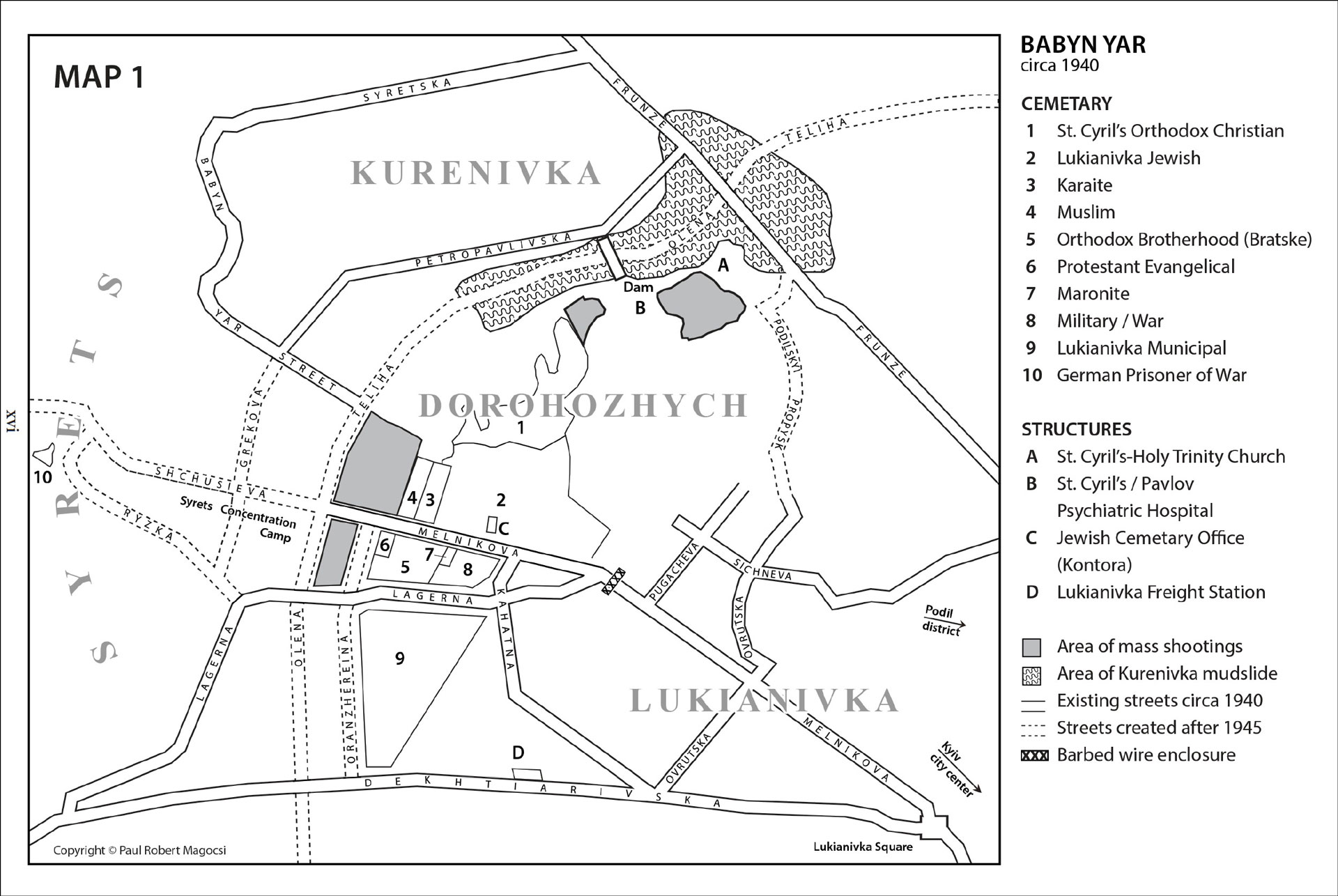
Babyn Yar is a place that has been populated since prehistoric times. During Kyiv's 1,500-year-long existence, Babyn Yar was always a suburb, which thanks to its picturesque landscape was dubbed the "Kyivan Switzerland."
During World War II Babyn Yar, like Auschwitz in present-day Poland, became a prominent symbol of the destruction of the European Jews during the Holocaust. This deadly process began in September 1941 with the murder of nearly 34,000 Jews and continued over the next several years with the shootings of tens of thousands more Jews as well as the Roma people, the mentally ill, Soviet prisoners of war, Ukrainian national activists, Communist party members, and ordinary residents of Kyiv taken as hostages. These people were stripped of their dignity as individuals, subjected to inhuman brutality, and then murdered. Babyn Yar became one of the most traumatic sites in the Ukrainian experience of World War II.
There are still many of mysteries surrounding the history of Babyn Yar. Questions connected with a scholarly understanding of the tragedy seem to be no less profound, obscured, and festering than the very ravines that were located in the suburbs of Kyiv before the war. To this day scholars do not have definite answers, and therefore a significant number of important questions are still under discussion. When the shootings began in Babyn Yar? Who were the first victims? Where were the sites of the mass shootings of the Jews on 29 and 30 September 1941? What was the total number of Jews killed, as well as the number of executed Roma, Soviet POWs, and civilians? Who were the executioners and participants of the crime? What role was played by "ordinary people" from among the local population? Did the "Ukrainian police," the "Bukovinian Battalion," and other Organization of Ukrainian Nationalist (OUN) formations take part in the shootings? The list of questions can be extended. Against this background, numerous myths, blatant falsifications, and even the utter denial of Babyn Yar as a symbol of the Holocaust are put forward not only in the media but also in popular and some scholarly literature.
This book initially took the form of a commemorative volume to mark the occasion of the seventy-fifth anniversary of Babyn Yar, 29–30 September 2016. It was the result of the collaborative effort of scholars working in various disciplines in Canada, France, Israel, the Netherlands, Ukraine, and the United States. All the contributors were united by a desire to inform the international community about the history of one of the twentieth century's most terrible human tragedies and by their realization of the importance of preserving its memory.
The original concept was a book of three sections: "Before Babyn Yar," "The Babyn Yar Tragedy," and "After Babyn Yar." At the center of the story lay the history of a Nazi crime, the politics of memory and forgetting from the Stalinist period to the present day, and the cultural memory of Babyn Yar. The contributions were designed to provoke questions for further discussion, especially since the various authors may have raised the same questions, but did not always arrive at the same answers.
Preparations for commemorating the 75th anniversary of the Babyn Yar tragedy showed us that the past is not some ossified construct, but rather a dynamic phenomenon open to new discoveries. Every generation contributes its own vision and interpretation of the Babyn Yar tragedy. These are expressed in a variety of dimensions: commemorative, mutual recognition, philosophical, and anthropological. Finally, there is a generational aspect to the reinterpretation of this tragedy, as every generation does this in its own way.
Persons who were born in an independent Ukraine are today posing the following questions: What is Babyn Yar in our memory, and how does this memory fit into our understanding of the past and the philosophical and ideological picture of the present and the future? In Babyn Yar Jews were killed only because they were Jews; the Roma people because they were Roma; the mentally ill because they were "defective and useless"; and Ukrainian nationalists and communists because of their political views. In the end, Babyn Yar as a Jewish memory was killed because someone deemed it "politically expedient." Behind all these crimes was a brutal disregard for the most important values: human dignity and the inherent right to life. To know and remember the Babyn Yar tragedy means not allowing such a crime to be repeated. In the Ukrainian experience, Babyn Yar is also a symbolic farewell to empire and its mythological legacy, a return to the work of sadness and the formation of a culture of mourning.
From the perspective of the third millennium, we realize somewhat in astonishment that the lessons of Babyn Yar have not lost their political, moral, or humanistic relevance. Today, the values that were ostensibly regarded as indispensable and inviolable in postwar Europe — respect for human life and ethnic and religious identify, the inadmissibility of using war as a way to change state borders — are once again under threat and being eroded by doubts and nihilism. Humanity's continuing existence, not just that of individuals or countries, depends today on whether the democratic world will be able to halt the manifestations of barbarism through solidarity-based efforts. Babyn Yar as a symbol of the Holocaust and other tragedies is reminding us of all this once again.
The commemorative 75th anniversary volume noted above served as the inspiration for this fully revised and expanded scholarly version of Babyn Yar: History and Memory. Each of the chapters has been revised and all the quotations, interpretive statements, and technical terms have been given footnote references to archival and secondary sources. An entirely new chapter (five) has been added as well as an afterword which surveys efforts at commemoration from 2016 to the present.
Transliteration from Cyrillic alphabets is always a challenge. Keeping in mind the English-language reader, we have opted to use in the text (but not in the source references) a simplified version of the Library of Congress transliteration system for Russian and Ukrainian no apostrophes for soft signs; no diacritical elisions; and the use of ya, ye, yu (instead of ia, ie, iu) at the beginning of a word. Placenames are given in the state language of the country in which they are presently located (Ukrainian for Ukraine; Polish for Poland, etc.). Personal names are given in the forms used in major reference works such as the Encyclopedia of Ukraine, 5 vols (University of Toronto Press, 1984–93) and The YIVO Encyclopedia of Jews in Eastern Europe, 2 vols. (Yale University Press, 2008).
Finally, a collaborative volume of this kind could not be realised without the cooperation of supportive "staff," in particular our translator Marta D. Olynyk, scholarly editor Serhiy Bilenky, critical reader Marco Carynnyk, copy editor Peter Bejger, and page designer John Beadle. We are extremely grateful to the work of all these individuals, knowing full well that any errors and shortcomings that remain are the sole responsibility of the editors.