




"Dnipro: Biography of a Great City in the Steppe" by Andrii Portnov and Tetiana Portnova is the winner of the 2026 Encounter Prize

Ukrainian Jewish Encounter (UJE), a Canadian charitable non-profit organization, and Ukraine's NGO Publishers' Forum (Lviv, Ukraine) are pleased to announce that Dnipro: Biography of a Great City in the Steppe written by Andrii Portnov and Tetiana Portnova and published in 2024 by Kyiv's Vikhola is the sixth winner of Encounter: The Ukrainian-Jewish Literary Prize.
The announcement was made at the award ceremony on 11 September, which also featured a discussion about the books shortlisted for the 2026 prize. A video of the ceremony will shortly be available on the UJE website.
Dnipro: Biography of a Great City in the Steppe explores the city's history, urban imagery, and life in the metropolis, which is situated in eastern Ukraine on the Dnipro River, across different historical eras. It pays special attention to the lives and experiences of the city's Jewish communities from the 19th century to the present day, with a dedicated chapter on the Holocaust in Dnipropetrovsk (as it was known at the time), and to the Jewish community's impact on the city's development.
Andrii Portnov is a Ukrainian historian, essayist, and editor. From 2018 to 2025, he was the Chair Professor of Entangled History of Ukraine at the European Viadrina University at Frankfurt (Oder). Born in Dnipro, Portnov is Professor at Pilecki Institute in Warsaw, director of the PRISMA UKRAЇNA Research Network Eastern Europe in Berlin, and a Member of the Ukrainian PEN. He is interested in the history of Dnipro, the intellectual history of Central and Eastern Europe in the 19th and 20th centuries, Ukrainian historiography, Polish-Ukrainian relations, the history of German-language Ukrainian studies, and the work of Viktor Petrov (V. Domontovych). The author of six books and over 200 articles, his works have been published in numerous languages, including English, Polish, German, French, and Japanese.
Tetiana Portnova is a researcher at the Dmytro Yavornytsky National Historical Museum of Dnipro and the Institute of Slavic Studies at the University of Potsdam. She has written two books. Her research interests include historical urban studies, intellectual history, and museum studies. Born in Dnipro, she served for over a decade as an associate professor in the Department of Historiography, Source Studies, and Archival Studies at the Oles Honchar Dnipro National University.
"The books submitted for this year's Encounter Prize underscore a growing tendency in Ukrainian literature to show the role Jews and other ethnic groups played in Ukraine's history and contemporary life in a wider context," said Natalia A. Feduschak, UJE's Director of Communications. "This is a positive development; various ethnic groups are treated as a part of the Ukrainian political state rather than 'the other'. As Russia continues its genocidal war against Ukraine, representatives of the country's ethnic groups are fighting and dying for Ukraine. This year's winning book is not only a testament to the role Jews and other ethnic groups played in the development of Dnipro but also to a city that is showing incredible fortitude in the face of daily attacks from its warmongering neighbor."
Members of the international jury commented on the winning entry and the shortlisted books submitted for the 2026 Encounter Prize:
Ola Hnatiuk (Poland-Ukraine/Jury Head)
Encounter: The Ukrainian-Jewish Literary Prize is being awarded for the sixth time. The list of winning works and authors is also a list of titles destined to become classics of Ukrainian fiction and the humanities. It demonstrates that Ukrainian-Jewish relations have become a significant topic not only for authors and publishers but also for the Ukrainian reading public. The diversity of themes among this year's books further confirms this. Crucially, classic subjects — such as the Holocaust — are represented. Yet it is telling that most books in the competition approach their topics within a broad historical context. Works dedicated to resistance against totalitarian systems — specifically those by Daniel Finkelstein and Natan Sharansky — are particularly striking. One is captivated by publications whose authors painstakingly restore the memory of phenomena that have vanished from our landscape — such as Iryna Kotlobulatova's work on Lviv's Jewish photographers and photo studios, and Yuriy Biryulov's study of the city's Jewish architectural heritage. The field of biography has also been enriched by the books of Vadym Adadurov and Ivan Monolatii; notably, both authors chose figures from the era of the Ukrainian National Republic (UNR) and West Ukrainian People's Republic (ZUNR) — Il'ko Borshchak and Yakiv Orenshtain — as their subjects. Yet, the most profound impression was made by Dnipro: Biography of a Great City in the Steppe by Tetiana Portnova and Andrii Portnov. The panorama spanning the centuries is truly striking in its richness and the intricate interweaving of the various communities and groups that shaped the city's urban landscape. Jewish-Ukrainian encounters stand out in this picture, though the authors have not overlooked the city's tragic historical chapters — the pogroms of the early 20th century, the purges of the Great Terror, and the Holocaust.
Serhiy Hirik (Ukraine/Jury Member)
In recent years, the UJE Encounter Prize has become a powerful tool for rethinking the shared history of Ukrainians and Ukrainian Jews and for freeing them from simplistic stereotypes about one another. This year's competition, which featured nonfiction works, highlighted the achievements of the Ukrainian-Jewish dialogue at a new intellectual level; unlike many other awards, there were no weak entries. Each nominated work is strong and will impact its specific readership. I was particularly impressed by the research — as well as the purely literary qualities — of the biographical books by Vadym Adadurov (on Il'ko Borshchak) and Ivan Monolatii (on Yakiv Orenshtain, whose life and work the historian has studied for decades). Andrii Portnov and Tetiana Portnova pay tribute to the often-underestimated significance of the city of Dnipro for the country's central and southern regions; their narrative skillfully integrates the role of the Jewish community — across the various eras of Katerynoslav/Dnipropetrovsk/Dnipro — into the broader story. Yuriy Biryulov's book on Lviv's Jewish architectural heritage and Iryna Kotlobulatova's research on the city's Jewish photographers reframe the Jewish minority's past within the multiethnic landscape of the Galician capital, thereby enriching the public's understanding of the city's history. The true significance of the Encounter Prize lies precisely in its ability to foster such profound works and to embed a complex, shared heritage into contemporary collective memory.
Vladyslava Moskalets (Ukraine/ Jury Member)
The book Dnipro: Biography of a Great City in the Steppe by Andrii Portnov and Tetiana Portnova is a concise history of the city that encompasses its various dimensions — as a steppe frontier, an industrial center, and a site of revolutions and wars. The history of the Jewish community — which was the second-largest group in the city during the 19th century — is organically woven into this biography. The authors recount the history of the Jewish community through its economic activities and political engagement, as well as through the painful chapters of its past — specifically the pogroms and the Holocaust. This history avoids idealization, demonstrating that a city can serve as both a setting for peaceful coexistence and a stage for bloody conflict. A valuable part of the book is the account of the revival and life of the modern Jewish community and the transformation of Dnipro into one of the most active centers of Jewish life in Ukraine. Andrii Portnov and Tetiana Portnova's book shows how Ukrainian history can be written in a multidimensional and inclusive way.
Our stories are incomplete without each other
Founded in 2019, Encounter: The Ukrainian-Jewish Literary Prize is awarded annually to the most influential work in literature and nonfiction (in alternate years) that fosters Ukrainian-Jewish understanding, helping solidify Ukraine's place as a multiethnic society and giving truth to the motto, "Our stories are incomplete without each other."
The prize is valued at 7000 Euros. The winner receives 6000 Euros, with the author/s receiving 4000 Euros and the publisher 2000 Euros. Four (4) incentive awards will receive 250 Euros each.
The first Encounter Prize was awarded in September 2020 in the fiction category to Vasyl Makhno for his novel Eternal Calendar (Lviv: The Old Lion Publishing House, 2019). The second year of the award, in 2021, was dedicated to the nonfiction category, with Yohanan Petrovsky-Shtern winning for the Ukrainian-language translation of his groundbreaking work, The Anti-Imperial Choice: The Making of the Ukrainian Jew (Kyiv: Krytyka, 2018). The third year of the award was in 2023, in the fiction category, and Sofia Andrukhovych won for her novel Amadoka (Lviv: The Old Lion Publishing House, 2020). In 2024's nonfiction category, Yuriy Skira won for his book Solid: The Life-Saving Footwear Factory (Lviv: Choven Publishing House, 2023). The fifth year of the prize in 2025 was held in the fiction category, with the award going to Khrystyna Semeryn (Editor) for Centuries of Presence. The Jewish World in Ukrainian Short Prose of the 1880s–1930s (Kyiv: Dukh i Litera, 2024).
The 2022 Encounter Prize was not awarded in connection with Russia's genocidal war against Ukraine.
Despite the many challenges Ukraine's literary community faced, 11 Ukrainian publishers submitted 16 books to the 2026 competition. The long list featured nine books, five of which made the short list.
Along with Dnipro: Biography of a Great City in the Steppe, the following books were shortlisted:
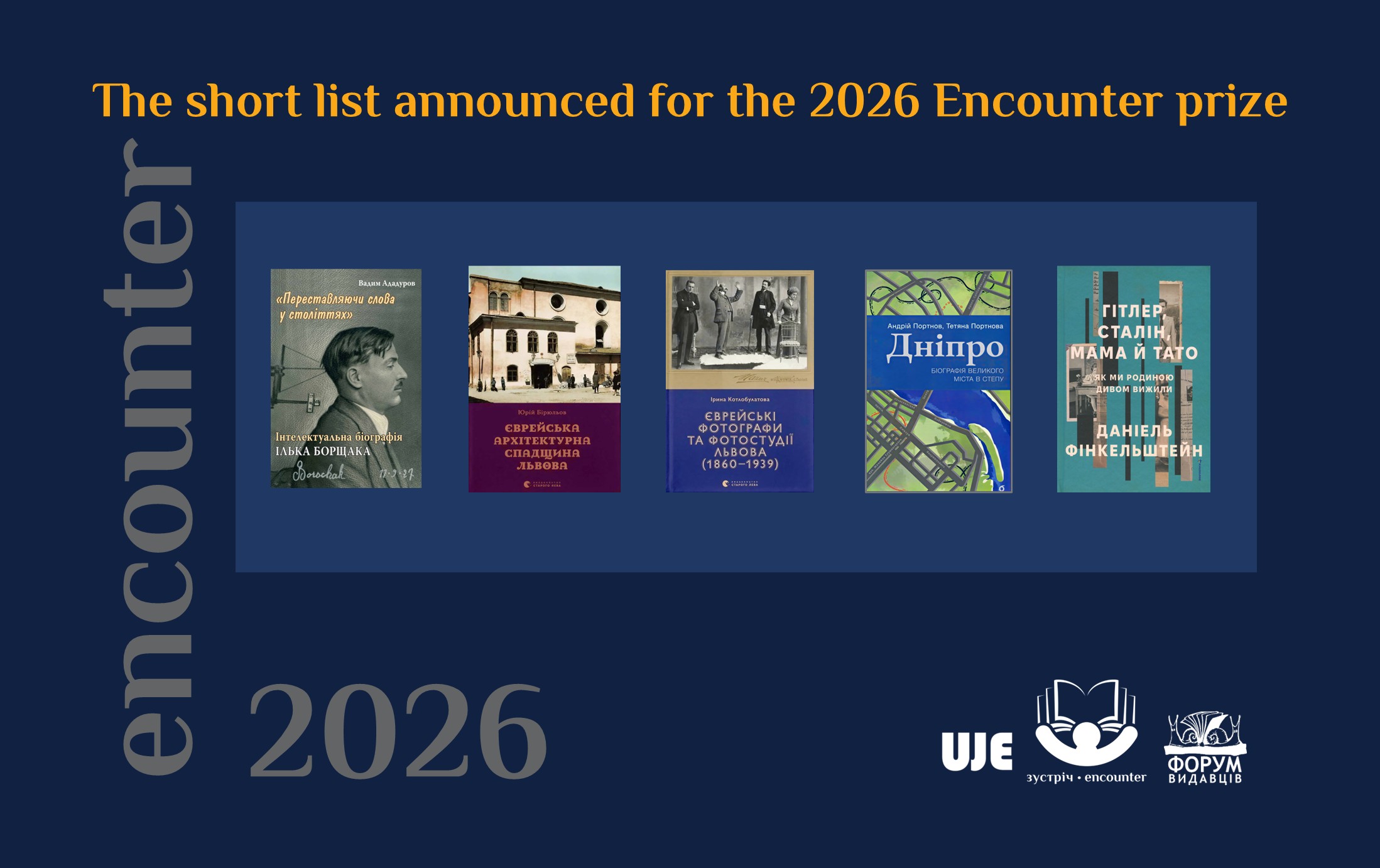
Vadym Adadurov, Rearranging Words Across Centuries: An Intellectual Biography of Il'ko Borshchak (Lviv: Ukrainian Catholic University Press, 2024)
Vadym Adadurov, Perestavliayuchy slova u stolittiah: intelektualna biohrafia Il'ka Borshchaka (Lviv: Vydavnytstvo Ukrainskoho Katolytskoho Universytetu, 2024)
Yuriy Biryulov, The Jewish Architectural Heritage of Lviv (Lviv: The Old Lion Publishing House, 2024)
Yuriy Biryulov, Yevreiska architekturna spadshchyna Lvova (Lviv: Vydavnytstvo Staroho Lvova, 2024)
Iryna Kotlobulatova, Jewish Photographers and Photo Studios of Lviv (1860–1939) (Lviv: The Old Lion Publishing House, 2024)
Iryna Kotlobulatova, Yevreiski photohrafy ta photostudii Lvova (1860-1939) (Lviv: Vydavnytstvo Staroho Lvova, 2024)
Daniel Finkelstein, Hitler, Stalin, Mom, and Dad: A Family Memoir of Miraculous Survival (Kyiv: Vydavnytstvo Knyholav, 2025)
Daniel Finkelstein, Hitler, Stalin, mama i tato. Yak my rodynoyu dyvom vyzhyly (Kyiv: Vydavnytstvo «Knyholav», 2025)
The international jury for the 2026 Encounter Prize is composed of:
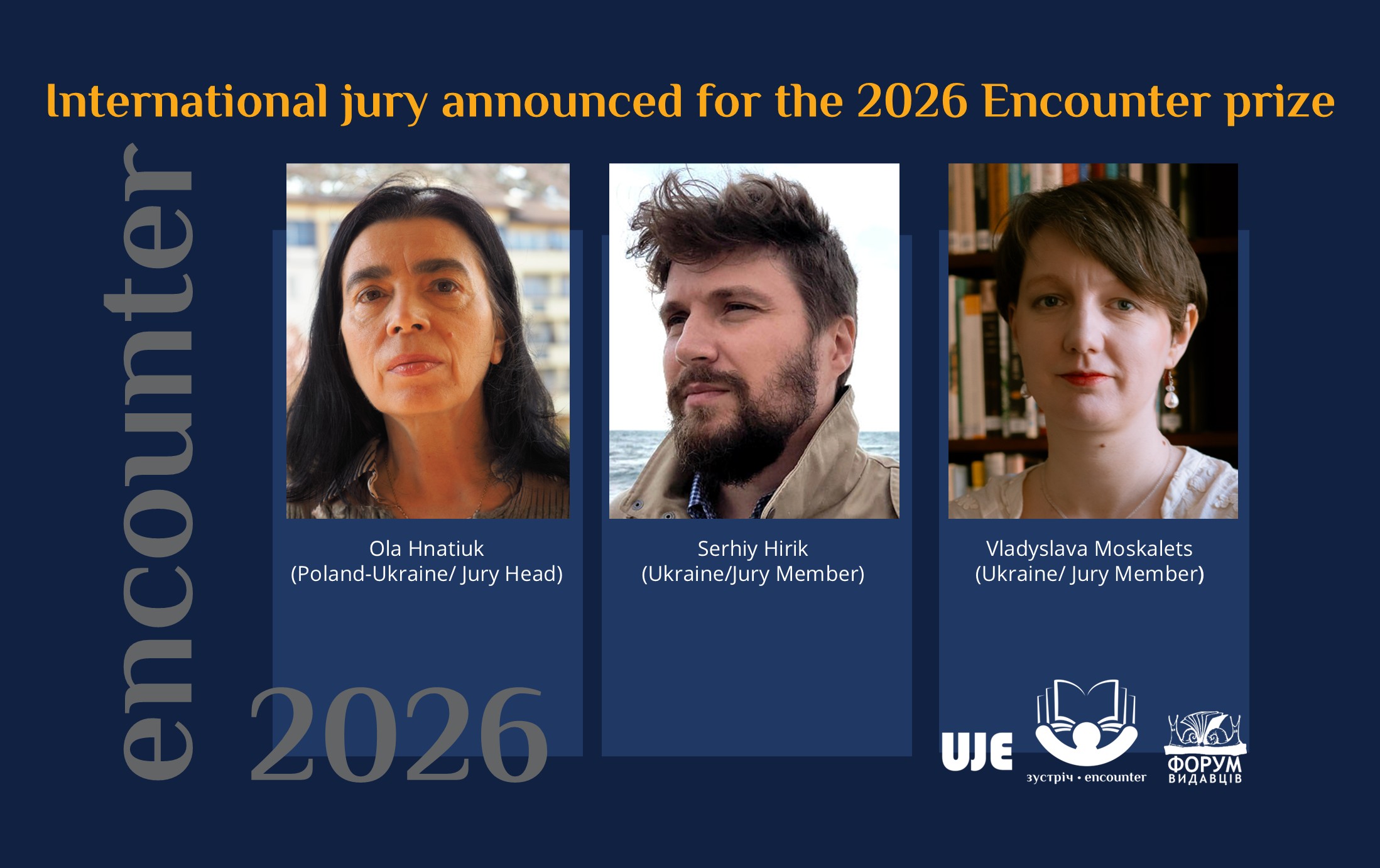
Ola Hnatiuk (Poland-Ukraine/Jury Head)
Ola Hnatiuk is a professor at the National University of Kyiv-Mohyla Academy, emeritus professor at the University of Warsaw, an essayist, translator, public figure, and member of the Ukrainian and Polish PEN Clubs. She is the author of Courage and Fear (2015) and Farewell to the Empire. Ukrainian Discussions on Identity (Polish edition — 2003, Ukrainian translation — 2005) and other works.
Serhiy Hirik (Ukraine/Jury Member)
Serhiy Hirik holds a PhD in History/Candidate of Science in History. Born in Kryvyi Rih in 1985, he lives and works in Kyiv. Since 2013, he has worked at the State Research Institution "Encyclopedia Press". Since 2015, he has taught in the MA in Jewish Studies program at the National University of Kyiv-Mohyla Academy. He has been the Vice President of the Ukrainian Association for Jewish Studies since 2019. His academic interests include the history of Ukrainian Jews, antisemitism, and political parties and propaganda.
Vladyslava Moskalets (Ukraine/ Jury Member)
Vladyslava Moskalets is a historian, a researcher at the Center for Urban History in Lviv, an associate professor in the Department of History, and the head of Jewish Studies at the Ukrainian Catholic University. She is engaged in research on the Jewish social history of Galicia in the 19th and early 20th centuries, Ukrainian-Jewish relations, and Yiddish reportage literature. She was a Fulbright Scholar (2018-2019) at Northwestern University, Chicago, with the project "Powerful and Needy: Economic Transformations of Eastern European Jews during the Period of Capitalism, the Case of Austrian Galicia."