




Empathy — The best means of mutual understanding
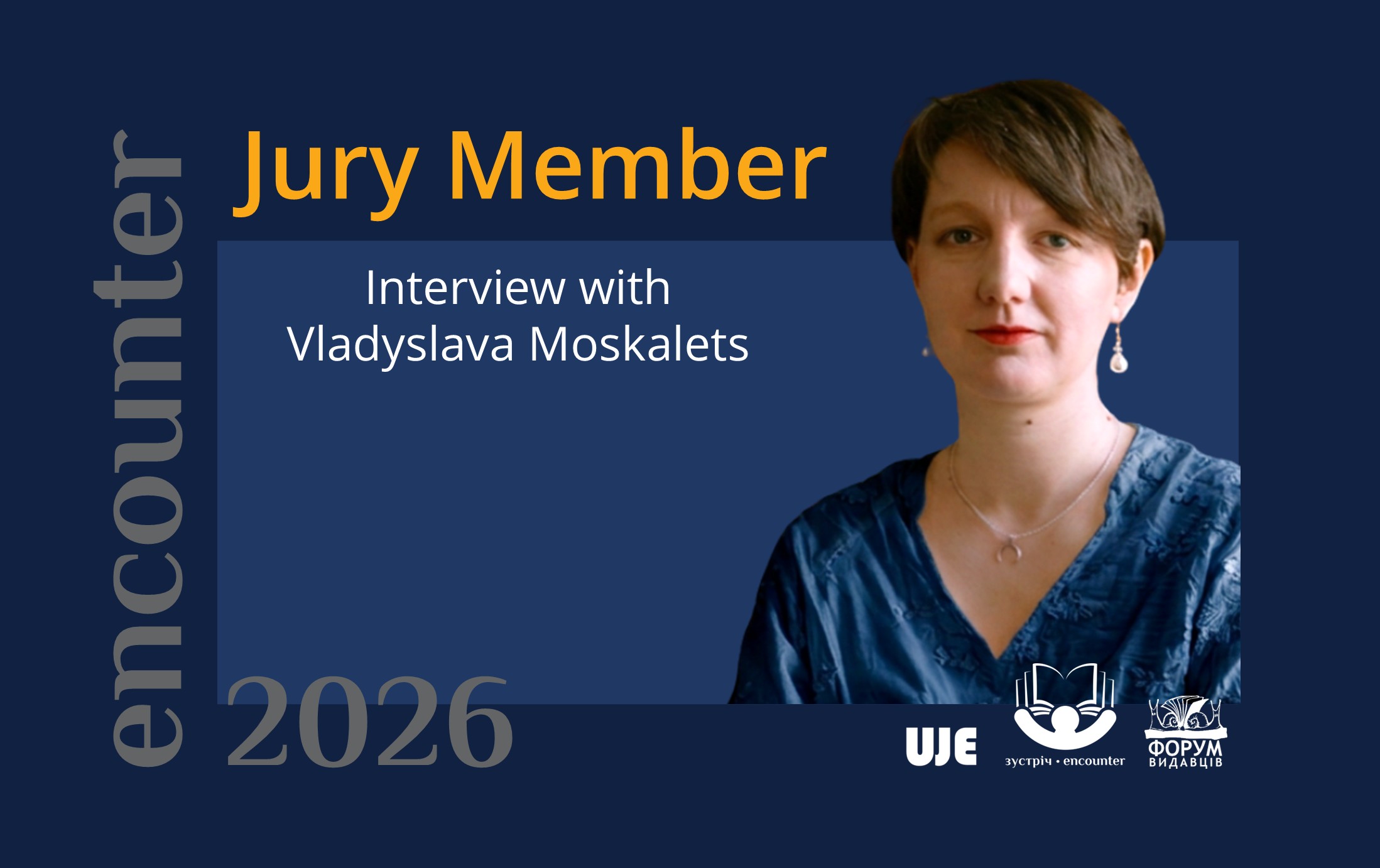
Vladyslava Moskalets: "We need to allow ourselves to explore not only Ukrainian history, but also Jewish, Polish, Armenian, and other histories. After all, they are all part of Ukraine's history"
Vladyslava Moskalets is a historian, researcher of Ukrainian Jewry and Ukrainian-Jewish relations, associate professor at the Department of History at the Ukrainian Catholic University (UCU), coordinator of the Jewish Studies Program at UCU, and researcher at the Lviv Center for Urban History. For over a decade, she has studied the history of Jewish communities in Galicia, analyzing Yiddish-language sources and researching the economic, cultural, and social ties between Ukrainians and Jews.
Moskalets began her academic career by researching the Jewish communities in the industrial town of Boryslav. She is currently working on a book titled The Oil Shtetl: A History of Jewish Business in Boryslav, studying the history of Carpathian Jews and rural communities in Galicia, and researching Ukrainian-Jewish cultural contacts — specifically, Yiddish translations of Ukrainian literature and attempts at dialogue during the interwar period.
In 2026, Moskalets joined the jury of Encounter: The Ukrainian-Jewish Literary Prize. In this interview, we discuss shared Ukrainian-Jewish heritage, the role of literature in reimagining the past, and why the history of Ukrainian Jewry is integral to the history of Ukraine.
You have been researching the history of Jewish communities in Galicia for over a decade — from the economic and social networks in Boryslav to cultural contacts between Ukrainians and Jews. Was there a moment in your work when engaging with Jewish sources allowed you to see history from a completely new perspective?
For me, gaining access to the language and literature was the most valuable part. It allowed me to see how the exact same event is described in different languages and from different perspectives. This develops critical thinking, helps one understand how historical narratives are shaped, and teaches one to work with diverse sources rather than accept any single version of events as the absolute truth.
When I read, for instance, the prose and essays of Ivan Franko or the Polish writer Józef Rogosz, I encountered familiar imagery: "exploiters," "profiteers," and so on. A significant portion of 19th-century Ukrainian literature portrays Jewish people in a very specific way. However, Jewish sources open up a completely different perspective: entrepreneurs discussing books and magazines and engaging in intellectual debates. Those we are used to seeing strictly as businessmen also turn out to be intellectuals, philanthropists, and founders of beit midrashot, centers of Jewish education and learning. It is an entirely different frame of reference, a different way of seeing the world.
Why do you think knowledge of history is more important than a declaration of reconciliation?
I don't think reconciliation should be our main goal. It is far more important that we know each other's history better. If we did, we would be more empathetic. And in my view, empathy is what truly matters.
Ukrainian-Jewish studies constantly emphasize that the history of Jews in Ukraine is a part of the history of Ukraine. Bruno Schulz is part of our cultural heritage not because he was Ukrainian, but because he lived and created within this space.
It seems to me that we need to allow ourselves to explore not only Ukrainian history, but also Jewish, Polish, Armenian, and other histories. They are all part of Ukraine's history. This kind of approach helps us look more honestly at the difficult chapters of the past. Yes, history can be painful and conflict-ridden, but Ukrainian-Jewish relations are about much more than just a history of conflicts.
Why shouldn't Ukrainian-Jewish relations be reduced solely to a history of conflicts?
We very often forget about everyday coexistence. For instance, consider the rural Jews, who were an inseparable part of life in Galician villages and small towns. Ukrainian peasants traded with Jewish merchants at marketplaces, conversed with one another, and knew at least a few Yiddish words. For our grandmothers' and great-grandmothers' generation, Jews were neighbors rather than some alien or exotic community.
Looking at the late 19th century, we can see that the Ukrainian national movement also sought political cooperation with Jewish circles. Therefore, the history of Ukrainian-Jewish relations should not be reduced solely to pogroms or the Holocaust, even though these are extremely important and tragic chapters. It is also made up of coexistence, cooperation, mutual influence, and shared experiences. Only by assembling the entire picture can we truly comprehend our past.
Any interethnic relations are complex and do not fit into a black-and-white narrative. That is precisely why they need to be researched. I am convinced that the history of various communities should be part of school curricula, and even more so, of university education. This is the only way to learn how to discuss complex issues without oversimplification and to break free from superficial perceptions.
What examples of Ukrainian-Jewish coexistence best demonstrate the close connection between these communities?
When you research the Carpathians, you notice that Jews frequently appear in ethnographic descriptions as intermediaries between the city and the countryside. They brought goods to the villages that weren't available there and purchased local produce to sell in the cities. They were a vital link in economic life.
Even familiar images from literature, such as the tavern (korchma) or the innkeeper, have a more complex context: these were not just places of commerce, but also spaces for socializing and exchanging news.
Such details can also be found in literary sources. For instance, Ivan Franko mentioned dymkari, Jewish artisans who used stamps to dye and pattern the skirts of peasant girls. These seemingly minor stories show just how deeply the Jewish presence was woven into the tapestry of everyday life in Ukrainian villages.
Researching political history is much easier because more sources are available. In contrast, researching the history of daily life is far more difficult. It requires processing a vast number of archival documents that are often fragmented and scattered, requiring specialized training to analyze them. That is why the number of such studies is still relatively low.
What role can works of fiction play in helping us better understand the history of Jewish communities in Ukraine?
I believe that it is precisely through fiction that one can reach a broader audience. Even if a story is fictional, as long as it is based on real experiences and historical context, it helps us see what is difficult to explain through facts alone. It portrays daily life, emotions, and human relationships — things that often remain outside the scope of academic research.
I teach Jewish studies courses at the Ukrainian Catholic University, and when I ask my students what they know about the history of Ukrainian Jewry, they most often mention only the Holocaust, Babyn Yar, or the Hasidim. Their knowledge is usually very fragmented. That is why literature can serve as a bridge to this topic: first, it helps people see the human dimension of history and then sparks interest in scholarly research.
Therefore, literature is playing an increasingly vital role. Books like Sofia Andrukhovych's Amadoka help us discuss the Holocaust and Jewish history through the lens of human experience. Overall, it seems to me that Ukrainian society is still just learning how to engage with difficult memory.
If the most painful topics are still difficult for society to process, where should we begin?
It seems to me that today we often begin with local history, cultural heritage, and museum and art projects. A good example is the ReHERIT project by the Lviv Center for Urban History, which operates in Medzhybizh, Uman, Rivne, and other cities, engaging local communities in rethinking Jewish heritage.
The same goes for tourist routes through Jewish Galicia, theater productions, books, and museum initiatives. For now, most of these emerge thanks to individual institutions rather than the state.
I would like to see this work become more decentralized so that small towns begin to view Jewish heritage not as something "alien," but as their own cultural resource for education, culture, tourism development, and a better understanding of their own history.
What role can the Encounter Prize play in opening up lesser-known chapters of our shared history to Ukrainian readers today?
The prize draws attention to books. When a publication receives an award, people take an interest in it, buy it, read it, and discuss it. This year, the Encounter Prize is awarded for nonfiction, but these are not narrow academic works. These are books written in an accessible language for a broad audience, helping people better understand history.
For me, it is particularly important that not all of them are dedicated exclusively to Jewish topics. It is central in some books, while in others, it is just one of the storylines. This demonstrates that Jewish history does not exist in isolation but is an inseparable part of Ukraine's history.
What are the main topics and stories presented in the books selected as finalists for the Encounter Prize?
First and foremost, these are books about people with complex biographies who lived at the intersection of different cultures, languages, and political environments. Figures like Il’ko Borschak or Yakiv Orenstain demonstrate just how multidimensional human history can be.
Another important topic is Ukrainian cities. An increasing number of researchers portray Lviv, Dnipro, Lutsk, and other cities as multicultural spaces in which Jewish communities were integral to their development. There is also a very noticeable focus on material heritage — architecture, cemeteries, photography, and urban spaces. These tangible elements enable us to see history where we previously did not notice it.
What is your experience as a jury member of the Encounter Prize, and what do you consider most important when selecting these books?
It is a fascinating experience. I especially resonate with books about people going through severe trials. That is why I would recommend paying attention to Natan Sharansky's memoirs and Daniel Finkelstein's book — they speak in different ways about loss, survival, and human resilience.
I also highly recommend the biographies of Yakiv Orenstain and Il’ko Borschak. These are brilliant, easy-to-read intellectual biographies that provide a wealth of historical context.
For residents of Lviv, I would suggest the books by Yuriy Biryulov and Iryna Kotlobulatova, and for anyone interested in the history of Ukrainian cities, the books about Dnipro and Lutsk.
It seems to me that all the 2026 finalists meet a significant public demand to rethink Ukraine's history. They are written for anyone who wants to better understand our multicultural past.
On 11 September 2026, we found out which of the shortlisted books won Encounter: The Ukrainian-Jewish Literary Prize.
A three-member jury selected the best work in the nonfiction category published in 2024–2025. The editorial board of the Zbruc magazine invites our esteemed readers to explore these conversations with the jury members.
The 2026 shortlist features the following books:
Vadym Adadurov, Rearranging Words Across Centuries: An Intellectual Biography of Il'ko Borshchak (Lviv: Ukrainian Catholic University Press, 2024)
Vadym Adadurov, Perestavliayuchy slova u stolittiah: intelektualna biohrafia Il’ka Borshchaka (Lviv: Vydavnytstvo Ukrainskoho Katolytskoho Universytetu, 2024)
Yuriy Biryulov, The Jewish Architectural Heritage of Lviv (Lviv: The Old Lion Publishing House, 2024)
Yuriy Biryulov, Yevreiska architekturna spadshchyna Lvova (Lviv: Vydavnytstvo Staroho Lvova, 2024)
Iryna Kotlobulatova, Jewish Photographers and Photo Studios of Lviv (1860–1939) (Lviv: The Old Lion Publishing House, 2024)
Iryna Kotlobulatova, Yevreiski photohrafy ta photostudii Lvova (1860-1939) (Lviv: Vydavnytstvo Staroho Lvova, 2024)
Andrii Portnov, Tetiana Portnova, Dnipro: Biography of a Great City in the Steppe (Kyiv: Publishing House Vikhola, 2024)
Andrii Portnov, Tetiana Portnova, Dnipro. Biohrafia velykoho mista v steppu (Kyiv: TOV Vikhola, 2024)
Daniel Finkelstein, Hitler, Stalin, Mom, and Dad: A Family Memoir of Miraculous Survival (Kyiv: Vydavnytstvo Knyholav, 2025)
Daniel Finkelstein, Hiter, Stalin, mama i tato. Yak my rodynoyu dyvom vyzhyly (Kyiv: Vydavnytstvo «Knyholav», 2025)
The winner was:
Andrii Portnov, Tetiana Portnova, Dnipro: Biography of a Great City in the Steppe (Kyiv: Publishing House Vikhola, 2024)
Andrii Portnov, Tetiana Portnova, Dnipro. Biohrafia velykoho mista v steppu (Kyiv: TOV Vikhola, 2024)
The long-listed books in 2026 are available here.
In December 2019, Ukrainian Jewish Encounter (UJE), with the support of the NGO Publishers' Forum (Lviv, Ukraine), launched Encounter: The Ukrainian-Jewish Literary Prize. The prize aims to honor the centuries-long shared experience of Ukrainians and Jews as expressed in the printed word. Awarded annually to a work that fosters Ukrainian-Jewish understanding and helps strengthen Ukraine's position as a multiethnic society, the prize alternates between two categories: fiction (prose, poetry, drama) and nonfiction (historical works, biographies, memoirs, journalism, essays).
The first Encounter prize was awarded in 2020 in the fiction category to Vasyl Makhno for his novel Eternal Calendar (Lviv: Old Lion, 2019). In 2021, the winner in the nonfiction category was Yohanan Petrovsky-Shtern for the Ukrainian-language translation of his groundbreaking work The Anti-Imperial Choice: The Making of the Ukrainian Jew (Kyiv: Krytyka, 2018). The third year of the award was in 2023, in the fiction category, and Sofia Andrukhovych won for her novel Amadoka (Lviv: Old Lion, 2020). In 2024's nonfiction category, Yuriy Skira won for his book Solid: The Life-Saving Footwear Factory (Lviv: Choven, 2023). The fifth year of the prize in 2025 was held in the fiction category, with the award going to Khrystyna Semeryn (Editor) for Centuries of Presence. The Jewish World in Ukrainian Short Prose of the 1880s–1930s (Kyiv: Dukh i Litera, 2024).
The 2022 prize was not awarded due to Russia's genocidal war against Ukraine.
Interview by Ksenia Pavlyshyn
This article originally appeared in @zbruc on 9 September 2026.
Translated from the Ukrainian by Vasyl Starko.