




It is natural for a Jew to consider themself Ukrainian
Serhiy Hirik: "The Nazis did not create antisemitism from scratch. It existed practically everywhere Jews lived and even where they did not"
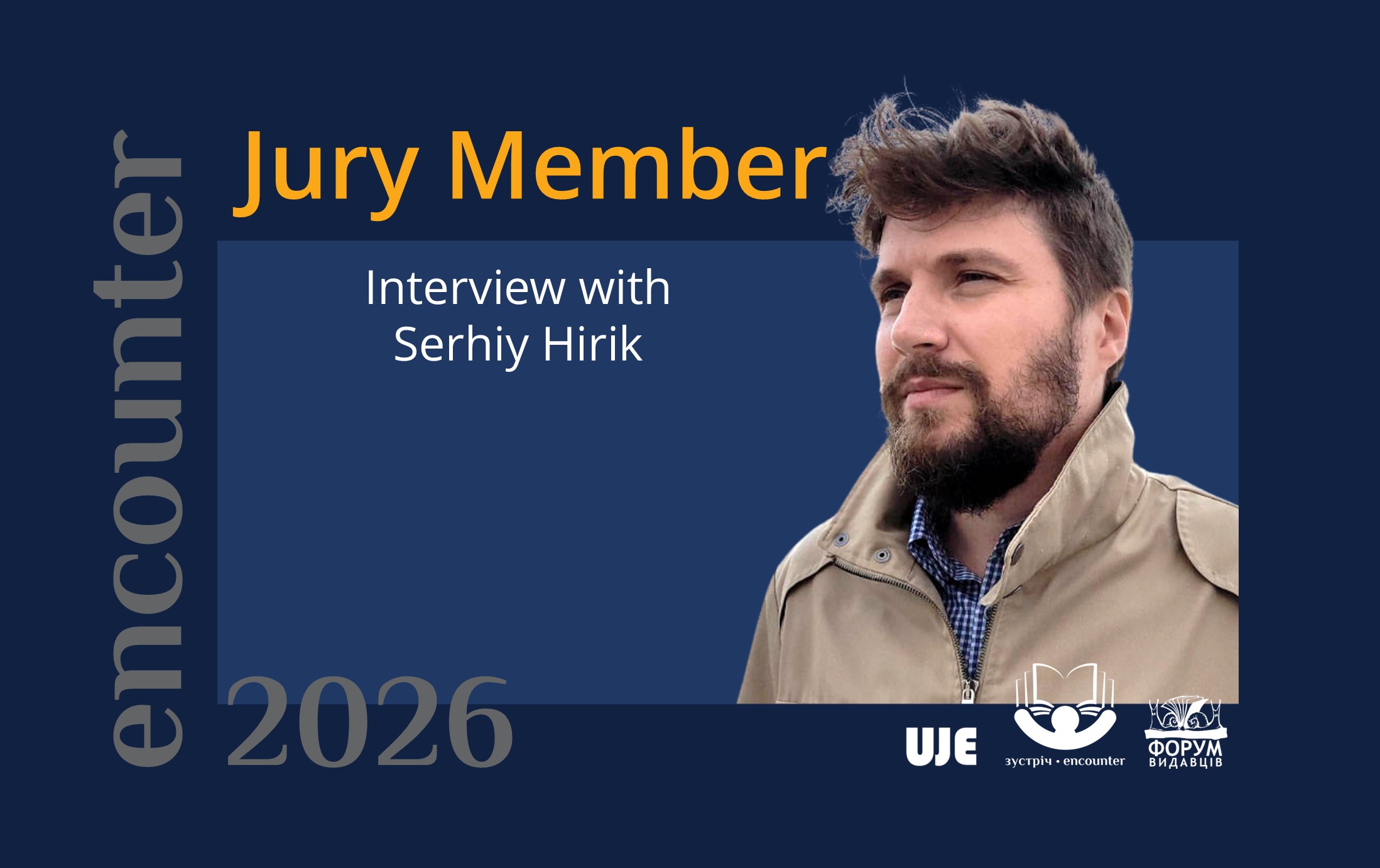
Serhiy Hirik, a PhD in History, specializes in the history of Ukrainian Jews and Ukrainian-Jewish relations. He serves as Vice President of the Ukrainian Association for Jewish Studies and is a Senior Researcher at the state-run Encyclopedic Publishing House. He teaches in the Master's Program in Jewish Studies at Kyiv-Mohyla Academy, where he lectures on the history of Ukrainian Jews, Ukrainian-Jewish relations, the Holocaust, and antisemitism.
His research interests encompass 20th-century Ukrainian political history, Ukrainian and Jewish National Communism, Ukrainian-Jewish political cooperation, and the history of antisemitism. He has authored studies on the interaction between Ukrainian and Jewish political forces, antisemitism, and the representation of the Holocaust in public discourse. This year, Hirik joined the jury of Encounter: The Ukrainian-Jewish Literary Prize.
How do you explain to your students where antisemitism originated, and why the Holocaust cannot be viewed solely as a consequence of Nazi policy?
The course itself is structured around the formation of modern antisemitism. It is essential to distinguish between Judeophobia, a form of religious intolerance towards Jews, and modern antisemitism, which became largely secularized in the late 18th and early 19th centuries. Religious explanations for hostility towards Jews lost their persuasiveness, yet the hostility itself did not disappear. Instead, economic, cultural, political, and eventually racial rationalizations emerged.
Crucially, the Nazis did not create antisemitism from scratch. It existed practically everywhere Jews lived and even where they did not. Every European country had its own traditions, which Nazi propaganda exploited and adapted to the local context. Even within Nazi-controlled Europe, it is more accurate to speak not of a single antisemitic campaign, but of a series of local campaigns tailored to regional dynamics.
For instance, in Ukraine and Belarus, one of the central narratives was "Judeo-Bolshevism." The Soviet regime was framed as inherently Jewish, and Jews were held collectively responsible for Soviet repressions. This gave rise to the narrative of the Germans as "liberators," while the extermination of Jews was framed as a supposed retaliation for the crimes of Bolshevism.
In Poland, this narrative also had a longer history: the myth of "Judeo-Communism" (żydokomuna) was actively exploited as early as the Polish-Soviet War of 1920. During the interwar period, this was compounded by economic stereotypes — the perception of Jews as exploiters of Poles and Ukrainians through trade. Calls to "buy from your own" proliferated, specifically urging the development of native cooperatives. The campaign for their creation and growth was sometimes accompanied by calls to boycott Jewish shops.
"Biological" antisemitism also existed: Jews were depicted as a source of disease, dirt, and infection. In Polish propaganda during the Nazi occupation, for instance, claims were spread that Jews supposedly carried lice, which in turn spread typhus. In France, different narratives were utilized, notably the thesis that Jews controlled Great Britain and were the driving force behind its war against Germany.
Therefore, to understand why the Holocaust unfolded differently in various countries, it is not enough to look solely at the decisions of the Nazi leadership. One must take into account local traditions of antisemitism (and alongside them, local traditions of cooperation between the non-Jewish population and Jews), political culture, and how Nazi policy interacted with specific societies.
If antisemitism manifested so differently across various countries, what was the common thread? Why have Jews been the target of such persistent hostility over the centuries?
Antisemitism assumed various forms across different societies. In France, where Jewish emancipation began as early as the French Revolution, accusations of economic exploitation were initially widespread. By the late 19th and early 20th centuries, this shifted to charges of "dual loyalty" to the state and some external power, a dynamic that became particularly prominent during the Dreyfus affair.
In the German states during the second half of the 19th century, racial, biological antisemitism began to take shape. Jews came to be perceived as a distinct race, one that could not be "eliminated" through assimilation or conversion. It was this precise transformation that laid the critical intellectual groundwork for the future genocidal project.
In Central and Eastern Europe, including Ukraine, religious perceptions persisted longer and merged with political conspiracy theories. In the Black Hundreds press of the Russian Empire, Jews were simultaneously accused of crucifying Christ and of conspiring to seize political power to enslave the Slavic population. A telling example is the Beilis case in Kyiv (1911–1913), which demonstrated that even at the beginning of the 20th century, the blood libel could still be viewed as plausible by a segment of society. Moreover, some people remain convinced of its truth even today.
In all these instances, the mechanism of "othering" — drawing a line between "us" and "them" — was at work. While specific arguments shifted from religious and economic to political and racial, the perception of Jews as foreign, dangerous, or disloyal could endure for centuries.
Moving away from the history of antisemitism to look at the other side of coexistence, how did Ukrainians and Jews interact politically? And when did Jews begin to perceive themselves as part of the Ukrainian political nation?
As modern nationalisms began to take shape in our part of Europe during the 19th century, contacts between Ukrainian and Jewish intellectuals in Ukraine gradually intensified.
A telling example is the discussion between the Jewish press and the Ukrainian journal Osnova. Specifically, the journal's use of the term zhyd [which was traditionally used in Ukrainian but increasingly perceived as a pejorative in the Russian Empire. — Transl.] sparked a polemic following a letter from a Jewish reader, Dr. Veniamin Portugalov, who was generally sympathetic to the Ukrainian national movement. He requested that the editorial board refrain from using the term, as Jews found it offensive. This marked the beginning of a debate over the language Ukrainians used to talk about Jews and the nature of Ukrainian-Jewish relations.
This discussion eventually ceased not because the parties reached an agreement, but due to the suppression of opportunities for a free Ukrainian and Jewish press within the Russian Empire. However, the very fact that this polemic occurred demonstrates that a dialogue between Ukrainian and Jewish intellectual circles was already taking place as early as the mid-19th century.
In the 20th century, we see growing numbers of Jews who became part of the Ukrainian political and cultural movement, spanning both literature and politics. For instance, Volodymyr Koriak and Naum Kaliuzhny, prominent figures in the Borotbist party, were of Jewish descent but identified themselves with the Ukrainian political and cultural milieu. In other words, the possibility gradually emerged for a person of Jewish origin to perceive themselves as part of the Ukrainian political nation, even if that individual did not renounce their Jewish heritage.
This process became widespread in the 20th century, and the final integration of the Jewish minority into the Ukrainian political nation occurred after Ukraine declared its independence. Post-1991, the fusion of Jewish and Ukrainian identities became entirely natural and did not conflict with the very model of the Ukrainian political nation. A person can simultaneously be Jewish by ethnic or cultural background and Ukrainian in a political sense — a citizen of Ukraine who identifies with the Ukrainian state, culture, and society.
This marks an important departure from the Soviet period, when the Soviet system itself insisted on recording nationality as a distinct administrative category. In independent Ukraine, such an administrative barrier no longer exists. Consequently, today it is completely natural for a person of Jewish descent to maintain a Jewish identity while concurrently considering themselves Ukrainian.
This year, you are serving on the jury for Encounter: The Ukrainian-Jewish Literary Prize. This year, which books present the most compelling depictions of different models of Ukrainian-Jewish interaction?
The books submitted for this year's prize fall under the nonfiction category. They are highly diverse, yet several are particularly illustrative of Ukrainian-Jewish cooperation and how individuals of Jewish descent became part of the Ukrainian cultural and political nation.
In particular, I would highlight Vadym Adadurov's study on Il’ko Borshchak and Ivan Monolatii's book Executor of the Word: Yakiv Orenshtain. A Ukrainian Publisher at the Crossroads of Cultures, Ideologies, and Politics.
The story of Yakiv Orenshtain, a Ukrainian publisher of Jewish descent from Kolomyia, is especially telling. He launched his Halytska Nakladnia publishing brand in Kolomyia (later Ukrainska Nakladnia in Berlin), publishing fiction, political, scientific, and educational literature. This enterprise was frequently unprofitable, so it was essentially an act of cultural patronage and cultural mission. Orenshtain integrated so deeply into the Ukrainian cultural milieu that his work became an integral part of the Ukrainian national project.
Il’ko Borshchak is a different but equally fascinating example. He was a historian of Jewish descent who became a Ukrainian historian and public figure. He researched Ukrainian history (while simultaneously constructing a Ukrainian national myth) and studied the history of Ukrainian-French relations and the Ukrainian presence in France, whereas Jewish themes were not central to his work.
An interesting narrative, though on the scale of a city, can be found in the book about Dnipro by Andrii Portnov and Tetiana Portnova. While the Jewish theme is not the primary focus, it weaves throughout the city's history, as the Jewish community was an inseparable part of it and played a central role during various periods.
There are also books where Ukrainian-Jewish interaction is less prominent. For instance, Yuriy Biryulov's The Jewish Architectural Heritage of Lviv is an extraordinarily interesting publication, even though Ukrainian-Jewish relations are not its main topic.
Therefore, I would not rank these books hierarchically. For me, what matters most is that they enable us to view one overarching theme from different angles: Ukrainian-Jewish history is not merely a chronicle of conflicts or the coexistence of two separate communities, but also a history of cultural interaction, cooperation, and the endeavors of individuals who became part of the Ukrainian cultural and political nation, regardless of their background.
What is the role of the Encounter Prize? To what extent does it serve as an international platform for dialogue between Ukrainians and Jews today?
I would slightly shift the focus from "dialogue" to the conceptualization of and reflection on the past. Today, Ukrainian and Jewish identities are not mutually exclusive. A person can simultaneously be Jewish and Ukrainian, and there is no contradiction in that. Therefore, the need for a dialogue specifically between two distinct communities is no longer as self-evident as it was 100 or 150 years ago.
Instead, it is exceptionally critical to understand how these two communities coexisted in the past, a time when Ukrainian and Jewish identities could not always merge within a single person; rather, they frequently existed side by side yet separately.
This is clearly reflected in the books nominated for this prize. Regardless of genre — historical research, journalism, or memoirs — most address the past. Even Natan Sharansky's memoirs are largely a narrative about a different historical experience, a time when the formation of the modern Ukrainian political nation was still incomplete. Therefore, what we need today is not so much a dialogue between two separate groups as a reflection on how the shared space we now inhabit was formed.
A prize always serves as an additional incentive for creating books. The vast majority of published works never receive any awards, but the very existence of specialized distinctions fosters a community of authors who realize that their work is valued and visible.
When a prize is established in a specific field, it acts as a catalyst, increasing the volume of research, books, and authors, while gradually elevating quality alongside quantity. Any specialized award can, in this manner, stimulate the development of a distinct intellectual ecosystem.
On 11 September 2026, we found out which of the shortlisted books won Encounter: The Ukrainian-Jewish Literary Prize.
A three-member jury selected the best work in the nonfiction category published in 2024–2025. The editorial board of the Zbruc magazine invites our esteemed readers to explore these conversations with the jury members.
The 2026 shortlist features the following books:
Vadym Adadurov, Rearranging Words Across Centuries: An Intellectual Biography of Il'ko Borshchak (Lviv: Ukrainian Catholic University Press, 2024)
Vadym Adadurov, Perestavliayuchy slova u stolittiah: intelektualna biohrafia Il’ka Borshchaka (Lviv: Vydavnytstvo Ukrainskoho Katolytskoho Universytetu, 2024)
Yuriy Biryulov, The Jewish Architectural Heritage of Lviv (Lviv: The Old Lion Publishing House, 2024)
Yuriy Biryulov, Yevreiska architekturna spadshchyna Lvova (Lviv: Vydavnytstvo Staroho Lvova, 2024)
Iryna Kotlobulatova, Jewish Photographers and Photo Studios of Lviv (1860–1939) (Lviv: The Old Lion Publishing House, 2024)
Iryna Kotlobulatova, Yevreiski photohrafy ta photostudii Lvova (1860-1939) (Lviv: Vydavnytstvo Staroho Lvova, 2024)
Andrii Portnov, Tetiana Portnova, Dnipro: Biography of a Great City in the Steppe (Kyiv: Publishing House Vikhola, 2024)
Andrii Portnov, Tetiana Portnova, Dnipro. Biohrafia velykoho mista v steppu (Kyiv: TOV Vikhola, 2024)
Daniel Finkelstein, Hitler, Stalin, Mom, and Dad: A Family Memoir of Miraculous Survival (Kyiv: Vydavnytstvo Knyholav, 2025)
Daniel Finkelstein, Hiter, Stalin, mama i tato. Yak my rodynoyu dyvom vyzhyly (Kyiv: Vydavnytstvo «Knyholav», 2025)
The winner was:
Andrii Portnov, Tetiana Portnova, Dnipro: Biography of a Great City in the Steppe (Kyiv: Publishing House Vikhola, 2024)
Andrii Portnov, Tetiana Portnova, Dnipro. Biohrafia velykoho mista v steppu (Kyiv: TOV Vikhola, 2024)
The long-listed books in 2026 are available here.
In December 2019, Ukrainian Jewish Encounter (UJE), with the support of the NGO Publishers' Forum (Lviv, Ukraine), launched Encounter: The Ukrainian-Jewish Literary Prize. The prize aims to honor the centuries-long shared experience of Ukrainians and Jews as expressed in the printed word. Awarded annually to a work that fosters Ukrainian-Jewish understanding and helps strengthen Ukraine's position as a multiethnic society, the prize alternates between two categories: fiction (prose, poetry, drama) and nonfiction (historical works, biographies, memoirs, journalism, essays).
The first Encounter prize was awarded in 2020 in the fiction category to Vasyl Makhno for his novel Eternal Calendar (Lviv: Old Lion, 2019). In 2021, the winner in the nonfiction category was Yohanan Petrovsky-Shtern for the Ukrainian-language translation of his groundbreaking work The Anti-Imperial Choice: The Making of the Ukrainian Jew (Kyiv: Krytyka, 2018). The third year of the award was in 2023, in the fiction category, and Sofia Andrukhovych won for her novel Amadoka (Lviv: Old Lion, 2020). In 2024's nonfiction category, Yuriy Skira won for his book Solid: The Life-Saving Footwear Factory (Lviv: Choven, 2023). The fifth year of the prize in 2025 was held in the fiction category, with the award going to Khrystyna Semeryn (Editor) for Centuries of Presence. The Jewish World in Ukrainian Short Prose of the 1880s–1930s (Kyiv: Dukh i Litera, 2024).
The 2022 prize was not awarded due to russia's genocidal war against Ukraine.
Interview by Ksenia Pavlyshyn
This article originally appeared @zbruc on 4 September 2026.
Translated from the Ukrainian by Vasyl Starko.