




The past directly influences the present
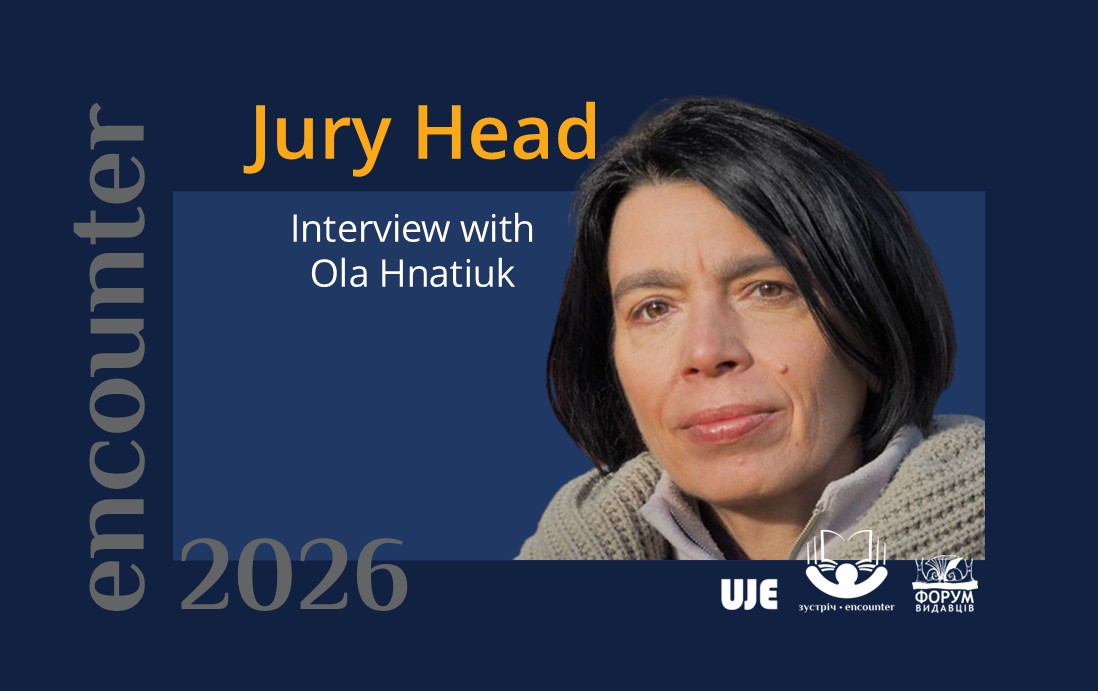
Ola Hnatiuk: "The past directly impacts the present. It can be explained in the simplest terms: we have run from the past for so long that the time has finally come to confront it and reclaim our memory"
Ola Hnatiuk is a historian, literary scholar, translator, professor at the Kyiv-Mohyla Academy, and professor emerita at the University of Warsaw. She specializes in Ukrainian culture, history, and Ukrainian-Polish relations.
She is the author of Farewell to Empire and Courage and Fear. The latter book is a study of the lives of Lviv's intelligentsia during World War II. Through diaries, memoirs, letters, and archival documents, the book explores the Polish, Ukrainian, and Jewish communities, their relationships, and instances of solidarity and hostility. The publication was awarded the Grand Prix at the 2015 Lviv Publishers' Forum.
This year, Hnatiuk chairs the jury for Encounter: The Ukrainian-Jewish Literary Prize.
What was your biggest revelation when you studied Ukrainian-Jewish relations for your book Courage and Fear? What did you take away as a manifestation of humanity in connection with the historical events you researched?
I was particularly interested in the figures of the Lviv intelligentsia during World War II — people who lived in the same space but simultaneously within different, segregated communities. These communities had begun to fracture as early as the late 19th century, and these divides only deepened after World War I. This was a matter of both cultural differences and the processes of modern nation-building, which were accompanied by a concurrent rise in nationalism.
Poles viewed themselves as the dominant nation within the resurrected Polish state during the interwar period. Outwardly, everyone was supposedly equal before the law, but in practice, the Ukrainian and Jewish communities possessed fewer rights — politically, socially, and economically. The authorities harshly suppressed the Ukrainian aspiration for independence or even autonomy. Not only illegal organizations but also legal ones came under fire, including the leadership of the largest Ukrainian political party, the Ukrainian National Democratic Alliance (UNDO). This increasingly strained relations between individuals and communities.
On an individual level, Ukrainians' strategies in Galicia varied: some chose assimilation and a shift in identity, while others chose resistance to oppression. On the community level, however, this led to an ever-widening rift and mutual misunderstanding.
Violence escalated during the 1930s, beginning with the 1930 pacification in Galicia, progressing through the beatings of Jewish students and property destruction, and leading to pogroms against Ukrainian institutions. Following the 1929 global economic crisis, antisemitism intensified. This phenomenon cannot be explained by economic factors alone; the state's policies and the search for scapegoats to blame for social and political hardships were also at fault, and Jews and Ukrainians increasingly filled that role. One of the most notorious manifestations of this policy was the numerus clausus, the strict limitation of higher education access for citizens of Jewish descent.
Tellingly, even when Jewish citizens appealed to the authorities demanding the punishment of those responsible for beatings or murders, their pleas often went unanswered. They might have been told, "Do you honestly think we are going to arrest our own children?" This is a vivid illustration of the breakdown of the rule of law and the absence of legal equality for all.
Why exactly did Jewish identity and the memory of the Holocaust become a problem for the Soviet regime after the war?
The Soviet regime saw the postwar unification of Jews around the memory of the Holocaust as a threat to itself. On one hand, it represented the creation of a new Jewish identity; on the other, it served as a reminder of the Soviet regime's own failures and offenses towards its citizens.
This was not only because the Soviet Union had been an ally of the Third Reich until 22 June 1941, and any attempts to report on the fate of Jews under German occupation were banned. Once the war began, the Soviet authorities also failed to do enough to evacuate the Jewish population. In other words, postwar state antisemitism was part of a policy of forgetting, designed to prevent anyone from daring to mention the USSR's role in unleashing World War II, the causes of the catastrophic civilian casualties, or the mass surrender of Red Army soldiers into captivity.
The rise of antisemitism, including the wave linked to the policy known as Zhdanovshchina (the Zhdanov doctrine), was a component of postwar Soviet policy. I would not separate the Soviet regime's antisemitism from its broader Russian chauvinistic policy towards these territories.
How did the Soviet regime combat the Jewish memory of the Holocaust?
The struggle against the Jewish memory of the catastrophe of World War II is a distinct and vital narrative to which I have dedicated several of my studies, and I plan to publish them as a book. In the works already published, I examined literary pieces dedicated to the Holocaust that were released immediately after the war.
The first Ukrainian work of fiction about the Holocaust, written by a Ukrainian author, appeared as early as 1945. This was a long short story by Olha Duchyminska titled Eti. The protagonist is a Jewish survivor from Lviv who escapes a burning ghetto at the last minute and finds refuge in a village with an elderly schoolteacher.
The work was heavily condemned by critics, and the author became the target of a harassment campaign. Later, Duchyminska was accused of every imaginable "sin," imprisoned, and sent to the camps, despite being well into her 70s. She managed to survive and lived to be over a hundred years old, but unfortunately, no one ever recorded her testimony. For me, such narratives — about lost memory, memory destroyed along with people, and the destruction of a sense of a shared destiny — are particularly significant.
In my research, I have sought to demonstrate that this was part of a broader policy of russian state chauvinism. It affected not only Jews but also Ukrainians, Poles, Lithuanians, and many other nationalities who found themselves under German occupation. This policy was known as the "struggle against bourgeois nationalism."
Are the tragedy of the Holocaust and Ukrainian-Jewish history sufficiently memorialized in Ukraine today? What role has civil society played in this process?
Soviet state policy focused on erasing memory: people were afraid to recall their past for fear of harming their descendants. Jewish parents often refrained from telling their children about their heritage, instead raising them in the spirit of the dominant Soviet culture. The situation in Poland was similar. The goal was to speak as little as possible about the horrors experienced not only due to trauma, but also out of fear of a repressive regime. Consequently, entire generations grew up knowing almost nothing of their own history.
Following Ukraine's independence, it took at least ten years for the process of remembering to begin. Authorities rarely act on their own initiative; they begin to move under pressure from civil society. First, a public demand for memorialization must form, and that requires time.
This is clearly illustrated by the commemoration of victims of Soviet repressions. In the Lviv region, monuments began appearing at the turn of the 1980s and 1990s — in villages, regional towns, and in Lviv itself. In the Kyiv region, however, this process unfolded much more slowly. Bykivnia existed as a place of memory, but attempts were made to erase it. The construction of a state memorial became possible only in the mid-2000s, meaning it took more than a decade to restore the memory of the repressions and ensure their full public commemoration.
Around this same period, initiatives to commemorate Jews who perished during the Holocaust also began. Babyn Yar is a separate story, as it is a symbolic place of memory, and its process of memorialization started earlier.
To break free from the captivity of oblivion, one needs to live for a while in liberty, to live in the spirit of freedom. A society may be liberated from a repressive system in a single day, but the liberation of public opinion and ways of thinking takes far longer.
This year, the submissions for Encounter: The Ukrainian-Jewish Literary Prize, for which you serve as a jury member, focus on nonfiction. Having read these books, what topics and trends have you identified?
I would categorize them by genre rather than by topic. One such genre is memoir literature — personal or family experiences rooted in the 20th century, covering the Holocaust and the experience of the repressive Soviet system. This category includes, most notably, the books by Natan Sharansky and Daniel Finkelstein.
Other books can be classified as local history: portraits of cities, specifically Dnipro and Lutsk. A separate direction involves research into Jewish cultural and architectural heritage in Ukraine. Within this scope, I would highlight Dmytro Poliukhovych's book on the Jewish cemetery in Sataniv, Yuriy Biryulov's The Jewish Architectural Heritage of Lviv, and Iryna Kotlobulatova's study on Jewish photographers and photo studios in Lviv.
Finally, there are works within the frame of intellectual biography: Vadym Adadurov's book on Il’ko Borshchak and Ivan Monolatii's book on Yakiv Orenstain. These last two works might be better described as scholarly research rather than general nonfiction.
Overall, however, this represents a very broad spectrum of topics concerning the Jewish presence in Ukrainian culture, viewed through the prism of personal or family history, urban history, photography, architecture, and cultural heritage. What unites these books is their reflection on the past.
The past directly impacts the present. It can be explained in the simplest terms: we have run from the past for so long that the time has finally come to confront it and reclaim our memory.
Can the Encounter Prize serve as a platform for Ukrainian-Jewish dialogue?
It is an important element of that dialogue, but not its only platform. A platform for dialogue can also take the form of a local community caring for a specific site, a monument, or the memory of people, such as prominent writers or simply local residents. There are many such examples. Local memory is of great significance. It is crucial for it to also find its place within national memory. For this to happen, there must be a perceived need for dialogue and remembering. The platform itself can take various forms depending on what it addresses. The Encounter Prize is a vital link in this dialogue. Works of fiction and nonfiction become the meeting place here — an encounter with readers, with a different experience, and with a different history.
On 11 September 2026, we found out which of the shortlisted books won Encounter: The Ukrainian-Jewish Literary Prize.
A three-member jury will select the best work in the nonfiction category published in 2024–2025. The editorial board of the Zbruc magazine invites our esteemed readers to explore these conversations with the jury members.
The 2026 shortlist features the following books:
Vadym Adadurov, Rearranging Words Across Centuries: An Intellectual Biography of Il'ko Borshchak (Lviv: Ukrainian Catholic University Press, 2024)
Vadym Adadurov, Perestavliayuchy slova u stolittiah: intelektualna biohrafia Il’ka Borshchaka (Lviv: Vydavnytstvo Ukrainskoho Katolytskoho Universytetu, 2024)
Yuriy Biryulov, The Jewish Architectural Heritage of Lviv (Lviv: The Old Lion Publishing House, 2024)
Yuriy Biryulov, Yevreiska architekturna spadshchyna Lvova (Lviv: Vydavnytstvo Staroho Lvova, 2024)
Iryna Kotlobulatova, Jewish Photographers and Photo Studios of Lviv (1860–1939) (Lviv: The Old Lion Publishing House, 2024)
Iryna Kotlobulatova, Yevreiski photohrafy ta photostudii Lvova (1860-1939) (Lviv: Vydavnytstvo Staroho Lvova, 2024)
Andrii Portnov, Tetiana Portnova, Dnipro: Biography of a Great City in the Steppe (Kyiv: Publishing House Vikhola, 2024)
Andrii Portnov, Tetiana Portnova, Dnipro. Biohrafia velykoho mista v steppu (Kyiv: TOV Vikhola, 2024)
Daniel Finkelstein, Hitler, Stalin, Mom, and Dad: A Family Memoir of Miraculous Survival (Kyiv: Vydavnytstvo Knyholav, 2025)
Daniel Finkelstein, Hiter, Stalin, mama i tato. Yak my rodynoyu dyvom vyzhyly (Kyiv: Vydavnytstvo «Knyholav», 2025)
The winner was:
Andrii Portnov, Tetiana Portnova, Dnipro: Biography of a Great City in the Steppe (Kyiv: Publishing House Vikhola, 2024)
Andrii Portnov, Tetiana Portnova, Dnipro. Biohrafia velykoho mista v steppu (Kyiv: TOV Vikhola, 2024)
The long-listed books in 2026 are available here.
In December 2019, Ukrainian Jewish Encounter (UJE), with the support of the NGO Publishers' Forum (Lviv, Ukraine), launched Encounter: The Ukrainian-Jewish Literary Prize. The prize aims to honor the centuries-long shared experience of Ukrainians and Jews as expressed in the printed word. Awarded annually to a work that fosters Ukrainian-Jewish understanding and helps strengthen Ukraine's position as a multiethnic society, the prize alternates between two categories: fiction (prose, poetry, drama) and nonfiction (historical works, biographies, memoirs, journalism, essays).
The first Encounter prize was awarded in 2020 in the fiction category to Vasyl Makhno for his novel Eternal Calendar (Lviv: Old Lion, 2019). In 2021, the winner in the nonfiction category was Yohanan Petrovsky-Shtern for the Ukrainian-language translation of his groundbreaking work The Anti-Imperial Choice: The Making of the Ukrainian Jew (Kyiv: Krytyka, 2018). The third year of the award was in 2023, in the fiction category, and Sofia Andrukhovych won for her novel Amadoka (Lviv: Old Lion, 2020). In 2024's nonfiction category, Yuriy Skira won for his book Solid: The Life-Saving Footwear Factory (Lviv: Choven, 2023). The fifth year of the prize in 2025 was held in the fiction category, with the award going to Khrystyna Semeryn (Editor) for Centuries of Presence. The Jewish World in Ukrainian Short Prose of the 1880s–1930s (Kyiv: Dukh i Litera, 2024).
The 2022 prize was not awarded due to Russia's genocidal war against Ukraine.
Interview by Ksenia Pavlyshyn
This article originally appeared @zbruc on 9 September 2026.
Translated from the Ukrainian by Vasyl Starko.