




"The Ukrainian-Jewish Encounter: Cultural Dimensions": Part 3.2
The Ukrainian Jewish Encounter was founded in 2008 with the goal of building stronger relations between Ukrainians and Jews, two peoples who, for centuries, lived side by side on the territory of what is modern-day Ukraine. Since then, in keeping with its motto, "Our stories are incomplete without each other," UJE has sponsored conferences, round-table discussions and research, as well as translations and publication of works the organization anticipates will promote a deeper understanding between the two peoples and an appreciation of their respective cultures.
We offer for the first time the book The Ukrainian-Jewish Encounter: Cultural Dimensions in an eBook format.
The book is a collection of essays that examine the interaction between the Ukrainian and Jewish cultures from the seventeenth century onwards. Written by leading experts from Ukraine, Israel, and other countries, the book presents a broad perspective on parallels and cross-cultural influences in various domains — including the visual arts, folklore, music, literature, and language. Several essays also focus on mutual representation — for example, perceptions of the "Other" as expressed in literary works or art history.
The richly illustrated volume contains a wealth of new information on these little-explored topics. The book appears as volume 25 in the series Jews and Slavs, published by the Hebrew University of Jerusalem since 1993. In several previous volumes, considerable attention is given to the defining role of the Old Testament in Ukrainian literature and art and to the depiction of Jewish life in Ukraine in the works of Nikolai Gogol, Taras Shevchenko, Ivan Franko, Lesia Ukrainka, Vladimir Korolenko, and other writers.
This collection of essays was co-edited by Wolf Moskovich, Professor Emeritus, Hebrew University of Jerusalem, and Alti Rodal, Co-Director of the Ukrainian Jewish Encounter, who also wrote the introduction to the volume. It was published in 2016 by Hebrew University of Jerusalem.
Part 3.2
Click here for a pdf of the entire book.
Ukrainian Influence on Hasidic Music
Lyudmila Sholokhova (YIVO, New York)
Jewish culture over many centuries experienced significant influences from the cultures of the nations among which Jewish people lived. For Jewish culture, these influences were enriching, yet highly selective: the Jewish world could adapt only those features of the surrounding cultures that did not conflict with the Jewish traditional way of life. The realm of music was particularly amenable to such influences, since religious limitations hardly applied to the language of music. Even on the verbal level of songs, the use of foreign words or whole phrases was common, as were parallel translations from Slavic and other languages into Yiddish or Hebrew — all transmitted through melodies and contributing to the unique character of Jewish creativity.
In eastern Europe, Jewish, and especially Hasidic, music benefited greatly from integrating traditional Ukrainian, Polish, Russian, Romanian, Hungarian, and Gypsy melodies into its folk repertoire. Ukrainian influence was probably the strongest. Ukraine was the place where Hasidism was born and flourished. The natural beauty of Ukrainian lands served as a great source of spiritual and musical inspiration for many Hasidic leaders, beginning with the Ba'al Shem Tov (1698–1760), acclaimed as the founder of Hasidism. The Hasidim idolized music. According to the Kabbalah, the Jewish mystical teaching and foundation of Hasidic philosophy, music was a bridge between life, nature, and the divine. Music was a powerful channel for reaching the holiness of God, for being heard by God and, as a result, for changing the world for the better by contributing to Tikkun Olam [Heb., "repairing the world"], the highest goal of life.
The ethnographer Abraham Rekhtman recalls gatherings of Bratslaver Hasidim attended by members of the An-sky ethnographical expedition in 1913, which demonstrated the significance of music for the Hasidim: "While dancing, they [the Bratslaver Hasidim] kept singing and repeating dozens of times the words of the Zohar: [1] ' The Torah was given to us with a tune, the Shekhineh ["the Divine Presence"] with a tune, and the Jews will come out of Golus ["Exile"] with a tune." [2] According to Rabbi Nahman of Bratslav's musical philosophy, which is based on his in-depth knowledge of esoteric Kabbalah concepts, one holy Yiddish tune "embraces all of Israel." [3] The soul of every individual contains a small fraction, a spark of this holy melody. The Zaddik [Hasidic leader] collects those sparks and sings a velt-nign ["a world-tune"]. Because he sings the melody with deep understanding and respect, he awakens all of the smaller sparks and makes them sing. People who possess these tiny sparks come to realize that they too are part of this holy velt-nign.
The central goal of Hasidic musical philosophy was therefore to assemble as many as possible of the divine particles disseminated in secular tunes. In their search for the divine, they would very often turn to Ukrainian melodies. It was considered a mitsve ["good deed"] to purify the melodies and bring out the holiness hidden within them.
There are a number of Hasidic stories that illustrate how particular nigunim [spiritual melodies] of the famous rabbis were created following accidental encounters with a Ukrainian song or instrumental melody sung or played by a shepherd (pastekhl, in Yiddish). One story (published in Chemjo Vinaver's Anthology of Hassidic Music, with annotations by Eliyahu Schleifer) refers to Rabbi Isaac Ayzik of Kaliv (1744–1821), one of the most prominent representatives of early Hasidism. Walking through the forest, the Rabbi heard the melody that a shepherd sang in the Ukrainian language about the forest that separates him from his beloved. The Rabbi immediately improvised Yiddish words to this song, partly translating it and also adding a meaningful Hasidic metaphor about Galut/Goles [physical and spiritual exile] that separates him from the Shekhinah [the dwelling place of the divine or presence of God in the world]. [4] After singing his version of the song to the shepherd, the Rabbi asked him to repeat the song, but the shepherd no longer remembered it. The Rabbi concluded that the song was released and returned to its pure original form, to its holy source. Another version of the song (according to Vinaver, possibly, the oldest one) is attributed to the Rebbe of Riminev [5] and was published in Menahem Kipnis's work, [6] under the title with which it became famous: "Royz, royz, vi vayt bistu": [7]
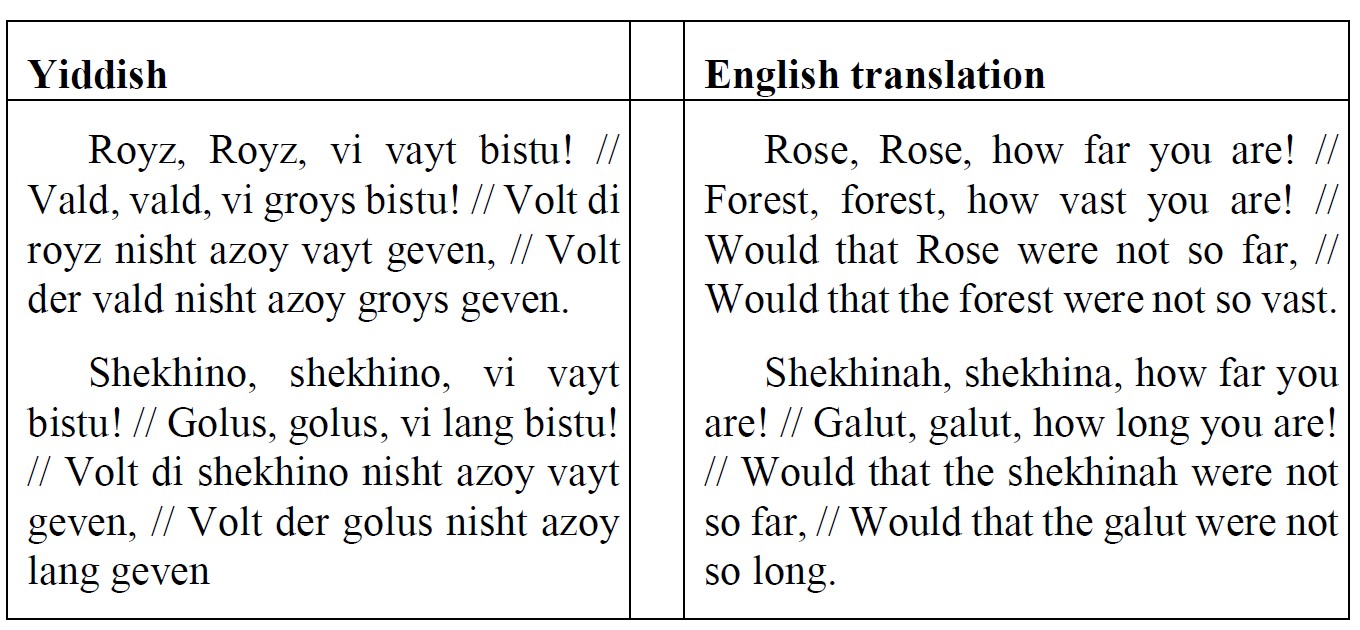
Another, similar situation is described in Abraham Rekhtman's book. The story was recorded during the An-sky expedition in 1913 and refers to the Zaddik Rabbi Leyb fun Pilyave (a small town in the Podolye/Podilia region), who was famous for his compassion and aspiration to reach out to the simple village Jews. According to Hasidic lore, Rabbi Leyb fun Pilyave's benevolence and wisdom enabled him to save his fellow Jews from Ivan Gonta's pogroms in 1768. [8] The story relates that on one of his trips to a remote forest village, when he was escorted by his devoted adherents, he encountered a young shepherd who played a simple and beautiful melody on the flute. The Rabbi asked him to repeat the melody a few times until he and his Hasidim memorized the tune and started to sing it along. When they asked the shepherd to play this melody one more time, he got mixed up and eventually began to play a completely different tune. [9]
The Hasidim embraced Ukrainian folk melodies because of their sincere beauty and warmth, as well as acute dance rhythms, which appealed to the Hasidim's own musical tastes. Hasidim would not only borrow melodies, but would also create new ones in a similar style, using the same melody types. Ukrainian Jewish folklorist Moisei Beregovsky was the first to indicate "a series of similarities in melody and means of expression" [10] in Ukrainian and Jewish folk music. Nevertheless, he was uncertain about the actual origin of those melodies, stating that the common elements in musical expressiveness could have been adopted "from a third source" [11] (such as Polish, German, Romanian, Turkish or Roma/Gypsy). Beregovsky's opinion was adopted and further developed by the composer and folklorist Max Goldin: "Ukrainian and Jewish musicality, warmth and depth of feeling turned out to be consonant with each other." [12] Beregovsky explained this diffusion phenomenon in the following way: "When a certain type of music has penetrated a certain milieu, it can also influence melodies which were created and disseminated in another melody type." [13] Goldin uses the term "slavisms" to generalize melodic types as well as modal and rhythmic structures that are characteristic for the East Slavs, which found their way into Jewish, and particularly Hasidic, music. That is why a simple musical transcription of Hasidic tunes (nigunim) may often look like a blend of a few typical Slavic melody types. But in the Hasidic interpretation, these melodies have become so creatively transformed to a Jewish music style that sometimes it is almost impossible to recognize the original. As Beregovsky rightfully states: "these 'borrowed' melodies are particularly quick to lose those specific national details that are not appropriate to the expressive means of the new user." [14] In other cases, however, when a joyful dance melody is adapted (e.g., the "Kozachok"), it may remain unchanged for the sake of "exoticism," or parody. [15]
Max Goldin also indicates that some Hasidic songs only borrowed initial intonation patterns from Ukrainian songs and then developed exclusively in the Jewish style, using liturgical modes and means of synagogue recitative. In the song "Po khasidatskomu" ["In Hasidic Style"], the beginning is the same as in the Ukrainian song "Zahrai meni, kozachenko" ["Play for me, Cossack"], but then the melody switches to paraphrase a synagogue recitative. The song has three stanzas to illustrate the Hasidic, Misnagdic (non-Hasidic Orthodox), and "aristocratic" or Maskilic (modern, progressive) ways of observing the Jewish religion. The melody of synagogue recitative remains unchanged, while the text that applies to the melody is different and may be interpreted somewhere between good-humoured and satire. Thus, this song is a rare example of double parody on both Ukrainian and Jewish patterns. [16]
Another good example is the song "Pastekhl", which refers to a shepherd who lost his only sheep. Worried, he is looking around in the hope of finding the sheep, and asks the passerby peasants who drive horse wagons if they might have seen it: "Adoyni, Adoyni, Adoyni! // Tshi ne bachiv ty, Tshi ne vidzev ty moi ovtsi?” ["My lord, my lord, my lord!// Did you see my sheep?"] The answer is always "neyt!" ["No!"]. The shepherd is in despair as he has to come home without the sheep: "Bida bidu, ovtsi nishto, // A yak zhe ya do domu pridu?" ["Misfortune, disaster, the sheep is not there, // How will I come home?"]
The multilingual text of the song is an interesting combination of Yiddish with elements of Hebrew (Adoyni — "My lord" — a respectable way of addressing a human being, which here can also be explained as an allusion to the Messiah/Moshiach), as well as elements of the Ukrainian, Polish, and Russian languages. The melody starts with a Doina-like Romanian shepherd's flute tune, and then proceeds to imitating synagogue recitative on the words "Adoni!" and ends with Ukrainian dance tune on the words "Bida, bidu…" [17]
Melodies of the "pastekhl" type influenced a number of Hasidic nigunim. Another example is a Chabad tune," Der pastukh," which also begins with a Doina-like motif, similar to the one above, but in the cantorial mode of "Adonai Malakh." [18]
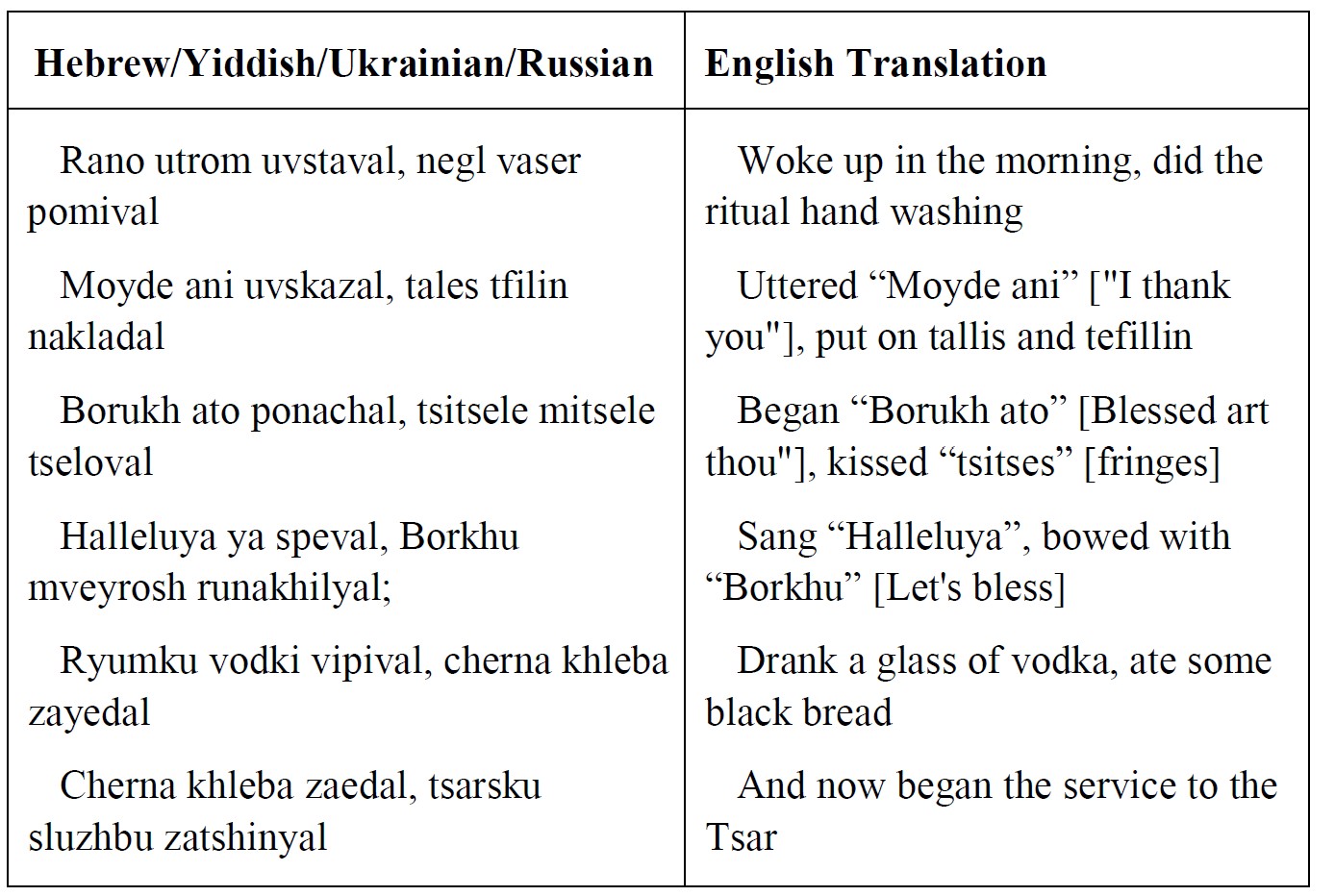
In religious and national songs, the life of a faithful Jew is often interpreted in terms of strictly regulated service to God. The texts of many of these songs combine loshn-koydesh (holy language, the Ashkenazi version of Biblical-Talmudic Hebrew) and a blend of elements of several Slavic languages. Slavic vocabulary (Ukrainian, Russian) usually dominates, but it is altered to become a blend of elements, while the main elements of the religious terminology remain unchanged in the original language. The following example is typical: [19]
Songs based on a combination of the Ukrainian and loshn-koydesh are also found in the thematic category of lamentations over the fate of Jews in the Diaspora and a plea to the forefathers to lead them out of exile. Here is an example: [20]
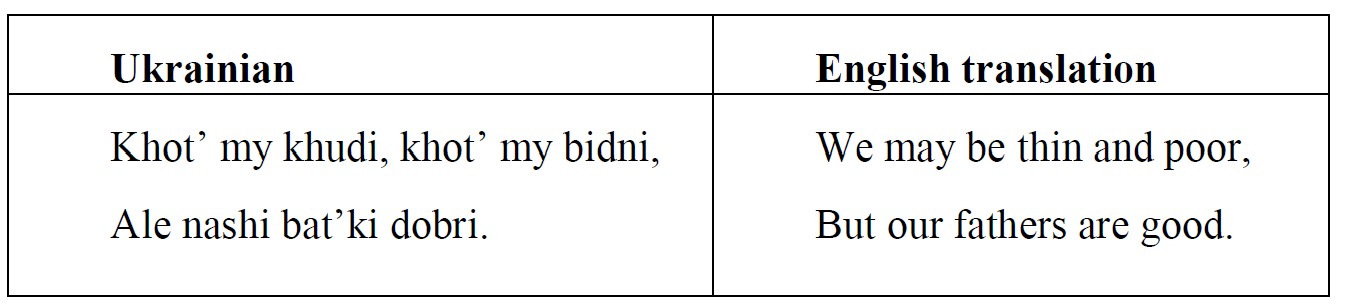
Hasidim adapted numerous Ukrainian song lyrics to their own Hasidic melodies that would be performed during weekly Sabbath gatherings. Reinforced with the powerful expressiveness of collective singing, those original Ukrainian texts would acquire additional mystical connotations, beyond the literal meaning of the words. The song "Khot' my khudi" ["Though we are thin"] alludes to the three Patriarchs, the physical and spiritual ancestors of Judaism — Abraham, Isaac, and Jacob: [21]
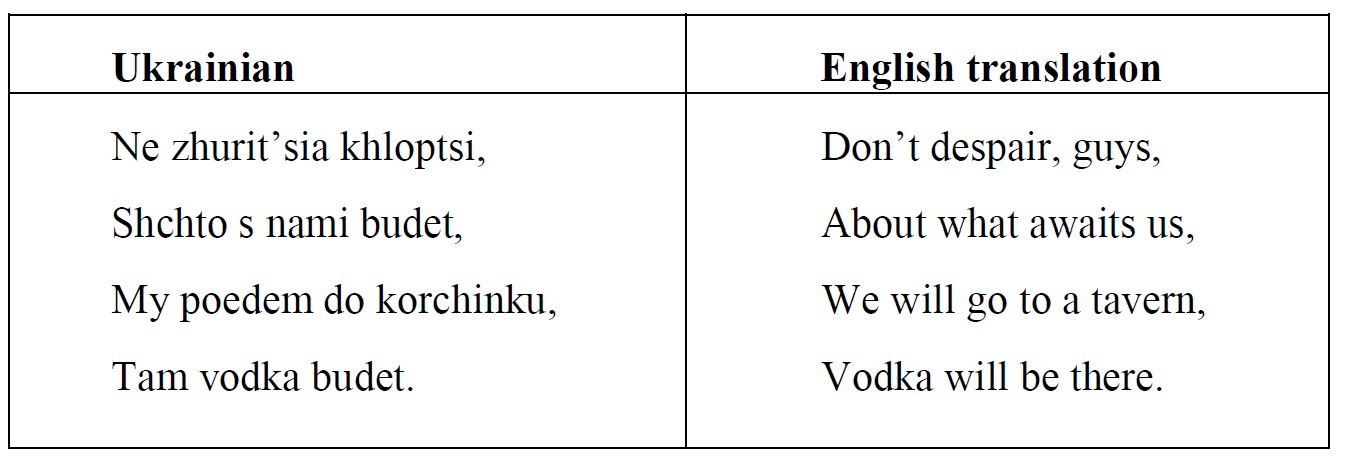
The song "Ne zhurit'sia khloptsi" ['Don't despair, guys"] contains the message that for Hasidim there is always a reason for joy and hope. Chabad Hasidim metaphorically interpreted the korchma (tavern) as a place of God and vodka as the spirit of God, as they sang this tune on their journey to visit the Lubavitcher Rebbe: [22]
Insert Table 5
Some of the Hasidic leaders, for example, Rabbi Aharon Perlov of Karlin (1802–1872) even used to address their adherents in Ukrainian or Russian, encouraging them to pray with even more passion: "Zharu poddavai!" ("add more fire [in your prayer]"). [23] Beregovsky explains this as a tendency to behave "goyishlekh" (in a peasant's way), in intentional contrast to the dogmatic traditional Jewish Misnagdic way.
As we can see, Slavic (and particularly, Ukrainian) elements penetrated both the music and the lyrics of Hasidic songs, though the range of influence in the music and in the lyrics is different. In music, the influence is largely concerned with mystical purification of the adopted melodies and rescuing the so-called "worldly tune," at the same time as more generally expressing admiration for both the joyful or sorrowful Ukrainian tunes. With regard to the lyrics, the infusion of Slavic elements may vary in terms of degree of influence, but usually the "slavisms" either contribute to creating a humorous effect by traditional means of macaronic (mixed language) songs, or more often hide a secret religious message that is intended for a closed circle of Hasidic adherents.
[1] The Zohar, a commentary on the Torah written in thirteenth century Spain, is a foundational work in the literature of Jewish mystical thought known as the Kabbalah.
[2] Abraham Rekhtman. Yidishe etnografye un folklore: zikhroynes vegn der etnografisher ekspeditsye, ongefirt fun Sh. An-ski (Buenos Aires, 1958), 256.
[3] Ibid.
[4] In this song, the Shekhinah is a metaphoric representation of the beloved woman and associated with the feminine dimension or power of God (the tenth Sefirah, Malkhut), whereas the lover is a representation of the masculine power of God (the sixth Sefirah, Tif'eret). Until the Messiah comes and the final Tikkun takes place, the lover (the masculine power of God) is temporarily separated from the Shekhinah and may reunite with her only during the heavenly wedding that occurs every Sabbath night. This longing for the Shekhinah is similar to the feelings of the shepherd dreaming about his beloved Royz.
[5] Rabbi Menahem Mendel of Rimanov (1745–1815), a Hasidic Rebbe and author, was well known for his writings and for attracting many scholars to his court in Rimanov, Poland.
[6] M. [Menahem] Kipnis, 80 folks lider: fun Zimrah Zeligfelds un M. Kipnises kontsert repertuar (Warsaw, A. Gitlin, 1930).
[7] Vinaver, Chemjo. Anthology of Hassidic Music, edited with an introduction and annotations by Eliyahu Schleifer (Jerusalem, 1985), 211. Isaac Ayzik Kaliv's version is published in this anthology, along with the music, on pp. 212–13. The version referred to in the present article is that of the Rebbe of Riminev (Rimanov), also mentioned in Vinaver's anthology. Please see musical example no. 1 for the music and text of the Rebbe of Riminev's song. Kipnis notes that the song would be repeated numerous times with and without words.
[8] Ivan Gonta (d. 1768) was one of the leaders of the Koliivschyna revolt of Cossacks against the Polish-Lithuanian Commonwealth in 1768. The Gonta-led massacre of Uman in 1768 resulted in the slaughter of thousands of local Poles, Jews, and Uniates (Ukrainian Catholics).
[9] Rekhtman, 267.
[10] Beregovsky, Moisei. "The interaction of Ukrainian and Jewish Folk Music" in Old Jewish Folk Music: The Collections and Writings of Moshe Beregovski, ed. and trans. Mark Slobin (Syracuse, 2001), 513. This article was originally published as "Kegnzaytike Virkungen tsvishn dem Ukraynishn un Yidishn muzik-folklor," in the Kyiv magazine Visnshaft un Revolyutsye 6 (1935): 79–101.
[11] Ibid., 513
[12] Goldin, Max. On Musical Connections between Jews and the Neighboring Peoples of Eastern and Western Europe, trans. and ed. Robert A. Rothstein (Amherst, MA: International Area Studies Programs, University of Massachusetts at Amherst, 1989), 13.
[13] Beregovsky. Old Jewish Folk Music, 524.
[14] Ibid., 525.
[15] Ibid., 525.
[16] This version of the song is taken from: Anthology of Yiddish Folksongs, comp. Aharon Vinkovetzky, intro. Abba Kovner, ed. Sinai Leichter (Jerusalem: Mount Scopus Publications by the Magnes Press, 1983–2004), 3: 141. The melody for this musical example may be accessed at: http://www.ukrainianjewishencounter.org, Yuval Waldman, — Violin Solo: Four Songs in Hassidic Style, no. 1; the version sung by Joseph Winogradoff ("Zaigrai meni, kozache, na dudu, na dudu") is at: http://faujsa.fau.edu/jsa/search.php?artisttext=&artist_select=&titletext=&title_select= &selectlabel=&cattext=&selectgenre=folk&selectlanguage=&select=sort_titled&fetch= 50&pagenum=3&id=500353-B&artist=Joseph%20Winogradoff&title=Po%20Chasidatskomu%20(Der%20Chusid,% 20der%20Misnagid%20un%20der%20Aristocrat)&playone=1
[17] This version of the song is taken from Beregovsky, Old Jewish Folk Music, 132–133. For the melody of this musical example see Yuval Waldman, — Violin Solo, no. 2.
[18] This version is taken from: Sefer Hanigunim: Book of Chasidic Songs, ed. Rabbi Samuel Zalmanoff (Brooklyn, NY: Nichoach, 1948), 54–55. For the melody of this musical example see Yuval Waldman, — Violin Solo, no. 3.
[19] From the Kiselgof collection, K 220. Recorded from David Rubich, 54 years old. The Vernadasky National Library of Ukraine, Institute of Manuscripts, Fond 190, no. 187–197. No information on the date and place of recording is available.
[20] Beregovsky, Moisei. "Foreign and Multilingual Songs of the Jews of Ukraine, Belorussia and Poland," in: Vseukrains'ka Akademiia Nauk, Etnohrafichna Komisiia, Etnohrafichnyi visnyk, no. 9 (Kyiv, 1930): attachment, pp. 4–5.
[21] Zalmanoff, 99.
[22] For the melody of this musical example, see Yuval Waldman, — Violin Solo, no. 4.
[23] Beregovsky. "Foreign and Multilingual Songs," 42.