




"The Ukrainian-Jewish Encounter: Cultural Dimensions": Part 5.5
The Ukrainian Jewish Encounter was founded in 2008 with the goal of building stronger relations between Ukrainians and Jews, two peoples who, for centuries, lived side by side on the territory of what is modern-day Ukraine. Since then, in keeping with its motto, "Our stories are incomplete without each other," UJE has sponsored conferences, round-table discussions and research, as well as translations and publication of works the organization anticipates will promote a deeper understanding between the two peoples and an appreciation of their respective cultures.
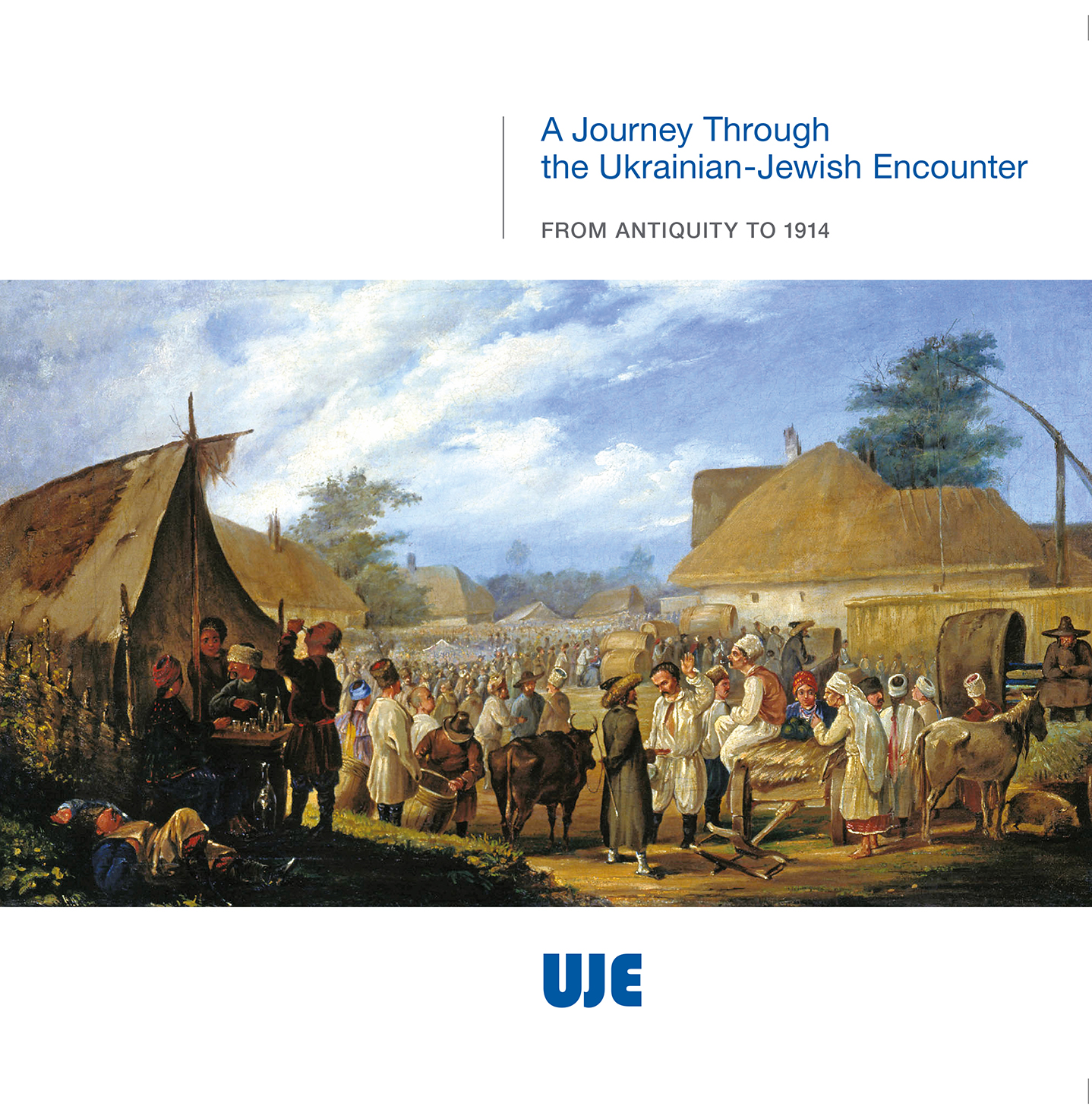
We offer for the first time the book The Ukrainian-Jewish Encounter: Cultural Dimensions in an eBook format.
The book is a collection of essays that examine the interaction between the Ukrainian and Jewish cultures from the seventeenth century onwards. Written by leading experts from Ukraine, Israel, and other countries, the book presents a broad perspective on parallels and cross-cultural influences in various domains — including the visual arts, folklore, music, literature, and language. Several essays also focus on mutual representation — for example, perceptions of the "Other" as expressed in literary works or art history.
The richly illustrated volume contains a wealth of new information on these little-explored topics. The book appears as volume 25 in the series Jews and Slavs, published by the Hebrew University of Jerusalem since 1993. In several previous volumes, considerable attention is given to the defining role of the Old Testament in Ukrainian literature and art and to the depiction of Jewish life in Ukraine in the works of Nikolai Gogol, Taras Shevchenko, Ivan Franko, Lesia Ukrainka, Vladimir Korolenko, and other writers.
This collection of essays was co-edited by Wolf Moskovich, Professor Emeritus, Hebrew University of Jerusalem, and Alti Rodal, Co-Director of the Ukrainian Jewish Encounter, who also wrote the introduction to the volume. It was published in 2016 by Hebrew University of Jerusalem.
5.5
Click here for a pdf of the entire book.
The challenge of recovering historical memory and cultural context: Reintegrating the Jewish past into the history and culture of Galicia
Taras Vozniak (Editor, Ji Magazine, Lviv)
One of the most pressing tasks of Ukrainian society is to recover historical memory and the cultural context of the country. These two existential components of any civilized nation were either consciously destroyed or lost in Ukraine over seventy years of Sovietization. The official indoctrination carried out during this time to a large extent deprived people of their identity.
A main objective of the Soviet regime was the creation of a new type of person, whom many ironically have designated as "homo sovieticus." Officially, the latter was known as the "Soviet person" and was to serve as the building block of the "new historical community of the Soviet people." The result of this policy, which was directed at expunging from historical memory entire cultural layers, was the development of a certain historical or cultural daltonism — a partial blindness or inability to see the full picture. The larger part of the culturally dominant population was no longer aware of the past, or even current, presence in the region of Polish, Austrian, Hungarian, and Jewish cultural communities — communities which prior to the establishment of Soviet power, ethnic cleansings, and the Holocaust had formed significant, and at times crucial, elements of the urban landscape. Naturally, this is corresponds with the physical non-presence of the carriers of these cultural communities. Nearly all of Galicia's Jews perished in the Holocaust. Literally, only individuals remained. Many Poles either voluntarily left or were forced to leave for Poland, while others were repressed and deported to Siberia. The repression also affected a significant portion of the Ukrainian population of the cities, the traditional bearer of the multicultural sensibility in the region.
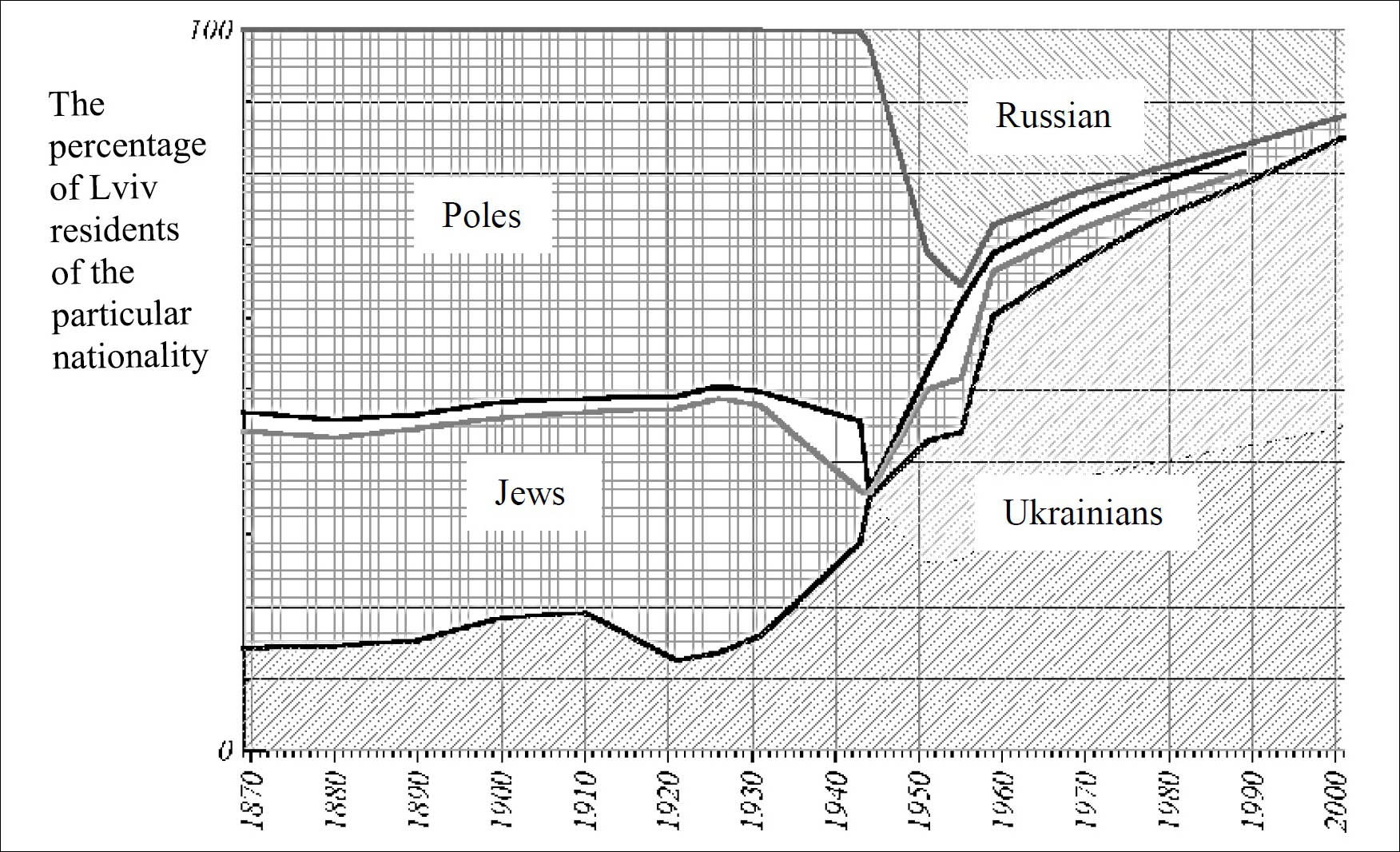
Between 1939 and the 1950s, the ethnic and cultural context of Western Ukraine was radically transformed. The dynamics of the demographic change in the city of Lviv is illustrated by the following graph:
After the collapse of the Soviet regime, there were attempts to master and humanize the cultural space. The problem, as noted above, is that the overwhelming majority of the carriers of the cultural context that had shaped the pre-Soviet experience — Poles and Jews — are gone. The question therefore became how to restore the pre-existing cultural contexts, despite the absence of carriers of these contexts? And, more generally, who is the heir to the cultural heritage of the region given, once again, the absence of the carriers of the cultural contexts of the past? On the other hand, how does one deliver the knowledge about the region's difficult history to the consciousness of the dominant majority? More importantly, how can one transform the current residents of Galicia into the heirs of the entire cultural heritage of the region — Ukrainian, Polish, and Jewish? The NGO independent cultural journal Ji has attempted to make its modest contribution to this matter via a series of activities aimed at promoting diversity. One of the initiatives was the publication of an intellectual guide to Galicia and Volhynia that showed the region as seen through Polish and Jewish eyes. But the guides were really directed at a Ukrainian audience. Several were published, including: Polish Life-Worlds of Galicia, Jewish Life-Worlds of Galicia, Jewish Lviv, Volynian Life-Worlds. Other publications exhibited the amalgam of cultural mosaics even in their titles:
"ТЕРНОПІЛЬ TARNOPOL TERNOPOL טארנָאפָאל",
"КОЛОМИЯ KOLOMEA KOLOMYJA ָאמייא ָאל ק", and
"ЧЕРНІВЦІ CZERNOWITZ."טשערנ ָאוויץ CERNĂUŢI
Of greatest significance was the conceptual issue Jewish Life-Worlds of Galicia, which familiarized contemporary residents of Galicia's small towns with the Jewish aspects of the history of the places in which they reside. An important element of the cultural landscape of Galicia was the phenomenon of the Galician shtetl — the small town with a predominantly Jewish population. Small towns served as intermediaries between large metropoles (such as Lviv and Kraków) and villages, estates, homesteads, and households. To provide a more detailed description of the region, we also published an issue dedicated to small towns. We created in effect the first registers of these towns. In this manner, we naturally encountered themes related to the Jewish past of many of the Galician townships. Jews, who started to arrive in our region quite late — at the earliest in the fourteenth century — settled mostly in towns and the adjoining areas. Similarly late was the arrival of other crucial migrational flows — those comprising Germans and Armenians. Whereas Germans and Armenians mostly settled in colonies and were connected with their homelands (respectively, the German lands and the Orient, broadly conceptualized), Jews had been exiles for one thousand five hundred years and had a different status. Of course, somewhere beyond the metaphysical horizon there existed the Land of Israel — Eretz Israel — to which they would one day return. While in exile however, they had to preserve themselves as a people and safeguard their faith, while settling in new lands. They concurrently had to maintain their dignity and avoid raising the ire of the powers that be, either through their wealth, success, or otherness. For example, the synagogue could not stand higher or exhibit more elaborate decorations than did the kosciol (Roman Catholic church) or the tserkva (Byzantine-rite Catholic or Orthodox church).
There were two reasons for Jewish separateness. On the one hand, the segregation was imposed by Christian neighbours who told Jews where to live, what to do, and what to build. On the other hand, the Jews themselves were not interested in assimilation, and therefore tried to maintain their traditions by living close to other Jews and limiting their contacts with non-Jews. Consequently, the Jews formed separate, self-enclosed communities and residential quarters. These communities functioned according to Jewish law. The relations with the king or the magistrate were conducted by the administration of the kehilla (congregation). After all, this was the medieval tradition. The Jews inhabited the Jewish quarter.
In the big cities the structure of such quarters was strictly controlled by the magistrates and regulated by the laws of self-governing cities. As many small towns later turned into almost uniformly Jewish settlements, a peculiarly social and architectonic structure characteristic of the Jewish shtetl developed. The partitions of the Polish-Lithuanian Commonwealth affected to a considerable degree the formation in Galicia of a specifically Galician Jewish sub-ethnos — Galician "zhydy" — a group that could be distinguished from the Jews in the Russian Empire by the significant degree of Germanization and developed public institutions. This peculiarity may be attributed to the relative liberalism, at first of the Austrian, and later of the Austro-Hungarian empires. Consequently, there was a vibrant national renaissance among the Jews in Galicia (as well as among the Poles and Ukrainians of the region). These processes unfolded in parallel to each other, often in the same place and at the same time.
The social structure of the cities grew to be more complicated and more regimented. In large cities the shackles of the Jewish ghetto were rapidly disintegrating, while small Jewish shtetls were turning into Jewish towns. The quest for new social and architectural forms of modern Jewish life was accompanied by spiritual and intellectual endeavours.
Our project and journal aim to describe the Jewish/Hebrew universe of Galicia as a "Life-World," which is a self-sufficient, large, and dynamic social community open to everybody. Some may view such a project and journal as unusual — which one can say is a natural reaction for the current residents of these towns, who still live under the conditions of a torn historical memory.
People representing the Jewish life-world are no longer in these places. Residents simply do not know what happened in the not-so-distant past. The goal of our publication is to help fill the glaring lacuna in our memory. In this manner we will try, at least virtually, to reconstruct a world that constitutes an important component of Galician identity. At the same time, while preparing this issue of the journal, we consciously drew chronological boundaries. Our story is about life in the Galician shtetl. In other words, we do not venture beyond the beginning of the Second World War. The Holocaust is the subject of another issue entitled Multicultural Lviv.
The journal is in the form of an intellectual guide. With the guide in hand, one can hop into a car over the weekend and immerse oneself into the world of the practically extinct Jewish shtetl. And you will see and feel a different Galicia.