




"The Ukrainian-Jewish Encounter: Cultural Dimensions": Contents
The Ukrainian Jewish Encounter was founded in 2008 with the goal of building stronger relations between Ukrainians and Jews, two peoples who, for centuries, lived side by side on the territory of what is modern-day Ukraine. Since then, in keeping with its motto, "Our stories are incomplete without each other," UJE has sponsored conferences, round-table discussions and research, as well as translations and publication of works the organization anticipates will promote a deeper understanding between the two peoples and an appreciation of their respective cultures.
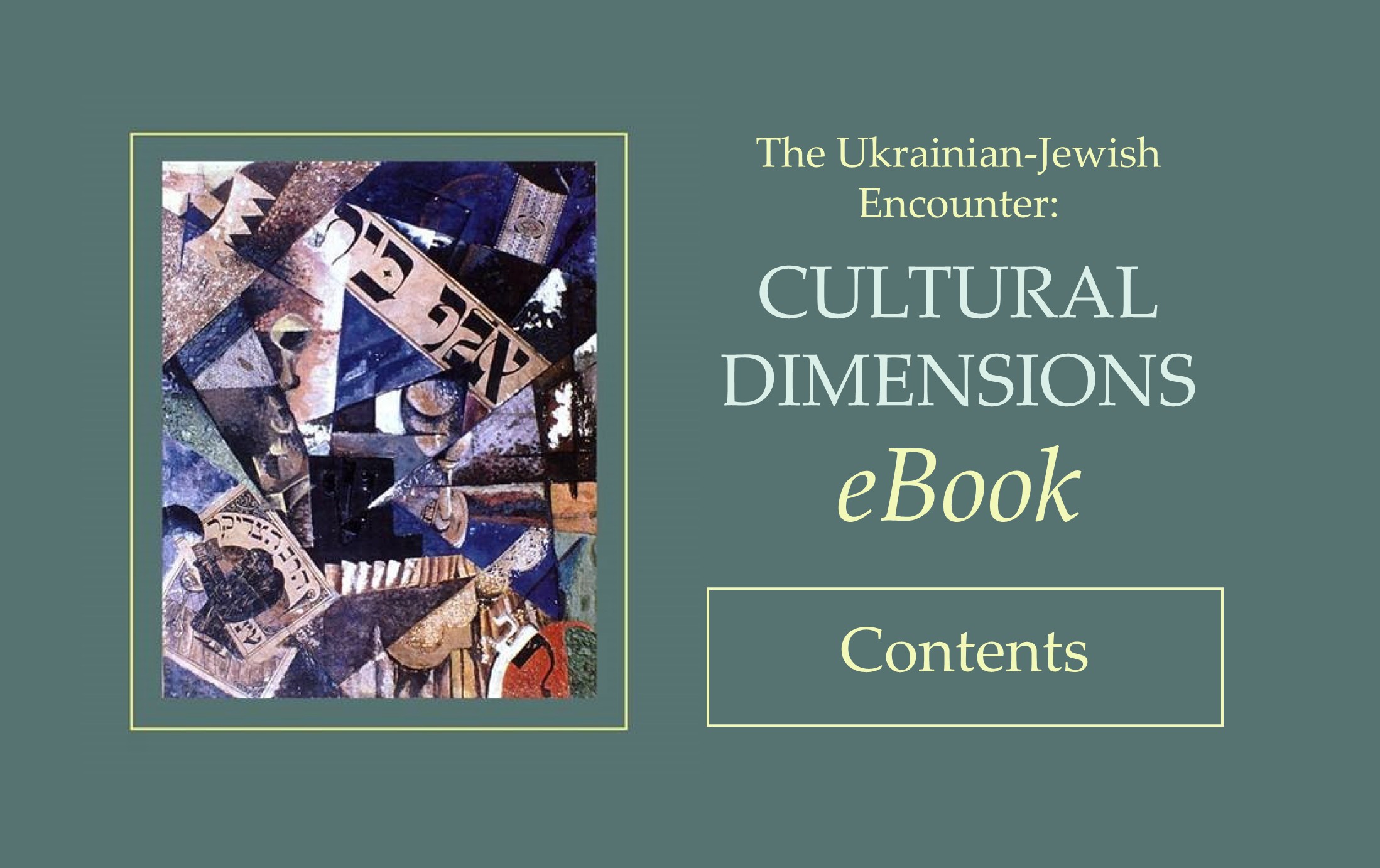
We offer for the first time the book The Ukrainian-Jewish Encounter: Cultural Dimensions in an eBook format.
The book is a collection of essays that examine the interaction between the Ukrainian and Jewish cultures from the seventeenth century onwards. Written by leading experts from Ukraine, Israel, and other countries, the book presents a broad perspective on parallels and cross-cultural influences in various domains — including the visual arts, folklore, music, literature, and language. Several essays also focus on mutual representation — for example, perceptions of the "Other" as expressed in literary works or art history.
The richly illustrated volume contains a wealth of new information on these little-explored topics. The book appears as volume 25 in the series Jews and Slavs, published by the Hebrew University of Jerusalem since 1993. In several previous volumes, considerable attention is given to the defining role of the Old Testament in Ukrainian literature and art and to the depiction of Jewish life in Ukraine in the works of Nikolai Gogol, Taras Shevchenko, Ivan Franko, Lesia Ukrainka, Vladimir Korolenko, and other writers.
This collection of essays was co-edited by Wolf Moskovich, Professor Emeritus, Hebrew University of Jerusalem, and Alti Rodal, Co-Director of the Ukrainian Jewish Encounter, who also wrote the introduction to the volume. It was published in 2016 by Hebrew University of Jerusalem.
Contents
Click here for a pdf of the entire book.
Introduction
Alti Rodal (Co-Director, Ukrainian Jewish Encounter)
Setting the context: Terminology, regional diversity, and the Ukrainian-Jewish Encounter
Paul Robert Magocsi (University of Toronto)
PART 1
Representation, parallels, and interaction in religious art and architecture
1.1
Allegories of divine providence in Christian and Jewish art in seventeenth- and eighteenth-century Ukrainian lands
Ilia Rodov (Bar-Ilan University, Ramat Gan)
1.2
Ukrainian and Jewish Influences in the art and architecture of pre-modern wooden synagogues, 1600-1800
Thomas C. Hubka (University of Wisconsin–Milwaukee)
1.3
The Synagogue Wall Paintings in Novoselytsia, Ukraine
Boris Khaimovich (Center for Jewish Art, Hebrew University of Jerusalem)
1.4
The Israelite Hospital in Lemberg/Lwów/Lviv, 1898–1912: "Jewish" architecture by an "international" team
Sergey Kravtsov (Center for Jewish Art, Hebrew University
of Jerusalem)
PART 2
Secular art and cinema
2.1
Teachers and pupils: Ukrainian avant-gardists Exter and Bohomazov and the Kyiv circle of Jewish cubo-futurists, 1918–20
Dmytro Horbachov (Karpenko-Kary National University, Kyiv)
2.2
Parallels in Ukrainian and Jewish "national styles" in art in the First third of the twentieth century
Vita Susak (Lviv National Gallery of Art)
2.3
Oleksandr Dovzhenko and Jewish mythology
Serhii Trymbach (President, Filmmakers' Union of Ukraine, Kyiv)
PART 3
Cross-cultural influences in language and music
3.1
Aspects of Ukrainian-Yiddish language contact
Wolf Moskovich (Hebrew University of Jerusalem)
3.2
Ukrainian Influence on Hasidic music
Lyudmila Sholokhova, YIVO Institute for Jewish Research, New York
PART 4
Representation of "the other" in Ukrainian and Jewish literatures, popular culture, and personal narratives
4.1
Perceptions of the Jew in Ukrainian literature
Myroslav Shkandrij (University of Manitoba)
4.2
Between the marketplace and enlightenment: Gogol and Rabinovich's Ukrainian memory space
Amelia Glaser (University of California in San Diego)
4.3
The Image of "the Other" in World War II memoirs of Lviv citizens
Ola Hnatiuk (Warsaw University)
4.4
Ukrainian-Jewish relations as depicted in narrative accounts of former Carpatho-Rusyn Jews in Israel
Ilana Rosen (Ben Gurion University of the Negev, Beer Sheva)
PART 5
The study, preservation, commemoration, and revival of interest in the Ukrainian-Jewish cultural heritage
5.1
Departure and comeback: Ethnographic expeditions to shtetls in Podolia and Volhynia in 1912/1914, the 1980s, and 2004–2008
Valerii Dymshits (Center Petersburg Judaica, St. Petersburg)
5.2
Traditional Jewish art and Ukrainian art Historians: collection, preservation, and research in the Czarist, Soviet, and Post-Soviet periods
+ ANNEX: Ukrainian art historians commenting on traditional Jewish art and architecture
Benyamin Lukin (Central Archives for the History of the Jewish People, Jerusalem)
5.3
Judaica at the Lviv Museum of Ethnography and Arts and Crafts: History, Ccontents, and the current situation
Roman Chmelyk (Museum of Ethnography and Arts and Crafts, Lviv)
5.4
Modern Jewish museums of Ukraine
Leonid Finberg (Jewish Studies Center, Kyiv-Mohyla Academy)
5.5
The challenge of recovering historical memory and the cultural context: Reintegrating the Jewish past into the history and culture of Galicia
Taras Vozniak (Editor, Ji Magazine, Lviv)
PART 6
Perspectives on divided memory and dialogue
6.1
Sharing the divided past: Symbols, commemorations, and representations at Babyn Yar
Georgii Kasianov (Institute of History, National Academy of Sciences of Ukraine, Kyiv)
6.2
Jewish-Christian Dialogue and Jewish-Ukrainian Relations: The Burdens of History and Prospects for the Future
Myroslav Marynovych (Ukrainian Catholic University, Lviv)